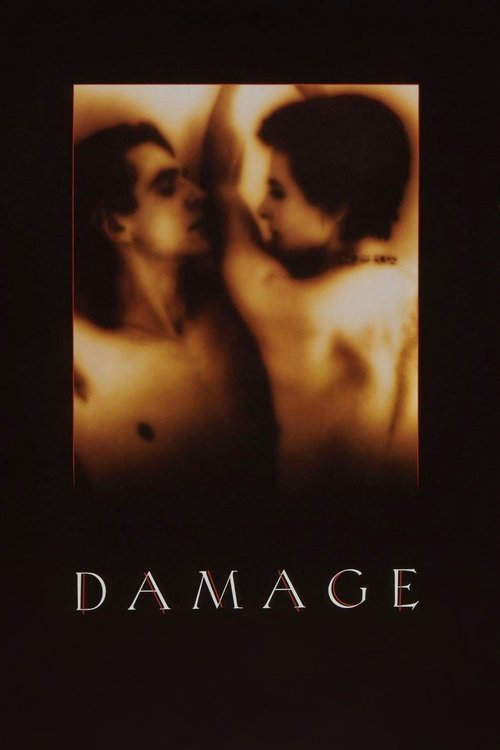
Damage
1992 · Louis Malle
When you want a serious, adult drama that stares at self-destruction without blinking — a film to chew on and argue about afterward. Emphatically challenge viewing, not date-night romance.
What it's about
A respected British politician at the height of his career meets his adult son's new girlfriend at a reception, and within days the two are locked in a compulsive secret affair. He has a wife, a family, a future in government — and he watches himself dismantle all of it, unable to stop. The question is never whether the collision is coming, only how much it will destroy.
The experience
Cold, controlled, and quietly suffocating — Malle films obsession with clinical evenness, refusing both titillation and judgment, so the dread accumulates like pressure behind glass. When feeling finally breaks through, it lands with shattering force.
Performances
Jeremy Irons is masterful as a man of impeccable public surfaces coming apart from the inside, and Juliette Binoche makes Anna deliberately unreadable, a mystery the film never cheapens by solving. Miranda Richardson, as the wife, delivers the performance people never forget — the film's one eruption of raw, unmediated feeling.
The craft
David Hare's screenplay, adapted from Josephine Hart's novel, strips the story to essentials, and Malle directs with late-career austerity: cool interiors, held silences, an erotic charge that comes from restraint rather than display. It's filmmaking that trusts you to feel the temperature drop.
Why it matters
A scandal and a talking point in 1992, it endures as one of Louis Malle's final major works and a benchmark for the serious erotic drama — proof the genre could be an instrument of moral inquiry rather than gloss. Richardson's work brought the film awards attention.
Snapshot
A senior British politician, Dr. Stephen Fleming, meets his son's new lover at a reception and, within days, has abandoned every structure that made him legible to himself. Damage is Louis Malle's adaptation — scripted by the playwright David Hare from Josephine Hart's 1991 novel — of a story that is less an affair than a compulsion, filmed with a clinical evenness that refuses to supply either titillation or judgment. Jeremy Irons plays Stephen as a man of impeccable public surfaces; Juliette Binoche plays Anna Barton as something closer to a condition than a character, opaque by design; Miranda Richardson, as the wife Ingrid, supplies the film's one eruption of unmediated feeling and, in doing so, detonates everything the preceding ninety minutes has held in check.
Made near the end of Malle's career — he would complete only Vanya on 42nd Street (1994) before his death in 1995 — the film sits at a peculiar intersection: a French director's anthropology of the English establishment, funded through the Anglo-French co-production channels that sustained European art cinema in the early 1990s, and released in the United States into the middle of the erotic-thriller boom, where it was promptly caught in the American ratings system's failure to accommodate adult drama. It is a tragedy in the strict sense, and it is structured so that you know this from the first shot.
Industry & production
Damage was assembled as an Anglo-French co-production, drawing on the funding architecture that defined prestige European filmmaking of the period: French pay-television and public-service British broadcasting money combined with independent production companies, aimed at both a domestic art-house release and an international, English-language market. Malle, who had spent the 1980s moving between American independent production (Atlantic City, My Dinner with Andre, Alamo Bay) and a return to French filmmaking (Au revoir les enfants, 1987; Milou en mai, 1990), was in the rare position of being bankable in two industries at once. Hart's novel had been a commercial and critical event on publication in 1991, which supplied the project with the pre-sold literary property that such co-productions typically required.
The film's most consequential industrial episode came at distribution. Submitted to the MPAA in the United States, Damage received an NC-17 — the rating introduced in September 1990 explicitly to give serious adult films an alternative to the commercially toxic X, and which had already, within two years, proven to be a commercial death sentence of its own, since major newspaper chains and theater circuits routinely refused NC-17 product. Its American distributor trimmed the film to secure an R for wider release. The cut material was slight in duration and concerned the sexual sequences, but the episode is historically legible: Damage became one of the standard case studies in the argument that the NC-17 experiment had failed at precisely the task it was created for.
There is a symmetry here that a scholar should not resist. Malle's second feature, Les Amants (1958), was the film at the center of Jacobellis v. Ohio (1964), the United States Supreme Court obscenity case that produced Justice Potter Stewart's "I know it when I see it." Thirty-four years apart, the same director bracketed the American century's argument with itself about adult sexuality on screen.
Commercially, Damage performed as an art-house title rather than a crossover; the surviving public record of its precise theatrical grosses is not something I can cite reliably, and I will not supply numbers. Its awards profile was concentrated in one performance: Miranda Richardson received an Academy Award nomination for Best Supporting Actress and won the BAFTA in the same category.
Technology
Damage is a 35mm photochemical production of the last pre-digital moment — made before digital intermediates made color grading a shot-by-shot authorial instrument, so its cool, drained palette was achieved in-camera and at the lab, through stock choice, lighting level, and print timing rather than post-production manipulation. It is commonly listed at 1.85:1, and nothing in its compositional logic suggests anamorphic ambitions; the frame is close, upright, architectural.
The relevant technology of Damage, in other words, is not optical. It is the low-light sensitivity of early-1990s emulsions, which allowed Peter Biziou to shoot interiors at levels near what the practical fixtures in the room would actually produce — the film is full of lamplight, window light, corridor light, and underexposed skin — and it is Dolby Stereo, which by 1992 was standard even on modest European productions and which the film uses for reticence rather than spectacle: room tone, traffic, the specific acoustic of a large empty flat.
The other technology at work is classificatory. The NC-17 rating, the film print recut for an R, and the subsequent home-video circulation of the fuller cut constitute a distribution apparatus that materially altered which Damage any given viewer saw. This is not a metaphor; different audiences watched measurably different films.
Technique
Cinematography
Peter Biziou — who had won the Academy Award for Mississippi Burning (1988) and whose range ran from Monty Python's Life of Brian and Pink Floyd — The Wall to, later, In the Name of the Father and The Truman Show — shoots Damage as a study in thresholds. The recurring compositional unit is the doorway: Stephen seen through one, Anna framed at the far end of a corridor, a conversation observed from an adjoining room. Glass does similar work — office partitions, car windows, the windows of Westminster — so that characters are constantly visible and constantly separated.
The palette is deliberately anaemic: grays, browns, bruised blues, skin rendered without warmth. Sexual scenes are underlit rather than glamorized, closer to documentation than to the honeyed backlighting of the contemporaneous American erotic thriller. Biziou favours a shallow focal plane in the intimate scenes, so that the lovers are isolated from any surrounding context — a formal correlative of Stephen's abandonment of the world — and then, in the public and domestic scenes, reverts to deeper staging where the room, the family, and the institution are all legible at once.
The film's visual system is also a piece of foreshadowing. Stairwells, banisters, and landings are given attention disproportionate to their narrative use, until the catastrophe arrives in exactly that architecture.
Editing
John Bloom, an Academy Award winner for Gandhi (1982) and editor of The French Lieutenant's Woman, cuts Damage against suspense. Scenes are entered late and left early; transitions frequently arrive before a scene has completed its ostensible business. The effect is one of acceleration without excitement — the sense that Stephen's life is being fast-forwarded by a force he does not control. Sexual encounters are cut rhythmically rather than for spatial continuity, sometimes in near-abstraction of limbs and light, which is part of why the material provoked the ratings response it did: the cutting refuses the reassuring geography that makes screen sex feel staged.
The film's decisive editorial choice is at the catastrophe. The discovery and the fall are given almost no coverage and no build. There is no cutaway to a reaction that would let the audience prepare. The event happens at approximately the speed such events happen, and the cut out of it is immediate. Everything after is aftermath, edited slower, as though the film itself has been concussed.
Mise-en-scène / staging
The film is organized around a contrast between two kinds of space. The Fleming world is period English domesticity — paneled rooms, inherited furniture, the country house, the ministerial office — spaces dense with objects and history, in which every surface asserts continuity. Anna's flat is the opposite: near-empty, modern, unfurnished in a way that suggests not poverty but refusal. Stephen's transit between these two spaces is the film's actual plot.
Malle stages the family scenes in depth, with characters crossing behind one another, half-attending, talking across each other in the way families do — a documentary habit retained from his nonfiction work. Against this, the scenes between Stephen and Anna are staged frontally and statically, two people in a bare room, with a formality that borders on ritual. The film's most quoted formal gesture belongs to Ingrid's grief, played without the protection of ornament, in a room where the accumulated objects of a life suddenly signify nothing.
Sound
Zbigniew Preisner's score is used with severe restraint, and its restraint is the point. Preisner arrived at Damage as Krzysztof Kieślowski's principal composer — Dekalog, The Double Life of Véronique — and would score Three Colours: Blue the following year, with Binoche. His idiom, somber strings and piano with a liturgical undertow of lament, is deployed here mainly at transitions and at the aftermath; the sexual scenes are largely unscored, which strips them of the swelling reassurance that tells an audience how to feel.
Over this sits Irons's first-person voiceover: retrospective, measured, past-tense. It establishes from the opening that the story has already concluded and that we are listening to a confession rather than watching a suspense. The voice is that of a man who has had years to find the right words and has not found them.
Performance
Irons, two years after winning the Academy Award for Reversal of Fortune and four after Dead Ringers, gives a performance built almost entirely from withheld information — a stillness so complete that the small breaks in it register as violence. Binoche plays Anna as a deliberate vacancy: she declines the actorly obligation to make a character sympathetic or explicable, and the film's coherence depends on that refusal. Whether it reads as profundity or as blankness has divided viewers since release, and reasonably so.
Miranda Richardson's Ingrid is the film's counterweight and its judgment. Where everyone else operates in code, she arrives at the end with a directness that is almost unbearable to watch, and the Academy and BAFTA recognition followed. Rupert Graves plays Martyn with an open, unguarded warmth that makes the betrayal legible as cruelty rather than merely as transgression. Leslie Caron, in essentially one scene as Anna's mother, delivers the film's psychological key — the account of Anna's brother — and the casting of a star of Malle's own generation gives that scene an additional weight of retrospect.
Narrative & dramatic mode
Damage is a tragedy that has been stripped of its rhetoric. The structure is classical: a man of high standing, a fatal flaw that is indistinguishable from his desire, a reversal produced by his own action, a catastrophe, an exile. The film's ancestor is not the thriller but Racine — specifically the Phèdre situation of an older figure consumed by desire for the younger generation's beloved, gender-inverted. There is no mystery, no investigation, no possibility that Stephen might get away with it; the retrospective voiceover removes suspense in the first minute so that what remains is inevitability.
Melodrama is systematically refused. The great melodramatic beats — discovery, death, confrontation, ruin — all occur, but each is denied its music, its held close-up, its catharsis. What the film substitutes is a coda of extraordinary bleakness: Stephen alone, abroad, in a room dominated by an enlarged photograph of the three of them, reporting in voiceover that when he saw Anna once more she was, in the end, unremarkable — like anyone else. The tragedy is not that she was worth it. It is that she was not, and it made no difference.
Genre & cycle
The film was released into the peak of the erotic thriller — Basic Instinct appeared the same year, Indecent Proposal and Sliver the next — and was marketed to intersect with it, which produced a persistent mismatch between audience expectation and delivery. Damage has none of the genre's machinery: no crime, no investigation, no femme fatale in the noir sense of a schemer, no plot. Its actual cycle is the early-1990s literary erotic art film in English — Paul Schrader and Harold Pinter's The Comfort of Strangers (1990), Bertolucci's The Sheltering Sky (1990), Jean-Jacques Annaud's The Lover (1992), released the same year — films that combined a prestige literary source, a hushed retrospective narration, and explicit sexuality treated as fatality rather than as fun.
It also sits, pointedly, against the British heritage cycle at its commercial summit: Merchant Ivory's Howards End was released in 1992. Damage occupies the same houses, the same class, the same tailoring — and finds them evacuated. It is an anti-heritage film shot in heritage locations.
Authorship & method
Malle's authorial signature is a refusal of moral commentary. Across a career that took in a teenager's affair with her mother's lover (Le souffle au cœur, 1971), collaboration (Lacombe Lucien, 1974), and child prostitution (Pretty Baby, 1978), his method was to place the camera at a level, unhurried distance and decline to instruct the audience. That method came out of documentary — he co-directed Le monde du silence with Jacques-Yves Cousteau, which took the Palme d'Or in 1956, and made the long-form Phantom India — and out of an apprenticeship in the rigor of Bresson. In Damage it produces a film that is frequently accused of coldness, which is roughly the accusation leveled at every Malle film about desire.
David Hare brought the counterweight: a dramatist's economy and a specifically English political intelligence. Hare had spent two decades anatomising the British establishment's self-deceptions on stage and, as a director, on film (Wetherby, Paris by Night, Strapless). His contribution is the precision with which Stephen's world is rendered — the ministerial vocabulary, the constituency obligations, the assumption of continuity — so that its collapse has institutional as well as personal weight. Hart's novel is written in a clipped, aphoristic first person; Hare's adaptation preserves the voice while giving the surrounding social world a density the novel deliberately withholds.
The key collaborators complete the design: Biziou's drained naturalism, Bloom's elliptical cutting, Preisner's withheld lament. The documentary record of the day-to-day working relationships on this production is comparatively thin — much of what circulates comes from later interviews rather than production scholarship — and I will not manufacture detail to fill it.
Movement / national cinema
Malle belonged to the French New Wave generation without belonging to its critical faction; he came from documentary and technical apprenticeship rather than from Cahiers du cinéma, and his subsequent career was defined by a mobility — France, America, England — that the Cahiers directors largely did not attempt. Damage therefore belongs to a distinct and productive tradition: the continental European director's film about England. Its clearest ancestors are Joseph Losey's collaborations with Harold Pinter — The Servant (1963) and especially Accident (1967), which shares with Damage an academic-professional protagonist, a fatal erotic entanglement across generations, a violent accident, and a confessional retrospective structure — alongside Antonioni's Blow-Up (1966) and Polanski's Repulsion (1965).
What the outsider's position supplies is defamiliarisation. The English viewer's habituation to the codes of the political class — the understatement, the euphemism, the correctness — is not available to Malle, who films those codes as ethnography, as strange behavior observed at close range.
Era / period
1992 is a specific moment. The Cold War had ended; Britain was in recession, in the first year of John Major's government, and heading into the Maastricht crisis. The Conservative establishment that Stephen embodies was about to enter its long sequence of sexual and financial scandals — the ministerial resignation over an affair in 1992, the "Back to Basics" campaign of 1993 and its serial humiliations — and Damage precedes that cycle rather than commenting on it. The film did not predict anything; it registered a structural condition that was about to become newsprint.
Sexually, the film arrives after a decade in which AIDS had reframed desire as consequence, and in the brief window when the American majors believed adult drama might be theatrically viable under a new rating. That window was closing as the film opened. In distribution terms, Damage is a late specimen of a species — the mid-budget adult drama with stars, released theatrically to a general audience — that would migrate almost entirely to television within fifteen years.
Themes
Damage as inheritance and repetition. The film's governing proposition is Anna's: "Damaged people are dangerous. They know they can survive." The line is not an excuse but a description of a mechanism — the compulsion to reproduce an original catastrophe, which the revelation about her brother makes explicit. Anna does not destroy Stephen out of malice; she is running a pattern.
The failure of language. Stephen is a physician turned legislator, a professional of diagnosis and of argument, and the film gives him almost nothing to say about the one thing that governs him. His articulacy is intact everywhere except at the center. The voiceover is the sound of that failure continuing for years afterward.
Privacy, office, and the English house. Stephen's public role is not incidental. The film is precise about the way institutional life depends on a partition between the person and the position, and about how completely the partition fails once desire is admitted through it. The house — furnished, inherited, continuous — is the physical form of that partition.
Fatherhood as tragedy. The catastrophe is a father's, not a lover's. What Stephen destroys is not his marriage or his career, both of which he might have survived, but his son, and the film is unsparing about the fact that this was foreseeable and did not deter him.
Reception, canon & influence
Critical reception in 1992–93 was respectful and divided. The performances — Irons's control, Richardson's devastation — drew near-universal praise; the film's austerity drew both admiration and the recurring complaint that it was airless, humorless, and emotionally sealed. Binoche's deliberate opacity was the main fault line: read by some as a rigorous refusal of psychological reassurance, by others as an absence at the center that left the plot unmotivated. Miranda Richardson's Academy Award nomination and BAFTA win concentrated the film's institutional recognition in the one performance that operated outside its emotional embargo, which is itself a critical judgment of a kind.
Backward, the lineage is legible. Malle's own Les Amants had already treated adulterous awakening as a rupture rather than a lapse; Le souffle au cœur and Pretty Baby had established his willingness to film desire that the culture prefers not to look at. Losey and Pinter's Accident supplies the structure. Buñuel's That Obscure Object of Desire (1977) supplies the model of an erotic object rendered deliberately unreadable. Ophüls, in the chamber tragedies, supplies the sense of a social order that destroys people politely. Josephine Hart's novel supplies the aphoristic first person and the terminal image.
Forward, the film's influence is diffuse rather than school-forming. It is a standing reference point in three distinct conversations: the historiography of the NC-17 rating and the commercial impossibility of adult drama in 1990s America; the critical literature on the erotic thriller, where Damage functions as the boundary case that shows what the genre's conventions were doing by showing a film that discards them; and the career trajectories it accelerated — Binoche's international ascent, consolidated the following year in Three Colours: Blue, and Preisner's crossover from Kieślowski's collaborator to a composer working across European cinema.
Two specific forward lines are worth naming. David Hare's later screen work — The Hours (2002), The Reader (2008) — proceeds directly from the mode established here: transgressive desire treated as a moral catastrophe with historical weight, narrated retrospectively. And Jeremy Irons's casting as Humbert Humbert in Adrian Lyne's Lolita (1997) is unthinkable without Damage, down to the distribution history: Lyne's film met the same American ratings and exhibition wall that Damage had struck five years earlier, and reached US audiences only through television.
Damage has not entered the canon as a landmark. It has done something more durable and less glamorous: it has remained the film people cite when they want to describe what a serious adult drama about desire looked like at the last moment such a thing was routinely made, and to describe the machinery that made it the last moment.
A Deleuzian reading
The film keeps looking at a banister.
The full Deleuzian reading of Damage →
Reception
Critics in 1992 were split — many found its passion chilly and faintly absurd, and it was mostly remembered for its ratings controversy. The erotic-drama revival has been kind to it: it's now regularly reclaimed as one of the great films about annihilating desire, with Malle's iciness read as the point.
How Damage was received, from release to now →
How to watch Damage: what to notice on a first viewing
- Watch how often you see characters through doorways or across a room. Peter Biziou repeatedly frames Stephen and Anna through thresholds, at the end of corridors, or through glass, so they stay visible and separated at once. The framing keeps intimacy and distance in the same shot before either character can say what they want.
- Notice how drained of warmth the color looks throughout, even in intimate scenes. Biziou shoots in grays, browns, and bruised blues, underlighting the sexual scenes rather than glamorizing them. The anaemic palette treats desire as something closer to documentation than seduction.
- Compare the furniture in the Fleming house to Anna's flat. The Fleming world is dense with inherited objects and history, while Anna's flat is modern, near-empty, and unfurnished in a way that reads as refusal. Deleuze calls the bare place beneath a furnished world the originary world, and Anna's empty flat is exactly that place.
- Listen for the absence of music during the sexual scenes. Zbigniew Preisner's score appears mainly at transitions and in the aftermath, leaving long stretches, including the intimate scenes, largely unscored. Without music telling you how to feel, you are left to sit with the scenes unguided.
- Watch how still Jeremy Irons stays through nearly every scene. Irons builds Stephen almost entirely from withheld information, a composure so complete that small breaks in it register as significant. His stillness becomes the measure by which every crack in his control is felt as violence.
The whole guide to watching Damage, with the keys for a rewatch →
Influences: the films it descends from and the films it influenced
- Accident (1967) — Supplies the film's structural template: Pinter's late-entry/early-exit scene construction and the elided catastrophe — the fatal crash registered as sound over a held exterior, the reaction shot withheld — which Malle and editor John Bloom reproduce almost move for move at the Docklands flat.
- The Servant (1963) — Establishes the English house as a power diagram shot through banisters, doorways and mirrors, so that a character's position in a frame states his position in a class system — the grammar behind Damage's doorway framing and glass-partitioned ministry offices.
- The French Lieutenant's Woman (1981) — Cut by John Bloom, the same editor: the rhythm of an affair advanced by hard cuts into scenes already underway, with the erotic encounters trimmed of build-up and aftermath, is the cutting pattern Bloom brings intact to Damage.
- Les Amants (1958) — Malle and Henri Decaë's sustained near-wordless nocturnal seduction, lit by available sources and treated as an irreversible rupture rather than a lapse, is the prototype for Damage's unscored sex scenes.
- Le souffle au cœur (1971) — Codifies Malle's refusal of moral commentary — a level, unhurried camera that declines the judging reaction shot at exactly the moment the culture expects one — which is the operative method of Damage's entire treatment of Stephen and Anna.
- Pretty Baby (1978) — Sven Nykvist's practice of shooting interiors on available window light, in composed depth, so the room's ordinary beauty does no editorialising about what happens in it — the lighting ethic Peter Biziou extends in Damage's contrasted family and flat interiors.
- That Obscure Object of Desire (1977) — The model of the erotic object rendered structurally unreadable — Buñuel's two-actress device, Malle's flat-affect Binoche — plus the retrospective narration to a captive listener that frames the whole obsession as already concluded.
- Letter from an Unknown Woman (1948) — The chamber-tragedy architecture of staircases and thresholds where a courteous social order does its killing, narrated in first person from after the fact — the terminal-image-plus-voiceover frame Damage inherits from Josephine Hart via Ophüls.
- Une femme douce (1969) — Bresson's reconstruction of a death by the surviving man in affectless retrospect, with performers drained of demonstrative interiority, is the discipline behind Irons's sealed voiceover and Binoche's deliberate opacity.
- Last Tango in Paris (1972) — Invents the unfurnished rented flat as an erotic stage — a bare, address-less room shot in flat daylight where the affair is contained and choreographed — which Damage reuses as the emptied London flat with the mattress on the floor.
- Lolita (1997) — Builds its whole design on Irons as retrospective confessor: the same low, exhausted first-person voiceover over an already-lost catastrophe, and the same desaturated, shallow-focus interiors that decline to eroticize or condemn.
- The Piano Teacher (2001) — Extends Damage's embargo on scoring sexual scenes to its limit — clinical static framings, glass and doorway partitions, no music and no cutaway — so that the audience is denied any emotional instruction during the transgression.
- The Hours (2002) — David Hare reapplies the Damage mode: desire treated as a moral catastrophe with historical weight, scenes entered late and left early across time frames, and the outcome announced before it is dramatized.
- Notes on a Scandal (2006) — Takes Damage's aphoristic retrospective first person — a narrator supplying epigrams about ruin over images that contradict them — and pairs it with the same English institutional interiors of staffrooms and hallways that hold the affair in view.
- The Reader (2008) — Hare's fullest continuation of the method: the transgressive affair narrated from decades later by the guilty survivor, the sex staged plainly and unscored, and the decisive act of destruction left outside the frame.
- The Unbearable Lightness of Being (1988) — Nykvist's shallow-focus, available-light handling of long sexual sequences played without score, and Binoche's established register of watchful non-explanation, are the immediate precedent for how Malle shoots and casts her.
- The Comfort of Strangers (1990) — A Pinter screenplay working the same devices in parallel: withheld exposition, architecture (thresholds, apartments, framed windows) used as menace, and a fatal erotic entanglement narrated in retrospect by its perpetrator.
- Three Colours: Blue (1993) — Preisner's method carried across from Damage — a score that withdraws entirely from the film's most intimate passages and then returns as an interruption — coupled again with a car crash elided at the moment of impact.
Similar films
- Murmur of the Heart (1971) — influence & lineage
- Last Tango in Paris (1972) — influence & lineage
- Lolita (1997) — influence & lineage
- The Piano Teacher (2001) — influence & lineage
- Dangerous Liaisons (1988) — same viewing thread
- The Devils (1971) — often watched together
- Amour (2012) — shared sensibility
- Fatal Attraction (1987) — shared sensibility
All the films related to Damage →
Watch it with: curated runs of related films
- Love as a Wrecking Ball — Watch these when you want desire pushed all the way to self-destruction — affairs and infatuations that leave nothing standing.