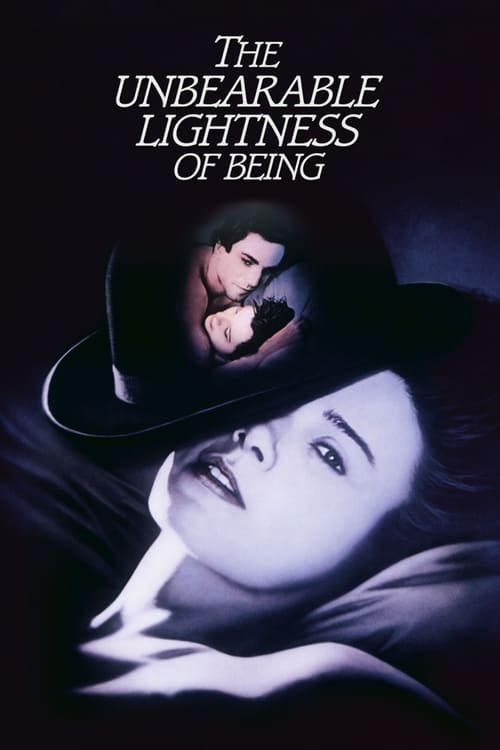
The Unbearable Lightness of Being
1988 · Philip Kaufman
For a long, absorbing evening when you want romance with real intellectual and historical weight — something to surrender a whole night to and think about for days. More bittersweet than cozy.
What it's about
Prague, 1968. Tomas, a brilliant surgeon and committed womanizer, brings home Tereza, a shy provincial photographer who wants all of him — while continuing his affair with Sabina, a painter as free as he is. Then Soviet tanks roll into Czechoslovakia, and the three are swept from bohemian Prague into exile, testing what love, loyalty, and home actually weigh.
The experience
Long, sensual, and immersive — nearly three hours that move like a slow current, alternating erotic intimacy with the shock of history crashing in. It's a film of ideas that you feel on your skin rather than parse, and it leaves a melancholy afterglow.
Performances
A young Daniel Day-Lewis makes Tomas's charm and evasiveness inseparable; Juliette Binoche, in an early role, is heartbreaking as Tereza; and Lena Olin nearly walks off with the film as Sabina, wit and freedom in a bowler hat.
The craft
Philip Kaufman turns Milan Kundera's famously essayistic novel into flesh — tactile, intimate scenes photographed by Sven Nykvist, Ingmar Bergman's great cinematographer, whose light gives every bedroom and street real texture. The staging of the Soviet invasion, weaving the actors into what feels like documentary footage, is a stunner on a big screen.
Why it matters
It became the benchmark for adapting the 'unadaptable' literary novel — proof that a book of ideas could live on screen as bodies and light — and it announced Day-Lewis and Binoche to international audiences.
Snapshot
A nearly three-hour adaptation of Milan Kundera's 1984 novel, The Unbearable Lightness of Being tracks three lives across the Prague Spring and the Soviet invasion of Czechoslovakia in August 1968: Tomas, a libertine surgeon (Daniel Day-Lewis); Tereza, the provincial photographer who loves him into monogamy he cannot quite manage (Juliette Binoche); and Sabina, the painter and serene erotic free agent who is Tomas's match and mirror (Lena Olin). Directed by the American literary sensualist Philip Kaufman, produced by Saul Zaentz, and photographed by Ingmar Bergman's cinematographer Sven Nykvist, the film translates Kundera's essayistic novel of ideas — lightness against weight, kitsch against truth, the body against history — into a current of intimate, tactile scenes. It arrived in February 1988, scored almost entirely from the music of the Czech composer Leoš Janáček, eighteen months before the Velvet Revolution would render its political backdrop history. Critically it was among the most honored films of its year; for Binoche and Olin it was an international breakthrough; and it remains a touchstone case study in how — and whether — a self-consciously "unfilmable" novel can survive the screen.
Industry & production
The film was a Saul Zaentz Company production released through Orion Pictures, and it bears the Zaentz signature: a prestige literary adaptation, independently financed, mounted at length and with European craft, in the lineage of his One Flew Over the Cuckoo's Nest (1975) and Amadeus (1984) and anticipating The English Patient (1996). Zaentz's model — patient, author-driven, indifferent to conventional running times — made a 171-minute adaptation of a Czech philosophical novel a plausible commercial proposition in the late-1980s American specialty market.
The central production constraint was political. The story is inseparable from Prague, but Czechoslovakia in the mid-1980s was still a Warsaw Pact state and the novel was banned there; shooting in the actual city was impossible. The production substituted Lyon and other French locations for Prague, with additional work in Geneva for the Swiss-exile passages. This act of geographic ventriloquism — staging occupied Prague in France — is itself an artifact of the Cold War conditions the film depicts.
Casting drew on a pan-European art-cinema talent pool rather than a Hollywood roster. Day-Lewis was cast before My Left Foot (1989) made him a marquee name; Binoche and Olin were known to European audiences but not yet internationally; the supporting ranks included Bergman regulars Erland Josephson and Stellan Skarsgård and the Czech dissident actor and signatory Pavel Landovský. English was adopted as the common tongue, with the cast speaking in lightly inflected accents — a pragmatic decision that has drawn both criticism and defense over the years.
Technology
Technically the film is conventional for a 1988 prestige production — 35mm photography, optical post-production — with one conspicuous exception that is central to its identity. For the invasion sequence, Kaufman and his collaborators intercut newly staged black-and-white footage of Day-Lewis and Binoche moving through the streets with genuine 1968 newsreel and amateur documentary footage of Soviet tanks entering Prague. To make the seam invisible, the freshly shot material was deliberately degraded — re-photographed, distressed, and matched in grain, contrast, and unsteadiness to the archival record — so that the actors appear to stand inside history rather than in front of a reconstruction. It is a pre-digital compositing of the actual and the staged, achieved photochemically, and it remains the film's most discussed technical achievement.
Technique
Cinematography
Sven Nykvist's photography is the film's spine, and it earned him an Academy Award nomination. Working far from Bergman's austere chamber dramas, Nykvist supplies a warm, naturalistic, often handheld intimacy: soft available-light interiors, skin rendered with frank tactility, a camera that stays close to faces and bodies. The look is sensual without gloss. Nykvist's signature command of the human face under soft, motivated light gives the erotic scenes their gravity — they read as observation rather than display — and his documentary-leaning handheld register makes the transition into the distressed invasion footage feel like a deepening of an existing texture rather than a rupture.
Editing
The editing — credited to a team led by Walter Murch, with collaborators including Stephen A. Rotter, B.J. Sears, and Vivien Hillgrove — faced the structural problem of Kundera's novel, which is digressive, recursive, and narrated by an intrusive philosophizing author. The film largely abandons that essayistic voice and reorders the material into a broadly chronological emotional throughline, letting scenes accrue weight by juxtaposition. Murch, the foremost theorist-practitioner of his craft, was a fitting choice for a film whose meaning lives in rhythm and association. The cutting is patient, giving scenes room to breathe across the long running time, and it is at its most virtuosic in the invasion sequence, where archival and staged frames are interleaved so closely that the boundary dissolves.
Mise-en-scène / staging
Kaufman stages the film around recurring objects and gestures that carry the novel's ideas without speechifying. Sabina's bowler hat — worn in front of a mirror, an emblem at once of erotic role-play, masculinity borrowed and subverted, and a vanished bourgeois past — is the clearest example, a motif that returns across continents and years. Mirrors recur throughout, doubling characters and implicating the act of looking. The film's most celebrated set piece, the scene in which Sabina and Tereza photograph each other nude, is staged as a game of advancing and retreating power, the camera (Tereza's and Nykvist's) becoming the instrument through which desire, rivalry, and self-knowledge pass.
Sound
The soundscape is dominated by music (below), but the film also uses sound to mark its three worlds: the charged hush of Prague interiors, the documentary clamor of the invasion, the thinner ambience of Swiss exile. Erotic scenes are notably quiet, trading score for breath and the small sounds of bodies, a restraint that intensifies them.
Performance
The performances are the adaptation's great success. Day-Lewis plays Tomas's compulsive philandering not as swagger but as a kind of distracted appetite shadowed by tenderness, so that his eventual turn toward weight and fidelity feels earned rather than sentimental. Binoche, in the role that opened her international career, gives Tereza a wounded watchfulness — jealousy, provincial fragility, and moral seriousness held in a single gaze. Lena Olin's Sabina is the film's center of gravity precisely because she embodies lightness: poised, unsentimental, erotically and intellectually free, refusing the kitsch that ensnares everyone else. The trio's chemistry carries ideas the film otherwise declines to state.
Narrative & dramatic mode
The film operates in the register of European art-cinema melodrama: a chamber love story of three (really four, counting Sabina's lover Franz) set against the pressure of history. Its dramatic mode is associative and accretive rather than plot-driven; tension comes less from event than from the slow revelation of how each character answers the book's governing question — whether a life lived once, lightly and without return, is liberation or unbearable weightlessness. Where Kundera narrates his themes directly, the film must dramatize them, and it largely succeeds by trusting performance, recurrence, and tone. The major structural sacrifice is the novel's narrating intelligence and its overt philosophical apparatus (Nietzsche's eternal return, Parmenides's light and heavy, the meditation on kitsch), which survive in the film only as implication.
Genre & cycle
The picture sits at the intersection of the prestige literary adaptation, the political love story, and the erotic art film. Within the late-1980s American specialty cycle it belongs beside other long, serious, sexually frank adult dramas aimed at the arthouse and awards markets. It also opens a distinct thread in Kaufman's own filmography — the eros-and-art cycle continued in Henry & June (1990), the first film to receive the new NC-17 rating, and Quills (2000) — establishing him as American cinema's most literary chronicler of desire.
Authorship & method
Philip Kaufman (director, co-writer) is the American cinema's great cosmopolitan outsider — a San Francisco–based, intellectually omnivorous filmmaker whose eclectic body of work (The Wanderers, the 1978 Invasion of the Body Snatchers, The Right Stuff) resists easy auteur branding. What recurs is a fascination with bodies, freedom, and ideas, and a willingness to take literary source material seriously on its own terms. Here his method was adaptation-by-distillation: stripping away Kundera's narrator to find the dramatic and erotic core beneath the essay.
Jean-Claude Carrière (co-writer) brought unmatched authority in European literary adaptation. Luis Buñuel's longtime collaborator (Belle de Jour, The Discreet Charm of the Bourgeoisie) and the screenwriter of The Tin Drum, Carrière specialized in translating "unfilmable" novels of ideas into supple screen structures, and his hand is evident in the film's confident pruning.
Sven Nykvist (cinematographer) imported the humanist intimacy of his decades with Bergman, grounding the film's intellectual ambitions in warm, tactile, faintly documentary images.
Walter Murch (lead editor) supplied the rhythmic and associative intelligence to reorganize a non-linear novel into a coherent emotional current.
Leoš Janáček is, in effect, the film's authorial fourth voice: nearly the entire score is drawn from the early-twentieth-century Czech composer's music, adapted for the production by Mark Adler. The choice is both nationalist anchor — Janáček as the sound of Czech identity — and emotional engine, his restless, speech-derived melodies mirroring the characters' yearning.
Movement / national cinema
The film is a hybrid of national cinemas rather than a product of any single one. Its subject is Czech and its musical soul is Czech, and it gestures toward the Czech New Wave whose flowering the 1968 invasion crushed. But it was made by an American director with a French co-writer, a Swedish cinematographer, Scandinavian and British and French actors, on French locations, in English, with American money. It is best understood as a work of late-1980s transnational art cinema — a Zaentz-style international prestige production — that takes a specific national tragedy as its material while standing outside any national movement.
Era / period
The Unbearable Lightness of Being is a Cold War film made at the very end of the Cold War. Released in early 1988, in the Gorbachev era of glasnost and perestroika, it depicts the 1968 crushing of reform from a vantage point just before the system it portrays collapsed; the Velvet Revolution would free Czechoslovakia in late 1989. This timing gives the film an unintended elegiac charge — it is a lament for a captivity that was, unknowingly, about to end. It also belongs to the broader late-1980s appetite for long, adult, literary cinema before the market for such films contracted.
Themes
The governing opposition is announced by the title: lightness versus weight. Tomas's life without commitment or consequence promises freedom but threatens to become unbearable in its very weightlessness; the burden of love and fidelity, of being needed, is the "weight" that may be the only thing that makes a life real. Around this axis the film arranges its other concerns: eros as a mode of knowledge and of evasion; kitsch, Kundera's central term, as the sentimental lie — political and personal — that denies the reality of the body, of death, of contingency; the political and the private, and the impossibility of keeping them apart once tanks are in the street (the personal cost of refusing to sign a recantation; the surveillance state's intrusion into the bedroom); exile and return, dramatized in Tereza's flight back to occupied Prague and Tomas's fateful choice to follow; and looking — photography as desire, evidence, betrayal, and art. The film resolves these tensions toward weight: its closing movement, in the muddy, modest pastoral of the countryside, finds in ordinary fidelity a grace the earlier libertine freedom never offered.
Reception, canon & influence
Critical reception. The film was among the most acclaimed releases of 1988. The National Society of Film Critics named it the best film of the year and honored Kaufman's direction and Nykvist's cinematography; it received Academy Award nominations for Adapted Screenplay and Cinematography and won the BAFTA for Best Adapted Screenplay. American critics including Roger Ebert championed it warmly, praising its intelligence, its eroticism, and its refusal to condescend to its audience. Reservations clustered around the same choices others admired: the great length, the loss of Kundera's narrating voice and philosophical scaffolding, and the use of accented English for a Czech story.
The author's verdict. The most consequential response came from Kundera himself, who was reportedly dissatisfied with the adaptation and felt it diverged from the spirit of his book; the experience is widely credited with hardening his refusal to permit further film versions of his work — a notable instance of a major novelist effectively disowning a respectful, well-made adaptation, and a permanent footnote in debates about fidelity.
Influences on the film (backward). It draws on the Bergman tradition through Nykvist, on the Buñuelian literary-adaptation lineage through Carrière, on the Czech musical inheritance of Janáček, and on the documentary record of 1968 itself, woven directly into the image track.
Legacy (forward). Its most durable consequences are in careers and craft. The film launched Juliette Binoche and Lena Olin internationally and broadened Daniel Day-Lewis's reach on the eve of his first Oscar. It cemented Kaufman's identity as American cinema's foremost director of intelligent eroticism and inaugurated the cycle that produced Henry & June and Quills. Its seamless integration of staged performance into degraded archival footage became a frequently cited model for marrying fiction to the historical record. And it endures as the central reference point in any discussion of the "unfilmable" novel — the case that is invoked precisely because it is so accomplished and yet left its author unconvinced, a permanent test case for the limits of literary adaptation.
A Deleuzian reading
Start with the bowler hat.
The full Deleuzian reading of The Unbearable Lightness of Being →
Reception
Critics in 1988 admired its ambition (two Oscar nods, including Sven Nykvist's cinematography) but audiences balked at the near-three-hour runtime, and Milan Kundera famously disowned it; today it's remembered as one of the rare 'unfilmable novel' adaptations that mostly worked, and as the film that introduced Juliette Binoche to the world.
How The Unbearable Lightness of Being was received, from release to now →
Influences: the films it descends from and the films it influenced
- Belle de Jour (1967) — Co-writer Jean-Claude Carrière established here his method of staging a woman's erotic interior life as matter-of-fact narrative event — the deadpan treatment of fantasy and infidelity he carries into Sabina and Tereza.
- The Discreet Charm of the Bourgeoisie (1972) — Carrière's structuring of digressive, essayistic material into a supple episodic chain is the screenwriting muscle behind the film's associative-accretive distillation of Kundera.
- The Tin Drum (1979) — Carrière's earlier screenplay proving an 'unfilmable' novel of ideas could be pruned to its dramatic core — the direct adaptation-by-distillation template applied to Kundera's narrator-heavy text.
- Cries and Whispers (1972) — Sven Nykvist's warm, tactile soft light and skin-close intimacy is the exact cinematographic grammar he re-imports to ground the film's intellectual ambitions in bodies.
- Persona (1966) — Nykvist's merging of two women's faces and the doubling of their identities prefigures the Tereza/Sabina mirror-doubling motif and its photographic handling.
- The Conversation (1974) — Walter Murch's associative sound-and-image editing — building emotional continuity across non-linear fragments — is the cutting intelligence he brings to reorganize the novel into an emotional current.
- The Right Stuff (1983) — Kaufman's own interleaving of staged scenes with period newsreel; the photochemical-compositing technique he refines to drop his actors into the degraded 1968 Soviet-invasion footage.
- Zelig (1983) — Pioneered the seamless insertion of staged performance into aged, degraded archival footage — the compositing lineage Kaufman extends from comic gag to dramatic historical witness.
- Hiroshima mon amour (1959) — Its interleaving of an erotic present with traumatic documentary history is the associative model for marrying the love triangle to the newsreel record of the Prague Spring.
- The Firemen's Ball (1967) — Czech New Wave's deadpan documentary texture and its Prague-Spring-era social observation supply the period and tonal world Kaufman reconstructs.
- Henry & June (1990) — Directly inaugurated Kaufman's intelligent-eroticism cycle, reusing the quiet, unsensational staging of sex as character revelation rather than spectacle.
- Quills (2000) — Extends the same cycle's treatment of eroticism as a vehicle for ideas, pairing literate adaptation with frank but unleering sexual staging.
- The English Patient (1996) — Reunites Juliette Binoche and editor Walter Murch to distill another 'unfilmable' novel through associative cross-cutting of an erotic present with wartime history.
- JFK (1991) — Industrializes the staged-into-archival compositing into a forensic reconstruction, blending fabricated and real degraded footage to suture fiction onto a historical trauma.
- Forrest Gump (1994) — Carries the fiction-into-newsreel compositing into the digital era, inserting a performer into real archival footage as the now-standard model the film helped legitimize.
- Cold War (2018) — An Eastern European romance scored to national folk-classical music used as both emotional engine and identity anchor — the Janáček strategy of nationalist sound carrying the love story's yearning.
- Jules and Jim (1962) — A lyrical free-love triangle treated with buoyant tonal lightness against a darkening historical tide — the same play of erotic lightness versus political weight.
- Damage (1992) — Nykvist's shallow-focus, available-light handling of long sexual sequences played without score, and Binoche's established register of watchful non-explanation, are the immediate precedent for how Malle shoots and casts her.
Similar films
- Beanpole (2019) — shared sensibility
- Wings of Desire (1987) — shared sensibility
- The Lives of Others (2006) — shared sensibility
- The Night Porter (1974) — shared sensibility
- Shame (1968) — shared sensibility
- Closely Watched Trains (1966) — shared sensibility
- Last Tango in Paris (1972) — shared sensibility
- Three Colors: Blue (1993) — shared sensibility
All the films related to The Unbearable Lightness of Being →