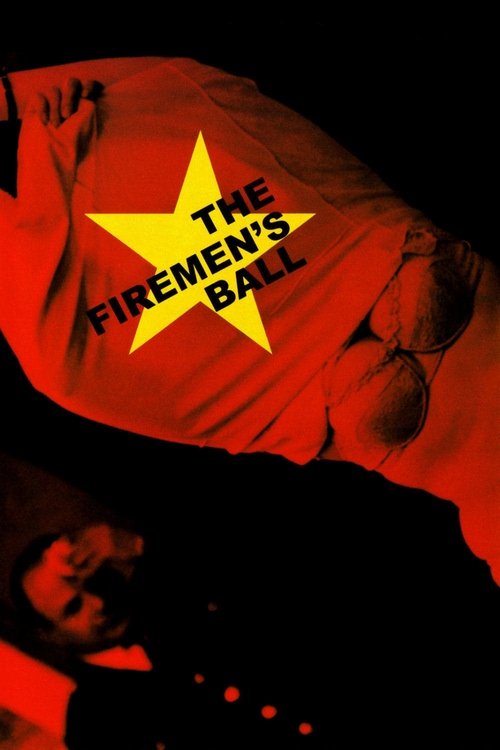
The Firemen's Ball
1967 · Miloš Forman
For when you want to laugh at human folly and bureaucratic absurdity — short, sharp, and perfect for a night when you want comedy with teeth.
What it's about
The volunteer firemen of a small Czechoslovak town throw a gala ball to honor their ancient retired chairman: there will be a band, a raffle, and a beauty pageant. Then the raffle prizes start disappearing one by one, the pageant collapses into chaos, and — in the evening's crowning indignity — an actual fire breaks out. A whole social order comes undone in a single catastrophic night.
The experience
Seventy-odd minutes of escalating, deadpan farce that keeps tipping from hilarious into mortifying and back. You laugh at the bumbling, then realize the joke is about something much bigger, and the aftertaste is surprisingly melancholy.
Performances
Forman cast mostly non-professionals — real townspeople with lived-in faces — and their unpolished, utterly believable awkwardness is the film's secret engine.
The craft
Forman builds the whole film from observed behavior: darting ensemble camerawork, overlapping chatter, comedy assembled in the editing from a hundred small humiliations. Nothing feels staged, which is exactly why the satire cuts — the incompetence and petty theft indict a whole system without one line of speechmaking.
Why it matters
Released on the eve of the Prague Spring and subsequently banned in Czechoslovakia, it became a defining work of the Czech New Wave and Forman's ticket to Hollywood — its fingerprints are on decades of ensemble satire.
Snapshot
The Firemen's Ball (Czech: Hoří, má panenko, literally "It's Burning, My Dear") is Miloš Forman's third and final Czechoslovak feature, a compact color comedy — barely over seventy minutes — that compresses an entire social order into the span of a single disastrous evening. A provincial volunteer fire brigade organizes a ball to honor its eighty-six-year-old former chairman and to present him with a ceremonial axe; over the course of the night the raffle prizes are pilfered one by one, an improvised beauty pageant collapses in embarrassment, an old man's house burns down while the firemen look on helplessly, and the honoree's gift itself vanishes. Made at the height of the Czechoslovak New Wave and released on the eve of the Prague Spring, the film is at once a affectionate ensemble farce and a devastating anatomy of collective incompetence, petty theft, and the gap between good intentions and human weakness. It was banned "permanently" in Czechoslovakia after the Soviet-led invasion of August 1968, earned an Academy Award nomination, and stands as the pivot on which Forman's career turned from Barrandov to Hollywood.
Industry & production
The film was produced through the state Barrandov Studios in Prague, within the relatively liberal creative units that made the Czechoslovak New Wave possible in the mid-1960s. Its most consequential production fact is its international financing: the Italian producer Carlo Ponti co-financed the picture, an arrangement that turned catastrophic when Ponti, reportedly dissatisfied with the finished film, withdrew and demanded the return of his investment. This left Forman personally exposed to a debt he could not repay and the film at risk of being shelved. The rescue is one of the well-attested legends of the era: François Truffaut, with help from the French producer Claude Berri, stepped in to acquire the international rights and secure the film's release, effectively saving both the picture and Forman from ruin. The exact sums involved vary across accounts, and I would treat any specific figure with caution, but the outline — Ponti's withdrawal, Truffaut's intervention — is firmly established, not least in Forman's own memoir Turnaround.
Production took place in the town of Vrchlabí, in the foothills of the Krkonoše (Giant Mountains), using the actual local hall and, crucially, local people. As in Loves of a Blonde, Forman built his cast almost entirely from non-professionals — real townsfolk and members of the local fire brigade — a decision that had unexpected fallout. The firemen who appeared as extras and bit players felt the film mocked their profession and their dignity, and Forman later recounted having to placate a genuinely wounded community; the episode fed directly into the film's eventual reception at home. The picture was completed in 1967 and released in Czechoslovakia that year.
Technology
The Firemen's Ball was Forman's first feature in color, a significant technical step after the black-and-white of Black Peter (1964) and Loves of a Blonde (1965). Shot on 35mm with cinematographer Miroslav Ondříček, the film uses color not for spectacle but as another register of the everyday — the drab institutional interior of the hall, the cheap finery of the ball, the lurid glow of the distant fire against snow. The technology is otherwise unshowy and deliberately so: the production leans on available and practical light sources appropriate to a real municipal hall, and on the mobility that lighter mid-1960s equipment afforded, allowing the camera to move among crowds and catch behavior rather than stage it. There are no optical effects to speak of; the film's ambition is entirely observational, and its technical choices serve that documentary-adjacent realism.
Technique
Cinematography
Ondříček's photography is the technical heart of the film. Working in muted color, he favors a crowded, densely populated frame in which the "action" is often buried among ordinary bodies — a composition strategy that keeps the viewer scanning the image the way one scans a real room. Telephoto and medium lenses let the camera observe faces and small gestures from within the throng without appearing to compose them, producing the sense that we are eavesdropping on a genuine event. The famous set pieces — the reluctant beauty-pageant contestants herded before the committee, the raffle table steadily emptying of its prizes, the fire seen across a snowy field — are shot with restraint, the camera holding on the human reactions rather than cutting to spectacle. It is a style descended from cinéma vérité and Italian neorealism, adapted to a controlled fiction.
Editing
Cut by Miroslav Hájek, Forman's editor on his earlier Czech features, the film sustains a comic rhythm built almost entirely on reaction and juxtaposition. Much of the humor is editorial: a plan announced by the committee, then the cut to its bungled execution; a stern speech intercut with the quiet disappearance of another raffle prize. Hájek orchestrates the ensemble so that no single protagonist emerges — the "character" is the collective — and the accumulating catastrophes gather momentum through pacing rather than plot mechanics. The film's brevity is itself an editorial virtue: it never outstays its single night.
Mise-en-scène / staging
The staging is a masterclass in controlled chaos. Forman and his collaborators choreograph large groups of non-professionals within the confined geography of the hall — the stage, the raffle table, the dance floor, the committee's bench — so that multiple small dramas unfold simultaneously in a single space. The recurring motifs are physical and concrete: the glass case of prizes, the banner, the ceremonial axe in its box, the sashes for the pageant. Objects carry the moral weight of the film. The staging repeatedly frames officialdom (the committee, the speeches, the ceremony) against the disorderly reality it cannot control, and the comedy emerges from that spatial and social friction.
Sound
The soundscape is naturalistic — the brass band, the murmur and clamor of the crowd, announcements over a struggling public-address system, the awkward silences of the pageant. Karel Mareš is credited with the music, but the film's aural texture is dominated by diegetic sound: the band's honest, slightly tinny playing and the ambient noise of a real social gathering. This grounding in unglamorous everyday sound reinforces the documentary illusion and lets the dialogue — much of it feeling improvised or lightly scripted around ordinary speech — land with unforced authenticity.
Performance
The performances are the film's signature achievement and its most radical gesture. Cast overwhelmingly with non-professionals, the film draws on faces and manners that no professional could counterfeit: the pompous gravity of the committee members, the blank discomfort of the pageant girls, the pathos of the old man watching his home burn. Jan Vostrčil, a recurring presence in Forman's Czech work, anchors the committee with a bluff self-importance that is both funny and human. Forman's method — coaxing behavior rather than directing "acting," shooting patiently to catch the unguarded moment — yields an ensemble that never reads as performance at all, which is precisely why the townspeople who inspired it felt so exposed.
Narrative & dramatic mode
The film's dramatic mode is observational ensemble comedy shading into social parable. There is no conventional protagonist and no arc of individual redemption; instead the narrative is a chain of escalating public embarrassments unfolding in near-real-time across one evening. The dramatic engine is the ever-widening gap between plan and reality — between the committee's dignified intentions (a beauty pageant, an orderly raffle, a gracious tribute) and the shabby, self-interested behavior of the very people who are supposed to enact them. Comedy and cruelty are held in exact balance: the pageant humiliates the young women, the raffle exposes everyone as a thief, and the fire — the one genuine emergency the firemen exist to answer — reduces them to spectators offering the burned-out old man worthless stolen raffle tickets as "compensation." The mode is closer to Chekhovian tragicomedy than to farce; the laughter curdles.
Genre & cycle
Formally a comedy, the film belongs to the cycle of intimate, ironic social observation that defined the Czechoslovak New Wave — small-scale stories of ordinary provincial life whose realism carried an implicit critique of the official optimism of state socialism. Within Forman's own body of work it completes an informal trilogy with Black Peter and Loves of a Blonde: three studies of Czech society built on non-professional casting, semi-improvised behavior, and a sympathetic but unsparing eye for human vanity. It also sits in the longer lineage of ensemble "event" films — a wedding, a dance, a party as a microcosm of a whole community — a structure Forman would revisit throughout his career.
Authorship & method
The film is authored by a tight collaborative unit. Forman wrote the screenplay with Ivan Passer and Jaroslav Papoušek, the same writing partnership behind his earlier features; their method involved close observation of real milieus, dialogue built from the cadences of ordinary speech, and a structure loose enough to accommodate what the non-professional cast actually did on set. Miroslav Ondříček's cinematography and Miroslav Hájek's editing were the other constants of Forman's Czech period, and their collaboration is inseparable from the film's vérité texture. Karel Mareš supplied the music. Forman's directorial method — patient, behavioral, distrustful of overt "acting" and of message — is central here: he consistently maintained that the film was about human beings and their foibles, not a coded political statement, a claim that is both artistically sincere and, given the reception, politically loaded. The authorship is thus doubled: a genuine ensemble comedy by design, and, in the eyes of its audiences and censors, an allegory whether Forman intended one or not.
Movement / national cinema
The Firemen's Ball is a canonical work of the Czechoslovak New Wave (Československá nová vlna), the extraordinary flowering of cinema that emerged from FAMU (the Prague film school) and Barrandov in the 1960s and included Věra Chytilová, Jiří Menzel, Jan Němec, Ivan Passer, and others. The movement's hallmarks — non-professional actors, everyday settings, tonal irony, formal experiment, and an oblique but unmistakable skepticism toward the regime — are all present. Forman represents the movement's more accessible, humanist, observational wing, as distinct from Chytilová's or Němec's formal radicalism. The film also stands as a terminal marker of the movement: the "normalization" that followed the crushing of the Prague Spring dismantled the conditions that had made such work possible.
Era / period
The film is inseparable from its moment: 1967, the last full year of relative cultural thaw before Alexander Dubček's reforms and the "socialism with a human face" of early 1968. It was made under a censorship regime loosened enough to permit sharp social satire, and released into a society testing the limits of official tolerance. Everything about it — the bumbling committee, the collective petty theft, the yawning gap between rhetoric and reality — reads, in retrospect, as a portrait of a system in quiet decay. The August 1968 Warsaw Pact invasion changed its meaning overnight. Under normalization the film was banned in Czechoslovakia, reportedly "forever," and Forman, abroad when the tanks arrived, chose exile in the United States.
Themes
The film's central theme is collective moral failure rendered comic: the way ordinary, mostly well-meaning people, acting in concert, produce dishonesty, humiliation, and inertia. The disappearing raffle prizes make everyone complicit — when the lights are turned off so that guilty parties may quietly return what they took, still more goes missing — a near-perfect parable of shared guilt and the impossibility of collective honesty under pressure. The beauty pageant dramatizes the cruelty of institutional spectacle and the objectification of the powerless. The burning house sets genuine human need against the ceremonial self-importance of the men sworn to meet it. Beneath the comedy runs a current of pathos about dignity — the old chairman's, the burned-out man's, the pageant girls' — and about the erosion of solidarity in a society organized around committees, speeches, and appearances. Whether one reads these as universal human truths or as a specific indictment of state socialism is, deliberately, left to the viewer.
Reception, canon & influence
Internationally, the film was received as a small masterpiece and earned an Academy Award nomination for Best Foreign Language Film, cementing Forman's reputation abroad just as his domestic career was ending. At home its fate was starkly political: the reaction of the real firemen who felt insulted foreshadowed official displeasure, and after 1968 the film was suppressed as part of normalization, a ban that lasted until the fall of communism. Its influences flow backward to Italian neorealism and to cinéma vérité, and, more locally, to the observational ethos Forman and his co-writers had already developed across Black Peter and Loves of a Blonde.
Its forward legacy is substantial. For Forman personally, the film was the bridge to the West: after emigrating he made Taking Off (1971) and then One Flew Over the Cuckoo's Nest (1975) and Amadeus (1984), both multiple-Oscar winners — and the humane, behavior-first, ensemble-attentive sensibility of The Firemen's Ball persists throughout that American work. More broadly, the film endures as a touchstone of political satire that operates entirely through the concrete and the everyday, without slogans or overt allegory — a model for filmmakers seeking to critique power through comedy and observation rather than didacticism. It remains widely taught and revered as one of the definitive achievements of the Czechoslovak New Wave and one of the great short comedies of world cinema.
A Deleuzian reading
The prizes for the raffle are laid out under glass at the side of the hall, counted and labeled, ready.
The full Deleuzian reading of The Firemen's Ball →
Reception
Banned "forever" in Czechoslovakia after the 1968 Soviet invasion, it became one of cinema's most famous suppressed films — and is now enshrined as the crowning satire of the Czech New Wave and Forman's farewell to his homeland.
How The Firemen's Ball was received, from release to now →
How to watch The Firemen's Ball: what to notice on a first viewing
- Watch how packed and unposed every wide shot looks. Ondříček shoots through a telephoto lens from within the crowd, so the frame stays dense with ordinary bodies rather than composed around one face. You end up scanning the image the way you'd scan a real, crowded room.
- Watch for a plan announced, then its bungled result. Hájek repeatedly cuts from a committee's confident announcement straight to the shabby reality of its execution, letting the gap do the joke. The comedy comes from the cut itself, not from anything a character says.
- Listen for the band and the struggling loudspeaker. The soundtrack stays entirely diegetic, a slightly tinny band and crackling announcements, with no score cueing you on how to feel about any of it. The ordinary noise makes the whole evening feel like something you are actually attending.
- Notice the glass case of raffle prizes at the side. The case, the banner, and the boxed ceremonial axe recur through the evening as objects the ceremony needs, and each one comes under threat. A handful of small objects end up carrying the entire moral weight of the night.
- Watch the committee members' faces during their own speeches. Cast from real townspeople, the faces carry a self-importance and discomfort no professional performance could quite fake. Nobody here looks like they are acting, which is exactly why the town felt so exposed by it.
The whole guide to watching The Firemen's Ball, with the keys for a rewatch →
Influences: the films it descends from and the films it influenced
- Bicycle Thieves (1948) — Establishes the neorealist grammar Forman inherits: non-professional cast, real locations, and a moral catastrophe built from small everyday transactions rather than plot machinery.
- Loves of a Blonde (1965) — Forman's own dry run for the ensemble-dance-hall method — telephoto eavesdropping on ordinary faces and dialogue lifted from real speech cadences, with the same Ondříček/Hájek/Passer/Papoušek unit.
- Black Peter (1964) — First deployment of Forman's behavioral, anti-'acting' direction of amateurs, letting gesture and hesitation carry meaning that the script only sketches.
- Primary (1960) — Direct-cinema/vérité observation — handheld, available-light, fly-on-the-wall coverage of a live public event — that legitimizes filming a real crowd as it behaves rather than staging it.
- Taking Off (1971) — Forman transplants the exact method to America — non-pros, ensemble-of-parents observed with telephoto detachment, comedy of a generation's foibles rather than message.
- One Flew Over the Cuckoo's Nest (1975) — Carries forward the ward-as-ensemble and reaction-shot editing, using an institution's petty rule-enforcement to indict authority through behavior, not allegory.
- Amadeus (1984) — Retains the behavior-first, distrust-of-'acting' direction and the crowded, reaction-cut ensemble frame, now scaled up but still humane and foible-driven.
- The Discreet Charm of the Bourgeoisie (1972) — Extends the 'social gathering that keeps failing' as satire — a dinner/ball perpetually derailed, exposing a class's self-regard through interrupted ritual.
- A Wedding (1978) — Inherits the single-event ensemble comedy with overlapping diegetic sound and telephoto observation of a large group, mining a social ceremony for collective embarrassment.
- The Celebration (1998) — Dogme reprise of the vérité ensemble-at-a-formal-event, using handheld naturalism and a party's escalating breakdown to detonate collective hypocrisy.
- Toni Erdmann (2016) — Modern heir to the observational tragicomedy of social embarrassment — long, patient behavioral takes where a group's mannered decorum collapses into humiliating comedy.
- The Death of Stalin (2017) — Political satire of collective moral cowardice played as ensemble comedy of officials managing a botched public occasion, critique carried by petty behavior rather than didactic speech.
- if.... (1968) — Forman's casting practice of placing non-professional locals alongside trained actors to generate a performance spectrum from naturalistic documentary behavior to broad caricature within a single institutional gathering directly models Anderson's approach to the Cheltenham cast.
- Silkwood (1983) — Ondříček's documentary-remove framing of group behavior, observing non-glamorous people in social ritual without flattering coverage — the observational distance Silkwood adopts for its workers.
- Kolya (1996) — Deadpan ensemble comedy of small-people foibles staged in patient observational takes that let behavior, not cutting, carry the joke — Smutný's restrained coverage descends from this.
- The Unbearable Lightness of Being (1988) — Czech New Wave's deadpan documentary texture and its Prague-Spring-era social observation supply the period and tonal world Kaufman reconstructs.
- L'Avventura (1960) — Shares the strategy of letting a group's collective moral indifference surface through duration and dead time, an event (a disappearance / a theft) that exposes the ensemble rather than resolving.
- Closely Watched Trains (1966) — Czechoslovak New Wave tragicomedy that fuses provincial small-town observation with sudden tonal reversal into tragedy — the same deadpan warmth curdling into moral weight.
- Daisies (1966) — Parallel Czech New Wave satire whose banquet-destruction climax similarly turns a table of food into an image of collective appetite and social collapse under the censors' noses.
- The Cremator (1969) — Same-movement political allegory-by-the-concrete: critique of complicity delivered through grotesque everyday ritual instead of slogan, trusting the audience to read the code.
- The Party and the Guests (1966) — Czech New Wave parable staged as a single social gathering where politeness enforces conformity — power critiqued entirely through the microbehavior of a group at a party.
Similar films
- Loves of a Blonde (1965) — influence & lineage
- Daisies (1966) — influence & lineage
- The Cremator (1969) — influence & lineage
- Closely Watched Trains (1966) — influence & lineage
- The Death of Stalin (2017) — influence & lineage
- One Flew Over the Cuckoo's Nest (1975) — influence & lineage
- Witchhammer (1970) — shared sensibility
- Even Dwarfs Started Small (1971) — shared sensibility