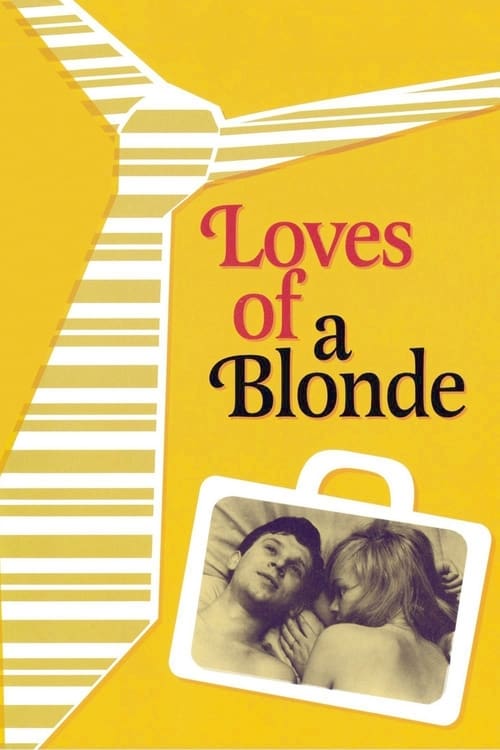
Loves of a Blonde
1965 · Miloš Forman
When you want something human-scale and bittersweet — a film that's easy to watch and hard to shake, for a night when tender and true beats big and loud.
What it's about
Andula works in a shoe factory in a small Czech town where women vastly outnumber men, and she is hungry for love in a place that offers almost none. After a night with Milda, a charming pianist visiting from Prague, she takes his casual flirtation for the real thing — and when he doesn't write, she packs a suitcase and shows up at his parents' apartment. What follows is a comedy of embarrassment that quietly becomes something sadder.
The experience
Funny in an overheard, almost documentary way — you laugh at fumbled seductions and mortified parents, then realize the film has broken your heart while you weren't looking. It's gentle, unhurried, and devastating by stealth.
Performances
Hana Brejchová is remarkable as Andula, playing naivety without ever condescending to it; the cast mixes professionals with non-actors so seamlessly that every awkward pause feels caught rather than staged.
The craft
Forman builds the film from long, patient set pieces — a village dance where middle-aged reservists court factory girls, a bedroom seduction, a late-night standoff in a cramped apartment — letting overheard, seemingly improvised dialogue do the work. The black-and-white location shooting gives it the texture of eavesdropped life.
Why it matters
One of the defining films of the Czechoslovak New Wave and the work that carried Miloš Forman to international attention before his Hollywood career.
Snapshot
Loves of a Blonde (Lásky jedné plavovlásky) is Miloš Forman's second feature and one of the defining works of the Czechoslovak New Wave. Shot in black-and-white on location in and around the provincial factory town of Zruč nad Sázavou, it observes Andula, a young worker in a shoe factory, as she mistakes a one-night stand with a visiting Prague pianist for the beginning of a love, then travels uninvited to his parents' cramped apartment. From that slender anecdote Forman builds a comedy of embarrassment and disappointment that is also a quietly devastating portrait of a state-managed society. The film is celebrated for its blend of professional and non-professional performers, its overheard, seemingly documentary dialogue, and three superb set-piece sequences — the factory town's gender imbalance and its official "solution," the dance-hall seduction, and the nocturnal squabble of Milda's parents. It earned Forman an international reputation and a nomination for the Academy Award for Best Foreign Language Film, and it remains, with The Firemen's Ball, the fullest statement of his Czech period.
Industry & production
The film was produced within the Czechoslovak state film system, centered on the Barrandov Studios in Prague, during the mid-1960s liberalization that made the New Wave possible. In this period a comparatively tolerant cultural climate and a studio structure that grouped filmmakers into semi-autonomous creative units allowed young directors to work with unusual freedom, provided budgets and tight schedules; Forman's aesthetic of location shooting and non-actors was partly a virtue made of these constraints. The picture was made cheaply and quickly by Western standards, and its modest scale is inseparable from its manner.
Forman drew his cast from a mix of trained and untrained people, a working method that shaped both production and reception. The lead, Andula, was played by Hana Brejchová — the younger sister of the well-known actress Jana Brejchová, to whom Forman was then married — while Milda was played by Vladimír Pucholt, a professional who also appeared in Forman's Black Peter. Many secondary figures, including the reservists and factory women, were non-professionals cast for their faces and manner. Beyond these widely documented facts, the granular commercial record — precise budget and domestic box-office figures — is not something the standard English-language literature reports in detail, and I will not invent numbers.
Technology
The film was shot on 35mm black-and-white film stock in the standard Academy aspect ratio, consistent with Czech studio practice of the period. Its technological signature is not novelty but discretion: lightweight, mobile shooting that let the camera work in real interiors — a factory dormitory, a dance hall, a small apartment — with available or minimally supplemented light. Sound was post-synchronized in the studio, as was normal for Czech production of the era, yet the film cultivates an impression of caught, spontaneous speech. There is no ostentatious use of new equipment; the "technology" that matters here is the ensemble of unobtrusive means that supports an observational, near-documentary look.
Technique
Cinematography
The cinematography is by Miroslav Ondříček, Forman's key collaborator, who would later shoot the director's American films (Hair, Ragtime, Amadeus). The camerawork alternates between two registers. In the crowd and party scenes it is loose and roving, favoring medium shots and the sudden, telling close-up plucked from a group — an approach indebted to cinéma-vérité and to British Free Cinema, catching gestures and glances as if unrehearsed. In the more intimate passages, particularly the seduction and the parents' bedroom, the framing tightens and holds, letting awkwardness accumulate within the shot. Ondříček's grayscale is soft and unglamorous, describing worn rooms and ordinary faces without prettifying them; the visual plainness is itself an argument about the world being shown.
Editing
The editing, credited to Miroslav Hájek, is structural rather than decorative. The film is essentially a triptych of long observational sequences, and much of its comedy is built in the cutting — on reaction shots, on the beat held a moment too long, on the deflation that follows an expectation. The dance-hall sequence, in which three middle-aged reservists try clumsily to send a bottle of wine to a table of young women, is a small masterclass in comic timing achieved through the exchange of looks between tables. Rather than accelerate, Forman and Hájek tend to let scenes breathe until embarrassment becomes unbearable, then cut.
Mise-en-scène / staging
Forman stages the film in real, unbeautified spaces and crowds them with bodies. The recurring principle is the individual isolated within, or exposed by, a group: Andula among the ranks of dormitory beds; the factory women lined up before officialdom; Milda's parents jammed together in a bed too small for the argument they are having. Props carry weight — a wedding ring turned nervously on a finger, a window blind that will not stay down, a tie, a guitar. The staging repeatedly sets private feeling against public or communal setting, so that intimacy is always faintly comic and faintly sad because it is never quite private.
Sound
Music and speech are the load-bearing elements of the soundtrack; the credited music is by Evžen Illín, and the film leans heavily on the diegetic dance-band pop and jazz of its party scenes, the very sound of provincial nightlife. Dialogue is the film's essential material — overlapping, banal, evasive, full of the platitudes people reach for when they cannot say what they mean. Forman treats talk almost documentarily, mining comedy and pathos from cliché and small talk. There is little non-diegetic scoring to instruct our feelings; the humor and the ache arise from the words themselves and from the silences around them.
Performance
Performance is where the film's method is most visible. Hana Brejchová gives Andula a watchful, guarded tenderness — a face that registers hope and humiliation with minimal outward gesture — and her non-professional freshness is central to the film's tone. Vladimír Pucholt makes Milda a persuasive small-time charmer whose glibness curdles into evasion. The supporting playing, much of it by non-actors, has the unpolished immediacy Forman sought; the reservists and the parents in particular seem less to act than to be. The famous strategy is the blend: trained performers give the film its spine while amateurs give it its texture of the real.
Narrative & dramatic mode
The narrative is deliberately anti-dramatic in the conventional sense. There is no plot engine of obstacle and resolution; instead the film proceeds by episode and observation, a loose chronicle organized around three extended situations. Its mode is ironic comedy shading into melancholy — the comedy of manners and misunderstanding, in which characters talk past one another and social ritual fails to deliver what it promises. The dramatic question is emotional rather than eventful: will Andula's hope survive contact with Milda's indifference and his parents' mortified rejection? The ending withholds catharsis, returning Andula to her routine chastened, and the muted close is integral to the film's honesty. Forman's method is to let situations reveal character and society, not to bend them toward a plot.
Genre & cycle
Nominally a comedy-drama-romance, the film belongs to a distinctly Eastern European strain of bittersweet social comedy that uses laughter to expose the gap between official optimism and private disappointment. Within Forman's own work it forms a clear cycle with the preceding Black Peter (Konkurs/Černý Petr, 1963–64) and the following The Firemen's Ball (1967): all three are ensemble comedies of provincial and generational life, built from non-actors, real locations, and satirically observed ritual. It also participates in the broader New Wave cycle of youth pictures across Europe, sharing with them an interest in the disappointments and drift of the young, but its comic-documentary texture is particular to the Czech school.
Authorship & method
Forman's authorship here is collaborative and script-centered even as it appears improvisational. The screenplay is credited to Forman with his regular writing partners of the period — Jaroslav Papoušek and Ivan Passer, with Václav Šašek — and the seemingly caught dialogue was in fact carefully constructed to sound overheard. Forman's method, well documented in his own later accounts, combined a written framework with casting for authenticity and a willingness to shape performance on location. The core creative team recurs across his Czech films: cinematographer Miroslav Ondříček, whose mobile observational camera defines the look; editor Miroslav Hájek, whose comic timing shapes the film's rhythm; the Forman–Papoušek–Passer writing circle; and composer Evžen Illín. The result is a body of work with a consistent signature — ensemble comedy drawn from ordinary Czech life, satirical toward authority and cliché, tender toward its bewildered individuals — that would carry, transformed, into Forman's American career (One Flew Over the Cuckoo's Nest, Amadeus).
Movement / national cinema
The film is a canonical work of the Czechoslovak New Wave (Nová vlna), the extraordinary flowering of the Prague film culture of the 1960s that also produced Věra Chytilová, Jiří Menzel, Jan Němec, Ivan Passer, and Jaromil Jireš, many of them trained at the FAMU film school. Forman's wing of the movement was its most accessible and observational: where Chytilová's Daisies pursued formal explosion and Němec pursued allegorical abstraction, Forman pursued a humane, documentary-flavored realism. The New Wave's freedom was a product of the political thaw that culminated in the Prague Spring of 1968; the movement was curtailed after the Warsaw Pact invasion of August 1968 and the ensuing "normalization," a context that lends Forman's gently satirical portraits their retrospective poignancy.
Era / period
Made in the mid-1960s, the film is a document of everyday life under Czechoslovak state socialism at the moment the system's cultural grip was loosening. The film's central social fact — a factory town so short of young men that the authorities arrange for army reservists to be garrisoned nearby to "balance" the population — is a pointed, near-absurdist image of central planning applied to human desire. Without polemic, the film registers the textures of the period: managed labor and dormitory life, the small pleasures of a provincial dance, the housing squeeze that forces three generations into a single flat. It reads now as both a comedy of its moment and, given what followed in 1968, an inadvertent elegy for a brief opening.
Themes
The film's governing theme is the collision between longing and disappointment — Andula's yearning for love against a world that offers only transaction and evasion. Around it cluster several others: the failure of communication, dramatized in dialogue where no one quite says what they feel; the gap between official promises and lived reality, embodied in the reservist scheme; the generation gap, sharpest in the parents' horrified response to their son's casual conduct and to the girl on their doorstep; and the tension between the individual and the collective, with private feeling perpetually staged in crowded, communal space. Underlying all of these is a compassionate skepticism about romance itself — a refusal to grant Andula the love story she (and the audience) desires, precisely because the film honors how such stories usually end.
Reception, canon & influence
Critically, Loves of a Blonde was the film that carried Forman's name beyond Czechoslovakia. It was received internationally as a fresh, wryly humane comedy and was nominated for the Academy Award for Best Foreign Language Film, an early signal of the crossover appeal that would define Forman's later career; it has since held a secure place in the canon of the Czech New Wave and in Forman's filmography, and is available in restored form through arthouse and repertory channels. (I flag that precise contemporary review excerpts and awards tallies beyond the widely reported Oscar nomination are not something I can quote reliably here without inventing, and I will not.)
Looking backward, the film's influences are legible: Italian neorealism's use of real locations and non-professionals; the observational ethos of cinéma-vérité and British Free Cinema; and the broader European New Wave interest in youth, drift, and disappointment. Its comic-documentary treatment of ordinary talk is Forman's synthesis of these currents into something recognizably his own.
Looking forward, the film's legacy is twofold. Within Czech cinema it stands with The Firemen's Ball as a model of satirical ensemble comedy that shaped how the New Wave's realist wing was understood at home and abroad. More broadly, it inaugurated the Forman manner — the mix of professionals and amateurs, the ear for cliché, the comedy of embarrassment, the refusal of sentiment — that he carried into American cinema and that has echoed in the work of later directors drawn to naturalistic, awkward, humane observation. The reservist sequence and the dance-hall seduction in particular have become touchstones for how comedy can expose a whole social order without raising its voice.
A Deleuzian reading
A bottle of wine crosses a dance floor.
The full Deleuzian reading of Loves of a Blonde →
Reception
An international sensation on release — it screened at the 1966 New York Film Festival, landed a Best Foreign Language Film Oscar nomination, and made Forman's name abroad. Now it's fixed in the canon as a defining film of the Czech New Wave and the origin point of the career that led to Hollywood and Cuckoo's Nest.
How Loves of a Blonde was received, from release to now →
How to watch Loves of a Blonde: what to notice on a first viewing
- Watch the wine bottle travel slowly across the dance floor. Three reservists send a bottle of wine to a table of women, and the scene lingers on the exchange of looks between tables far longer than the gesture itself needs. The comedy is built entirely from waiting and watching, not from anything anyone actually does.
- Watch the camera pick a small gesture out of a crowd. In party and dormitory scenes the camera roves loosely, favoring medium shots that suddenly tighten on one unrehearsed-looking glance or reaction. The style makes the film feel caught rather than staged, even though every line was written.
- Listen for characters talking around what they actually mean. The dialogue is full of platitudes, small talk, and evasions rather than direct statements of feeling, treated almost documentarily throughout. The comedy and the sadness both come from what people say instead of what they feel.
- Watch rows of beds and lines of women waiting. The film repeatedly frames its characters as part of a larger group, dormitory beds in a row, factory women queued before officials. The individual keeps getting absorbed into a crowd the state is managing, not just observing.
- Watch Andula's face for what it does not say. Hana Brejchová plays hope and humiliation with almost no outward gesture, a guarded stillness that carries the film's real feeling. Her restraint means you have to read her the way you would read someone you actually know.
The whole guide to watching Loves of a Blonde, with the keys for a rewatch →
Influences: the films it descends from and the films it influenced
- Bicycle Thieves (1948) — Established the neorealist practice of casting non-professionals on real locations that Forman adopts as 'casting for authenticity,' letting untrained faces carry the drama of ordinary life.
- Umberto D. (1952) — Zavattini's dedramatized 'cinema of duration' — following mundane, plotless everyday time — is the structural model for Forman's anti-dramatic construction and withheld catharsis.
- Momma Don't Allow (1956) — British Free Cinema's handheld observation of working youth at a jazz dance hall is the direct precedent for the dance-hall seduction shot as caught, roving documentary of a room full of people.
- Chronique d'un été (1961) — Cinéma-vérité's method of provoking and recording real speech underlies Forman's dialogue that was carefully scripted to sound overheard and unrehearsed.
- A Taste of Honey (1961) — Kitchen-sink realism's bittersweet register — tender toward drifting young people, unsentimental about their disappointment — supplies the exact tonal blend of longing versus letdown.
- Konkurs (Audition) (1963) — Forman's own prototype: filming a genuine singing audition of amateur hopefuls, fusing documentary observation with light fiction — the working method he refines here.
- Something Different (1963) — An early Czech New Wave experiment interleaving vérité documentary of a real gymnast with staged fiction, pioneering the professional/nonprofessional and doc/fiction blend Forman deploys.
- Closely Watched Trains (1966) — A bittersweet comedy of a young man's sexual initiation that withholds catharsis and mixes gentle documentary texture with deadpan comic timing, the New Wave realist wing's parallel achievement.
- The Firemen's Ball (1967) — The definitive companion piece: a single social event (a ball) staged with nonprofessionals to expose an entire social order through comic embarrassment rather than raised voices.
- Kes (1969) — Extends the neorealist-vérité line through a non-professional child lead and unforced observation, refusing sentiment in the Forman manner while staying tender toward its bewildered protagonist.
- Taking Off (1971) — Forman's American transposition of his exact method — nonprofessional casting, an ear for generational cliché, and dry comedy of parents and children failing to communicate.
- One Flew Over the Cuckoo's Nest (1975) — Carries the signature into Hollywood: an ensemble of vivid individuals within an institution, blending professional actors with authentic-feeling faces and staging the individual against the group.
- Life Is Sweet (1990) — Builds its comedy of embarrassment from dialogue rehearsed to sound improvised and overheard — the direct inheritance of Forman's carefully constructed 'caught' ordinary talk.
- Fish Tank (2009) — Continues the observational-vérité tradition with a nonprofessional lead, handheld proximity, and a bittersweet study of a drifting young woman's longing and disappointment.
- Silkwood (1983) — Cinematographer Miroslav Ondříček's Czech New Wave grammar — available-light interiors and semi-improvised ensemble texture among ordinary workers — imported wholesale into Silkwood's plant and home scenes.
- Kolya (1996) — Czech New Wave observational tragicomedy — humor mined from ordinary embarrassment via near-documentary framing and non-professional naturalism, the unobtrusive register Jan Svěrák inherits.
- Slaughterhouse-Five (1972) — Established cinematographer Miroslav Ondříček's steady, naturalistic Czech New Wave surface, the unforced photographic register that makes the film's temporal discontinuities legible rather than chaotic.
- Awakenings (1990) — The film's cinematography descends directly from Miroslav Ondříček's Czech New Wave method here — available-light, close observation of ordinary faces caught in unguarded reaction, a documentary tenderness he carried into the ward scenes of Awakenings.
- When Father Was Away on Business (1985) — The FAMU 'Prague school' formation Kusturica absorbed: character-first humanist comedy built from ordinary people and observed lived detail rather than didactic plotting.
- Black Peter (1964) — Immediate companion film using the same Ondříček mobile camera and amateur teenagers to build a comedy of adolescent embarrassment from inarticulate, cliché-ridden talk.
- Intimate Lighting (1965) — Co-writer Passer's own feature applies the shared circle's method — observational ensemble comedy of provincial ordinary life, anti-dramatic and affectionately deflating.
- If.... (1968) — Shot by Forman's cinematographer Miroslav Ondříček, carrying his observational, faces-in-a-group camera method directly into British cinema.
- Faces (1968) — Independently arrives at the same aesthetic of long, naturalistic performance mining social awkwardness and failed communication in near-real-time close observation.
Similar films
- Closely Watched Trains (1966) — influence & lineage
- The Firemen's Ball (1967) — influence & lineage
- Lola (1961) — shared sensibility
- Happiness (1965) — shared sensibility
- Daisies (1966) — shared sensibility
- Mädchen in Uniform (1931) — shared sensibility
- A Woman Is a Woman (1961) — shared sensibility
- The Blue Angel (1930) — shared sensibility