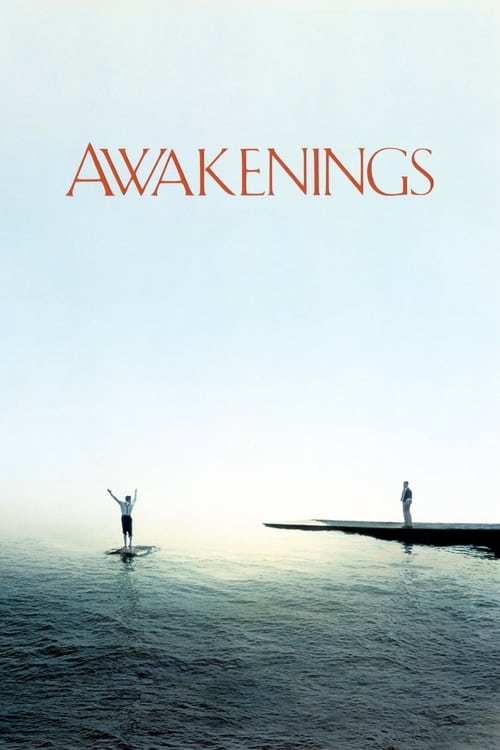
Awakenings
1990 · Penny Marshall
When you need a good cry with substance behind it — a hopeful, humane drama for a night you want to feel grateful to be awake and alive.
What it's about
In a Bronx hospital ward in 1969, shy research neurologist Malcolm Sayer inherits a group of patients frozen for decades — survivors of a long-ago sleeping-sickness epidemic, alive but locked in catatonic stillness. Convinced there are people still inside, he tries an experimental drug on Leonard, a man who has been unreachable since childhood. Based on the real cases described in Oliver Sacks's memoir, it's about what happens when a life resumes after thirty lost years — and what the awakening does to the doctor, too.
The experience
Warm, wondering, and quietly heartbreaking — the joy of the awakening scenes is genuinely euphoric, and the film earns its tears honestly rather than jerking them. It leaves you thinking about how much of an ordinary Tuesday you take for granted.
Performances
Robert De Niro does astonishing physical work as Leonard, from stone stillness to flooding vitality, and Robin Williams, cast against comic type, makes the withdrawn Dr. Sayer one of his most touching dramatic turns — the two together are the whole film.
The craft
Penny Marshall directs with unshowy compassion, keeping the camera on faces and letting the medical detail — drawn from Sacks's real case studies — ground the miracle in procedure. The ward is rendered with lived-in specificity, and the film's structure gives its emotions a genuine arc rather than a straight climb.
Why it matters
A prestige hit and Best Picture nominee that proved Marshall was a major dramatic director after Big, and a key entry in the run of humane, fact-based medical dramas of its era.
Snapshot
Awakenings is a prestige medical drama adapted from the neurologist Oliver Sacks's 1973 memoir of the same name, which recounted his treatment, in the summer of 1969, of a ward of patients who had survived the encephalitis lethargica epidemic of 1917–1928 only to fall into a decades-long frozen, catatonic state. Penny Marshall's film, her third feature and her follow-up to the commercial phenomenon Big (1988), translates Sacks's clinical case-study prose into a two-hander of intimate performance: Robin Williams as the shy, socially withdrawn Dr. Malcolm Sayer (a lightly fictionalized Sacks) and Robert De Niro as Leonard Lowe, the first patient roused from statue-like stillness by the experimental use of the drug L-DOPA. The film's emotional architecture is a bell curve — the miraculous, joyous awakening of Leonard and his ward, followed by the tragic, involuntary retreat back into paralysis as the drug's effect breaks down. Released by Columbia Pictures at the end of 1990, it earned Academy Award nominations for Best Picture, Best Actor (De Niro), and Best Adapted Screenplay (Steven Zaillian), and stands as a canonical example of the "true medical story" prestige drama.
Industry & production
The film emerged from the producing partnership of Walter Parkes and Lawrence Lasker, who had previously collaborated on WarGames (1983) and who optioned Sacks's book and shepherded Steven Zaillian's screenplay. It arrived at a specific inflection point in Penny Marshall's career: she had become, with Big, one of the first women to direct a film that grossed over $100 million domestically, and Awakenings represented her deliberate pivot from comedy toward serious dramatic material while retaining her interest in warmth and human transformation. Columbia Pictures backed the production, which was shot substantially in and around New York — the story is grounded in the Bronx, at a fictionalized chronic-care institution ("Bainbridge Hospital") standing in for the real Beth Abraham Hospital where Sacks worked.
The casting is the production's defining decision. De Niro, then at the height of his reputation for physically and behaviorally immersive preparation, took the more overtly demanding role of the patient rather than the doctor, reportedly researching post-encephalitic and neurologically impaired patients directly to construct Leonard's tremors, dystonic postures, and speech. Williams, cast against his manic comic persona, played the reserved, halting scientist — an inversion that critics noted at the time. Oliver Sacks himself served as a consultant on the production, lending clinical authenticity to the depiction of symptoms and the ward. Beyond the two leads, the ensemble included Julie Kavner as the sympathetic nurse Eleanor Costello, Ruth Nelson and others as the awakened patients, John Heard as a skeptical hospital administrator, and Penelope Ann Miller as Paula, the young woman who visits Leonard. Precise budget and box-office figures I will not assert from memory; the film was a solid commercial performer and an awards-season contender, but specific grosses should be verified against trade records rather than stated here.
Technology
Technologically, Awakenings is a conventional production for a major-studio drama of 1990: it was photographed on 35mm film with standard anamorphic/spherical studio equipment and released in the ordinary theatrical exhibition chain of its day. It is not a film that advanced or showcased a technical innovation — there are no significant optical or, of course, digital effects, and the "spectacle" is entirely a matter of performance and human behavior rather than apparatus. This is worth stating plainly: the film's ambitions are dramaturgical and humanist, not technological, and the craft achievement lies in restraint. What technique it deploys is deliberately invisible, in service of documentary-like credibility about a clinical setting.
Technique
Cinematography
The cinematographer is Miroslav Ondříček, the distinguished Czech director of photography whose career was bound up with the Czechoslovak New Wave and, above all, with Miloš Forman — he shot Loves of a Blonde, The Firemen's Ball, and later Forman's American films Hair, Ragtime, and Amadeus. His presence connects Awakenings to a lineage of humane, observational realism. Ondříček's work here favors naturalistic, softly modeled light and an unshowy, patient camera that privileges faces and the small physical events of the ward — the flicker of returning awareness, the tremor, the catch of a ball. The palette leans toward muted institutional tones warmed by the human presences within them; the visual strategy is to let the extraordinary content (people returning from decades of stillness) register through an ordinary, credible surface rather than through stylization.
Editing
Editing is credited to Gerald B. ("Jerry") Greenberg and Battle Davis. Greenberg was among the most respected editors of the New Hollywood generation, having cut The French Connection and worked on Apocalypse Now. In Awakenings the cutting is largely classical and unobtrusive, built to serve performance — holding on De Niro and Williams long enough for behavioral nuance to accumulate, and structuring the film's central movement (the collective awakening of the ward, then the collective relapse) so that its rise and fall land with clear emotional legibility. The montage of the patients' awakening is one of the film's signature passages, a rhythmic assembly of small recoveries that gives the ensemble a shared arc.
Mise-en-scène / staging
The dominant setting is the hospital ward, and much of the film's meaning is staged through bodies in space: the frozen patients arranged like furniture, unmoving, then gradually reanimated and mobile. Marshall stages the contrast between stillness and motion as the film's core visual idea — the awakened Leonard walking the corridors, dancing, pressing his face to a window, set against the earlier tableau of immobile figures. The production design renders the institution as neither gothic nor sterrifying but mundane and bureaucratic, which sharpens the drama's ethical stakes: these are ordinary people warehoused by a medical system that had given up on them.
Sound
The score is by Randy Newman, working in an earnest, orchestral, non-ironic register quite distinct from his satirical songwriting. Newman's music underlines the film's tenderness and its wonder without, for the most part, tipping into overt manipulation — cues that swell at the moments of awakening and recede into melancholy as the recoveries fail. Beyond the score, the film's sound design attends closely to the textures of the ward and to speech itself: Leonard's laborious, effortful communication (early on via a Ouija-like letter board, later in halting speech) makes the soundtrack an instrument of the film's central theme, the struggle to make contact.
Performance
Performance is unequivocally the film's principal medium. De Niro's Leonard is the showcase: a physical characterization built from the outside in, moving from total immobility, through the euphoric fluency of the awakened months, into the harrowing tics, tremors, and dystonias of the drug's collapse. Williams's Sayer is the counter-performance — recessive, awkward, more comfortable with data and lab animals than with people — and the film's quieter achievement is his gradual awakening to human connection through his patient. The supporting patients, and Julie Kavner's nurse, ground the ward in ensemble reality. The De Niro/Williams pairing works precisely because each actor plays against type: the comedian goes still and internal, the intensity-actor plays open, childlike joy.
Narrative & dramatic mode
The film operates in the mode of humanist realist drama organized as a true-story recovery narrative — but one that pointedly refuses the triumphal shape such films usually take. Its structure is a rise-and-fall: the "miracle" of the awakening occupies the film's radiant middle, but the drug L-DOPA loses efficacy, side effects mount, and the patients slide back into catatonia. This tragic reversal is the film's dramatic signature and the source of its seriousness; it converts what could have been a sentimental cure story into a meditation on impermanence and on the value of even a brief return to life. The doctor-patient relationship supplies the dual protagonist structure — the patient's literal awakening mirrored by the doctor's emotional and social awakening — so that the title applies to both men. Dramatically, the film is built on reversal and on the cruelty of hope offered and withdrawn.
Genre & cycle
Awakenings sits at the intersection of the medical drama and the "based on a true story" prestige picture, a cycle of literate, performance-driven, awards-oriented studio films. It belongs specifically to a lineage of institutional dramas set in hospitals and asylums, and its DNA overlaps with films about the ethics of treating the neurologically and psychologically afflicted. Within Robin Williams's own filmography it forms part of a cluster of sensitive-professional roles — teachers, doctors, therapists — that defined a phase of his career (adjacent to Dead Poets Society, 1989, and later Good Will Hunting, 1997). It also participates in the broader late-1980s/early-1990s vogue for socially conscious disability-and-illness dramas that foregrounded neurodivergent or medically extraordinary experience (a wave that included, in different registers, films like Rain Man).
Authorship & method
Penny Marshall's authorship is legible in the film's tonal signature: an emphasis on emotional accessibility, warmth, and human transformation, and a willingness to build entire films around a central relationship and a high-concept premise (a boy in a man's body in Big; a frozen man restored to life here). Her method favors giving performers room, and the film's success rests on her handling of two very different star actors. Her key collaborators reinforce a specific sensibility: screenwriter Steven Zaillian, who would go on to write Schindler's List and direct Searching for Bobby Fischer, brings a restrained, literate adaptation of Sacks's essayistic source; cinematographer Miroslav Ondříček imports a European humanist realism; editor Gerald B. Greenberg brings New Hollywood classicism; and composer Randy Newman supplies an uncharacteristically sincere score. Above all, the collaboration with Oliver Sacks as consultant anchors the project's authorial claim to authenticity — the film is, in a real sense, co-authored by the case history it dramatizes.
Movement / national cinema
The film is a mainstream American studio production and belongs to no formal movement. Its most interesting national-cinema thread is indirect: through Ondříček (and the humanist observational tradition of the Czech New Wave and Forman), Awakenings inherits a certain European commitment to the ordinary texture of institutional life and to faces over spectacle. Otherwise it is a Hollywood prestige film in the classical realist tradition, made within the studio system for a wide adult audience.
Era / period
Awakenings is doubly period. As a production it is a product of the early-1990s Hollywood appetite for adult, performance-centered dramas released into the year-end awards corridor. As a story it is set principally in 1969, reconstructing the specific moment when L-DOPA — then newly available and revolutionary in the treatment of Parkinsonism — was applied experimentally to post-encephalitic patients. The film thus reaches back further still, to the encephalitis lethargica ("sleeping sickness") pandemic of 1917–1928 that produced these patients, folding three time horizons together: the 1920s catastrophe, the 1969 intervention, and the 1990 act of cinematic remembrance.
Themes
The film's governing theme is consciousness itself — what it means to be present, to be a self, and the terror of a mind imprisoned in an unresponsive body. Around this it develops a cluster of related concerns: the question of what makes a life worth living, dramatized through Leonard's fierce insistence on freedom and experience during his brief awakening; the ethics of medicine, particularly the tension between institutional resignation and the risk of intervention, and the moral weight of raising hope that cannot be sustained; and the reciprocity of healing, whereby the doctor is himself awakened — to friendship, to human need, to courage in his own withdrawn life — by the patient he treats. Underlying all of this is impermanence: the film insists that the gift of the awakening remains a gift even though it is lost, that a temporary return to life still teaches the living how to value it. The relapse is not framed as failure but as the deepening of the film's argument about attention and gratitude.
Reception, canon & influence
Critically, Awakenings was received largely warmly, praised above all for its two central performances, though a strand of criticism found the film's sentiment overly soft or emotionally engineered relative to the harder clinical realism of Sacks's book. It was a significant awards contender, earning Academy Award nominations for Best Picture, Best Actor for De Niro, and Best Adapted Screenplay for Zaillian; it did not win in those categories (the year's Best Picture went to Dances with Wolves). I will not attribute specific published quotations or figures from memory; the general critical consensus — admiration for the acting, some reservations about sentimentality — is well established, but individual reviews should be consulted directly for exact wording.
The influences on the film run in two directions. The primary source is Sacks's literary neurology, itself part of a humane essayistic tradition of case-writing that treats patients as full human subjects rather than specimens. Before Marshall's film, Sacks's Awakenings had already generated adaptations in other media — notably a 1974 documentary and Harold Pinter's stage play A Kind of Alaska (1982), which dramatized a woman awakened from decades of encephalitic sleep — establishing the material's dramatic potency prior to the movie. Cinematically, the film's ancestry includes the institutional/asylum drama (the Forman–Ondříček connection points naturally toward One Flew Over the Cuckoo's Nest), and its two-hander humanism draws on the long tradition of doctor-patient films.
The film's legacy forward is threefold. It cemented the commercial and critical viability of the "true neurological/medical story" as a prestige subgenre, a template of empathetic dramatization that later films about extraordinary patients and dedicated physicians would follow. It contributed materially to Robin Williams's transition into serious dramatic and "healing professional" roles, a persona strand that culminated in his Academy Award for Good Will Hunting. And, beyond cinema, it substantially raised public awareness of encephalitis lethargica, of the L-DOPA story, and of Oliver Sacks himself, whose broader reputation as a public interpreter of neurology was amplified by the film's popularity. Its most enduring cultural contribution may be precisely this: it made a nearly forgotten medical catastrophe, and the fragile, temporary miracle of its treatment, into a widely shared story about what it means to be awake to one's own life.
Reception
A hit in 1990 with three Oscar nominations including Best Picture, though some critics wrote it off as sentimental awards bait; it's since settled into warm affection, remembered as a peak of Robin Williams' dramatic turn and Exhibit A in the 'Penny Marshall never got her due' conversation.
How Awakenings was received, from release to now →
How to watch Awakenings: what to notice on a first viewing
- Notice how still the patients are before Leonard changes. Marshall stages the ward with patients arranged like furniture, motionless, before the drug begins to take effect on them. The contrast between stillness and motion is the film's whole visual argument about what has been lost.
- Watch how physically restrained Robin Williams plays Dr. Sayer. Williams plays the doctor as recessive and awkward, more at ease with lab animals and data than with people, against his usual comic energy. The performance works because a famous comedian is deliberately playing against his own persona.
- Listen to how effortful Leonard's early attempts at speech are. Leonard first communicates through a letter board, then halting speech, and the film's sound design makes each word cost something to produce. The effort of speaking becomes its own kind of drama, separate from the plot around it.
- Notice how plainly and patiently the camera holds on faces. Miroslav Ondříček favors naturalistic, softly modeled light and an unshowy camera that privileges faces and small physical details over stylized flourishes. The plain, patient look lets the extraordinary events register as ordinary and credible rather than showy.
- Notice how mundane and bureaucratic the hospital ward looks. The production design avoids gothic or frightening dressing, rendering the institution as an ordinary bureaucratic place rather than a house of horrors. The plainness of the setting sharpens the point that ordinary people were simply warehoused here.
The whole guide to watching Awakenings, with the keys for a rewatch →
Influences: the films it descends from and the films it influenced
- Loves of a Blonde (1965) — The film's cinematography descends directly from Miroslav Ondříček's Czech New Wave method here — available-light, close observation of ordinary faces caught in unguarded reaction, a documentary tenderness he carried into the ward scenes of Awakenings.
- One Flew Over the Cuckoo's Nest (1975) — Establishes the Forman institutional/asylum-ward dramaturgy Awakenings inherits: staging a room of afflicted patients as a chorus of distinct full human subjects rather than clinical specimens, with the ensemble's individuated tics doing narrative work.
- Amadeus (1984) — Ondříček's warm, period-humanist lighting — sourced, soft, faces modeled out of surrounding darkness — is the exact painterly-naturalist palette he brings to the Bronx hospital, dignifying institutional interiors the way he dignified 18th-century Vienna.
- The Miracle Worker (1962) — The template for the immersive-physical breakthrough two-hander: a dedicated professional wrenching a locked-in patient toward contact, built around a bodily performance of affliction and a single galvanic 'awakening' as the dramatic hinge.
- Charly (1968) — The precise rise-and-fall architecture Awakenings reuses — a mind temporarily restored to full function by a medical intervention, then tragically regressing — structuring the whole film around the impermanence of the miracle.
- Raging Bull (1980) — Source of De Niro's method-physical transformation approach: the actor remaps his own body — here into the rigid dystonic contortions and frozen postures of post-encephalitic Parkinsonism — so the illness is performed muscularly rather than indicated.
- The Elephant Man (1980) — Models the humane clinical two-hander of a physician and an 'incurable' case, insisting on the patient's full interior personhood against the medical gaze — the doctor-patient dignity Awakenings takes as its moral center.
- The Natural (1984) — Randy Newman's sincere, un-ironic Americana orchestral idiom — swelling diatonic strings scoring transcendence straight — is the same uncharacteristically earnest scoring voice he supplies to Awakenings' reawakening sequences.
- Lorenzo's Oil (1992) — Extends the 'true neurological story' as prestige subgenre pioneered here: dedicated figures battling a rare degenerative disease through the actual pharmacology (the drug as protagonist), dramatizing real clinical case-history with empathetic authenticity.
- Schindler's List (1993) — Carries forward Steven Zaillian's screenwriting method — restrained, literate adaptation of dense nonfiction source that trusts documentary detail over sentiment — the discipline he first honed compressing Sacks's essayistic case-writing.
- Searching for Bobby Fischer (1993) — Zaillian directing his own script continues the Awakenings adaptation ethic: quiet, observational prestige realism about a gifted mind and its guardians, prioritizing understatement and human texture over dramatic engineering.
- Good Will Hunting (1997) — Consummates the Robin Williams 'healing-professional' persona strand that Awakenings launched — the gentle, wounded therapeutic authority figure — the role type that carried him to his Academy Award.
- A Beautiful Mind (2001) — Directly inherits the prestige-true-neurological-story template: awards-courting, empathetic dramatization of a real brain-disordered subject, using a star's immersive performance to render an invisible neurological condition legible and moving.
- The Diving Bell and the Butterfly (2007) — Pushes the film's central subject — consciousness intact inside an unresponsive body — into radical first-person form, extending Awakenings' theme of a fully awake mind imprisoned by neurological stillness.
- Big (1988) — Marshall's own authorial signature applied to a twin premise: a high-concept transformation (a consciousness thrust into the wrong bodily/temporal state) organized entirely around one central relationship and mined for warmth and wonder rather than mechanism.
- Rain Man (1988) — Contemporary companion in the immersive-performance neurological drama: an unshowy caretaker paired with a virtuosic, physically-coded portrayal of an atypical mind, the film's emotion routed through the dual-protagonist caregiving bond.
- My Left Foot (1989) — The parallel late-'80s benchmark of method-physical disability performance — Day-Lewis remaking his body into cerebral-palsy spasticity — sharing Awakenings' conviction that interiority is best revealed through rigorously controlled physical constraint.
- My Left Foot: The Story of Christy Brown (1989) — De Niro's clinically researched physical embodiment of a neurological disorder makes it the same-moment companion piece marrying Method immersion to disability portrayal.
Similar films
- The Elephant Man (1980) — influence & lineage
- A Beautiful Mind (2001) — influence & lineage
- Good Will Hunting (1997) — influence & lineage
- One Flew Over the Cuckoo's Nest (1975) — influence & lineage
- The Sixth Sense (1999) — shared sensibility
- The Hours (2002) — shared sensibility
- Dead Man Walking (1995) — shared sensibility
- What's Eating Gilbert Grape (1993) — shared sensibility