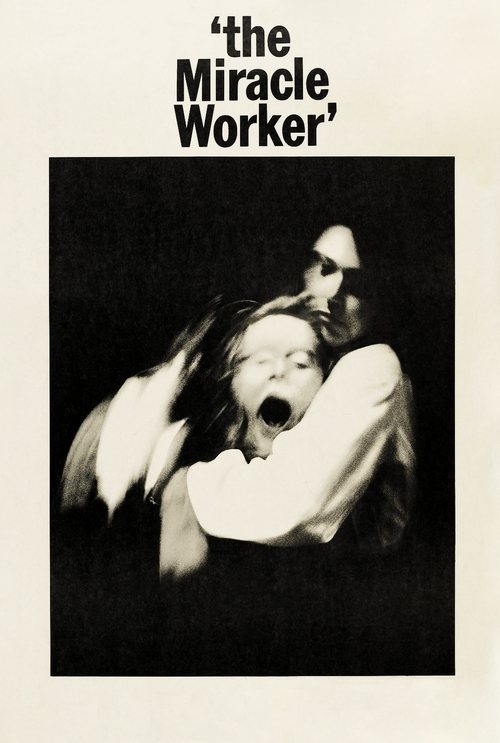
The Miracle Worker
1962 · Arthur Penn
For when you need a good cry that feels honestly won — an inspiring true story with real grit under it, not a soft-focus tearjerker.
What it's about
The true story of seven-year-old Helen Keller — deaf and blind since infancy, locked in a wordless world of tantrums and darkness — and Annie Sullivan, the fierce young teacher who arrives at the family's Alabama home determined to reach her. Their battle of wills, fought through touch and finger-spelling pressed into a palm, becomes a fight over whether Helen can be taught at all.
The experience
Ferocious rather than sentimental — this is a physical, exhausting, sometimes brutal film about teaching as combat, and when breakthrough moments come they hit with overwhelming force. Bring tissues, but don't expect them to be earned cheaply.
Performances
Anne Bancroft and Patty Duke, who forged these roles on stage, both won Oscars — Bancroft's Sullivan is all stubborn, wounded resolve, and Duke's Helen is one of the most astonishing physical performances ever given by a young actor.
The craft
Arthur Penn directs William Gibson's adaptation of his own play as a tight black-and-white chamber drama, staging the teacher-pupil confrontations as genuine physical battles — one extended dining-room fight is legendary for its sheer sustained intensity. The camera gets close enough that you feel every blow and every breakthrough.
Why it matters
It remains the definitive screen version of one of America's most retold true stories, won Academy Awards for both leads, and marked a key step in Arthur Penn's rise as a major American director.
Snapshot
The Miracle Worker dramatizes the weeks in 1887 during which the young teacher Annie Sullivan broke through to Helen Keller, a deaf-blind child locked in a wordless, tantrum-driven isolation, teaching her that the finger-spelled shapes pressed into her palm were names for things. Directed by Arthur Penn from William Gibson's screenplay adaptation of his own stage play, the film is compact, ferocious, and physically demanding — a chamber drama built around two performances that had already been forged onstage. Anne Bancroft plays Sullivan; Patty Duke plays Keller. Both won Academy Awards for the roles, and the film remains the definitive screen treatment of one of the most retold true stories in American culture. It sits at an interesting hinge in Penn's career and in Hollywood history: a black-and-white, theatrically derived "prestige" property directed by a filmmaker who would, within a few years, become associated with the American New Wave.
Industry & production
The film is the culmination of an unusually long incubation across three media. Gibson's material began as a television play broadcast on CBS's Playhouse 90 in 1957, moved to Broadway in 1959 — where Penn directed Bancroft and Duke to great success — and then reached the screen in 1962 with the same director and same two lead actresses. This continuity of authorship and casting across TV, stage, and film is the single most important production fact about the movie, and it explains the extraordinary precision of the central performances.
The producer was Fred Coe, the influential television producer-director who had shepherded much of the live-TV "golden age" drama and who was closely associated with both Gibson and Penn. The film was released by United Artists, the studio then most hospitable to independent-minded producers and to serious, adult, black-and-white subject matter at a moment when much of Hollywood was chasing color and widescreen spectacle. Casting Bancroft and Duke rather than established film stars was itself a statement of intent: the picture was sold on the strength of the drama and the performances rather than on marquee glamour. I do not have reliable box-office figures for the film and will not invent them; its cultural durability rests more on its awards and its performances than on any documented commercial record I can cite with confidence.
Technology
The Miracle Worker is a black-and-white film made in the standard 35mm process at a time when prestige productions increasingly defaulted to color. That choice reads as deliberately austere and period-appropriate, aligning the film with the documentary-tinged, high-contrast look of live television drama from which its makers had emerged. The film uses conventional early-1960s sound recording and does not, so far as the established record indicates, deploy any novel technical apparatus. Its "technology," in the meaningful sense, is dramaturgical rather than mechanical: the innovation lies in staging and cutting rather than in any new camera or lab process. Where the film feels advanced is in its willingness to sustain long, physically violent action within a realistic domestic space — a demand made on the camera and the editing room rather than on new equipment.
Technique
Cinematography
The cinematography is credited to Ernesto Caparrós. The visual strategy is one of tactile realism and strong contrast: the film favors close, often unglamorous framing of faces and — crucially — of hands. Because the story is fundamentally about touch as the only shared channel between teacher and child, the camera repeatedly isolates the physical business of finger-spelling, grasping, and resisting. The black-and-white photography lends the Keller household a plain, sometimes harsh materiality, and it allows the film to dwell on texture — water, food, cloth, skin — without the prettifying effect of color. The most celebrated visual passages are not "beautiful" in a pictorial sense but kinetic and legible: the camera stays close enough to make the choreography of a struggle readable while preserving the sense of confined space.
Editing
Editing is credited to Aram Avakian. The film's most discussed set piece — the extended dining-room battle in which Sullivan forces Helen to eat from her own plate and fold a napkin — depends on cutting for its impact. The scene is long, physically real, and sustained past the point of comfort; its power comes from the refusal to abbreviate or soften the struggle, and from a rhythm that lets exhaustion and repetition accumulate. Penn and his editor treat the fight almost as an endurance test for the audience, and the pacing is calibrated so that the eventual breakthrough registers as earned rather than sentimental.
Mise-en-scène / staging
Penn's background in live television and theater is most visible here. The film is largely set within the Keller home and grounds, and Penn stages the drama with a strong sense of blocking — bodies in contested space, doors and tables as obstacles, the pump in the yard as a destination. The famous climactic scene at the water pump, where Helen connects the feel of flowing water to the word being spelled into her hand, is staged as the release of everything the confined interiors have compressed. The transition from claustrophobic domestic interiors to the open yard is itself a dramatic argument. Penn's staging keeps the two central figures physically entangled for much of the running time, so that closeness, resistance, and touch are constant visual facts.
Sound
Because Helen exists in silence, the film's sound design carries unusual thematic weight, though the record does not credit any avant-garde sound experimentation. The score is by Laurence Rosenthal. Dialogue and the sounds of struggle — breaking crockery, splashing water, the scrape and thud of the dining-room fight — do much of the expressive work. The single most important sound in the film is a spoken one: Helen's near-wordless attempt to say "water," the human voice breaking through where it had been absent. The film reserves its most emotional use of sound for that moment of linguistic dawn.
Performance
Performance is the film's reason for being. Anne Bancroft's Annie Sullivan is willful, sardonic, and physically committed, a young woman whose own history of near-blindness and institutional hardship informs her refusal to pity Helen. Patty Duke's Helen is a genuinely difficult creation — feral, non-verbal, communicating through violence and appetite — performed without the crutch of dialogue and sustained through long physical scenes. The two performances are inseparable; both actresses had already played the roles for months onstage, and the film captures a partnership that was fully rehearsed into their bodies. Bancroft won the Academy Award for Best Actress and Duke won Best Supporting Actress, with Duke among the youngest competitive Oscar winners of her era.
Narrative & dramatic mode
The film is a tightly focused two-hander built on a single dramatic objective: getting one word to land inside one child's mind. Gibson's structure is essentially theatrical — unity of place, a small cast, a rising line of conflict that culminates in a single cathartic reversal. The dramatic mode is realist domestic drama pushed toward something close to physical combat. There is a clear antagonism between Sullivan's discipline and the Keller family's protective indulgence, which has allowed Helen to rule the household through tantrums. Sullivan's insistence that language and obedience are prerequisites to Helen's humanity puts her at odds with the parents, and much of the film's tension is a negotiation over authority within the home. The narrative withholds its payoff — the pump scene — until nearly the end, so the entire film is engineered as a delayed, hard-won epiphany.
Genre & cycle
The film belongs to the "prestige biographical drama" of the studio era's later years and, more specifically, to the cycle of serious black-and-white social and human-interest dramas that United Artists and independent producers favored around the late 1950s and early 1960s. It also belongs to the lineage of stage-to-screen adaptations that dominated Oscar-caliber drama in this period. Thematically it is a teacher-and-pupil / breakthrough story, a durable genre template of transformation through instruction. Its true-story, historical framing places it among biographical films, though its restricted timeframe and single-crisis focus distinguish it from the sprawling life-spanning biopic.
Authorship & method
The controlling authorship here is unusually shared. William Gibson is the originating author across all three versions — teleplay, stage play, and screenplay — and the film is faithful to his dramaturgy. Arthur Penn directed all three principal iterations as well, making this one of the most thoroughly "pre-directed" films imaginable: by 1962 Penn had staged this material repeatedly and knew exactly how the scenes worked on actors and audiences. The Miracle Worker was only Penn's second feature, following The Left Handed Gun (1958), and it precedes his later, more famous work; it shows him as a director of actors and of physical staging rather than of visual pyrotechnics. Producer Fred Coe connects the project to the live-television tradition that shaped Penn, Gibson, and Bancroft alike. Key craft collaborators include cinematographer Ernesto Caparrós, editor Aram Avakian, and composer Laurence Rosenthal. The method, in short, was to transfer a fully matured theatrical production to film while exploiting the camera's capacity for intimacy and the editing room's capacity for sustained, realistic violence.
Movement / national cinema
This is an American film, and it sits at a transitional point in American cinema. It emerges from the confluence of the New York theater world and the live-television drama establishment — a milieu that produced a generation of directors (Penn, Sidney Lumet, John Frankenheimer, and others) who brought a taut, performance-driven, often black-and-white realism to Hollywood. In that sense the film belongs less to classical Hollywood glamour than to this "New York realist" current. Penn himself would soon become a central figure of the American New Wave with Bonnie and Clyde (1967); The Miracle Worker is a document of the sensibility — theatrical rigor, actorly intensity, willingness to be uncomfortable — that he carried into that later revolution.
Era / period
Made in 1962, the film reflects an industry in flux: the studio system was weakening, independent production through outfits like United Artists was ascendant, and television-trained talent was reshaping serious drama. Its black-and-white austerity runs deliberately counter to the era's spectacle-driven trend toward color and wide screens. The film dramatizes events of 1887, and it renders that late-nineteenth-century Southern household with a plain, unromanticized period texture. The gap between the 1887 setting and the 1962 production is bridged by the film's fundamentally modern interest in psychology, discipline, and the mechanics of communication.
Themes
The central theme is language as the threshold of the human: the film's entire argument is that Helen becomes fully a person at the moment she grasps that things have names. Closely bound to this is the theme of touch as connection — the hand as the one instrument teacher and pupil share, and the finger-spelled word as the bridge across sensory darkness. The film also dramatizes discipline versus pity: Sullivan's conviction that love without structure has imprisoned Helen, against the family's protective indulgence. There is a strong theme of the wounded healer — Sullivan's own history of blindness and institutional suffering equips her to reach Helen precisely because she refuses sentimentality. Underlying all of this is a theme of will: two stubborn intelligences locked in a struggle whose resolution is not defeat but mutual recognition.
Reception, canon & influence
Critically and within the industry, the film was received as a major achievement, above all for its performances; the twin Academy Award wins for Bancroft and Duke are the clearest institutional marker of its standing, and Penn and Gibson's contributions were also recognized in the awards conversation of the year. (I am describing the awards record I can state confidently — the two acting wins — rather than reciting a full slate I cannot verify.) The film's reputation has proven durable: it is the version of the Helen Keller / Annie Sullivan story that has entered the general culture, and the water-pump breakthrough is one of the most widely recognized scenes in American film.
Influences on the film (backward): The picture draws directly on the historical record — Helen Keller's own autobiographical writings and Annie Sullivan's accounts of the teaching that Gibson mined for his play. Artistically it inherits the intimate, performance-centered realism of 1950s live television drama and the New York theatrical tradition in which Penn, Gibson, Coe, and Bancroft all worked. Its aesthetic austerity aligns it with the serious black-and-white American dramas of its moment rather than with contemporaneous color spectacle.
Legacy (forward): The film set the benchmark for dramatizing deaf-blind experience and the teaching of language, and it fixed the Sullivan-Keller relationship in the popular imagination in a form later retellings have had to reckon with. Patty Duke's association with the material continued in later years through her own return to the story, a testament to how thoroughly the film welded performer to role. More broadly, its uncompromising, physically real depiction of a difficult child and an unsentimental teacher influenced how subsequent films approached disability, instruction, and the drama of breakthrough — and it stands as an early demonstration of Arthur Penn's gift for staging intense, bodily human conflict, a gift he would soon turn to very different ends.
A Deleuzian reading
A napkin on the floor.
The full Deleuzian reading of The Miracle Worker →
Reception
A prestige hit on arrival — two Oscars for Anne Bancroft and Patty Duke, both reprising their Broadway roles — and it's never really fallen out of favour; it's just migrated from event-movie to 'assigned viewing' classic that still floors first-time watchers with how physical and unsentimental it is.
How The Miracle Worker was received, from release to now →
Influences: the films it descends from and the films it influenced
- Johnny Belinda (1948) — Jane Wyman's Oscar for a wordless deaf-mute role built the prestige template Bancroft and Duke inherit — a non-verbal, signed performance carried entirely by face and hands as the dramatic center of the film.
- The Passion of Joan of Arc (1928) — Established the grammar of rendering interior states through extreme close-ups of face and hands rather than dialogue, the silence-and-touch vocabulary Penn's water-pump and finger-spelling scenes depend on.
- A Streetcar Named Desire (1951) — Model for transferring a fully matured stage production to film with its theatrical blocking preserved, exploiting camera intimacy and Method physicality rather than opening the play out into spectacle.
- On the Waterfront (1954) — Actors Studio Method physicalization of inarticulate emotion — the naturalist, bodily performance idiom Bancroft (a stage-trained Method actress) and Duke draw on for the film's wordless struggle.
- Marty (1955) — The Fred Coe live-television teleplay expanded into an unadorned black-and-white feature, establishing the New York realism pipeline — same producer, same intimate performance-first method Penn's film runs on.
- 12 Angry Men (1957) — Live-TV director's stage-to-screen technique of carving intimacy and mounting endurance out of a single confined theatrical space through lens choice and cutting, kin to the Keller dining-room set-piece.
- The Left Handed Gun (1958) — Penn's own first feature, from a Gore Vidal teleplay — his method of translating live-television intimacy and the Method physicality of inarticulate rage into film, rehearsed here before Miracle Worker perfects it.
- L'Enfant sauvage (1970) — The teacher-and-untamed-child two-hander dramatizing language acquisition as the literal threshold of the human, staged in austere black-and-white with instruction rendered as physical, tactile drill.
- Bonnie and Clyde (1967) — Penn turns the gift for staging intense bodily conflict and cutting sustained, realistic violence — first proven in the Keller-Sullivan dining-room fight — toward kinetic, elliptical action editing.
- Children of a Lesser God (1986) — Deafness dramatized through signed, non-verbal performance inside a combative single-objective two-hander, yielding a lead-actress Oscar — the direct descendant of the Sullivan-Keller pedagogical duel.
- The Piano (1993) — A mute protagonist whose meaning is carried entirely through hands, touch and gesture, extending the hands-and-touch cinematography and language-as-threshold device into a sensory register.
- My Left Foot (1989) — Unsentimental physicalization of severe disability and the bodily fight to communicate, producing an Oscar-winning performance built from muscular effort rather than dialogue — the Duke/Bancroft physical-performance legacy.
- Nell (1994) — The pedagogical two-hander of teaching normative language to an isolated human, staging language acquisition itself as the drama of becoming fully human — Sullivan-Keller relocated to the wild.
- The Diving Bell and the Butterfly (2007) — A near-wordless, locked-in subject whose communication breakthrough is staged through a patient tactile method (blink-spelling), heir to the water-pump epiphany where touch converts to language.
- The Elephant Man (1980) — Austere black-and-white treatment of disability that asserts full personhood through halting, hard-won speech — the black-and-white-realism and language-as-threshold-of-the-human lineage.
- Rain Man (1988) — A prestige drama built as a single-objective two-hander around reaching a non-normative mind, anchored by paired lead performances in the mold of the Sullivan-Keller dual-performance structure.
- My Left Foot: The Story of Christy Brown (1989) — Its breakthrough-communication set piece (the water-pump) prototypes My Left Foot's chalk 'MOTHER' scene, resolving sustained wordless physical struggle into a single hard-won letter and treating disability as performance-duration rather than dialogue.
- Like Stars on Earth (2007) — Supplies the one-on-one pedagogy climax: a devoted teacher physically and patiently breaks through to a 'trapped' disabled child, the beat Nikumbh's remedial tutoring of Ishaan reprises.
- CODA (2021) — Communication-first, tactile two-hander staging in which manual/physical language, not spoken dialogue, carries the dramatic climax — the antecedent to CODA's hands-in-frame blocking.
- Becket (1964) — Carries Laurence Rosenthal's score and the same stage-to-screen two-hander craft — a feature sustained almost entirely on the charged confrontation of two performers in confined rooms.
Similar films
- The Piano (1993) — influence & lineage
- The Elephant Man (1980) — influence & lineage
- The Passion of Joan of Arc (1928) — influence & lineage
- On the Waterfront (1954) — influence & lineage
- Mary Poppins (1964) — shared sensibility
- The Piano Teacher (2001) — shared sensibility
- Doubt (2008) — shared sensibility
- A Tree Grows in Brooklyn (1945) — shared sensibility