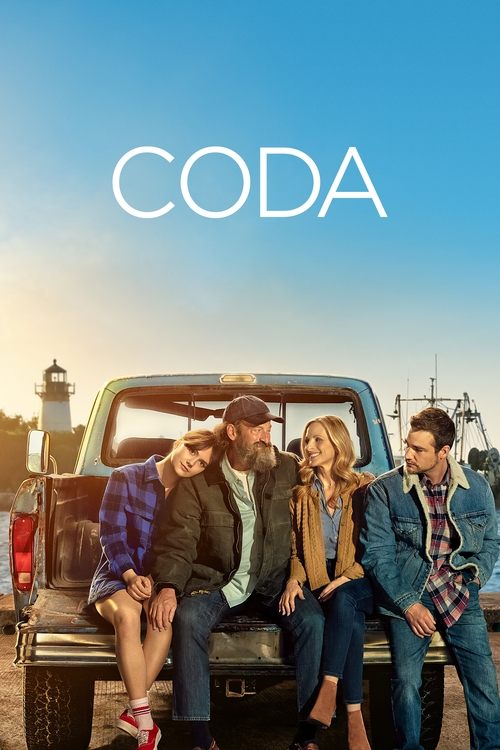
CODA
2021 · Sian Heder
For when you need a good cry that leaves you lighter, not heavier — a generous, big-hearted film for a night when you want to feel something and end up smiling anyway. Comfort with real emotional weight.
What it's about
Ruby Rossi is the only hearing person in her Deaf family, spending pre-dawn hours on their fishing boat in Gloucester, Massachusetts and serving as their interpreter in a world that won't meet them halfway. When she joins the school choir and discovers she can really sing, she's pulled between a teacher who sees a future for her in music and a family whose livelihood — and daily survival — runs through her.
The experience
Warm, funny, and completely disarming — a crowd-pleaser that earns its tears honestly through a family that feels lived-in rather than saintly. It sneaks up on you; a couple of scenes late in the film are quiet knockouts.
Performances
Troy Kotsur is extraordinary as Ruby's father — profane, hilarious, and devastating — and won the Oscar for it; Emilia Jones carries the film while singing live and signing fluently, with Marlee Matlin and Daniel Durant completing a superb Deaf family ensemble.
The craft
Sian Heder's adaptation moves fluidly between spoken English and American Sign Language, and its boldest choices are sonic — the film uses silence itself to put you inside the family's experience at a pivotal moment. The Gloucester fishing-town texture is real and salty, and the music scenes are staged for maximum lift.
Why it matters
The first streaming release to win Best Picture and a landmark for Deaf representation, with a predominantly Deaf principal cast at its center — it shifted the conversation about who gets to lead a mainstream American crowd-pleaser.
Snapshot
CODA is a coming-of-age family drama built around Ruby Rossi, the sole hearing member of a Deaf fishing family in Gloucester, Massachusetts, who discovers a gift for singing just as the family's precarious livelihood comes to depend on her as its interpreter and go-between. Adapted by writer-director Sian Heder from the 2014 French comedy La Famille Bélier, the film premiered at the 2021 Sundance Film Festival, where it was acquired by Apple TV+ in what was widely reported as a record festival deal (in the region of $25 million). Roughly a year later it became the first film released by a streaming service to win the Academy Award for Best Picture, and the first with a predominantly Deaf principal cast to do so. The title is a double signifier: "CODA" is the established acronym for Child of Deaf Adults, and a coda is also a concluding musical passage — the two meanings bound together in Ruby's position between silence and song. Its historical significance rests less on formal innovation than on casting, access, and the industrial fact of a small independent drama winning Hollywood's top prize.
Industry & production
CODA sits at the intersection of the independent festival ecosystem and the streaming platform wars. The project originated as a remake, with Heder brought on to write and direct an English-language adaptation of La Famille Bélier, relocating the story from a French dairy farm to a New England fishing community. Financing and production ran through independent players — Vendôme Pictures and Pathé among the credited backers — with the film shot on location around Gloucester, Massachusetts, an actual working fishing port, which anchors its documentary texture.
The decisive industrial event was its Sundance 2021 premiere. Held virtually because of the COVID-19 pandemic, that edition of the festival became a stage for aggressive streaming acquisition, and Apple's purchase of CODA was reported as the largest deal in the festival's history to that point. The transaction is a case study in the streaming era's economics: a modestly budgeted independent film could command a headline price not for its projected theatrical gross but for its value as prestige content and awards bait for a platform seeking cultural legitimacy. Apple gave the film a token theatrical window alongside its streaming release, a hybrid distribution pattern typical of the moment.
A production dimension worth foregrounding is access and accommodation. With three of its central roles played by Deaf actors — Marlee Matlin, Troy Kotsur, and Daniel Durant — the set operated bilingually in spoken English and American Sign Language, requiring interpreters and a workflow attentive to sightlines and communication. Heder has spoken in interviews about learning ASL and about structuring the production around Deaf performers' needs; the specifics of on-set protocols are best treated as reported by the filmmakers rather than as fully documented technical record.
Technology
CODA is not a technologically ambitious film in the sense of visual effects or novel capture systems; its innovations are logistical and linguistic rather than optical. It was shot digitally with a naturalistic, available-light-leaning aesthetic suited to its coastal locations and domestic interiors. The most consequential "technology" in the film is language itself — American Sign Language treated as a full cinematic register, requiring the camera and cutting to preserve the legibility of hands, faces, and bodies rather than fragmenting them.
The film's distribution is its clearest technological marker: it belongs to the streaming-first era, delivered principally through Apple TV+. Its Best Picture win is often cited as a threshold moment in the legitimation of streaming platforms as prestige-film distributors, a shift enabled by broadband infrastructure and the pandemic-accelerated collapse of the theatrical-only release model. On the exhibition side, the film's subject also intersects with accessibility technology — captioning and the representation of a Deaf audience's experience — though the film treats these as lived reality rather than as technical subject matter.
Technique
Cinematography
Cinematographer Paula Huidobro shoots CODA in a warm, unshowy naturalist idiom. The visual grammar prioritizes clarity of communication: because much of the family's dialogue is signed, the framing must keep hands and faces in view, favoring fuller shots and sustained two-shots over tight singles that would sever signing from expression. This is a genuine formal constraint turned into a style — the camera "listens" to ASL by giving it room. Location work in Gloucester supplies a lived-in palette of harbor light, boat decks, and clapboard interiors, and the film draws a recurring contrast between the open, weather-exposed world of the fishing boat and the enclosed warmth of the domestic and rehearsal spaces where Ruby's music grows.
Editing
Edited by Geraud Brisson, the film follows a classical, emotionally legible cutting pattern appropriate to its coming-of-age arc. Its most discussed formal gesture is a sound-driven editorial choice rather than a purely visual one: during Ruby's climactic recital, the film drops the soundtrack to silence to place the audience inside the parents' Deaf experience, watching the crowd's reactions and their daughter's body without hearing the song. The power of that sequence depends on precise coordination of cut, sound, and performance — the edit withholds and then restores hearing to make a point about perspective and empathy that dialogue could not.
Mise-en-scène / staging
The staging is organized around the practical realities of a bilingual household. Blocking keeps signers in one another's eyelines; conversations are arranged so that hands and faces read cleanly; and the physical business of the fishing trade — nets, gutting, auctions, the cramped wheelhouse — grounds the family in labor rather than sentiment. The Gloucester setting is not backdrop but structure: the fishing economy's precarity is the engine of the plot, and the film's spaces (boat, home, school choir room, the teacher's studio) map Ruby's competing obligations.
Sound
Sound is the film's conceptual center of gravity, precisely because so much of its world is soundless to its central characters. The design toggles between the hearing world's fullness — music, chatter, the working port — and passages that approximate Deaf experience through silence and vibration. The recital blackout of sound is the boldest instance, but the strategy runs throughout: the film asks a hearing audience to notice sound by taking it away. Music functions diegetically and thematically, from choir rehearsals to Ruby's audition, and the film treats singing as both self-expression and a language her family cannot directly share — a poignant asymmetry the sound design keeps in front of us.
Performance
Performance is where CODA made its strongest historical mark. Emilia Jones, in the lead, carries the film's dual demands: she learned ASL and singing for the role and sustains a genuinely bilingual performance. The Deaf principals — Marlee Matlin as the mother Jackie, Troy Kotsur as the father Frank, and Daniel Durant as the brother Leo — perform in ASL with a physical expressiveness that the film's framing is built to serve. Kotsur's work, in particular, blends bawdy comedy and deep feeling, and his Best Supporting Actor win made him the first Deaf man to receive an acting Academy Award (Matlin, decades earlier for Children of a Lesser God, remained the reference point as the first Deaf performer to win). Eugenio Derbez plays the choir teacher Bernardo Villalobos with heightened comic-mentor energy that stands somewhat apart from the family's naturalism.
Narrative & dramatic mode
The film runs on a classical coming-of-age structure crossed with a family melodrama: a gifted young protagonist must individuate from the family that needs her, with the central tension between self-realization (music, college, leaving) and obligation (interpreting, the fishing business, staying). It is dramatically conventional by design — the beats of the discovered talent, the demanding-but-believing mentor, the audition, the romantic subplot with fellow choir student Miles, and the eleventh-hour reconciliation are all familiar. What refreshes the template is the specificity of the CODA experience: Ruby's individuation is complicated by the fact that her family depends on her not merely emotionally but functionally, as their bridge to a hearing world. The dramatic mode is warm, accessible, and emotionally direct, aiming for catharsis rather than ambiguity.
Genre & cycle
CODA belongs to several overlapping traditions: the coming-of-age drama, the musical-adjacent "discovering my voice" film, and the family melodrama. It also participates in a cycle of American independent dramas about working-class regional life and in the longer lineage of films engaging Deafness and disability. Its most direct genealogical fact is that it is a remake of La Famille Bélier (2014), transposing that film's structure of a hearing child interpreter in a Deaf family from French agricultural life to American fishing life. Within the disability-representation cycle, it marks a shift from earlier films that centered hearing perspectives on Deafness toward a film that casts Deaf actors in the Deaf roles — a corrective the production and its reception explicitly foregrounded.
Authorship & method
Sian Heder is the film's authorial center as both screenwriter and director; CODA followed her earlier feature Tallulah and established her as a filmmaker attentive to female interiority and family bonds. Her method here combined adaptation with immersion: reworking the French source into a specific American milieu, learning ASL, and building a production capable of centering Deaf performers. Her Best Adapted Screenplay Oscar recognized that translation work.
Among key collaborators, cinematographer Paula Huidobro shaped the film's naturalist, communication-first visual approach. Composer Marius de Vries — known for his work in music-driven cinema — oversaw the film's musical texture, and the song choices (including Joni Mitchell's "Both Sides Now" and the Marvin Gaye–Tammi Terrell duet "You're All I Need to Get By") carry thematic weight about perspective, love, and interdependence. Editor Geraud Brisson executed the film's crucial sound-and-image coordination. The casting of Matlin, Kotsur, and Durant should itself be read as an authorial and ethical choice as consequential as any craft decision.
Movement / national cinema
CODA is an American independent film, though its DNA is transnational by virtue of the French original — an instance of the well-worn Hollywood practice of remaking European art-house and popular successes for English-language audiences. It does not belong to a formal movement so much as to a moment: the early-2020s convergence of festival cinema, streaming distribution, and a heightened industry conversation about authentic representation. If it participates in any "national cinema" argument, it is in its regionalism — a portrait of New England's working coastal culture — placing it within an American tradition of place-rooted independent drama.
Era / period
The film is a document of the pandemic-era film industry. It premiered at a virtual Sundance, was acquired in a landmark streaming deal, released in a hybrid theatrical-streaming pattern, and won Best Picture at the 94th Academy Awards during a period when the theatrical model was under acute strain. Its victory has become shorthand for the streaming ascendancy in prestige filmmaking. It also belongs to a period of intensified attention to disability representation and authentic casting, and its success is often read as both a product and an accelerant of that shift.
Themes
Central themes include the negotiation between individual aspiration and familial duty; communication and its failures across the hearing/Deaf divide; interdependence and the labor of interpreting; and the coming-of-age passage from being defined by one's family role to claiming one's own voice. The recurring motif of "voice" is literalized — Ruby's singing is a mode of expression her family cannot directly access, which turns her gift into a source of both connection and separation. The film also engages class and economic precarity through the fishing business, grounding its emotional drama in material stakes. Underlying all of it is a theme of perception and empathy: the film repeatedly asks its hearing audience to imagine a world experienced differently, most powerfully in its passage of imposed silence.
Reception, canon & influence
Critically, CODA was received warmly as a crowd-pleasing, emotionally effective drama, with particular praise reserved for its Deaf cast and especially Troy Kotsur; some critics noted that its narrative conventionality kept it from formal daring even as its representational significance was widely acknowledged. Its awards trajectory was unusual — a relatively quiet contender that surged late — culminating in three Academy Awards: Best Picture, Best Supporting Actor (Kotsur), and Best Adapted Screenplay (Heder). It was widely observed at the time to be the first Best Picture winner with no corresponding Best Director nomination in some years, a marker of its atypical path.
Looking backward, the film's most concrete influence is La Famille Bélier, its direct source, along with the broader traditions of the coming-of-age drama and Deaf-centered cinema for which Matlin's Children of a Lesser God is a touchstone. Looking forward, its legacy is primarily industrial and cultural rather than stylistic: as the first streaming Best Picture winner and the first with a predominantly Deaf principal cast, it is repeatedly cited as a milestone in both the streaming platforms' arrival as prestige distributors and the push for authentic disability casting. Its clearest downstream effect is as precedent and argument — evidence marshaled in ongoing debates about representation and access in mainstream filmmaking — more than as a template of technique that later films have visibly imitated.
Reception
A Sundance 2021 sensation (it swept the festival's top awards and Apple paid a record ~$25M for it) that rode a feel-good wave all the way to Best Picture — then almost immediately became shorthand for 'the streaming-era Oscar winner nobody rewatches,' even as its defenders insist the warmth was the point.
How CODA was received, from release to now →
How to watch CODA: what to notice on a first viewing
- Notice the camera keeps hands and faces in one frame. Huidobro shoots fuller shots and long two-shots whenever the Rossis are signing. A tight single would cut the hands out of a sentence, so the camera stays back and lets the whole body speak. The framing is built to carry a language. You get to watch ASL as dialogue rather than as something happening beside dialogue.
- Watch how the family arranges itself to see each other. Signers have to be in one another's eyeline, so nobody talks over a shoulder or shouts from another room. Heder blocks the kitchen, the boat and the truck around that requirement. The household's physical habits come out of its language. You learn how this family works by watching where people stand.
- Listen for the film moving between full sound and near silence. The mix toggles between the hearing world, a loud working port and a choir room, and passages built from quiet and vibration. The film keeps making you notice sound by taking it away. Ruby's singing is the one thing her family cannot share directly. The sound design keeps that gap in front of you.
- Look at the fishing work: nets, gutting, the auction, the wheelhouse. Heder shot in Gloucester and keeps the labor physical: early mornings, cramped decks, prices called at the dock. The family's money trouble is filmed as a job rather than as background. Ruby's choice has a price attached to it. The boat needs an interpreter and she is the only one available.
- Watch Kotsur's face and shoulders when Frank makes a joke. Kotsur, Matlin and Durant play in ASL, and the comedy and the anger live in posture, speed and the size of a sign. Jones learned ASL and singing to work in both languages at once. Notice how much changes without a spoken word. The largest performances in this film happen in hands and bodies.
The whole guide to watching CODA, with the keys for a rewatch →
Influences: the films it descends from and the films it influenced
- La Famille Bélier (2014) — Direct source text: CODA lifts its structural engine — a hearing daughter who serves as her Deaf family's interpreter and whose singing audition forces a rupture — and transposes the French farming family into a Massachusetts fishing family.
- Children of a Lesser God (1986) — Established casting a Deaf actress (Marlee Matlin, who returns as CODA's mother) and staging ASL as a full dramatic register the camera holds in shot, not a subtitled obstacle.
- The Tribe (2014) — All-Deaf cast performing exclusively in sign with no subtitles — the radical precedent for treating signed, bilingual blocking as a film's primary visual grammar and for framing wide enough that hands stay legible.
- Johnny Belinda (1948) — Early Hollywood centering of a deaf protagonist (Jane Wyman) whose signing the camera frames as genuine communication, seeding the communication-first framing tradition CODA inherits.
- The Miracle Worker (1962) — Communication-first, tactile two-hander staging in which manual/physical language, not spoken dialogue, carries the dramatic climax — the antecedent to CODA's hands-in-frame blocking.
- Billy Elliot (2000) — Working-class family melodrama built on the individual-artistic-aspiration-versus-familial-duty engine and resolved by a conservatory-audition climax that CODA reproduces almost beat for beat.
- Sound of Metal (2019) — Subjective sound design that drops the audience into silence to render deafness from the inside — the same sound-driven cut CODA deploys when it mutes the recital to the parents' POV.
- Moulin Rouge! (2001) — Music director Marius de Vries's method of repurposing pre-existing pop songs as emotional argument and narrative text — later applied to CODA's Joni Mitchell and Marvin Gaye/Tammi Terrell cues.
- Sing Street (2016) — Naturalist available-light coming-of-age in which diegetic song performance becomes the vehicle for escaping familial and class constraint — the indie-musical grammar CODA works in.
- Read My Lips (2001) — Deploys the same device in a single set piece, dropping the concert audio to the deaf family's silence, the now-standard subjective-deafness cut whose widely seen fiction-feature precedent is Audiard's.
- Deaf (2025) — Committed to authentic deaf casting across a whole family unit and organized its drama around the communication-and-love tension between deaf and hearing members of a household.
- A Quiet Place (2018) — Casts Deaf actress Millicent Simmonds and makes ASL a diegetic register while using imposed-silence sound design as a structuring device rather than an effect.
- Wonderstruck (2017) — Builds a subjective silent-cinema register around Deaf actress Millicent Simmonds, treating imposed silence as an authored sensory perspective the way CODA does in its recital scene.
- La La Land (2016) — Shares music supervisor-producer Marius de Vries and his method of embedding live, imperfect vocal performance into scene texture instead of polished playback.
- Manchester by the Sea (2016) — Renders the same Massachusetts working-class coastal milieu in restrained naturalist available light, grounding family drama in labor and place rather than gloss.
- Little Miss Sunshine (2006) — Family-melodrama-meets-coming-of-age that reconciles its ensemble through a performance-as-liberation climax, the crowd-pleasing structural template CODA refines.
- Tallulah (2016) — Heder's prior feature establishes her authorial method — attention to female interiority and improvised, intimately blocked family bonds shot in naturalist light — that she carries directly into CODA.
- Cha Cha Real Smooth (2022) — The immediate precedent for the Sundance-audience-winner-to-streamer economics Cha Cha replicated (Apple TV+), paired with authentic casting of disabled actors as an ethical craft baseline.
Similar films
- Sing Street (2016) — influence & lineage · same viewing thread
- Blue Heron (2026) — same viewing thread
- I Swear (2025) — same viewing thread
- Minari (2021) — shared sensibility
- The Quiet Girl (2022) — shared sensibility
- Deaf (2025) — shared sensibility
- The Shape of Water (2017) — shared sensibility
- Sound of Metal (2020) — shared sensibility
All the films related to CODA →
Watch it with: curated runs of related films
- Funny Because It Aches — A run of tender, deadpan dramedies where love, grief, and the panic of becoming yourself all get metabolized through jokes — watch these when you want to laugh and cry in the same scene.