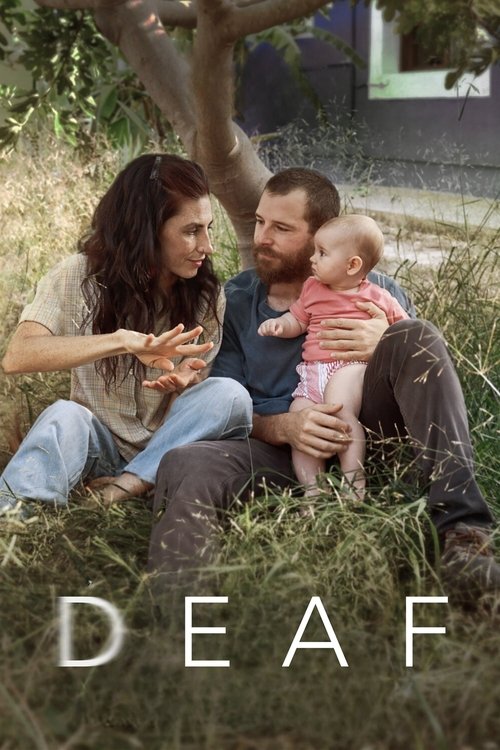
Deaf
2025 · Eva Libertad
For when you want an intimate, empathetic drama that shows you a life you haven't lived — something to watch attentively and carry around for a few days. Gentle in manner, but emotionally demanding.
What it's about
Ángela is deaf; her partner Héctor is hearing; and when she becomes pregnant, a question begins to press on their life together — will she be able to reach her hearing daughter across the gap of language? The film follows the couple through pregnancy, birth, and the first stretch of motherhood in a world that offers deaf parents almost no accommodation, watching their relationship slowly pressurize under strains neither of them chose.
The experience
Quiet, naturalistic, and emotionally exact — the drama lives in small frictions and unspoken fears rather than big confrontations. It puts you inside Ángela's experience closely enough that ordinary scenes of hospitals and family gatherings turn tense, and its tenderness sneaks up on you.
Performances
Miriam Garlo, the director's deaf sister, plays Ángela with lived-in authority — no acted-at deafness, just a full person whose frustrations and joys register in every glance and sign — and Álvaro Cervantes matches her with warm, quietly strained support as Héctor.
The craft
Eva Libertad, expanding her own short film, builds the sound design around Ángela's perception, letting hearing audiences feel exclusion from the inside. The casting of a deaf lead and the film's insider perspective shape everything, and it won the Panorama Audience Award at the Berlin film festival.
Why it matters
A breakout Spanish debut and festival audience favorite, it stands with a growing wave of films putting deaf experience on screen from within rather than observing it from outside.
Snapshot
Deaf — Spanish title Sorda — is the feature debut of Spanish filmmaker Eva Libertad, a naturalist domestic drama about a deaf woman navigating pregnancy, birth, and early motherhood inside a partnership and a society built for the hearing. Ángela (Miriam Garlo) and Héctor (Álvaro Cervantes) are an inter-abled couple in Spain; the film tracks the slow pressurization of their relationship as Ángela confronts the fear that she will not be able to reach her hearing daughter across a widening gulf of language. The film expands Libertad's earlier short of the same name and casts her own deaf sister, Miriam Garlo, in the lead — a fact of authorship that shapes the whole project. It premiered in the Panorama section of the 75th Berlin International Film Festival in February 2025, where it won the Panorama Audience Award for best feature and the CICAE Art Cinema Award, launching an unusually strong festival-and-awards run for a first feature. Running roughly 99 minutes and performed in both spoken Spanish and Spanish Sign Language (LSE), it belongs to the current wave of intimate, women-authored Spanish cinema while joining a small international lineage of films that place deaf experience at their formal center.
Industry & production
Deaf is a Spanish production, staged by Distinto Films with Nexus CreaFilms and A Contracorriente Films; A Contracorriente also handled Spanish distribution, releasing the film theatrically in Spain in April 2025 after the Berlin premiere. The credited producers are Miriam Porté, Nuria Muñoz Ortín, and Adolfo Blanco. Reporting indicates the film was shot in the Murcia region over roughly six weeks in the summer of 2024. This is a modestly budgeted, festival-oriented art film rather than a commercial vehicle; its industrial logic is the familiar European one in which a proven short becomes the calling card for public and co-production financing and the festival circuit does the work of distribution and prestige. The strategy paid off: the Panorama Audience Award at Berlin is a meaningful commercial signal, and the film's subsequent domestic-awards momentum (below) turned a small drama into one of the more visible Spanish releases of the year. Exact budget and box-office figures are not something I can responsibly cite here; the public record is thin on hard numbers.
Technology
The verifiable technical-format record for Deaf is limited, and I will not invent camera or lens specifications. It is a contemporary digitally originated production in the standard mode of current Spanish independent film; beyond that, the specifics of capture and finishing are not reliably documented in accessible sources. More interesting than the acquisition technology is the film's diegetic engagement with assistive technology. Hearing aids and, implicitly, the broader apparatus of "correcting" deafness are not neutral props here but a thematic battleground: a recurring source of friction is the pressure on Ángela — reportedly from her hearing parents — to wear hearing aids, i.e., to route herself back toward the hearing world through technology rather than be met within Deaf culture and sign. The film thus treats hearing technology the way other films treat a contested inheritance, as a device that carries a whole politics of normalization. That is the register in which "technology" matters most to this particular work.
Technique
Cinematography
Cinematography is by Gina Ferrer (Gina Ferrer García). Reviewers described the film as handsomely made — a "good-looking, sympathetically told" seaside drama — which is consistent with the observational, character-anchored realism the material invites. The controlling problem for any camera on this subject is point of view: how to hold Ángela's face and hands as primary sites of meaning while also situating her within, and against, hearing spaces. In sign-language cinema the frame must respect the body — hands and facial grammar carry the language — so staging tends to favor fuller framings and sustained takes over aggressive coverage. Detailed shot-by-shot analysis is beyond what the current published record supports, and I flag that; but the consensus of early notices is of controlled, empathetic, unshowy image-making at the service of performance.
Editing
Marta Velasco is the credited editor. The film's most-discussed formal decision is fundamentally an editorial-and-sound one: its management of the shift between the hearing world's soundscape and Ángela's. Critics singled out how the film "drifts into silence" in its final stretch, so that the cut and the mix together move the audience inside Ángela's sensory reality rather than merely observing it. That is an editing logic organized around subjectivity and duration — letting scenes breathe long enough for the loneliness to register — rather than around plot mechanics.
Mise-en-scène / staging
The staging works the geometry of inclusion and exclusion. The drama repeatedly turns on who can follow a conversation and who is left outside it: family gatherings, medical settings, and moments with the new baby become spaces in which Ángela is either brought into the circle of communication or stranded at its edge. The couple's domestic space and the coastal, small-community setting ground the film in a specific, lived Spanish milieu. Ángela is surrounded by a Deaf community of friends who share her language, and the contrast between those scenes of easy fluency and the strain of hearing-world settings is carried substantially through blocking — proximity, eyelines, the physical labor of getting someone's visual attention before you can speak to them.
Sound
Sound is the film's signature. It is built as a bilingual object — spoken Spanish and Spanish Sign Language — and, more radically, as a film that manipulates the presence and absence of sound to relay deaf experience. The withdrawal of the soundtrack into silence, foregrounded by critics, is the device through which hearing audiences are made to feel Ángela's detachment from a world that assumes hearing. The score is by Aránzazu Calleja, a Basque composer with a notable pedigree in recent Spanish cinema; scoring a film about deafness poses an obvious paradox — music addressed to an ear its protagonist does not share — and the film's restraint with sound suggests the score is deployed sparingly and pointedly. The specific working method behind the sound design is not something I can document in detail from the available record.
Performance
The performances anchor everything. Miriam Garlo, a deaf actress, plays Ángela from the inside, and the casting is inseparable from the film's authority: this is deaf experience performed rather than mimed. Álvaro Cervantes plays Héctor, the hearing partner whose love is real and whose comprehension is partial — a role that must register good faith and its limits at once. Elena Irureta and Joaquín Notario appear in support (as the older, hearing-world generation). The performances were among the most honored elements of the film in Spain's awards season (below), which speaks to their specificity rather than to sentiment.
Narrative & dramatic mode
The dramatic mode is intimate psychological realism organized around a life passage — pregnancy, birth, the first months of motherhood — rather than around external event. There is no antagonist and no plot engine in the conventional sense; the tension is generated by an internal fear made concrete. Ángela's dread that she will be unable to fully connect with a hearing child becomes a slow-acting strain on a loving marriage, so the film is structured as a study of "loneliness within a loving marriage," in one reviewer's phrase. It proceeds by accumulation — small exclusions, small failures of translation — toward an emotional rather than narrative climax, which the film delivers formally, through its move into silence, rather than through incident. This is melodrama's subject matter (motherhood, disability, the couple) handled in an anti-melodramatic, observational key.
Genre & cycle
Deaf sits at the intersection of the maternal drama and disability-centered cinema. As a maternal film it belongs to a long tradition of movies about the anxieties and isolations of new motherhood, but it refracts that tradition through deafness, which makes the ordinary terror of not-reaching-your-child literal. As a disability film it participates in a contemporary cycle insisting on authenticity of casting and point of view — deaf characters played by deaf actors, sign language treated as a full language rather than a symptom. The "inter-abled couple" framing is itself a recognizable current strand in international cinema and television. The film's distinctness within that cycle is its refusal of the uplift or triumph arc; it is neither an overcoming narrative nor a tragedy, but a domestic study.
Authorship & method
The authorial fact that governs Deaf is proximity. Eva Libertad wrote and directed it, and she developed it out of her own short film of the same name, which earned recognition on the Spanish awards circuit (including a Goya nomination); the exact production year and co-direction credits of that short are recorded inconsistently across sources, so I flag that rather than assert a false precision. Crucially, the protagonist is played by the director's sister, Miriam Garlo, who is deaf — meaning the film is drawn from within a family's lived relationship to deafness rather than researched from outside it. That grounding is the source of its credibility and, plausibly, of its formal choices about sign and silence.
Libertad's key collaborators form a largely female-led team: cinematographer Gina Ferrer, editor Marta Velasco, and composer Aránzazu Calleja, alongside her lead actors Garlo and Álvaro Cervantes. Calleja is an established figure in recent Spanish film music; readers should note that beyond the credit itself, published detail on each collaborator's specific contribution to Deaf is limited, and I have not embellished it. The method that the film's reception makes visible is one of patient, performance-first realism with a single bold formal gambit — the surrender of sound — reserved for maximum effect.
Movement / national cinema
The film is best read within the resurgent wave of Spanish cinema authored by women that has defined the country's festival profile in the 2020s — the milieu of directors such as Carla Simón, Pilar Palomero, Clara Roquet, Elena Martín Gimeno, and Alauda Ruiz de Azúa, whose work favors autobiographically inflected, intimate, naturalist storytelling about family, memory, and the body. Deaf shares that generation's aesthetic values: restraint, emotional precision, non-professional or authentically cast performers, and subject matter rooted in the domestic. It also extends Spanish cinema's engagement with sign language and Deaf culture, bringing LSE onto the international festival stage. Its warm reception abroad — Berlin, and later a Lux Audience Award from the European Parliament — confirms how legible this strand of Spanish film has become to European audiences.
Era / period
Deaf is a film of the mid-2020s, post-pandemic, festival-and-streaming-era European art cinema. It reflects that period's heightened attention to authentic representation and to disability as lived experience rather than metaphor, and it benefits from an infrastructure — Berlinale's Panorama, the Lux Prize, national awards — increasingly receptive to small, socially attuned dramas by first-time women directors. Its bilingual, sign-forward construction is very much of this moment, when accessibility and representation have moved from the margins of production discourse toward its center.
Themes
The central theme is communication as the substance of love and its most fragile point: the film asks what it means to mother, and to remain married, across a barrier of sense. Around that sit several linked concerns — maternal anxiety about disability and inheritance; the isolation that can exist inside intimacy; and the politics of normalization, embodied in the pressure to "fix" deafness with hearing aids rather than to meet Ángela within Deaf identity. The film treats deafness not as a deficit to be cured but as a culture and a language, and it locates its drama in the hearing world's failure to accommodate rather than in Ángela herself — a pointed reframing that gives the domestic story a quiet political edge.
Reception, canon & influence
Reception was strongly positive from its Berlin premiere onward. In Panorama it took the Audience Award for best feature and the CICAE Art Cinema Award; critics praised its empathy and, above all, its use of silence to deliver Ángela's point of view, with warm notices (a four-star review among them) treating it as a sensitive, well-made study of an under-dramatized situation. In Spain the film became an awards-season presence: it won the Golden Biznaga for best Spanish film at the Málaga Film Festival, with acting honors for Garlo and Cervantes, and it was recognized at the Goya Awards — where it figured prominently in the new-director and acting categories — as well as at other Spanish and international festivals. It also received the European Parliament's Lux Audience Award. Given how recent these results are, readers should treat the finer distinctions between nominations and wins across the 2025–2026 ceremonies as still-settling record.
On influences upon the film (backward): its most immediate source is Libertad's own short, and its lineage runs through the international canon of deaf-centered cinema — from Children of a Lesser God (1986) through more recent, formally ambitious work such as Myroslav Slaboshpytskyi's The Tribe (2014), Darius Marder's Sound of Metal (2019), and CODA (2021), all of which pushed the industry toward authentic deaf casting and toward sound design as a tool of subjectivity. Deaf aligns most closely with that recent turn, marrying it to the intimate naturalism of contemporary Spanish women's cinema.
Its legacy forward is genuinely too early to assess, and I will not manufacture one. What can be said is that its festival success models a viable path for sign-forward, authentically cast disability drama on the European art circuit, and that it raises the profile of both Eva Libertad as a director and Miriam Garlo as a deaf lead — a pairing whose future work will be the clearest measure of the film's influence.
Sources: Wikipedia: Deaf (film)); Berlinale — Sorda; Berlinale — Panorama Audience Awards 2025; Variety — Eva Libertad on Sorda; The Hollywood Reporter — Berlin Panorama Audience Awards; Filmuforia review; FilmAffinity — Sorda (2025).
Reception
It premiered quietly in Berlinale's Panorama sidebar in February 2025 and left with the Audience Award, then snowballed through 2025 into a Spanish awards juggernaut — seven Goya nominations and three wins, including Best New Director for Eva Libertad.
How Deaf was received, from release to now →
Influences: the films it descends from and the films it influenced
- Sorda (2021) — The feature is a direct expansion of Libertad's own short, carrying over the casting of her deaf sister Miriam Garlo and the working method of building silence-as-point-of-view from within a family's lived relationship to deafness.
- Children of a Lesser God (1986) — Established the template of casting a deaf lead (Marlee Matlin) performing in sign opposite a hearing partner, staging the hearing/deaf couple so that on-screen signing carries the dramatic weight rather than being translated away.
- The Tribe (2014) — Told entirely in sign language with no subtitles or voiceover, forcing hearing viewers into bodily, spatial reading of gesture — the formal precedent for privileging sign as primary language over spoken translation.
- Sound of Metal (2019) — Uses subjective sound design that muffles and drops out the audio mix to seat the audience inside the character's hearing loss, the exact 'withdrawal into silence' device Deaf deploys for Ángela's POV.
- CODA (2021) — Committed to authentic deaf casting across a whole family unit and organized its drama around the communication-and-love tension between deaf and hearing members of a household.
- Beyond Silence (1996) — Dramatizes sign as a family's primary language and the friction between deaf parents and the hearing world, prefiguring Deaf's interest in the bilingual household and the politics of normalization.
- Read My Lips (2001) — Keys its sound design to a hard-of-hearing protagonist, switching her hearing aid on and off to modulate the mix — an early demonstration of hearing state as an editable subjective channel.
- A Woman Under the Influence (1974) — Model of performance-driven, anti-melodramatic domestic realism where the camera holds on a woman's unmanaged emotional life in duration rather than shaping it into genre catharsis.
- Rosetta (1999) — Handheld, body-respecting camera that follows its protagonist at close range in real duration, the observational-realist grammar Deaf adopts for framing that honors the physical presence of its lead.
- The Silent Child (2017) — Centers a deaf child communicating in sign with a deaf performer (Maisie Sly) in the role, sharing Deaf's insistence that the signing body, not a hearing proxy, carry the story.
- A Quiet Place (2018) — Casts deaf actress Millicent Simmonds and ties its sound-drop design to her point of hearing, using ASL and selective silence as the audience's access to a deaf character's perception.
- Summer 1993 (2017) — Autobiographical family naturalism drawn from the director's own lived experience, shot at the subject's eye level in patient observational takes — the contemporary Spanish women's-cinema idiom Deaf marries to its deaf material.
- Alcarràs (2022) — Builds an entire family drama from non-professional, authentically-placed casting and observes the household's routines in unhurried realism rather than plotted melodrama.
- Cinco Lobitos (2022) — Intimate, anti-melodramatic study of new motherhood between a daughter and her mother, sharing Deaf's maternal-drama subject rendered in low-key naturalist register.
- La maternal (2022) — Social-realist maternal drama built with non-professional performers and observational framing, part of the same Spanish women's-cinema wave of authentically cast, undramatized motherhood stories.
- La Famille Bélier (2014) — Precedent for the hearing/deaf family comedy-drama built on sign-language exchange within the home, though Deaf pointedly corrects its hearing-cast approach with authentic deaf performers.
Similar films
- Summer 1993 (2017) — influence & lineage
- A Quiet Place (2018) — influence & lineage
- CODA (2021) — influence & lineage
- The Beloved (2026) — same viewing thread
- Young Mothers (2025) — shared sensibility
- All About My Mother (1999) — shared sensibility
- The Mysterious Gaze of the Flamingo (2025) — shared sensibility
- Tótem (2023) — shared sensibility
All the films related to Deaf →
Watch it with: curated runs of related films
- When the Family Comes Undone — Watch these when you want intimate, one-household dramas where love and grief are the same thing — a parent fading, a marriage on trial, a child at the center of the wreckage.