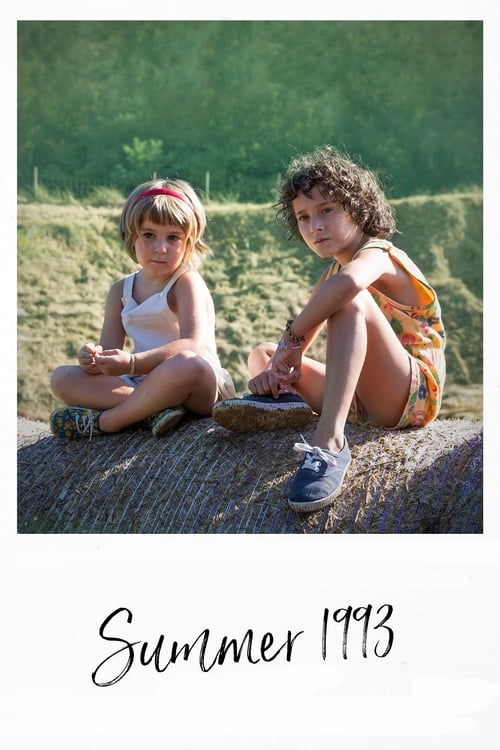
Summer 1993
2017 · Carla Simón
For when you want a gentle film that earns a good cry — a slow, humane watch for a reflective evening, not a night when you need plot to carry you.
What it's about
After her mother's death, six-year-old Frida is sent from Barcelona to live with her uncle's young family in the Catalan countryside. Over one humid, insect-humming summer she tests her new parents, competes with her smaller cousin, and circles a grief she has no words for. Director Carla Simón lived this story as a child, and the film unfolds like memory rather than plot.
The experience
Quiet, sun-drenched, and patient, with an ache building under every ordinary afternoon — it works on you slowly, through glances and small cruelties and small mercies, until it lands with real force. You leave feeling tender and a little wrecked, in the good way.
Performances
Laia Artigas, the six-year-old at the center, gives one of the great child performances — completely unstudied, never cute, letting jealousy, mischief, and bewilderment cross her face without ever seeming to act.
The craft
Simón keeps the camera low, at a child's eye level, and refuses a musical score, so nothing tells you how to feel; adults murmur at the edges of rooms and catastrophe arrives in fragments, the way children actually piece it together. The countryside is shot with such tactile lushness that the summer heat becomes a character.
Why it matters
Winner of Best First Feature at the 2017 Berlinale and Spain's Oscar submission, it announced Simón as a major new voice in Spanish cinema and became a touchstone for autobiographical filmmaking about childhood.
Carla Simón grew up as the girl at the center of this film, and her autobiographical debut carries the authority of memory rather than the tidiness of plot. Six-year-old Frida, newly orphaned, is delivered from Barcelona to her uncle's family in the Catalan countryside, where a lush, insect-humming summer proceeds around a grief she has no words for. Simón keeps the camera low and patient, at a child's height, letting Laia Artigas's astonishingly unstudied performance register bewilderment, jealousy, and mischief without a score to cue our sympathies. The film's ellipses — adults murmuring at the edges of rooms, questions half-answered, rituals of touch and washing — reconstruct how children assemble catastrophe from fragments. Winner of Best First Feature at the 2017 Berlinale and Spain's Oscar submission, it announced Simón as the leading voice of a resurgent Catalan-language cinema, a promise confirmed when her Alcarràs took Berlin's Golden Bear five years later. Few debuts have trusted so completely that a child's face, watched closely enough, can hold an entire film.
Reception
A Berlinale darling from day one — it won Best First Feature in 2017 and swept Spain's Goyas — but its stock has only risen since Simón's Alcarràs took the Golden Bear in 2022, retroactively canonizing this as one of the great debuts of the 2010s.
How Summer 1993 was received, from release to now →
Influences: the films it descends from and the films it influenced
- The Spirit of the Beehive (1973) — Establishes the Spanish art-cinema template Simón inherits: a small girl's uncomprehending gaze framed at her own eye level, where a child's failure to understand the adult world becomes the film's structuring mystery rather than its plot.
- Cría Cuervos (1976) — Models the child processing a parent's death through unreliable memory and imagined presence, letting grief register as a domestic mood rather than a dramatized event — the exact register of Frida's mother-haunted summer.
- The 400 Blows (1959) — Founding text for the autobiographical debut built around a single nonprofessional child lead and location shooting, ending on the child's unresolved direct look — the tradition Simón's final unexplained crying jag descends from.
- Forbidden Games (1952) — Pioneers watching young children invent private rituals to metabolize death (the secret cemetery), the same observational logic behind Frida's games about her dead mother and her half-tests of her new family.
- Ponette (1996) — Directly precedes Simón's method of eliciting a very small child's grief performance through patient, in-the-moment observational direction rather than scripted line-readings, keeping the camera at toddler height.
- Where Is the Friend's House? (1987) — Supplies the patient, non-melodramatic observation of a child navigating an indifferent adult geography with a nonprofessional lead, refusing score and letting real duration carry emotional stakes.
- Nobody Knows (2004) — Sets the standard for shooting children semi-documentarily across a real season — feeding action rather than dialogue, cutting elliptically around unspoken loss — the observational-closeness approach Simón adopts wholesale.
- My Life as a Dog (1985) — Prototype of the grieving child dispatched to rural relatives for a summer, structuring the film as a fragmentary memory-collage of a specific landscape and season.
- Alcarràs (2022) — Simón's own follow-up extends the identical Catalan rural-summer method — entirely nonprofessional local cast, natural light, no score, ensemble observation — scaling the child's-eye intimacy of Summer 1993 up to a whole peasant family.
- Aftersun (2022) — Autobiographical debut that, like Simón's, reconstructs a childhood summer as elliptical memory-fragments around a parent's unspoken pain, refusing conventional scoring and dramatic climax for accumulated texture.
- Romería (2025) — Simón's own debut establishes the child-eye autofiction template Romería completes — opaque young lead cast through extended searches, immersive shooting in actual family locations, and grief held just off-screen rather than dramatized.
- 20,000 Species of Bees (2023) — The nearest formal model: child's-eye summer realism built from shallow-focus handheld intimacy, a non-professional child, and an elliptical accretion of small scenes carried by diegetic sound rather than score.
- The Florida Project (2017) — Contemporary parallel that keeps the lens locked at a child's height across one hot summer, using nonprofessional kids improvising in a real location so adult catastrophe stays at the blurred edge of the child's play.
- Petite Maman (2021) — Shares the hushed, scoreless treatment of childhood bereavement and memory, working at eye-level with young non-stars and trusting small gestures over exposition to convey a mother-shaped absence.
- The Quiet Girl (2022) — Near-twin premise executed with the same craft: a quiet child handed to relatives for a rural summer, shot observationally and low, where a nonprofessional lead's silences and a final ambiguous emotional break do the work.
- Playground (Un monde) (2021) — Takes the child-height camera to its literal extreme, physically pinning the lens to a young girl's eyeline so the adult world is cropped and half-heard — the formal device Simón uses to keep Frida the measure of every scene.
- Beasts of the Southern Wild (2012) — Builds an entire film on a nonprofessional child's sensory, ground-level experience of loss and an elemental rural place, prioritizing observed physical immediacy over explanatory plot.
- The Kid with a Bike (2011) — Shares the near-scoreless, handheld observational realism trailing a child through abandonment and a fragile new caregiver bond, letting behavior rather than dialogue disclose the wound.
- House of Hummingbird (2019) — Semi-autobiographical childhood shot at child eye-level with a naturalistic young lead, where grief and family strain register only obliquely through overheard adult exchanges.
- Close (2022) — Shoots grief entirely from a small child's eye level with a non-professional lead across a single season, sharing Close's child-height camera and seasonal-mourning form.
- Deaf (2025) — Autobiographical family naturalism drawn from the director's own lived experience, shot at the subject's eye level in patient observational takes — the contemporary Spanish women's-cinema idiom Deaf marries to its deaf material.
- Sundays (2025) — Carla Simón's naturalist child's-eye realism — available light, elided plot, grief absorbed into the texture of ordinary domestic days — is the immediate Spanish current Sundays belongs to and shares its withheld-resolution structure with.
Similar films
- Cria! (1976) — influence & lineage
- The Quiet Girl (2022) — influence & lineage
- Petite Maman (2021) — influence & lineage
- Nobody Knows (2004) — influence & lineage
- The Spirit of the Beehive (1973) — influence & lineage
- Romería (2025) — shared sensibility
- 20,000 Species of Bees (2023) — shared sensibility
- Tótem (2023) — shared sensibility