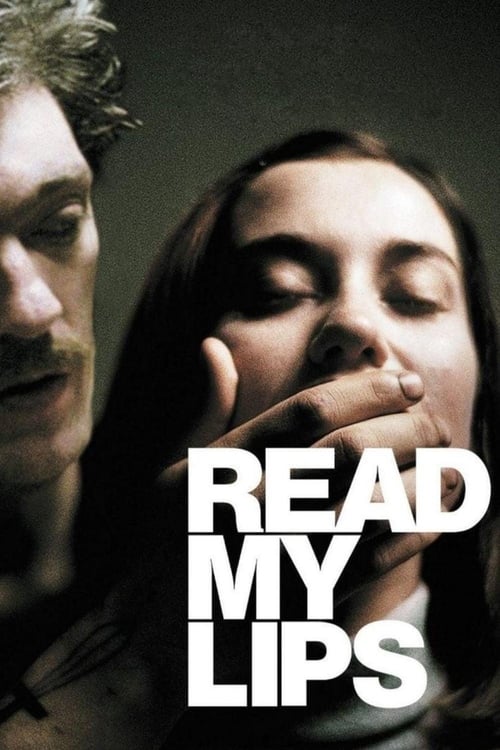
Read My Lips
2001 · Jacques Audiard
Emilia Pérez went from Cannes triumph and 13 Oscar nominations to the most spectacular awards implosion ever — Mexican critics savaging its representation, his own dismissive comments about Spanish, and the Gascón tweet scandal. The cautionary tale every awards strategist now cites.
For a night when you want a smart, grown-up thriller with an undertow of romance — something seductive and a little dangerous rather than loud. Moderately challenging, richly rewarding.
What it's about
Carla, a nearly deaf secretary at a Paris property firm, is overlooked, underestimated, and quietly furious about it. Allowed to hire an assistant, she picks Paul — a rough-edged ex-convict with no skills and nowhere to sleep. Each discovers the other has something they need: he can push back against the office men who humiliate her, and her lip-reading, aimed through binoculars, is exactly the tool a thief could use. Their alliance drifts from the workplace toward a gangster's money.
The experience
Slow-burn tense, intimate, and charged — part crime thriller, part prickly two-hander about power and desire, with long stretches told through glances and half-heard sound. It keeps you leaning forward, unsure who is using whom.
Performances
Emmanuelle Devos won the César for Best Actress as Carla, making resentment and hunger visible under a mousy surface, and Vincent Cassel plays Paul with a feral wariness that softens by millimeters. The push-pull between them carries the whole film.
The craft
Jacques Audiard builds the sound design around Carla's hearing — the mix drops in and out as she removes her hearing aids, putting you inside her head — which makes this a film that genuinely rewards good speakers or headphones. The script keeps flipping the power dynamic scene by scene, and the camera stays close and tactile.
Why it matters
It marked Audiard's turn from clever literary puzzles to the visceral, body-centered crime dramas that made him one of France's most acclaimed directors, and it won the César for Best Screenplay along the way.
Snapshot
A deaf secretary at a Paris property-development firm is granted permission to hire an assistant and chooses, out of the applicants sent by the employment office, a twenty-five-year-old ex-convict with no qualifications, no typing, and nowhere to sleep. Sur mes lèvres proceeds from that hiring decision to a rooftop, a pair of binoculars, and a bag of a gangster's money, and the connective tissue between the office and the heist is a single physical fact: Carla Behm can read lips at a distance, and a distance is exactly what a thief needs.
The film is the hinge in Jacques Audiard's career. His first two features, Regarde les hommes tomber (1994) and Un héros très discret (1996), were ironic, literary, structurally clever pictures about impostors and self-invention, made by a man who had spent fifteen years as a screenwriter and who carried the surname of Michel Audiard, the most celebrated dialoguiste of the French polar. Read My Lips keeps the impostor theme and abandons the irony. It relocates Audiard's interest in the fabricated self into the body — into a prosthesis, a hearing aid, a mouth watched from across a courtyard — and it establishes the method that would produce De battre mon cœur s'est arrêté, Un prophète, and De rouille et d'os: take a hard genre armature, hollow out its psychology, and let physical sensation carry what dialogue used to carry. That a screenwriting dynast's son should make his breakthrough with a film about the failure of speech is a coincidence the film seems aware of.
Industry & production
Read My Lips is a textbook instance of a category that barely exists outside France: the mid-budget auteur genre film, financed through the ecology of broadcaster pre-purchase, distributor advance, and public support that the CNC system sustains. The production carries France 2 Cinéma among its participants, which is to say it was underwritten in part by public-service television, and Pathé handled French distribution — an arrangement that let a director with two features and no commercial hit access a star of Vincent Cassel's magnitude and a Scope-scaled crew without the picture ever needing to behave like a blockbuster. Detailed budget figures and admissions numbers are not cited here; the reliable secondary record on this production is thinner than its reputation suggests, and I would rather leave the gap visible.
The screenplay is original — worth flagging, because Audiard is otherwise an adaptor. Un héros très discret came from a Jean-François Deniau novel, De battre is a remake of James Toback's Fingers, Un prophète was reworked from a spec script, De rouille et d'os from Craig Davidson's stories. Read My Lips was written from scratch with Tonino Benacquista, a crime novelist whose books sit in the wry, procedural end of French noir. The Audiard–Benacquista partnership begun here ran through De battre and Un prophète, and its signature is visible in this film's construction: a plot engineered with genre-writer rigor, then deliberately underexplained at the level of motive.
Casting is the production's other decisive move. Cassel arrived from La Haine, Dobermann, and Les Rivières pourpres as French cinema's most kinetic young male star, and was cast against that entirely — Paul Angeli is slow, hungry, badly washed, and charmless. Emmanuelle Devos came from Arnaud Desplechin's company of actors (La Sentinelle, Comment je me suis disputé…, Esther Kahn), where she had been a superb supporting presence; this was her first lead of consequence, and it won her the César for Best Actress in 2002. The film also took the César for Best Original Screenplay and the César for Best Sound, out of a substantial slate of nominations. Olivier Gourmet, cast as the club owner Marchand, brings the Dardenne brothers' cinema into the frame with him — he had made La Promesse and Rosetta with them and would win Best Actor at Cannes in 2002 for Le Fils — and his presence is a legible signal about the kind of physical realism Audiard wanted at the film's criminal end.
Technology
Two technologies structure the film, and neither is a filmmaking tool.
The first is the hearing aid. Carla wears behind-the-ear devices, and the film treats them not as a medical detail but as a switch: she can turn the world on and off. The whistle of feedback, the muffled compression of aided hearing, the abrupt drop into near-silence when she removes them at night — these are the film's dramatic punctuation. A prosthesis that in most cinema signifies deficit is here the character's instrument of control, and the film's most intimate act is her decision to go deaf on purpose.
The second is the ordinary technology of secretarial labor circa 2001: the headset telephone, the dictaphone, the photocopier, the fax, the filing cabinet, the architectural maquettes and elevation drawings of a firm that sells buildings. Carla's job is to be a medium through which other people's language passes without residue. The film's plot is what happens when the medium starts keeping copies. The surveillance apparatus of the third act — binoculars, an earpiece, a radio link between the rooftop watcher and the man in the room — is simply the same job performed for a different employer.
On the filmmaking side, the picture sits at an instructive technical moment. It was shot photochemically on 35mm at the point just before the digital intermediate became standard practice in European production; the film's grain, its desaturated office grays and sodium-amber nights, were achieved in camera and in the lab rather than in a grading suite. I have not found a reliable account of whether a DI was used, and the safe assumption is that its look is optical. The consequence matters aesthetically: the low-light handheld work has a coarseness that later films of the same visual family would smooth away.
Technique
Cinematography
Mathieu Vadepied shot the film — his only feature with Audiard, before he moved toward directing (La Vie en grand, Tirailleurs). The photography is built around a single problem: how to film attention. Vadepied's answer is long lenses and shallow focus, which flatten the open-plan office into an unreadable smear of activity behind Devos's head and isolate the one thing Carla can actually process — a mouth, in profile or three-quarter, at the plane of focus. The camera is frequently handheld and frequently too close, and it favors the back of heads, doorframes, and glass partitions, so that a great deal of the film is watched from a position of partial obstruction.
The palette divides cleanly. Daylight office interiors are cool, fluorescent, evenly lit and unflattering. Night — the club, the rooftop, the empty apartment Carla lends Paul — is warm, dirty, and underexposed, with faces reduced to planes. The surveillance sequences are the film's formal thesis: images seen through binoculars, framed by circular masking or simply by distance, in which we are given sight without sound and must, like Carla, extract meaning from the movement of lips.
Editing
Juliette Welfling has cut every Audiard feature since 1994, and her rhythm is the most identifiable authorial signature in his cinema after the casting. Here she works elliptically and slightly ahead of the audience: scenes begin after their opening beat and end before their resolution, so that the film moves by inference. Cuts are made on gesture rather than on line readings — a hand reaching, a head turning to catch a face — which suits a protagonist for whom the visual event always precedes the verbal one.
The other editorial task is the film's alternation of sensory point of view. The cuts into and out of Carla's aided or unaided hearing are not signposted with dissolves or optical effects; they are hard, and they are placed so that the audience is briefly disoriented in the way she is. The heist sequence is where picture and sound editing fuse: the cutting shuttles between a woman watching silently at long range and a man moving inside the room she is watching, with the radio link as the only bridge, and the suspense is generated almost entirely by the lag between what she sees and what he can act on.
Mise-en-scène / staging
The office is staged as a hostile acoustic environment — overlapping conversation, phones, the low roar of open plan — and Audiard blocks it so that Carla is repeatedly positioned at the edge of groups, physically present and functionally absent. The running humiliations are staged as ordinary workplace business: a colleague talking while turned away, a joke delivered too fast, a project appropriated by a man named Keller who never has to raise his voice to take it.
Against this, the film's second world: an unsold apartment, empty of everything but a mattress, that Carla can hand over because her firm holds the keys. The property developer's stock becomes a private kingdom, and the vacancy is the point — Paul lives inside a commodity nobody has bought, as he himself is a commodity nobody has bought. The club interiors are staged as pure noise, the environment in which Carla is most disabled and most useful, and the rooftop is her natural terrain: elevated, silent, seeing everything.
The film also refuses the makeover. Carla changes her clothes and her hair at one point, and the film registers it as a small, failed bid for a kind of visibility she will ultimately obtain by other means. She does not become beautiful. She becomes dangerous.
Sound
The César for Best Sound was not a courtesy. Read My Lips is one of the significant works of subjective sound design in European cinema, and its method is restraint rather than effect: instead of building an elaborate simulation of deafness, the mix simply establishes two acoustic regimes — the compressed, high-frequency-shy, feedback-prone world of the aids, and the enormous soft roar of their absence — and moves between them without warning. The result is that the audience's ears are made an instrument of identification. When Carla removes her aids in bed and the film goes almost quiet, the effect is not pathos; it is relief.
Alexandre Desplat's score belongs to his pre-international period — he had already worked with Audiard on both previous features, and his global career would begin two years later with Girl with a Pearl Earring. The writing here is spare, mostly rhythmic and low, functioning as pulse rather than commentary, and it is used sparingly enough that its withdrawal registers. In a film about hearing, music is a resource that has to be spent carefully, and Desplat spends it on the sequences where Carla is least in control.
Performance
Devos's work is built from the neck up and is almost entirely about direction of gaze. She fixes on mouths with a concentration that reads as either desire or predation depending on the scene, tilts her head a few degrees to bring the good ear forward, and lets a half-second of processing delay sit inside every reaction. The performance is not an impersonation of deafness; it is a study of the labor of comprehension, and its erotic charge comes from the fact that watching a mouth that intently is indistinguishable from wanting it.
Cassel gives up his usual velocity. Paul is played as a man conserving energy, perpetually eating, perpetually calculating the shortest route to a bed and a meal, and Cassel plays his stupidity honestly — Paul is not secretly clever, he is a person with one skill and a debt. The pair's chemistry is asymmetric by design: she is the one with the plan, he is the one with the nerve, and the film withholds physical consummation long enough that the transfer of information between them becomes the sex scene. Gourmet's Marchand is a quiet, tired functionary of violence, and Olivier Perrier as Paul's parole officer supplies the film's one register of exhausted decency.
Narrative & dramatic mode
The structure is a graft: a workplace melodrama in the first movement, a mutual-exploitation two-hander in the second, a heist thriller in the third, with the transitions unannounced. Audiard and Benacquista organize the film around a dual protagonist whose asymmetry is the engine — each possesses precisely what the other lacks, and each begins by intending to use the other. The romance is never declared, only enacted through complicity.
The dramatic mode is behaviorist and elliptical. We are given no childhood, no backstory scene, no explanatory monologue for either lead; character is disclosed through what people do with their hands and where they choose to look. Motives are frequently illegible in the moment and become clear only retroactively. This is the film's most consequential formal choice, and Audiard has worked in this register ever since: information is rationed to the audience at roughly the rate the deaf protagonist receives it, so that the film's epistemology matches its subject.
Genre & cycle
Read My Lips sits at the intersection of two French cycles that were running simultaneously in 2001 and are rarely discussed together.
The first is the revival of the polar — the domestic crime tradition of Becker, Melville, and Michel Audiard's own screenplays — which by the late 1990s had been reanimated in various registers by Dobermann (1997) and Les Rivières pourpres (2000). Jacques Audiard's contribution is to strip the polar of its swagger and its epigrams, keeping the criminal machinery and discarding the argot glamour that was his father's stock in trade.
The second is the French cinema of work and precarity that peaked at exactly this moment: Laurent Cantet's Ressources humaines (1999) and L'Emploi du temps (2001), the Dardennes' La Promesse and Rosetta just across the Belgian border. Read My Lips is, for its first forty minutes, straightforwardly a film in that cycle — about a woman doing too much work for too little recognition — and its move into genre is best read as a proposition about what that cycle's characters would need in order to win. The film's answer is crime.
It belongs, too, to the small canon of films built around a sensory-deficit protagonist, where disability is dramatized as asymmetry rather than pathos. The obvious ancestor is the Hitchcockian scenario of the constrained observer, and the obvious descendants are the later films of deaf subjectivity — but see below on the limits of claiming influence.
Authorship & method
Audiard's authorship in this period is inseparable from a small, stable crew. Juliette Welfling's editing and Alexandre Desplat's scoring both predate this film; Vadepied's cinematography is a one-off, and Stéphane Fontaine would take the camera from De battre onward, giving the later films a smoother, more classically composed surface than this one has. Benacquista's arrival as co-writer is the significant change: the shift from Audiard's earlier collaborator Alain Le Henry to a working crime novelist coincides exactly with the shift from irony to sensation.
The method visible here — and consistent across everything Audiard has made since — has three moves. First, find a genre chassis strong enough to hold weight. Second, cast against the actor's established register and build the performance from physical business rather than psychology. Third, remove explanation. Audiard has spoken in interviews of his interest in bodies that are damaged, incomplete, or in the process of being remade; whether or not one takes that as a stable authorial statement, it describes the trajectory from Carla's hearing aids to the pianist's hands in De battre, the illiterate prisoner's slow literacy in Un prophète, and the amputee's prostheses in De rouille et d'os.
Movement / national cinema
The film is French cinema doing the thing French cinema is structurally best positioned to do: making a genre picture with the resources and the artistic latitude of an art film. That possibility is an artifact of policy — the avance sur recettes, the broadcaster investment obligations, the exhibition ecosystem for mid-scale domestic releases — rather than of taste, and it explains why an equivalent American film of this budget would have been either a studio thriller with the ambiguity removed or an independent drama with the heist removed.
Within national film history, Audiard occupies an unusual position as a legatee of the pre-New Wave cinéma de qualité — his father was one of the writers the Cahiers generation defined itself against — who nonetheless makes films of intense physical and formal modernity. Read My Lips is where that inheritance stops being a biographical footnote and becomes a working method: the screenwriter's plot precision harnessed to a director's sensory apparatus.
Era / period
2001, and the film is legible as a document of its moment. The French workplace it depicts is the one produced by the late-1990s expansion of service employment and the contemporaneous debates around the thirty-five-hour week — a firm where the salaried woman does unrecognized overtime while the men close deals. The property-development setting places it in a real-estate economy on the verge of a long boom. The surveillance the film stages is analog and artisanal, dependent on line of sight and a radio, which dates it precisely: a version of this plot made a decade later would be about phones.
It arrived, too, at a moment when French cinema was conspicuously turning toward the body — the same years produced Baise-moi, Trouble Every Day, and shortly after, Irréversible. Read My Lips shares none of that cycle's transgressive program but shares its underlying conviction that sensation, not dialogue, is where meaning now lives.
Themes
Instrumentality. Every relationship in the film is initially a use. Carla hires Paul to have someone beneath her; Paul takes the job for a bed. What the film argues, slowly, is that being genuinely useful to another person is not the opposite of love but one of its available forms.
The prosthesis and the self. The hearing aids are simultaneously a marker of lack, a tool of superiority, and a switch for withdrawal. The film refuses to settle which. Its most radical proposition is that Carla's deafness is not an obstacle the plot must overcome but the capital she trades on.
Invisibility as a weapon. Carla is unseen because she is a woman of a certain age in a job designed to be transparent. The film follows the logic of that invisibility to its conclusion: the person nobody looks at is the person best positioned to watch.
Language and its failures. In a film by Michel Audiard's son, almost nothing important is said aloud. Information is stolen, overheard at a distance, or read off a face. Speech in this film is either noise or evidence.
Class and the two economies. The office and the club are the same economy at different levels of legality; Paul's debt and Carla's unpaid overtime are the same relation. The heist is not an escape from the world of work but its logical extension.
Reception, canon & influence
The film was very well received in France and consolidated Audiard's standing, converting him from a respected two-film director into a major one. The 2002 César results are the durable institutional record: Best Actress for Devos, Best Original Screenplay, Best Sound. It traveled widely on the festival and arthouse circuit, premiered at Cannes in 2001 outside the main competition, and was released in the United States by Magnolia Pictures the following year to strong notices, where reviewers reliably reached for Hitchcock as the comparison. I am not citing box-office figures; the frequently repeated claims about its commercial performance are not well sourced, and its cultural weight has always exceeded its receipts.
Backward. The film's most obvious ancestors are the observer thrillers — Rear Window above all, for the immobilized or impaired watcher whose limitation becomes the mechanism of suspense, and the broader Hitchcockian arrangement in which looking is both the plot and the guilt. Brian De Palma's Blow Out is a useful cousin for the treatment of a sensory faculty as forensic instrument. Bresson's Pickpocket stands behind the film's tactile, hands-first approach to crime, and the classical French heist tradition of Touchez pas au grisbi and Du rififi chez les hommes supplies the procedural grammar of the third act. And behind all of it sits Michel Audiard's polar — present as the thing being answered rather than continued.
Forward. Its clearest legacy is internal: Read My Lips is the template for everything Audiard has made since, and the Audiard–Benacquista–Welfling combination that produced Un prophète, the film that made his international reputation, was assembled here. It made Emmanuelle Devos a leading actress and demonstrated that Cassel could work in a minor, withheld key, which reshaped both careers.
Beyond that, its influence is best described as lineage rather than documented transmission. The film is now routinely invoked in discussions of subjective deaf sound design, alongside later works — The Tribe, Sound of Metal, CODA — that made the audience's hearing part of the dramatic apparatus. I have not found evidence that those filmmakers cite it directly, and it would be wrong to claim they do. What can be said with confidence is that Read My Lips got there first among widely seen fiction features, and did it inside a genre film, with a protagonist who is neither an inspiration nor a victim but a thief with an advantage.
A Deleuzian reading
A woman lies on a Paris rooftop with binoculars, watching a mouth move in a lit window across the courtyard.
The full Deleuzian reading of Read My Lips →
Reception
A critical hit in France on release — it won three Césars in the year Amélie swept everything else — but abroad it stayed a connoisseur's pick until A Prophet made Audiard a name, sending fans back to discover it as the blueprint.
How Read My Lips was received, from release to now →
How to watch Read My Lips: what to notice on a first viewing
- Watch how the lens blurs everything except one mouth. Vadepied shoots long and shallow, so the busy office dissolves into a smear behind Devos's head while a single mouth stays sharp. The camera shows you someone perceiving, not just the thing perceived, which is exactly Carla's daily labor.
- Watch her head tilt a few degrees in conversation. Devos angles her head to bring her better ear forward every time someone speaks near her. The gesture repeats in nearly every scene at the office. That small tilt is her whole position at the firm, played out in her body instead of said aloud.
- Listen for the mix dropping to near silence. The sound design swings between the compressed, feedback-prone world of Carla's hearing aids and the enormous soft roar of their absence, cut without warning. Your own ears are made to do the identifying, so you hear the film the way she hears the room.
- Notice where Carla stands inside each office conversation. Audiard blocks her at the edge of groups, close enough to be present, never inside the circle where the talking happens. Her position in the room states her status before any line of dialogue does.
- Watch scenes start after the opening beat has passed. Welfling cuts in late and out early, on a hand reaching or a head turning rather than on a finished line. The film moves by inference, not by explanation. You are trained early to read action instead of waiting to be told what happened.
The whole guide to watching Read My Lips, with the keys for a rewatch →
Influences: the films it descends from and the films it influenced
- Rear Window (1954) — Builds suspense out of an impaired watcher's optics — the long-lens/binocular POV that crops the frame to what the observer can physically resolve, which Audiard converts from telephoto to lip-reading with the same masked, obstructed framing.
- Pickpocket (1959) — Films crime as hand-work: inserts of fingers, wallets and gestures carry the plot while faces withhold motive, the source of Audiard's cut-on-gesture editing and refusal to psychologize Carla's thefts.
- A Man Escaped (1956) — Constructs its suspense in the sound mix rather than the image — offscreen footsteps, keys and scraping wood define space the camera never shows — the model for Audiard making audibility itself the dramatic variable.
- Rififi (1955) — Supplies the wordless procedural heist grammar — extended real-time theft played without dialogue or score, where sound suppression is the tension device — which Audiard reuses in the third-act stakeout and safe job.
- Touchez pas au grisbi (1954) — Establishes the polar's habit of building character from small physical routine and milieu detail between the crime beats, the procedural register Audiard grafts onto an office comedy of humiliation.
- Any Number Can Win (1963) — The Michel Audiard–dialogued polar of quotable argot and star bravado that Read My Lips answers by inverting it — muting the dialogue track, casting the star in a withheld key, and letting business replace wisecracks.
- Le Samouraï (1967) — Behaviorist protagonist rendered entirely through repeated procedure and near-silent apartment interiors, with ambient room tone doing the scoring — the template for Carla's empty-flat scenes and Audiard's explanation-free character construction.
- The Conversation (1974) — Locks the audience's hearing to one character's ear, filtering, isolating and degrading the track as he strains to decode it — the perceptual-subjectivity mix Audiard reverses by cutting the world out when Carla removes her hearing aids.
- Blow Out (1981) — Treats a sensory faculty as forensic instrument — the technician's ear reconstructs a crime — the same premise Audiard gives a lip-reader whose disability becomes surveillance equipment.
- See How They Fall (1994) — First assembly of the workshop that Read My Lips consolidates: Juliette Welfling's elliptical cutting across parallel timelines and Alexandre Desplat's sparse motivic scoring, already used to withhold connective narrative information.
- The Beat That My Heart Skipped (2005) — Repeats the method exactly — a genre chassis (the Fingers remake) driven by a damaged body's specialized hands, Welfling cutting on physical business, and a lead cast against his prior register.
- A Prophet (2009) — Same Audiard–Benacquista–Welfling authorship, with the prisoner's illiteracy functioning as Carla's deafness did: a legible sensory/skill deficit that the plot converts into criminal advantage without a single explanatory scene.
- Rust and Bone (2012) — Extends the damaged-body procedural — prostheses and retrained physical technique staged in long-lens shallow focus by Stéphane Fontaine — with ellipses that skip the rehabilitation the genre would normally dramatize.
- The Tribe (2014) — Pushes the sensory-subjectivity gambit to its limit — sign-language crime narrative with no subtitles, voice-over or score — making the audience's comprehension gap the dramatic apparatus Audiard opened by cutting the track.
- Sound of Metal (2019) — Systematizes the perspective-cut mix: the track alternates between objective room sound and the protagonist's occluded/implant-processed hearing, the same POV-audio editing logic as Carla's hearing-aid on/off transitions.
- A Quiet Place (2018) — Uses a deaf character's subjective silence as a suspense mechanism — cutting to Regan's cochlear-implant dropout so the audience loses the threat cue at the moment she does — deafness as thriller engineering, not affliction.
- CODA (2021) — Deploys the same device in a single set piece, dropping the concert audio to the deaf family's silence, the now-standard subjective-deafness cut whose widely seen fiction-feature precedent is Audiard's.
- Deaf (2025) — Keys its sound design to a hard-of-hearing protagonist, switching her hearing aid on and off to modulate the mix — an early demonstration of hearing state as an editable subjective channel.
- Harry, He's Here to Help (2000) — Contemporaneous French genre graft that runs on the same engine: a thriller mechanism buried in banal, workaday spaces, sustained by an ingratiating star (Sergi López) cast against type and playing menace through small physical business.
Similar films
- The Beat That My Heart Skipped (2005) — influence & lineage
- A Prophet (2009) — influence & lineage
- Pickpocket (1959) — influence & lineage
- Stolen Kisses (1968) — shared sensibility
- Mr. Klein (1976) — shared sensibility
- Souleymane's Story (2024) — shared sensibility
- The Last Metro (1980) — shared sensibility
- Le Doulos (1962) — shared sensibility