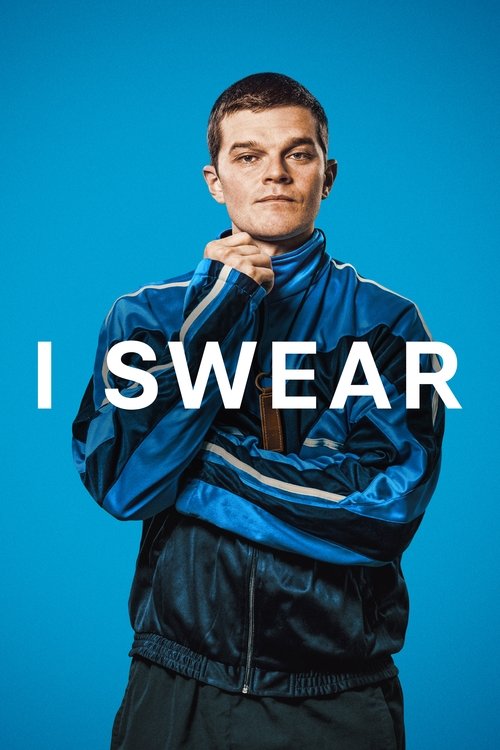
I Swear
2025 · Kirk Jones
For when you want to feel genuinely lifted by a true story without being lied to — a comfort watch that earns its comfort. Good for a night when you need proof that decency exists.
What it's about
John Davidson is fifteen, growing up in a small Scottish Borders town in the 1980s, when he's diagnosed with Tourette syndrome — including the rare, cruelly misunderstood symptom that makes him swear uncontrollably. Drawn from a true story, the film follows him from a turbulent adolescence into adulthood, through classrooms, job interviews and bus rides that turn into ordeals, as the kindness of a few people helps him carve out a life and a purpose on his own terms.
The experience
Bracing and funny in the same breath — it lets you laugh with John, never at him, then catches you off guard with how much the small humiliations sting. It moves like a warm British crowd-pleaser but keeps an honest edge of exhaustion and loneliness underneath.
Performances
Robert Aramayo is remarkable as John, playing the tics not as a showcase but as constant weather the body lives under — and letting a gentle, quick-witted man stay visible beneath them.
The craft
Kirk Jones, who made his name with warm-hearted British comedies, threads a difficult needle: the swearing is played for its real social havoc, comic and mortifying at once, without ever tipping into mockery or sainthood. The period detail of 1980s and '90s small-town Scotland grounds it, and the film's docudrama roots keep the sentiment honest.
Why it matters
It brings to the screen the story of a man a BBC documentary made briefly famous in 1989, and stands as a rare mainstream portrait of Tourette's told with humor from the inside rather than pity from the outside.
John Davidson became briefly, involuntarily famous in 1989, when a BBC documentary about his Tourette syndrome made him one of Britain's most recognizable teenagers — a Scottish boy whose involuntary tics and outbursts turned every classroom, bus ride, and job interview into an ordeal. Kirk Jones, the British director of Waking Ned Devine and Nanny McPhee, tells Davidson's story from adolescence in the Borders town of Galashiels through decades of setback and slow-won dignity, as the condition's most misunderstood symptom — coprolalia, the compulsive swearing that gives the film its title — collides with small-town propriety. Robert Aramayo gives a fearless central performance, playing the tics not as affliction-movie showcase but as a body's weather, constant and exhausting, beneath which a gentle, funny man keeps insisting on being seen. Jones's touch is warmly populist in the tradition of British crowd-pleasers like The Full Monty, but the film earns its uplift honestly, grounded in the real Davidson's later life as an advocate who changed how the condition is understood in Britain. It premiered at Toronto in 2025 to standing ovations.
Reception
Premiered at TIFF 2025 as the festival's word-of-mouth crowd-pleaser and got snapped up by Sony Pictures Classics — then snowballed from modest British sleeper into a full BAFTA underdog story, with five nominations and two wins.
How I Swear was received, from release to now →
Influences: the films it descends from and the films it influenced
- The Full Monty (1997) — Supplies the core British crowd-pleaser structure I Swear inherits: a marginalized working-class figure earns dignity by exposing his most shameful vulnerability in a public performance climax.
- Waking Ned Devine (1998) — Jones's own debut established his directorial method of mining warmth and comedy from the gossip and propriety of a tight-knit small community observing one of its own.
- My Left Foot (1989) — The Daniel Day-Lewis template for a lead physically embodying an involuntary bodily disability from the inside out, converting spasm and difficulty into dignity rather than pity.
- Billy Elliot (2000) — Coming-of-age in a hard northern town where uncontrollable bodily expression becomes the vehicle for overcoming communal shame and social prejudice.
- Shine (1996) — Biographical portrait organized around a subject's neurological difference, driven by a transformation-of-self lead performance that renders tics and compulsions with clinical specificity.
- Rain Man (1988) — Mainstream model for performing a neurological condition through precisely calibrated repetitive behaviors and verbal tics played straight, never as caricature.
- Kes (1969) — Foundational British social-realist grammar: an unsentimental, regionally textured observation of a working-class outsider that I Swear's realism descends from.
- Brassed Off (1996) — Northern-English community-in-adversity crowd-pleaser that fuses social-realist grit with an earned, cathartic public-performance payoff.
- John's Not Mad (1989) — The literal media-fame and advocacy-legacy source: the landmark documentary that first made John Davidson's Tourette's publicly visible, the reality the film dramatizes.
- Eddie the Eagle (2016) — Feel-good biographical underdog that delivers crowd-pleasing uplift through earnest sincerity and public spectacle, extending the same earned-triumph formula.
- The King's Speech (2010) — Speech-disorder dignity drama that earns its uplift through the sufferer's public vocal ordeal, in the same prestige British crowd-pleaser register.
- The Theory of Everything (2014) — Biographical disability drama built on a lead's sustained, physically committed transformation, dignifying progressive bodily loss of control.
- Silver Linings Playbook (2012) — Warm crowd-pleaser centered on a neurodivergent protagonist whose involuntary outbursts are folded into an earned-uplift romance rather than pathologized.
- What's Eating Gilbert Grape (1993) — Small-town drama where disability is conveyed through embodied physical performance and the pressure of a watchful community's gaze on propriety.
- Calendar Girls (2003) — Small-town British propriety comedy in which ordinary people breach respectability norms for a greater cause, sharing I Swear's tension between decorum and exposure.
- Pride (2014) — British crowd-pleaser that converts a stigmatized group's struggle into communal solidarity and collectively earned uplift.
Similar films
- CODA (2021) — same viewing thread
- Twinless (2025) — same viewing thread
- Hard Truths (2024) — same viewing thread
- Rental Family (2025) — same viewing thread
- Short Term 12 (2013) — same viewing thread
- Holding the Man (2015) — shared sensibility
- Kneecap (2024) — shared sensibility
- Tuner (2026) — shared sensibility
All the films related to I Swear →
Watch it with: curated runs of related films
- Funny Because It Aches — A run of tender, deadpan dramedies where love, grief, and the panic of becoming yourself all get metabolized through jokes — watch these when you want to laugh and cry in the same scene.