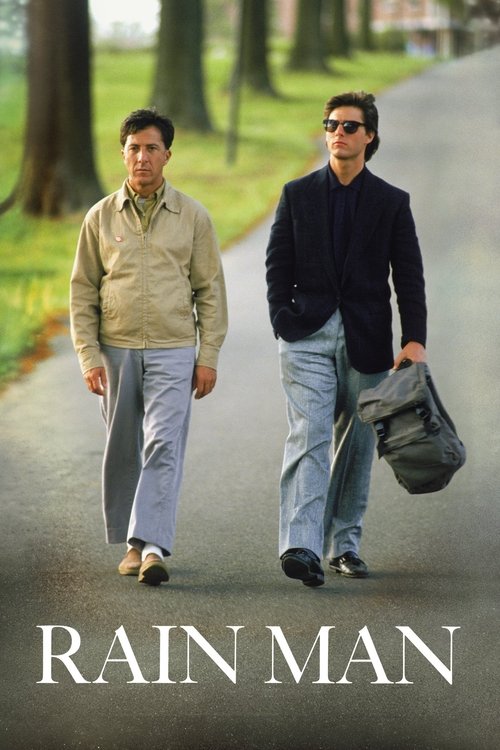
Rain Man
1988 · Barry Levinson
For a night when you want a classic — funny, heartfelt, and satisfying — the kind of film that leaves you a little softer than it found you. Pure comfort with substance.
What it's about
Charlie Babbitt, a slick Los Angeles car dealer drowning in debt, learns his estranged father has died and left the $3 million estate to someone Charlie never knew existed: Raymond, his older brother, an autistic savant living in an institution. Scheming to get his share, Charlie checks Raymond out and drives him cross-country — and the road trip becomes something neither man planned. It's a story about two brothers learning, very late, what family means.
The experience
Warm, funny, and quietly moving, with the easy rhythm of a great road movie — the laughs come from character, not mockery, and the emotion sneaks up on you. It's comfortable viewing that still lands a real punch.
Performances
Dustin Hoffman's Raymond is one of the most famous performances of the 1980s — precise, unshowy, built from rituals and rhythms rather than tics — but Tom Cruise arguably has the harder job, playing the selfish brother whose slow thaw gives the film its actual arc, and he nails it.
The craft
Barry Levinson directs with patience, letting long two-hander scenes breathe inside cars, diners, and motel rooms, and Hans Zimmer's early, percolating score gives the journey a strange, buoyant pulse. The desert-highway photography turns the American Southwest into the film's third character.
Why it matters
It swept the top Academy Awards, was the biggest American box-office hit of its year, and became the reference point — celebrated and contested — for how mainstream movies portray autism; lines from it are still quoted decades later.
Snapshot
Rain Man is the rare prestige drama that was also the most commercially dominant American film of its release year, and it remains the touchstone by which mainstream cinema's depiction of autism is measured — for better and worse. Built on a deceptively simple premise — a callow, debt-pressed Los Angeles car dealer discovers he has an institutionalized older brother, an autistic savant, and effectively kidnaps him in a play for an inheritance — the film converts a road-trip structure into a study of two men learning the rudiments of intimacy. Dustin Hoffman's performance as Raymond Babbitt and Tom Cruise's as Charlie anchor a film that swept the top categories at the Academy Awards, won the Golden Bear at Berlin, and lodged a handful of phrases ("I'm an excellent driver"; "Qantas never crashed") into the popular lexicon. Its cultural footprint is double-edged: it brought autism into living rooms worldwide while also cementing a savant stereotype that advocates have spent decades qualifying.
Industry & production
Rain Man is one of Hollywood's celebrated survivors of development hell. The project originated with writer Barry Morrow, whose original story drew on his acquaintance with people with developmental disabilities; Ronald Bass came on to share screenplay credit. The film passed through a remarkable roster of directors before reaching Barry Levinson. Martin Brest, Steven Spielberg, and Sydney Pollack are all part of the widely reported chain of filmmakers attached and then departed over creative differences and scheduling — Spielberg in particular left to make Indiana Jones and the Last Crusade. That the screenplay went through multiple writers and directors is well documented and central to the film's lore; the precise sequence and contributions of each pass are murkier, and I won't reconstruct disputed details.
Dustin Hoffman's commitment was the project's gravitational center. He was attached early and, by most accounts, initially considered playing Charlie before settling on Raymond. Tom Cruise, fresh off Top Gun and The Color of Money, took the less showy, arguably harder role of the brother who must carry the audience's identification and change across the film. Mark Johnson produced for United Artists, then part of the troubled MGM/UA constellation. Levinson, brought in relatively late, is frequently credited with finding the tone — neither maudlin nor clinical — that had eluded earlier iterations. The production was a location shoot tracing the brothers' cross-country journey, with key sequences in Cincinnati, the open American highway, and Las Vegas (the Caesars Palace card-counting set piece). The film opened in December 1988 in the year-end awards corridor and became the top-grossing domestic release of its year; I'll avoid citing a specific dollar figure rather than risk an inaccurate one, but its commercial dominance and long theatrical legs are matters of record.
Technology
Rain Man was made with the standard photochemical apparatus of late-1980s studio production: 35mm film origination, optical and mechanical effects rather than digital ones, and a conventional analog post chain. There is nothing technologically avant-garde in its capture or finishing, and the film makes no claim to be — its modernity lies in performance and music, not apparatus. The one area where it sits at a genuine inflection point is sound: Hans Zimmer's score is built substantially from synthesizers and sampled/processed instrumentation, part of the broader transition in which electronic and hybrid scoring moved from genre novelty toward respectability in mainstream drama. I'll flag where I'm uncertain: I cannot confirm the precise camera systems, lenses, or aspect ratio from memory, so I won't specify them.
Technique
Cinematography
John Seale, the Australian cinematographer who would later win an Oscar for The English Patient, shot Rain Man, and his work here is a model of restraint in service of character. The visual strategy favors the American vernacular landscape — highways, diners, motels, the hard desert light approaching Las Vegas — rendered in a naturalistic, unfussy register that lets the two actors hold the frame. Seale tends to give Raymond stillness and symmetry, framings that respect his need for order and routine, while Charlie is staged with more restless, mobile coverage. The film's lyricism is rationed; it earns its few openly beautiful images precisely because the surrounding visual language is so plain.
Editing
Stu Linder, Levinson's regular editor, cut the film, and the editing's chief virtue is patience. Rain Man is willing to hold on behavior — Raymond's rituals, his recitations, the small repeated frictions of travel — long enough for the audience to learn his rhythms rather than be told about them. The cutting privileges performance over montage; comic and emotional beats are allowed to land in sustained two-shots and reaction shots rather than being manufactured in the cut. This restraint is itself a dramatic argument: the film's subject is the slow accretion of understanding, and its editing enacts that slowness.
Mise-en-scène / staging
The film's staging is organized around the contrast between confinement and the open road. Raymond's world is one of bounded spaces and fixed objects — the institution, the rigidly ordered motel room, the television schedule — and Levinson stages these with an attentiveness to ritual props (the notebook, the boxer shorts from a specific store, the television tuned to People's Court). Against this, the road offers an unbounded space that the brothers must domesticate. The car becomes the central set: a forced, intimate two-hander on wheels, the confined geometry of front seats compelling proximity between men who would otherwise keep their distance.
Sound
Hans Zimmer's score is the film's sonic signature and a landmark in his career — among his first major Hollywood assignments and the one that announced his arrival. Eschewing a traditional orchestral idiom, Zimmer built a synthesizer-forward soundscape laced with world-music textures (steel-drum-like timbres and percussion), a choice that reads as both contemporary and curiously placeless, mirroring Raymond's interiority and the cross-country drift. The decision not to score Raymond with sentimental strings is crucial: the music observes rather than instructs the audience how to feel. Beyond the score, the sound design foregrounds Raymond's verbal tics and recitations — the patter of memorized facts, statistics, and routines — as a kind of found rhythm.
Performance
The performances are the film's reason for being. Hoffman's Raymond is a study in controlled, externalized detail: the flattened affect, averted gaze, fixed cadences, and rigid physical carriage built from extended research into autism and savant syndrome. The role courts the danger of mannerism, and critics have long debated whether it tips into "performance of disability" as spectacle; what keeps it honest is its refusal of arc — Raymond does not transform, and Hoffman holds that line. The subtler achievement is Cruise's. Charlie carries the film's actual character development, traveling from instrumental selfishness to something like love, and Cruise modulates the brashness of his star persona into genuine vulnerability without ever upstaging his co-star. The film understood, correctly, that the showy role would win the awards and the quiet one would make the picture work.
Narrative & dramatic mode
Structurally, Rain Man is a road movie wearing the clothes of a family melodrama. Its dramatic mode is intimate and behavioral rather than plot-driven: the inheritance MacGuffin sets the journey in motion, but the film's real events are micro-incidents — a diner meltdown, a refusal to fly, a counted deck of cards, a near-disaster at a road crossing, a dance lesson in a hotel room. The screenplay uses the classic device of a static character (Raymond, who cannot change) to force change in a dynamic one (Charlie). This is an old and sturdy machine — the redemption of a cynic through contact with innocence — and the film's craft lies in how unsentimentally it runs it. The ending notably withholds the conventional payoff: there is no permanent reunion, and the brothers part, a restraint that the film treats as honesty about Raymond's needs rather than as tragedy.
Genre & cycle
The film sits at the confluence of several cycles. It is a road movie in the American tradition that runs from It Happened One Night through the New Hollywood, using the cross-country journey as a crucible for relationship. It is also a prestige "issue" drama of a kind the late-1980s studios cultivated for awards season — humane, performance-forward, socially resonant. And it belongs to the long lineage of mismatched-pair narratives, the odd-couple structure in which antagonism curdles into bond. Within the specific micro-genre of films centering disability, Rain Man became the dominant exemplar, the film against which subsequent depictions would be praised or faulted.
Authorship & method
Barry Levinson came to Rain Man as a writer-director associated with the semi-autobiographical, dialogue-rich "Baltimore" films (Diner, Tin Men, and later Avalon), works defined by ensemble talk and affectionate observation of ordinary American life. Rain Man is, on its face, atypical for him — a star vehicle inherited from other hands — yet his sensibility is legible in its patience with character, its trust in performance, and its avoidance of melodramatic underlining. Levinson is often described as the director who finally found the film's workable tone after years of false starts, and that framing is fair: his contribution reads as one of calibration and humane restraint rather than visual signature.
His key collaborators each brought distinct strengths: cinematographer John Seale's unobtrusive naturalism; editor Stu Linder's behavioral patience; composer Hans Zimmer's genre-bending electronic score; and the writing team of Barry Morrow (story and co-screenplay) and Ronald Bass (co-screenplay), whose script survived an unusually long gestation. The film's authorship is genuinely distributed — a case where the "auteur" is less a single vision than a finally-stabilized collaboration, with Hoffman's research and commitment functioning as a quasi-authorial force in shaping Raymond.
Movement / national cinema
Rain Man is mainstream American studio cinema of the late Reagan era, not a product of any formal movement. It can be situated within the period's tradition of the actorly, socially-minded prestige picture, and within Hollywood's recurring fascination with the redemptive journey across the national landscape. Its creative personnel reflect the era's internationalization of Hollywood craft — an Australian cinematographer, a German-born composer — but the film itself is thoroughly American in setting, idiom, and mythology, mapping its emotional reconciliation onto a literal traversal of the United States.
Era / period
The film is a document of 1988: end-of-decade Hollywood, the awards-season prestige machine in full operation, and a culture not yet fluent in the vocabulary of neurodiversity. Its very framing — autism as exotic affliction paired with savant "gift," the institution as default, the brother as a problem to be managed before he is a person to be known — belongs to its moment. Part of the film's later complexity is that it both reflected the limited public understanding of its era and helped move that understanding forward, even as the specific image it popularized later required correction.
Themes
At its core Rain Man is about the recognition of personhood: Charlie's journey from seeing Raymond as an instrument (a means to half the estate) to seeing him as a brother and an end in himself. Adjacent themes cluster around it — family, inheritance, and the long shadow of a withholding father; the tension between exploitation and care; the limits of connection across a neurological gulf that love cannot dissolve. The title itself encodes the emotional revelation: "Rain Man" is Charlie's childhood mishearing of "Raymond," the trace of a buried memory of having been loved and protected. The film is unusually disciplined in refusing a cure-narrative or a sentimental fusion; its deepest theme may be the acceptance that intimacy can be real and still bounded.
Reception, canon & influence
Critically and commercially, Rain Man was a triumph in its moment. It became the top-grossing domestic film of 1988 and swept the most prestigious Academy Awards — Best Picture, Best Director for Levinson, Best Actor for Hoffman, and Best Original Screenplay — while earning further nominations in craft categories; it also took the Golden Bear at the Berlin International Film Festival. Contemporary reviews were largely admiring, with particular praise for the performances, though some critics found the redemption arc conventional and the disability central to a degree that risked spectacle.
The influences on the film are several: the road-movie tradition and the odd-couple buddy structure; Hollywood's humanist prestige drama; and, crucially, Hoffman's documentary-style research into real individuals with autism and savant syndrome. The widely reported inspiration includes the savant Kim Peek, whom Hoffman is said to have met during preparation, and Barry Morrow's prior acquaintance with people with disabilities; Raymond is best understood as a composite rather than a portrait of any single person, and the often-noted fact that Peek himself was not autistic underscores the film's conflation of distinct conditions.
The influence of the film has been immense and contested. It is frequently credited with transforming public awareness of autism more than any prior cultural work, prompting families, clinicians, and advocates to engage with a wider audience. Simultaneously it installed the "autistic savant" as a dominant — and statistically unrepresentative — popular template, a stereotype that researchers and self-advocates have spent the subsequent decades complicating. The phrase "Rain Man" itself entered the language as shorthand, sometimes reductively, for autistic ability. Within the industry, the film reaffirmed the awards-season viability of the performance-driven disability drama and helped launch Hans Zimmer's Hollywood career. Its legacy is thus genuinely twofold: a humane, beautifully acted film that opened a conversation, and a cultural artifact whose central image required ongoing correction — a combination that keeps it actively discussed rather than merely canonized.
A Deleuzian reading
Raymond steps off the curb and the sign flips to DON'T WALK, so he stops.
The full Deleuzian reading of Rain Man →
Reception
A juggernaut in 1988 — the year's biggest box-office hit and a four-Oscar Best Picture winner — it's since become the go-to example of the 'Oscar-bait' prestige drama, with its savant portrayal now widely criticized for shaping decades of public misconception about autism.
How Rain Man was received, from release to now →
Influences: the films it descends from and the films it influenced
- Midnight Cowboy (1969) — Establishes Hoffman's method of building a character from the outside in — Ratso Rizzo's limp, wheeze and clipped vocal cadence — the same externalized-detail technique he reuses to construct Raymond's tics and flat affect.
- Scarecrow (1973) — The road two-hander in which a shared car and Vilmos Zsigmond's naturalistic vernacular Americana carry the relationship, letting landscape and confinement do the dramatic work instead of plot.
- Paper Moon (1973) — Odd-couple con-man-and-innocent road pairing held in sustained two-shots inside the car, the staging template Levinson adopts for Charlie and Raymond's cross-country drive.
- Five Easy Pieces (1970) — Pioneers the behavioral patience and refusal-of-arc Linder's editing echoes — a protagonist observed in real time rather than redeemed, the withheld payoff left deliberately unresolved.
- Charly (1968) — The Oscar-winning prestige-drama precedent of a star's externalized performance of altered cognition, installing the awards-season viability of the disability-performance vehicle Rain Man perfects.
- Kramer vs. Kramer (1979) — Supplies the humanist-issue-drama template — Hoffman in restrained, domestic, performance-driven mode — that proves a quiet character study can anchor a Best Picture campaign.
- Diner (1982) — Levinson's own film of ensemble talk and affectionate observation, source of the tonal calibration and trust in performance — avoiding melodramatic underlining — he transplants into the star vehicle.
- It Happened One Night (1934) — The ur-template of the odd-couple road-movie melodrama, an antagonistic pair softened only by forced proximity en route, whose structure Rain Man inherits wholesale.
- The Miracle Worker (1962) — A prestige drama built as a single-objective two-hander around reaching a non-normative mind, anchored by paired lead performances in the mold of the Sullivan-Keller dual-performance structure.
- What's Eating Gilbert Grape (1993) — DiCaprio's externalized intellectual-disability performance, built from observed physical and vocal detail inside a naturalistic family drama, descends directly from Hoffman's Raymond.
- Scent of a Woman (1992) — Pairs a guarded younger man (star-persona modulation) with an older man's showpiece disability performance on a journey, recombining Rain Man's two-hander and its performance-driven engine.
- Forrest Gump (1994) — Centers a neurodivergent-coded static protagonist who refuses an arc yet forces change in everyone around him — Rain Man's 'static character forces change' inverted into sentiment.
- Sling Blade (1996) — Carries the whole film on an externalized-detail performance of cognitive difference — fixed posture, gravelled voice, repeated verbal tics — in Hoffman's constructed-from-the-outside tradition.
- The Straight Story (1999) — A road movie of behavioral patience across naturalistic vernacular American landscape, scored without sentimental underlining — the stillness-vs-mobile-coverage and non-sentimental scoring Rain Man modeled.
- Nebraska (2013) — A father-and-son car two-hander crossing flat vernacular Americana toward a withheld, deflated payoff, refusing the redemptive arc and the sentimental score.
- Temple Grandin (2010) — Extends the autism-performance lineage while explicitly correcting Rain Man's savant template, using researched first-person sensory staging in place of the externalized-spectacle template it inherits.
- The Accountant (2016) — Commercializes the 'autistic savant' image Rain Man installed in popular culture, building a genre vehicle on the statistically unrepresentative savant template the earlier film made shorthand.
- A Beautiful Mind (2001) — Codifies neurological affliction performed by a star as the Oscar anchor — sympathetic dramatization of mental difference as the engine of a Best Picture campaign.
- Elling (2001) — Defines the neurodivergent/neurotypical pairing as a performance-led acting showcase, where a precisely interiorized portrayal of mental difference anchors the dyad rather than plot.
- Shine (1996) — Hoffman's compulsive, repetitive speech-texture and mannered savant behavior as an awards-magnet lead is the direct performance idiom Rush extends in Helfgott's stammered, looping verbal tics.
- I Swear (2025) — Mainstream model for performing a neurological condition through precisely calibrated repetitive behaviors and verbal tics played straight, never as caricature.
- Driving Miss Daisy (1989) — The immediately following Best Picture built on the same confined two-hander — the car as the arena where a guarded pair's relationship is negotiated within prestige-issue-drama restraint.
- My Left Foot (1989) — Day-Lewis extends Hoffman's documentary-research approach to disability — total physical externalization of the body's specifics — as the researched centerpiece of an awards drama.
- Awakenings (1990) — Contemporary companion in the immersive-performance neurological drama: an unshowy caretaker paired with a virtuosic, physically-coded portrayal of an atypical mind, the film's emotion routed through the dual-protagonist caregiving bond.
Similar films
- Forrest Gump (1994) — influence & lineage
- Nebraska (2013) — influence & lineage
- The Straight Story (1999) — influence & lineage
- The Big Lebowski (1998) — shared sensibility
- Little Miss Sunshine (2006) — shared sensibility
- The Truman Show (1998) — shared sensibility
- Il Sorpasso (1962) — shared sensibility
- Paris, Texas (1984) — shared sensibility