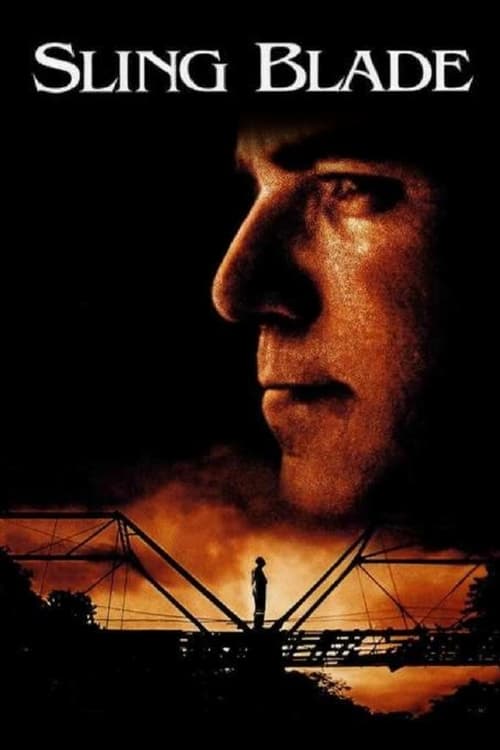
Sling Blade
1996 · Billy Bob Thornton
When you want a serious, soulful drama that earns its emotions the slow way — not a light watch, but deeply humane. Reach for it when you're ready to sit with characters rather than be rushed past them.
What it's about
Karl Childers, a mentally disabled man institutionalized since boyhood for killing his mother and her lover, is released after decades into the small Arkansas town where it happened. Fixing lawnmowers and speaking in a low gravel growl, Karl befriends a fatherless boy and his kind, weary mother — and finds himself standing between them and her cruel, volatile boyfriend. It's a slow-gathering Southern drama about decency, damage, and what protection costs.
The experience
Patient, quiet, and heavy with a storm you can feel coming — long unhurried scenes of talk and kindness shot through with menace whenever Doyle is in the room. It's tender and dread-soaked at once, and it stays with you.
Performances
Billy Bob Thornton's Karl is one of the great acts of transformation in American film — the jutting jaw, the rasp, the 'mmm-hmm' — a full-body invention that never once asks for pity. Dwight Yoakam is frighteningly believable as Doyle, all lazy charm curdling into cruelty, and young Lucas Black and John Ritter give the film its open heart.
The craft
Thornton wrote, directed, and stars, and his direction trusts stillness: long takes, front-porch light, and Southern small-town texture shot on a shoestring in his home state. The Oscar-winning screenplay builds its power from plain speech — people saying simple things that carry enormous weight.
Why it matters
One of the defining American independent successes of the mid-'90s: it won Thornton the Academy Award for Adapted Screenplay, earned him a Best Actor nomination, and made him a major figure overnight.
Snapshot
Sling Blade is a Southern drama written, directed by, and starring Billy Bob Thornton, who plays Karl Childers — a mentally disabled man released from a state psychiatric hospital decades after killing his mother and her lover as a boy. Returning to the small Arkansas town of his childhood, Karl forms a tender, watchful bond with a fatherless boy, Frank (Lucas Black), and his widowed mother, Linda (Natalie Canerday), and is drawn into conflict with Linda's brutal boyfriend, Doyle (Dwight Yoakam). The film resolves in an act of protective violence that returns Karl, by his own moral logic, to the institution. Made cheaply in Thornton's home state, it became one of the defining American independent successes of the mid-1990s, winning Thornton the Academy Award for Best Adapted Screenplay and earning him a Best Actor nomination. Its significance is twofold: as a star-making act of authorship by a character actor turned auteur, and as a model of regional, performance-driven storytelling at the height of the Miramax-era indie boom.
Industry & production
Sling Blade belongs squarely to the independent ecosystem of the 1990s, when boutique distributors — Miramax foremost among them — built a market for adult, literary, performance-centered films outside the studio mainstream. The project's path is unusual and worth recording precisely, because it shapes everything about the finished work. The character of Karl Childers originated in Thornton's stage and improvisational work and was first committed to film in a short, Some Folks Call It a Sling Blade (1994), directed by George Hickenlooper, which consisted essentially of the long opening monologue: Karl, in custody, interviewed before his release. That short is the reason the eventual feature competed (and won) as an adapted rather than original screenplay — a rare instance of a writer adapting his own prior short into a feature.
The feature was produced on a low budget — reported in the neighborhood of one million dollars, though figures vary in secondary accounts and should be treated as approximate — and shot in Arkansas. The Daniel Lanois involvement on the music side and the participation of recognizable actors (J.T. Walsh, John Ritter, Robert Duvall, and country musician Dwight Yoakam) gave a small production unusual texture. Miramax handled distribution, platforming the film through specialty release and awards positioning, the strategy that converted modest production cost into substantial returns and cultural footprint. Precise box-office totals are widely cited as a multiple of the budget; I won't assert an exact gross, but the film was, by any account, a strong commercial performer relative to its cost and a critical centerpiece of its awards season.
Technology
The film was photographed on 35mm film, the standard for theatrical features of its moment, and there is nothing technologically novel about its production methods — which is itself the point. Sling Blade is an artifact of pre-digital, modestly resourced regional filmmaking: available and practical locations, natural and source-motivated light, and an aesthetic that derives its power from restraint rather than apparatus. Its one genuinely forward-looking technological dimension lies in the music, where Daniel Lanois — a producer steeped in ambient and atmospheric recording techniques — brought a sensibility shaped by studio texture rather than orchestral convention. The record is thin on documented technical innovation here, and it would be inaccurate to claim any; the film's achievements are aesthetic and performative, not technological.
Technique
Cinematography
Barry Markowitz's photography is patient, static, and observational. The visual grammar privileges the held shot and the steady frame over coverage and movement, allowing performance and duration to carry scenes. The opening interview sequence is the keystone: Karl is framed frontally, given time and space, so that the audience learns to read his stillness, his sidelong glances, and his halting cadence before the plot proper begins. Throughout, the camera tends to settle and watch, treating Karl's body and face as landscape. The Arkansas exteriors are rendered without postcard prettiness — flat light, ordinary streets, working interiors — grounding the film's near-fable in concrete, unglamorous place. The compositional reticence is a deliberate ethic: the film declines to sensationalize either Karl's disability or the violence that bookends his story.
Editing
The cutting follows the cinematography's lead — unhurried, willing to let takes run, structured around performance beats rather than momentum. The film's rhythm is conversational and accretive; meaning builds through repeated encounters (Karl with Frank, with Linda, with Doyle, with the store owner Vaughan) rather than through propulsive event. This deliberate pacing is the chief stylistic risk the film takes and the source of frequent critical commentary about its length and slowness; it is also inseparable from its emotional method, which depends on the viewer's growing intimacy with Karl's tempo of thought and speech.
Mise-en-scène / staging
Staging is theatrical in the best sense — a legacy of the material's monologue origins. Scenes are often built around two people in a room, talking, with blocking that keeps Karl slightly apart, observing. Production design favors the lived-in ordinariness of small-town Southern domestic and commercial spaces. Karl's physical presence — the stooped posture, the clasped hands, the jutting jaw — is the central element of the mise-en-scène, a body arranged in space to read as both gentle and capable of sudden force. The kaiser blade that gives the film its title functions as a staged object whose meaning the narrative slowly loads with menace.
Sound
Sound design is spare and atmospheric, with Daniel Lanois's score deployed sparingly — guitar-based, ambient, melancholic textures that comment on the action without underscoring it conventionally. The film's most distinctive sonic element, however, is the human voice: Karl's growling, deliberate speech, with its repeated verbal tics ("mmm-hmm," "I like the way you talk," "some folks call it a sling blade — I call it a kaiser blade"), is the film's signature, a vocal performance so specific it became instantly quotable and widely imitated. The soundscape otherwise favors quiet, ambient room tone, again privileging stillness and attention.
Performance
Performance is the film's reason for being. Thornton's Karl is a fully embodied creation — vocal pattern, gait, gaze, and stillness fused into a character who is simultaneously childlike, dangerous, dignified, and morally lucid. It avoids the sentimentality and the condescension that frequently mar screen portrayals of intellectual disability; Karl is granted interiority and ethical agency rather than presented as a saintly innocent. The supporting cast is precisely cast against and around him: Dwight Yoakam's Doyle is a study in casual, escalating cruelty; Lucas Black's Frank gives the film its emotional fulcrum with remarkable naturalness for a young actor; John Ritter, cast against his sitcom persona, plays Vaughan, the closeted gay store manager, with quiet decency; J.T. Walsh's brief turn as the institutionalized Charles Bushman is chilling; and Robert Duvall appears in a small, weighty role as Karl's father. The ensemble's restraint keeps the film anchored in observed human behavior.
Narrative & dramatic mode
The dramatic mode is that of the moral fable rendered in realist texture. The narrative is linear and deliberate: release, return, the forging of a surrogate family, the gathering threat of Doyle, and the inevitable, self-sacrificing resolution. The film's structure rhymes its beginning and end — Karl enters in custody and chooses, finally, to return to it — giving the story the closed, almost mythic shape of a parable about a man who can only protect the people he loves by removing himself from the world along with the evil he eliminates. Crucially, Karl's defining act is governed by an internal ethical code that the film takes seriously: his original crime was rooted in a child's confused sense of justice, and his final act is its mirror — premeditated, accepted, and morally reasoned within his own framework. The mode is melodrama disciplined by realism: high stakes and a violent climax delivered through quiet, granular scenes of everyday life.
Genre & cycle
Sling Blade sits at the intersection of the Southern drama, the character study, and what might be called the indie regional film of the 1990s. It participates in a long tradition of Southern Gothic storytelling — outsider figures, the menace lurking beneath small-town surfaces, violence as moral reckoning — while keeping its register closer to social realism than to the grotesque. Within its own moment, it belongs to the cycle of mid-90s American independents built around a single transformative performance and a literary, character-first script (the kind of film Miramax and its peers championed). It also belongs to a smaller lineage of films centered on intellectually disabled protagonists, a tradition it both extends and quietly critiques by refusing easy uplift.
Authorship & method
The film is, above all, an act of singular authorship. Thornton wrote it, directed it, and built it around a character he had developed and inhabited over years — a degree of creative ownership rare for a then-character actor. His method is performance-derived: the screenplay grew from a monologue, and the directorial choices (long takes, theatrical staging, patience with silence) all serve to preserve and extend the conditions under which that performance lives. As a director, Thornton shows an actor's instincts — trusting faces, protecting his cast, declining to over-cut.
His key collaborators sharpen this approach. Cinematographer Barry Markowitz supplies the observational, unhurried visual style that became something of a signature in his subsequent work with Thornton. Composer Daniel Lanois — a musician and producer better known for ambient and rock recording than for film scoring — contributes a spare, atmospheric soundtrack that lends the film its melancholy, regional mood without conventional orchestral cueing. The editing shapes the film's deliberate rhythm in service of performance. And the strong supporting ensemble — Yoakam, Black, Ritter, Walsh, Duvall, Canerday — reflects an authorial confidence in casting that elevates a small production. The through-line is consistent: every craft decision subordinates spectacle to character.
Movement / national cinema
The film is a product of American independent cinema's commercial flowering in the 1990s, the period in which Sundance, Miramax, and a network of specialty distributors made it possible for personal, regionally specific, performance-driven features to reach national audiences. More specifically, it is a work of Southern American cinema — rooted in Arkansas place, dialect, and social texture — and it represents the regional-realist strand of that independent movement rather than its more ironic or stylized urban tendencies. It can be read alongside other 1990s films that treated the American South and its working-class and rural communities with seriousness rather than caricature.
Era / period
Sling Blade is contemporary in setting — a mid-1990s present — but its sensibility is deliberately timeless, evoking a small-town South that feels minimally touched by modernity. The film's textures (the appliance store, the modest homes, the diner) locate it in a recognizable working-class present while its fable structure lifts it toward the archetypal. As a cultural artifact of its production era, it captures the moment when independent film commanded both critical prestige and meaningful box office, and when an awards-season campaign could turn a million-dollar regional drama into a national conversation and an Oscar winner.
Themes
The film's central theme is moral clarity in a compromised world: Karl, judged simple by everyone around him, possesses an ethical lucidity sharper than that of the "normal" adults who surround him. Closely related is the theme of protective violence and its costs — the question of whether killing can be a moral act, and the price of carrying that burden. The film explores surrogate family and tenderness between unlikely figures (the wounded man and the fatherless boy), and the persistence of childhood trauma, since Karl's adult life is wholly shaped by what he did and witnessed as a boy. Cruelty and decency are mapped across the cast: Doyle's casual abuse, Vaughan's quiet kindness, Frank's openness. Underlying all of it is a meditation on institutionalization, belonging, and the impossibility of a place in the world for someone whose nature makes him both gentle and dangerous. The film also engages, glancingly but with unusual sympathy for its time and setting, with homophobia and difference through Ritter's character.
Reception, canon & influence
Critically, Sling Blade was widely praised, with Thornton's performance and screenplay singled out as the achievements of the work; commentary frequently noted the film's deliberate pace as both its method and its principal demand on viewers. Its awards recognition was substantial: Thornton won the Academy Award for Best Adapted Screenplay and was nominated for Best Actor (the lead acting award that year went to Geoffrey Rush for Shine). The film established Thornton, previously known as a working actor and writer, as a major creative figure, and it remains his signature work as a filmmaker.
The influences on the film are rooted in American literature and earlier cinema. Karl belongs to a lineage of gentle, powerful, morally simple figures whose archetype is most often traced to Lennie in Steinbeck's Of Mice and Men and to the sympathetic outsider of Southern fiction (the Boo Radley figure of To Kill a Mockingbird is a frequent comparison). The Southern Gothic tradition — Faulkner, Flannery O'Connor — informs its sense of place, violence, and moral reckoning. Comparisons to Forrest Gump (1994) were common at the time, though Sling Blade deliberately resists that film's sentimentality.
Going forward, the film's legacy operates on several levels. It became a touchstone for the character-actor-as-auteur, demonstrating that a performer could build a durable directorial career from a self-authored, self-starring vehicle, and it anchored Thornton's subsequent stature in American film. Karl Childers entered the broader culture as an instantly recognizable, much-quoted and much-parodied character, his voice and catchphrases lodging in popular memory well beyond the film's own audience. And it stands as an enduring exemplar of 1990s independent filmmaking — proof that a small, regional, performance-first drama could achieve both critical canonization and mainstream reach. Within the narrower history of screen portrayals of intellectual disability, it is frequently cited as a more dignified and morally complex example than the genre's norm, a reference point in later discussions of how such characters should be written and played.
A Deleuzian reading
He sits with his hands folded in his lap and his jaw pushed out, and he waits for the whole question to finish before he answers any of it.
The full Deleuzian reading of Sling Blade →
Reception
A genuine 1996 sleeper — a ~$1M indie that Miramax snapped up, grossed over $24M, and won Thornton the Adapted Screenplay Oscar (plus a Best Actor nod). Today it's remembered a little through the fog of a thousand Karl impressions, but revisits keep landing on how quiet and sincere the actual film is.
How Sling Blade was received, from release to now →
Influences: the films it descends from and the films it influenced
- One False Move (1992) — Thornton's own co-written Southern noir of slow-burn regional violence — a sibling from the same authorial hand, proving his ear for working-class Arkansas speech and menace.
- The War (1994) — Extends the Southern gentle-fable craft: a child bonding with a damaged adult amid simmering domestic violence, building to a redemptive moral reckoning in a sun-soaked rural key.
- Rain Man (1988) — Carries the whole film on an externalized-detail performance of cognitive difference — fixed posture, gravelled voice, repeated verbal tics — in Hoffman's constructed-from-the-outside tradition.
- What's Eating Gilbert Grape (1993) — Extends the tender, non-caricatured portrait of intellectual disability set inside a Southern dead-end town, again leaning on stillness and recessive performance.
- Of Mice and Men (1992) — John Malkovich's Lennie is the direct performance archetype for Karl — the gentle, intellectually disabled strong man whose protective love turns lethal — staged as a two-hander of patient speech and physical embodiment.
- To Kill a Mockingbird (1962) — Establishes the silent, watchful Southern outsider (Boo Radley) as redemptive moral presence, revealed through frontal, held framing and a child's-eye fable structure.
- The Night of the Hunter (1955) — Southern Gothic moral fable built on stark frontal tableau staging, where children menaced by a predatory adult can only be saved by an answering protective violence.
- Marty (1955) — The small character drama expanded from a teleplay built entirely around one ordinary protagonist's speech rhythms — the monologue-to-feature method Thornton used to grow Karl from a stage piece.
- Tender Mercies (1983) — Horton Foote's spare regional minimalism and a country-music milieu carried by Robert Duvall's quiet, deliberately underplayed redemption — the patient Southern character study (Duvall later cast in Sling Blade).
- Paris, Texas (1984) — Ry Cooder's spare slide-guitar score replaces orchestral cueing with atmospheric regional mood, paired with a near-mute returning protagonist — the template for Lanois's ambient soundtrack and Karl's laconic affect.
- Badlands (1973) — Flat-affect regional narration and observational, unhurried landscape framing that lets behavior unfold without editorial over-cutting.
- The Heart Is a Lonely Hunter (1968) — The gentle Southern outsider whose stillness and silence draw others' confidences — a dignified portrayal of difference that resists pity, anticipating Karl's listening presence.
- The Apostle (1997) — The character-actor-as-auteur self-authored, self-financed, self-starring Southern regional vehicle built around one towering performance — the durable-directorial-career model Sling Blade proved viable a year earlier.
- Frailty (2001) — Another actor's directorial turn into Southern Gothic moral fable, where righteous/protective violence is administered by a soft-spoken patriarch and framed as moral reckoning rather than spectacle.
- George Washington (2000) — Malick-inflected observational long takes and nonprofessional Southern regional realism, prioritizing deliberate pace and faces over plot.
- Monster's Ball (2001) — Spare, deglamorized Deep-South character drama with Thornton himself cast against type, extending the performance-first, regional, anti-sentimental mode.
Similar films
- One False Move (1992) — influence & lineage
- To Kill a Mockingbird (1962) — influence & lineage
- My Left Foot: The Story of Christy Brown (1989) — shared sensibility
- Mother (2009) — shared sensibility
- The Straight Story (1999) — shared sensibility
- Ghostlight (2024) — shared sensibility
- We Need to Talk About Kevin (2011) — shared sensibility
- I Swear (2025) — shared sensibility
All the films related to Sling Blade →
Watch it with: curated runs of related films
- Judgment and Mercy — Watch these together for the way each puts a life on the scales — a jury room, a death-row block, a slave plantation, a gunfighter's conscience — and asks what mercy costs the people handing down the verdict.