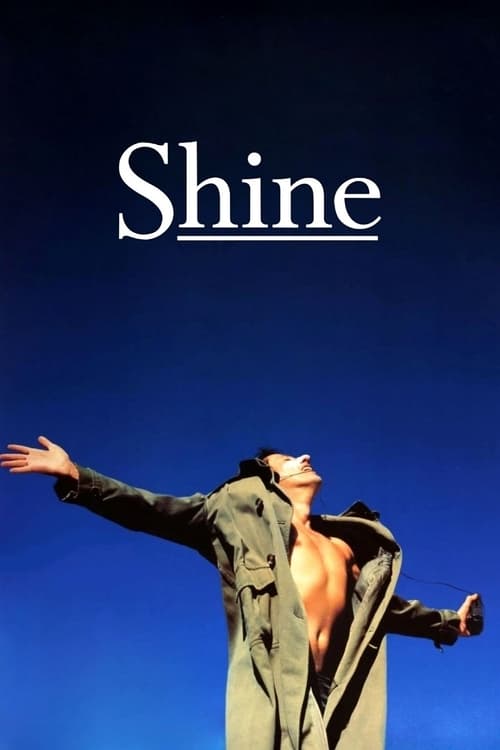
Shine
1996 · Scott Hicks
When you need a good cry that pays off in uplift — a film about surviving your family and reclaiming the thing you love. Emotionally demanding but ultimately warm; ideal for a night when you want to feel something and leave hopeful.
What it's about
The true story of Australian pianist David Helfgott: a child prodigy pushed mercilessly by a father who both worships and smothers his gift, driven toward the notoriously punishing Rachmaninoff Third Concerto, and broken by the weight of it all. Years after a psychological collapse, a scattered, chattering, irrepressible David finds his way back to the keyboard — and to the possibility of love and an audience again.
The experience
Wrenching in its first half and quietly euphoric in its second — it hurts to watch a gift be turned into a cage, and it's genuinely moving to watch someone climb back. The music sequences hit with real physical force; you may come out wanting to hug someone and put on Rachmaninoff.
Performances
Geoffrey Rush's Oscar-winning turn as the adult David is the event: a torrent of tics, wordplay, and unguarded joy that never tips into caricature, and he's utterly convincing at the piano. Armin Mueller-Stahl is quietly terrifying as the father, love and tyranny fused in one face, and Noah Taylor gives the adolescent David a heartbreaking, hollowed-out watchfulness.
The craft
Scott Hicks builds the film around performance itself — the concert scenes are shot and cut so you feel the physical cost of playing, sweat and blur and breath, with the Rach 3 sequence a genuine showstopper. It's a music film that rewards good speakers as much as any action movie rewards a big screen.
Why it matters
The breakout international hit of mid-'90s Australian cinema: seven Oscar nominations, a Best Actor win that launched Geoffrey Rush's screen career in his forties, and a renewed public fascination with Helfgott himself.
Snapshot
Shine is an Australian biographical drama tracing the life of pianist David Helfgott — a prodigy crushed and propelled by a domineering father, who suffers a psychological collapse in early adulthood and, decades later, finds his way back to the keyboard and to a measure of public love. Directed by Scott Hicks from a screenplay by Jan Sardi (story by Hicks), the film became the breakout international success of mid-1990s Australian cinema and the vehicle for Geoffrey Rush's emergence, in his early forties, as a world-class screen actor. It premiered at the Sundance Film Festival in January 1996, was picked up for international distribution, and went on to earn seven Academy Award nominations, winning Best Actor for Rush — the first Australian to win that category. As much as it is a music film, Shine is a film about inheritance: the way love, trauma, and ambition pass from a Holocaust-shadowed immigrant father to a son who cannot bear their weight. Its reputation has always been double — a beloved crowd-pleaser and, simultaneously, the object of a sharp ethical controversy over how it portrayed the real Helfgott family.
Industry & production
Shine belongs to the institutional ecology of subsidized Australian filmmaking. It was produced by Jane Scott and developed over many years by Hicks, a documentary and feature director based in Adelaide, who had become personally involved with Helfgott's story long before financing came together. The project drew on the public-sector apparatus that underwrote nearly all ambitious Australian features of the period — the Australian Film Finance Corporation and state film bodies — combined with private and international equity. International distribution was crucial: the film's Sundance reception generated a competitive sale, and it reached American audiences through Fine Line Features, the specialty arm associated with New Line, with other distributors handling the UK and elsewhere.
The economics matter to the film's meaning. Shine arrived during a remarkable commercial run for Australian cinema abroad — following Strictly Ballroom (1992), Muriel's Wedding (1994), and The Adventures of Priscilla, Queen of the Desert (1994) — that proved a national industry of modest budgets could produce international crossover hits. Shine was, by the standards of Australian production, a substantial arthouse-to-mainstream success, though precise grosses should be treated cautiously; what is securely established is that it performed far beyond expectations for a subtitled-free but distinctly "specialty" drama and helped consolidate the careers of nearly everyone involved. Its awards campaign, sustained across a full season into the early-1997 Academy Awards, was central to that success and is a textbook case of a small national film amplified by festival and prize momentum.
Technology
Technologically, Shine is conventional for its moment: a 35mm production using standard photochemical capture and post-production, with no notable claim to formal innovation in camera or processing. Its one genuinely distinctive technical decision lies in the soundtrack. The film foregrounds a demanding classical repertoire — most prominently Rachmaninoff's Piano Concerto No. 3, the "Rach 3," whose punishing difficulty is made a dramatic object in itself — and the recordings draw on David Helfgott's own playing. Geoffrey Rush, who had childhood piano training, performed convincingly at the keyboard for the camera, but the virtuoso passages heard on the soundtrack are anchored in Helfgott's performances, an authorial choice that fused the film's fiction to its subject's actual artistry. The resulting album became a commercial phenomenon in its own right and introduced Helfgott's playing to a mass audience, with all the critical debate that entailed (see Reception). Beyond this, the film's technical signature is in editing and sound design rather than hardware.
Technique
Cinematography
Geoffrey Simpson's photography is warm, classical, and emotionally legible rather than showy. The camera tends toward expressive proximity in the breakdown sequences — closeness to faces, to hands, to the instrument — and opens to a softer, more luminous register in the later recovery passages. Light is used thematically: the childhood and conservatory scenes carry a burnished, memory-tinted quality, while David's adult disarray is rendered in cooler, more fragmented compositions. The signature visual motif is the piano keyboard and the pianist's hands shot as a site of both transcendence and danger, the instrument photographed almost as a character. Simpson's work serves the performances and the structure; it is craft in support of feeling, not an autonomous visual argument.
Editing
Pip Karmel's editing is arguably the film's most important formal contribution and earned her an Academy Award nomination. Shine is built on a fractured, non-chronological structure that braids three life stages — child, young man, and the disheveled adult who stumbles into a wine bar and back toward the piano — cutting across time in ways that mirror Helfgott's fragmented consciousness. The film withholds and then circles back to its traumatic center (the collapse during, and around, the "Rach 3"), using temporal dislocation to dramatize memory and breakdown rather than merely to deliver biography in order. The editing also manages the film's tonal swings, modulating between near-comic loquacity in the adult Helfgott's rapid, associative speech and the gravity of the conservatory scenes.
Mise-en-scène / staging
The film's settings move from a cramped, oppressive family home in Australia, through the institutional spaces of competition and the Royal College of Music in London, to psychiatric facilities and, finally, ordinary, redemptive domesticity. The father's house is staged as a zone of surveillance and control; the piano within it is both refuge and battleground. Costuming and physical staging chart David's decline and return — from neat prodigy to the trembling, raincoated, chain-smoking adult whose body itself becomes the film's most eloquent image of damage. Staging consistently privileges the actor's body and gesture over environmental spectacle.
Sound
Sound is inseparable from the film's design. The classical repertoire is not background but dramatic event — the "Rach 3" functions as a literal threshold the young David must survive, and the soundtrack treats music as the medium through which love, pressure, and eventual healing are transmitted. Equally important is the texture of speech: the adult Helfgott's compulsive, tumbling, repetitive talk — endearments, fragments, free associations — is a sonic portrait of his mind, and the sound mix balances this verbal stream against silence and against the score. David Hirschfelder's original music threads through and around the classical pieces, binding source and score.
Performance
Shine is, finally, an actors' film, and its central achievement is a relay of three performers playing David across a lifetime: Alex Rafalowicz as the child, Noah Taylor as the adolescent and young man who reaches the breakdown, and Geoffrey Rush as the adult. Taylor's contribution is frequently underweighted because Rush won the prizes, but the young-man section carries the film's tragic engine. Rush's performance — physically intricate, verbally torrential, never condescending to its subject's disability — is the role that made him a star and is the film's enduring calling card. Armin Mueller-Stahl, as the father Peter, gives a performance of frightening tenderness-and-tyranny that earned a Best Supporting Actor nomination; Lynn Redgrave plays the astrologer Gillian who becomes David's wife and anchor, and John Gielgud appears as the London teacher figure. The ensemble's coherence across the time-jumps is what makes the fractured structure cohere emotionally.
Narrative & dramatic mode
The film operates in the mode of redemptive melodrama, organized around a fall-and-recovery arc. Its non-linear construction is psychological rather than merely stylish: by fragmenting chronology it asks the audience to assemble a self the way David must reassemble his own. The dominant dramatic question shifts over the film — first whether the boy can satisfy and survive his father, then whether the broken man can be loved and can play again. Emotionally the film courts uplift, and its ending leans frankly toward catharsis (a return to public performance, a restored marriage, applause). Critics have divided precisely on this: admirers find the structure earns its tears; skeptics find the redemptive shape softens and sentimentalizes a more intractable reality of chronic mental illness.
Genre & cycle
Shine sits at the intersection of several well-worn cycles: the music biopic, the "tortured genius" artist film, and the mental-illness recovery narrative. It belongs to a long lineage of films that equate extraordinary gift with extraordinary suffering, and to a 1990s vogue for prestige biographical dramas built around a single transformative lead performance. Within Australian cinema it is part of the mid-1990s international breakout cycle, though tonally it diverges from the broad comedy of Muriel's Wedding or Priscilla; Shine is the earnest, awards-courting face of that wave. It also anticipates a recurring later sub-genre — the film built explicitly as an Oscar vehicle for a virtuoso transformation — without yet being cynical about it.
Authorship & method
Scott Hicks is the film's animating author in the older sense: a director who carried a personal obsession with his subject for years and shaped the project around it. His background in documentary informs the film's interest in the real Helfgott and its claim to authenticity, even as the dramatized result took significant liberties. The screenplay credit is shared — story by Hicks, screenplay by Jan Sardi — and Sardi's script is responsible for the film's distinctive verbal texture and its braided structure. The key collaborators form an unusually balanced creative team: cinematographer Geoffrey Simpson, whose warm classicism gives the film its emotional accessibility; composer David Hirschfelder, who integrated original scoring with the classical repertoire and whose work was Oscar-nominated; and editor Pip Karmel, whose fractured timeline is the film's structural signature and who would go on to direct her own features. The method, in sum, is collaborative craft in service of a single performance and a single emotional throughline — a director's vision realized largely through editing, music, and acting rather than through visual authorship.
Movement / national cinema
The film is a landmark of the second great phase of Australian cinema's international visibility. Where the 1970s–80s Australian New Wave (Weir, Schepisi, Beresford, Armstrong) had established a national art cinema, the mid-1990s produced a run of internationally commercial features, and Shine was among its most decorated. It exemplifies the strengths and dependencies of that national industry: world-class performers and craftspeople working at modest budgets under public subsidy, reliant on festival exposure and foreign distribution to reach scale. It also demonstrates the period's pattern of exporting talent — Rush, Hicks, and others gained international careers in its wake.
Era / period
Made and released in 1995–96, Shine is a product of the prestige-independent moment that Sundance and the specialty-distribution boom defined in the 1990s, when small, performance-driven dramas could become awards contenders and modest box-office hits. Its sensibility — the redemptive arc, the transformative lead turn, the tasteful integration of high culture (classical music) into accessible melodrama — is characteristic of mid-decade middlebrow prestige cinema. It belongs to a pre-digital production era and to a film culture in which the Academy Awards still functioned as a powerful amplifier for international art-house product.
Themes
The film's deepest subject is paternal inheritance — love and damage transmitted as one inseparable thing. Peter Helfgott is portrayed as a survivor scarred by loss who cannot distinguish protection from possession, and the film treats David's gift as both the father's project and the son's wound. Around this core cluster several themes: the romantic and dangerous equation of genius with suffering; music as simultaneously salvation and the instrument of breakdown; survival and the long shadow of trauma across generations; and recovery through ordinary human attachment rather than through art alone — it is love, marriage, and gentleness, as much as the piano, that bring David back. The film is also, more uneasily, about spectatorship itself: how an audience consumes a damaged man's performance, a question its own commercial success made unavoidable.
Reception, canon & influence
Critical reception was broadly enthusiastic, centered overwhelmingly on Geoffrey Rush's performance, which swept the major acting honors of the 1996–97 season and culminated in the Academy Award for Best Actor. The film received seven Oscar nominations — including Best Picture, Best Director, Best Supporting Actor (Mueller-Stahl), Best Original Screenplay, Best Film Editing, and Best Original Dramatic Score — and won major Australian Film Institute awards at home. It was a defining export success for Australian cinema and a key text in Rush's elevation to international stardom.
The film's influences run backward into the long tradition of the artist-biopic and the music film, and into the 1990s prestige-independent template; structurally, its fractured-memory storytelling participates in a wider arthouse interest in non-linear subjectivity. Its forward legacy is twofold. As craft, it helped normalize the "transformative biographical lead performance as Oscar vehicle" — a pattern visible across later music and disability dramas. As career catalyst, it launched or boosted Rush, Hicks, Karmel, Hirschfelder, and others.
Crucially, Shine is inseparable from the ethical controversy it provoked. Members of the real Helfgott family, most prominently David's sister Margaret Helfgott — whose book Out of Tune (1998) directly challenged the film — argued that the portrayal of their father as a tyrant was a distortion that defamed a man unable to answer. The episode became a standard case study in the ethics of biographical filmmaking: the tension between dramatic truth and biographical fairness, and the question of who has the right to narrate a living person's life and a dead person's character. Separately, the film's success thrust the real David Helfgott into an international concert career, and some classical critics responded harshly to his actual playing, raising a further unease about whether the film's celebration had set its subject up for a kind of public exposure. These debates have not diminished the film's standing so much as complicated it: Shine endures as both a beloved, expertly made redemption drama and a permanent reference point in arguments about the responsibilities of the biopic.
A Deleuzian reading
The man at the window is soaking wet.
The full Deleuzian reading of Shine →
Reception
A Sundance 1996 sensation that rode a wave of standing ovations to seven Oscar nominations and a Best Actor win for Geoffrey Rush — but the afterglow was complicated by a real-world backlash, as classical critics panned the real David Helfgott's cash-in concert tour and his sister publicly disputed the film's version of their father. Today it sits in that curious mid-90s prestige zone: hugely awarded then, rarely discussed now.
How Shine was received, from release to now →
Influences: the films it descends from and the films it influenced
- Amadeus (1984) — Established the template Shine inherits: a classical-music genius narrated retrospectively by an envious witness, with the repertoire performed diegetically as the dramatic climax rather than underscoring, all wrapped in Best Picture prestige.
- Citizen Kane (1941) — The braided non-chronological biography assembled from fragmentary witness-memories — the structural grammar Pip Karmel's fractured timeline reconstructs a single life through dislocated recollection.
- Rain Man (1988) — Hoffman's compulsive, repetitive speech-texture and mannered savant behavior as an awards-magnet lead is the direct performance idiom Rush extends in Helfgott's stammered, looping verbal tics.
- Five Easy Pieces (1970) — The classical prodigy who flees his gift and the stroke-silenced father reduced to a wheelchair — piano performed diegetically as a confession of an unresolved paternal bond, the exact emotional machinery of Shine's father plot.
- Raging Bull (1980) — De Niro's total behavioral and physical immersion as a Best Actor vehicle set the standard for the 'transformative biographical lead' that Rush's full-body Helfgott impersonation consciously chases.
- Don't Look Now (1973) — Associative match-cut editing that collapses past into present, letting shards of memory intrude on the now — the temporal-dislocation cutting logic Karmel deploys across Helfgott's timeline.
- Lust for Life (1956) — The tortured-artist biopic that frames mental breakdown as the literal price of creative genius, with an Oscar-nominated transformation (Douglas) — the genius-and-suffering genre code Shine reactivates.
- Hilary and Jackie (1998) — A classical-musician genius-and-suffering biopic told, like Shine, through fractured overlapping timelines and shifting perspectives, with illness-as-cost of the gift at its center.
- A Beautiful Mind (2001) — The redemptive mental-illness-genius drama and subjective-unreliability device taken to Best Picture — the direct heir to Shine's 'madness and gift, then recovery' melodramatic arc.
- The Pianist (2002) — Builds its emotional spine, as Shine does, on Chopin performed diegetically as a survival-event and on the pianist's hands as the literal locus of feeling, anchored by a transformative Oscar-winning lead.
- Ray (2004) — Structures a music biopic around childhood-trauma flashbacks erupting into the present and a full immersion lead (Foxx) as Oscar vehicle — Shine's flashback-and-transformation engine applied to a popular musician.
- The King's Speech (2010) — Reunites Geoffrey Rush in the patient-mentor relay, dramatizing a speech/communication disability overcome through a tested intimate partnership, as a polished prestige-performance vehicle.
- Whiplash (2014) — Recasts Shine's tyrannical paternal figure as a sadistic mentor whose abuse both forges and nearly destroys the musical prodigy — the genius-and-suffering-through-domination theme inherited and intensified.
- Love & Mercy (2014) — Splits a single mentally-ill musician across two actors and a fractured dual timeline — the exact young/adult multi-actor relay and non-linear subjectivity Shine uses for Helfgott.
- The Soloist (2009) — Pairs a mentally-ill musical prodigy with a caretaker-witness narrator and treats classical performance as the fragile thread back to lucidity — Shine's redemptive-witness structure transposed.
- The Imitation Game (2014) — Hicks deploys the three-period temporal structure — traumatic childhood, institutional crisis, adult reckoning — specifically to construct a neurodivergent genius, establishing the scaffold Moore's screenplay adapts for Turing's schoolboy, wartime, and postwar prosecution timelines.
- I Swear (2025) — Biographical portrait organized around a subject's neurological difference, driven by a transformation-of-self lead performance that renders tics and compulsions with clinical specificity.
- Strictly Ballroom (1992) — Part of the same AFI-launched Australian-1990s export wave, built like Shine around a climactic music-driven performance set-piece staged as emotional release.
- Muriel's Wedding (1994) — A contemporaneous Australian breakout that weaponizes diegetic source-music (ABBA) as the carrier of a suburban-family melodrama's emotional peaks — the same 'recording/repertoire as event' device Shine applies to the classical canon.
- Proof (1991) — The spare, single-performance-driven character study that typified the early-90s Australian prestige-art film whose international pipeline Shine rode to global success.
- The War (1994) — Sibling in Geoffrey Simpson's cinematography, sharing the luminous golden-amber palette and soft period glow Simpson developed across his Avnet collaborations.
Similar films
- Whiplash (2014) — influence & lineage · same viewing thread
- The King's Speech (2010) — influence & lineage
- The Pianist (2002) — influence & lineage
- A Beautiful Mind (2001) — influence & lineage
- Rocketman (2019) — same viewing thread
- La La Land (2016) — same viewing thread
- Rush (2013) — shared sensibility
- The Fabelmans (2022) — shared sensibility
All the films related to Shine →
Watch it with: curated runs of related films
- Burning to Be the Best — Watch these together for the shared fever of ambition — musicians, dancers and one table-tennis obsessive driving themselves past exhaustion toward a greatness that keeps costing more.