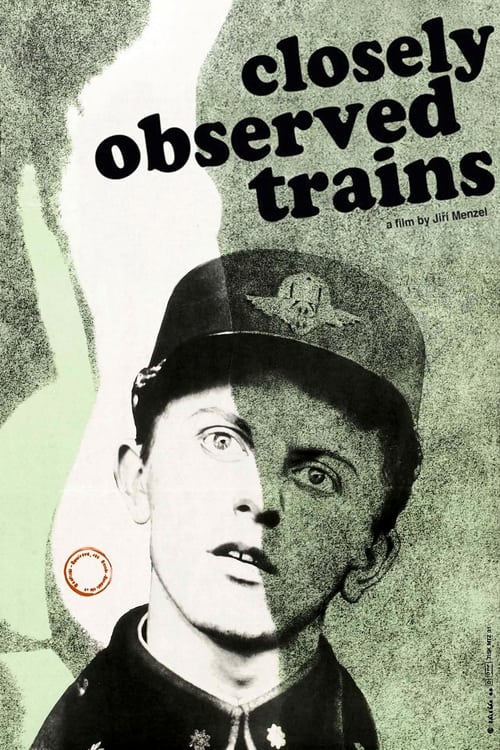
Closely Watched Trains
1966 · Jiří Menzel
For when you want something short, wry, and human that sneaks up on you — a comedy with a real ache underneath. Comforting in tone, but it leaves a mark.
What it's about
In the last months of the German occupation, a gawky young man starts his first job as a dispatcher's apprentice at a sleepy village railway station in Bohemia. Trains carrying the war roll past his platform, resistance activity stirs around him, but Miloš is consumed by a much more personal crisis: his own inexperience with women. His fumbling attempts at manhood keep colliding with the larger history he's barely paying attention to.
The experience
Gentle, funny, and quietly devastating — it plays like a warm sex comedy that keeps letting the war in through the side door. The pace is unhurried and the humor deadpan, so when gravity arrives it lands harder for having been smuggled in.
Performances
Václav Neckář's Miloš is a small marvel of awkwardness — wide-eyed, earnest, never mugging — and the whole station ensemble around him plays absurdity with a completely straight face.
The craft
Jiří Menzel's debut, adapted from Bohumil Hrabal's novella, is a masterclass in tonal control: erotic farce, small-town observation, and wartime dread held in a single relaxed register. The black-and-white images of the drowsy depot — rubber stamps, pigeons, passing freight — turn bureaucratic tedium into visual comedy.
Why it matters
It won the Academy Award for Best Foreign Language Film and stands as the most internationally recognized work of the Czechoslovak New Wave, fixing that movement's blend of irony and tenderness in the world's memory.
Snapshot
Closely Watched Trains (Ostře sledované vlaky) is Jiří Menzel's feature debut, a tragicomedy adapted from Bohumil Hrabal's 1965 novella and set at a drowsy provincial railway station in Bohemia during the last months of the German occupation. Its ostensible subject is small: Miloš Hrma, a gawky, newly minted dispatcher's apprentice, is consumed less by the war rumbling past his platform than by his own sexual inadequacy. Yet the film binds that intimate coming-of-age to an act of anti-Nazi sabotage, so that a young man's private passage into adulthood and his sudden, fatal entry into history become the same event. Released at the crest of the Czechoslovak New Wave, it won the Academy Award for Best Foreign Language Film and remains the movement's most internationally recognized single title — a work whose gentle bawdy humor and abrupt tragic turn have made it a durable model for the comedy that refuses to insulate itself from death.
Industry & production
The film was produced within the state-run Czechoslovak film industry at the Barrandov Studios in Prague, the centralized apparatus through which nearly all feature production passed. The mid-1960s represented a distinctive, relatively liberal window in that system: reforms had devolved considerable creative authority to semi-autonomous production groups (dramaturgical units) staffed by writers and editors sympathetic to younger filmmakers, which allowed unconventional, politically ambivalent, and formally adventurous projects to reach the screen with less interference than either the preceding Stalinist decade or the "normalization" years that followed the 1968 Soviet-led invasion. Closely Watched Trains is a product of that thaw.
Menzel, born in 1938 and trained at FAMU (the Prague film academy) under the veteran director Otakar Vávra, was in his mid-twenties and directing his first solo feature. The project grew directly out of his relationship with Hrabal, whose prose he had already adapted for a segment of the 1965 portmanteau film Pearls of the Deep (Perličky na dně), a collective showcase for the emerging generation. Hrabal collaborated on the screenplay adaptation of his own novella, a partnership that would define much of Menzel's career. Production values were modest and regional in feel — a small station, period rolling stock, a handful of interiors — consistent with a national cinema that prized intimacy and location texture over spectacle. Precise budget and box-office figures are not part of the reliably documented record and are best left unstated.
Technology
The film was shot on 35mm black-and-white, the standard stock for Czechoslovak features of the period, and presented in the era's conventional near-Academy aspect ratio rather than widescreen — a framing choice consonant with the movement's preference for the human-scaled and the unglamorous over the panoramic. There is nothing technologically exceptional in the film's manufacture; its distinction lies wholly in the deployment of ordinary tools. Monochrome here is not a limitation but an aesthetic, lending the station's winter light and grimy interiors a documentary plainness against which the comedy plays. As was normal for the industry at the time, sound was constructed in post-production, giving the filmmakers deliberate control over the layering of station noises, railway signals, and the sparse score.
Technique
Cinematography
The photography, by Jaromír Šofr — a FAMU contemporary who would become one of Menzel's most enduring collaborators — is unshowy and precise, favoring clean, legible compositions over the handheld restlessness that marked some of the New Wave's more radical entries. Šofr's black-and-white registers the station as a lived, cluttered space: signal levers, timetables, the geometry of tracks and platforms. The camera tends to hold and observe, allowing performance and staging to carry the comedy, and reserves its emphatic gestures — a sudden change of scale, a movement toward the ammunition train — for the moments when the private story collides with the historical one. The visual mode is closer to lyrical realism than to expressionism.
Editing
The film's editing sustains a deceptively relaxed, anecdotal rhythm keyed to the slow tempo of station life, digressing into vignettes and comic business before tightening, in its final movement, toward the sabotage. That structural asymmetry is essential to the film's effect: the long, meandering, sexually preoccupied middle lulls the viewer into the same obliviousness Miloš embodies, so that the violent ending arrives with genuine shock. The tonal management — the pivot from farce to fatality accomplished without a jarring seam — is one of the film's most admired formal achievements.
Mise-en-scène / staging
Menzel stages the station as a self-contained comic universe, densely populated with running motifs: the pigeons, the upholstered furniture, the stationmaster's obsession with his imminent promotion, the ceaseless erotic preoccupations of the staff. The famous set piece — in which the dispatcher Hubička playfully applies the station's official rubber stamps to the bare thighs and backside of the young telegraphist Zdenka, an "outrage" that later becomes the subject of a solemn bureaucratic investigation — exemplifies Menzel's method: the collision of institutional propriety with irrepressible bodily life, staged with a straight face that makes the absurdity funnier. Objects and props carry as much comic and thematic weight as dialogue.
Sound
The soundtrack works chiefly through restraint. Jiří Šust's music is used sparingly, and the aural texture leans on the ambient vocabulary of the railway — bells, whistles, the passing of trains, the mechanical punctuation of station routine. This economy keeps the register close to the everyday and lets the few musical or sonic emphases land with weight, particularly in the transition to the film's tragic climax.
Performance
The playing is central to the film's tone. Václav Neckář — then a young pop singer, not a trained screen actor — gives Miloš a hangdog, half-blank sincerity that is the film's emotional anchor; his very passivity and inexperience make the character's obliviousness and eventual transformation credible. Josef Somr's Hubička, the lecherous, unflappable senior dispatcher, supplies the film's raffish comic engine and, ultimately, its bridge to the resistance. Jitka Bendová plays Máša, the conductor Miloš loves, with an unforced naturalism. The ensemble performs in a deadpan, understated key that keeps even the broadest material grounded and human rather than cartoonish.
Narrative & dramatic mode
The film's dominant mode is tragicomedy of the specifically Central European variety — the comic and the catastrophic held in a single frame rather than sequenced. Its narration is episodic and digressive, organized around Miloš's subjective preoccupation (his virginity, his humiliating sexual failure with Máša, his despairing suicide attempt, his search for someone to "help" him) rather than around the war plot, which proceeds almost unnoticed in the background until it abruptly seizes the foreground. The dramatic irony is structural: the audience is nudged to register the historical stakes the protagonist ignores. The ending — Miloš, now "a man," planting a bomb on a German munitions train and being killed in the act — retroactively reframes everything comic that preceded it, so that sexual initiation and political sacrifice are revealed as the two halves of a single rite of passage. The tone is compassionate rather than satirical; the film laughs with its provincials even as it delivers them to death.
Genre & cycle
Nominally a war film, Closely Watched Trains belongs more truly to the tradition of anti-heroic, demythologizing accounts of occupation and resistance — a body of Central and Eastern European work that replaced the partisan-heroic template of official war cinema with fallible, ordinary, sexually and comically distracted protagonists. Within that frame it is also a coming-of-age story and a bawdy provincial comedy of manners. Its refusal to treat wartime heroism as noble spectacle, insisting instead that history erupts into unremarkable lives that were preoccupied with other things, aligns it with the broader New Wave impulse to puncture inherited pieties.
Authorship & method
The film is best understood as the founding act of a director-author partnership. Jiří Menzel brought to Hrabal's material a sensibility that would define his career: humane, ironic, attentive to the comedy of provincial life, and fundamentally tender toward "little people." His method here — patient observation, deadpan staging, tonal control across an enormous emotional range — became his signature. Bohumil Hrabal, one of the major Czech prose writers of the century, co-adapted his own novella; his voice — digressive, anecdotal, earthy, alert to the poetry in the vulgar — is the film's literary DNA, and Menzel's genius lay partly in finding cinematic equivalents for it. The two would collaborate repeatedly, most notably on Larks on a String (1969), suppressed for two decades by the normalization regime; Cutting It Short (Postřižiny, 1980); and, much later, I Served the King of England (2006).
The key craft collaborators reinforce the sense of a coherent young generation working together: cinematographer Jaromír Šofr, composer Jiří Šust, and the editor who shaped the film's crucial rhythm. (Specific attributions beyond the principal figures are not uniformly documented in the widely available English-language record, and are left unasserted here rather than guessed.)
Movement / national cinema
Closely Watched Trains is a canonical work of the Czechoslovak New Wave (Nová vlna), the mid-1960s flowering that produced Miloš Forman, Věra Chytilová, Ján Kadár and Elmar Klos, Jan Němec, Ivan Passer, and Evald Schorm, among others. Many of these filmmakers, Menzel included, trained at FAMU and shared a set of impulses: a turn toward ordinary and non-professional life, an ironic and often absurdist humor, an anti-heroic distrust of official narratives, and a formal openness that ranged from cinéma-vérité naturalism to avant-garde provocation. Menzel occupied the movement's warmer, more accessible, less overtly experimental wing — closer to lyrical realism than to the radical modernism of Chytilová's Daisies — and Closely Watched Trains became, in effect, the New Wave's most successful ambassador abroad.
Era / period
The film sits at the hinge of two histories. Its diegetic setting is the German occupation of Bohemia and Moravia during the Second World War, a period of controlled trains, requisitions, and clandestine resistance. Its production moment, 1966, belongs to the liberalizing years that led toward the Prague Spring of 1968 — a period of expanding cultural latitude that the movement both exploited and helped to widen. That window closed violently: the August 1968 Warsaw Pact invasion and the ensuing normalization dismantled the New Wave, drove some filmmakers into exile, and shelved films (Menzel's own Larks on a String among them). Closely Watched Trains thus stands as a high-water mark reached just before the tide went out.
Themes
The film's governing theme is the inseparability of the personal and the historical: Miloš's sexual maturation is not a distraction from the war but the very path by which he enters it. Around this run several interlocking concerns — the comedy and pathos of sexual initiation and masculine anxiety (Miloš's impotence is treated with unusual frankness and sympathy for its period); the persistence of appetite, absurdity, and bureaucratic pettiness even under occupation (the stamp scandal, the stationmaster's careerism); and a quietly subversive anti-heroism that grants dignity to accidental, half-comprehending sacrifice rather than to noble resolve. Underlying all of it is Hrabal's and Menzel's shared humanism — a conviction that the ordinary, the foolish, and the carnal are the proper stuff of both comedy and tragedy.
Reception, canon & influence
Closely Watched Trains was received internationally as a breakthrough and won the Academy Award for Best Foreign Language Film (presented at the 1968 ceremony, for 1967), the crowning international honor for the Czechoslovak New Wave and the film that most secured the movement's reputation with Western audiences and critics. It has since held a stable place in the canon of European art cinema and in the history of world war-film, frequently taught as an exemplary instance of tragicomedy and of small-scale, humane historical storytelling.
Looking backward, the film's deepest debt is literary — to Hrabal's prose and to a Central European tradition of ironic, anti-heroic storytelling with roots reaching to Jaroslav Hašek's Švejk, in which the ordinary man's obliviousness becomes a mode of comment on catastrophe. Cinematically it draws on the New Wave's shared vocabulary of naturalism, non-professional casting, and demystified realism, and on Menzel's own FAMU training in a classical, legible style.
Looking forward, its immediate legacy was the Menzel–Hrabal partnership itself, which produced a distinguished run of adaptations across four decades. More broadly, the film helped establish a durable template — the war or occupation story told through comedy and sexual awakening, ending in sudden loss — that reverberates through later tragicomic treatments of history in European cinema. As the New Wave's most awarded single work, it also became a reference point and, after 1968, a poignant emblem of what the normalization era interrupted. Menzel's international standing rested substantially on this debut for the remainder of his career; the film endures as both an artistic achievement in its own right and a synecdoche for one of the great, foreshortened flowerings of modern cinema.
A Deleuzian reading
A dispatcher picks up the station's official rubber stamps and, one after another, presses them onto the bare thighs and backside of the young telegraphist, Zdenka.
The full Deleuzian reading of Closely Watched Trains →
Reception
An instant international hit — it took the Best Foreign Language Film Oscar and made the Czechoslovak New Wave world-famous — and it never really fell out of favour; if anything it's now the movement's gentle, humane ambassador, even as flashier siblings like Daisies have stolen the Letterboxd spotlight.
How Closely Watched Trains was received, from release to now →
How to watch Closely Watched Trains: what to notice on a first viewing
- Track the recurring objects in the station office. Menzel fills the station with running motifs: pigeons, upholstered furniture, timetables, rubber stamps. These objects recur constantly and carry as much comic weight as any line of dialogue. The comedy comes from a small, densely furnished world, not from big incident.
- Watch Miloš's blank, hangdog face react to almost nothing. Neckář, a pop singer with no acting training, gives Miloš a passive, half-blank sincerity. The performance barely changes register even as his situation does. His flatness makes you read intention into small shifts, the way the film wants you to.
- Listen for bells and whistles instead of music. Šust's score appears sparingly. Most of the soundtrack is railway noise: bells, whistles, the mechanical rhythm of passing trains. The quiet makes the rare musical or sonic emphasis land harder when it finally arrives.
- Notice the camera holding still instead of moving in. Šofr favors clean, legible, unshowy compositions over handheld restlessness. He holds and observes, letting performance and staging carry the comedy instead of the camera. The stillness keeps the comedy grounded in observation, not in visual flourish.
- Notice how loosely one scene drifts into the next. The editing keeps a relaxed, anecdotal rhythm, wandering into small vignettes and comic business at the pace of station life itself. The looseness lulls you the same way it lulls Miloš, who barely notices the war around him.
The whole guide to watching Closely Watched Trains, with the keys for a rewatch →
Influences: the films it descends from and the films it influenced
- The Good Soldier Schweik (1956) — Screen precedent for the Hašek anti-hero whose passivity and comic obliviousness become the indictment of a war machine — the exact 'little man' comic logic Hrabal reworks in Miloš's sexual failure and unwitting sabotage.
- The Shop on Main Street (1965) — The immediate Czechoslovak model for the tonal-pivot architecture: a gentle, digressive occupation comedy that swerves without warning into a single catastrophic death, teaching the film how to earn fatality through accumulated warmth.
- Loves of a Blonde (1965) — Established the New Wave grammar of deadpan non-professional casting and unhurried observation of provincial sexual embarrassment that Menzel adopts for Miloš's fumbling initiation.
- Bicycle Thieves (1948) — Neorealist non-professional casting and demystified location realism — the naturalist toolkit the Czech New Wave inherited and applied to the small railway station rather than the city street.
- La Grande Illusion (1937) — The humane, anti-heroic wartime register — tenderness toward ordinary men and refusal of combat spectacle — that underwrites Menzel's insistence that the personal and historical are inseparable.
- The 400 Blows (1959) — New Wave template of adolescent initiation carried by a non-professional lead in unadorned location realism, with the boy's private drama pressed against an indifferent institutional world.
- Larks on a String (1969) — Direct continuation of the Menzel–Hrabal partnership, transposing the same lyrical-realist deadpan and tender-toward-little-people irony onto a labor re-education camp.
- Cutting It Short (1980) — Menzel–Hrabal again, extending the prop-driven comic motif technique (here the wife's hair, the chimney, the pig-slaughter) as the organizing rhythm of provincial episodes.
- I Served the King of England (2006) — The late Menzel–Hrabal capstone: an episodic-digressive picaresque of an oblivious 'little man' waiter carried through the same Nazi-occupation-into-catastrophe historical sweep.
- My Sweet Little Village (1985) — Menzel purifies his signature into a village tragicomedy of humane deadpan character portraiture, sustaining the tender comedy-of-provincial-life he pioneered here.
- Life Is Beautiful (1997) — Inherits the war-told-through-comedy-ending-in-sudden-death template, using accumulated tenderness and farce to make the final off-screen killing land as gut-punch reversal.
- Divided We Fall (2000) — Directly revives the Czech occupation-tragicomedy tonal pivot, mixing farcical domestic comedy with the constant proximity of execution during the Nazi era.
- Jojo Rabbit (2019) — Extends the occupation coming-of-age comedy that swerves into fatal loss, binding a boy's naive sexual/emotional awakening to historical catastrophe via abrupt tonal reversal.
- One Flew Over the Cuckoo's Nest (1975) — Menzel calibrates the same tragicomic tonal register Forman inherits: behavioral observation of a passive protagonist navigating institutional authority, resolved by a sudden irreversible act of resistance that reframes the preceding comedy as tragedy.
- if.... (1968) — Menzel's Czech New Wave use of a closed institutional space as a container for a coming-of-age narrative that modulates between deadpan naturalism and sudden political violence provided a structural model Anderson absorbed while developing *if....*'s script.
- Kolya (1996) — The Hrabalian 'little man' coming of age against the weight of history, mixing gentle comedy with sudden mortality — the put-upon-everyman humanism Zdeněk Svěrák writes from.
- Slaughterhouse-Five (1972) — Modeled the Czech New Wave's deadpan, affectless tone toward wartime death — the same emotional coolness behind the film's performance of blankness.
- 12:08 East of Bucharest (2006) — The Czech absurdist-bureaucratic comic tradition of small-town provincial farce against a backdrop of historical upheaval, a deadpan irony toward official narrative that Porumboiu channels.
- Pearls of the Deep (1966) — The collective Hrabal omnibus from which Menzel's method directly emerged: same source author, same digressive-anecdotal voice, and the proving ground for finding cinematic equivalents to Hrabal's earthy prose.
- Intimate Lighting (1965) — Twin exercise in deadpan provincial observation and musical small-scale humanism, where plot dissolves into digressive everyday detail exactly as Menzel lets narrative drift into prop-driven anecdote.
- The Firemen's Ball (1967) — Shares the strategy of a non-professional deadpan ensemble whose provincial comedy of manners doubles as veiled political allegory of a whole society's complacency.
- Ashes and Diamonds (1958) — Menzel inherits the Eastern European thaw-cinema war-film-subversion grammar directly: diegetic counterpoint in which official history is scored against carnal life, culminating in a bittersweet ironic finale that converts a heroic resistance act into absurd, accidental death.
- The Cremator (1969) — Black comedy staged against the Occupation and adapted from a canonical Czech literary source — the tonal and source-material sibling to Herz's Fuks adaptation.
Similar films
- Loves of a Blonde (1965) — influence & lineage
- The Firemen's Ball (1967) — influence & lineage
- Kolya (1996) — shared sensibility
- Brief Encounter (1945) — shared sensibility
- A Short Film About Love (1988) — shared sensibility
- Marketa Lazarová (1967) — shared sensibility
- Cairo Station (1958) — shared sensibility
- The Painted Bird (2019) — shared sensibility