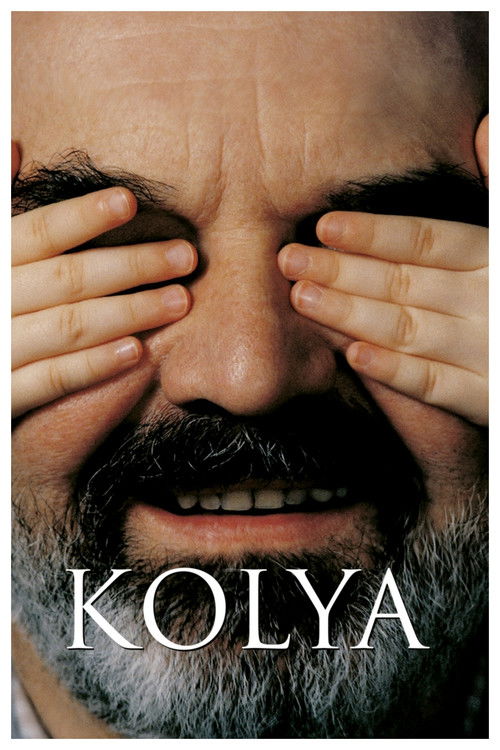
Kolya
1996 · Jan Svěrák
For a gentle night when you want to feel your heart grow a size — comfort viewing with real substance, the kind of film to watch when the news has worn you down and you need proof people can change.
What it's about
Prague, 1988, with the old regime creaking toward collapse. František Louka, a middle-aged cellist blacklisted from the Philharmonic and reduced to playing funerals and gilding tombstones, agrees to a paper marriage with a Russian woman who needs Czech residency — strictly for the money. Then she vanishes to the West, leaving behind her five-year-old son Kolya, who speaks no Czech, in the care of a confirmed bachelor who wanted nothing less than a child.
The experience
Warm, wry, and unhurried, with a melancholy streak running under the comedy — it sneaks up on you, trading big laughs for small thaws until you realize you're completely invested in this odd little household. It earns its emotion honestly, without forcing a single tear.
Performances
Zdeněk Svěrák (the director's father, who also wrote the screenplay) gives Louka a rumpled, roguish charm that makes his slow surrender to the boy believable, and little Andrei Chalimon is naturally, unaffectedly winning as Kolya — their scenes together never feel coached.
The craft
A father-son collaboration behind the camera as well as in front of it: Jan Svěrák directs his father's script with a light, patient hand, letting late-communist Prague — crematoriums, trams, cramped flats, cello rehearsals — do the storytelling. Music threads through everything, and the film's images of the city on the eve of upheaval have a burnished, lived-in beauty.
Why it matters
It won the Academy Award for Best Foreign Language Film and became the international face of post-communist Czech cinema, catching the moment when the Velvet Revolution could finally be looked back on with tenderness rather than anger.
Snapshot
Kolja is a Czech chamber drama-comedy set in Prague in 1988, on the eve of the Velvet Revolution, that uses the forced cohabitation of a middle-aged Czech bachelor and a small Russian boy to stage, in miniature, the thaw of a frozen political order. František Louka, a once-eminent cellist expelled from the Czech Philharmonic for a political blemish on his record, scrapes by gilding tombstone inscriptions and playing at crematorium funerals. Chronically short of money and incorrigibly unattached, he agrees to a paper marriage with a Russian woman seeking Czech residency. When she absconds to West Germany to join a lover, her five-year-old son Kolya is left in Louka's reluctant care. The film's engine is the slow erosion of the man's resistance — to fatherhood, to attachment, and, by extension, to the Russian "occupier" the boy unwittingly personifies. Directed by Jan Svěrák from a screenplay by his father Zdeněk Svěrák, who also plays Louka, Kolya won the Academy Award and the Golden Globe for Best Foreign Language Film, becoming the most internationally visible Czech film of the post-Communist decade.
Industry & production
Kolya was produced in the mid-1990s, a turbulent period for Czech cinema following the 1993 dissolution of Czechoslovakia and the privatization of the state-run Barrandov Studios, the historic Prague production complex. The collapse of the centralized funding model that had sustained Czech filmmaking left producers assembling financing from a patchwork of domestic and foreign sources. Kolya was an international co-production drawing on Czech, British, and French involvement, reflecting the era's necessity of cross-border partnership for ambitious Czech projects. The film was the third feature directed by Jan Svěrák and the most prominent fruit of the father-son partnership between Jan and Zdeněk Svěrák, who had already collaborated on Obecná škola (The Elementary School, 1991), itself an Academy Award nominee for Best Foreign Language Film.
The production was modest in scale by international standards but carefully appointed, shot on location in Prague to capture the gray, late-socialist texture of the city in its final pre-revolutionary year. The decision to cast Zdeněk Svěrák — a beloved figure in Czech culture as a writer, actor, and humorist long associated with the Jára Cimrman theatrical tradition — in the lead role both anchored the film domestically and gave the screenplay's autobiographical warmth a living embodiment. The casting of a genuinely Russian-speaking child, Andrei Chalimon, in the title role was a practical and aesthetic gambit central to the film's authenticity; the language barrier between actor and co-star is real and visible on screen.
Technology
Kolya was photographed on 35mm film and released as a conventional theatrical feature, employing no exceptional or novel technology — appropriate to a character-driven chamber piece of its period. Its technical ambitions lie in craft rather than innovation: precise location shooting, naturalistic interiors, and a restrained palette suited to its overcast Prague setting. The film predates the digital-intermediate workflows that would soon transform color management, and its look derives from traditional photochemical means. Where the production invested technically was in the controlled, painterly quality of its image and the integration of a substantial orchestral and chamber-music score into the sound design, given that the protagonist's profession is music itself. The record does not indicate any specialized technological process beyond standard professional 35mm practice of the mid-1990s.
Technique
Cinematography
The cinematography is credited to Vladimír Smutný, a frequent Svěrák collaborator whose work here favors a muted, autumnal palette and an unhurried, observational framing well matched to the film's tone. The camera tends to hold and watch rather than agitate, letting performance and gesture carry scenes. Smutný draws a quiet visual contrast between the cramped, dim interiors of Louka's apartment and the wider, light-filled spaces — the cemetery, the rooftops of Prague, the countryside — that open up as the relationship between man and boy deepens. Prague is photographed without postcard prettiness; the late-socialist city is rendered in its worn grays, with the warmth of the image reserved increasingly for human faces as the narrative softens. Compositions frequently exploit the disparity of scale between the tall, lanky Louka and the small child, using the frame itself to dramatize the imbalance that the story works to resolve.
Editing
The editing sustains a deliberate, gentle rhythm consistent with the film's emotional register; it is a picture built on accumulation and small reversals rather than on cutting energy. Scenes are allowed to breathe, particularly in the wordless passages where communication must pass between a Czech man and a Russian boy who share no common language — moments where the cut respects the duration of glances, hesitations, and gradual understanding. The pacing accelerates only as the political world outside intrudes, building toward the convergence of the personal story with the public eruption of the Velvet Revolution. The editor's restraint is itself a technique: the film trusts the viewer to register feeling without underlining.
Mise-en-scène / staging
The mise-en-scène is grounded in the lived-in clutter of late-Communist domestic life — Louka's bachelor apartment, the music stands and instruments, the bureaucratic offices, the funeral parlor. Production design conveys period and class without ostentation, and the staging repeatedly organizes itself around the central pairing, framing adult and child within shared spaces they must learn to occupy together. The crematorium, the cemetery where Louka regilds inscriptions, and the bathhouse-like ordinariness of socialist public space give the film a strong sense of place. Props carry weight: the cello, the telephone over which Louka conducts his complicated love life, and the small possessions of the boy that humanize an initially unwelcome intruder.
Sound
Sound is unusually significant given the protagonist's vocation. The score, composed by Ondřej Soukup, integrates classical and chamber textures appropriate to a film about a cellist, and music functions both diegetically — Louka's funeral playing, his orchestral career — and as emotional commentary. Equally important is the film's treatment of the spoken word and its absence. The Czech-Russian language divide is a structuring sonic element: much of the relationship is built in the gaps where words fail, and the gradual leakage of Russian and Czech across that barrier marks the thawing bond. The sound design treats silence, ambient room tone, and the textures of the city as expressive resources.
Performance
Performance is the film's center of gravity. Zdeněk Svěrák's Louka is a study in rumpled, self-deprecating charm slowly overtaken by tenderness; the actor underplays, letting irritation, vanity, and dawning affection register in small adjustments rather than declarations. The performance's intimacy is inseparable from the fact that Svěrák wrote the role for himself. Opposite him, Andrei Chalimon delivers a remarkably unaffected child performance, his genuine incomprehension of Czech lending the cross-language scenes an authenticity that could not have been manufactured. The supporting cast — including the veteran Czech actress Libuše Šafránková, an icon of Czech screen acting, as Louka's lover — provides a warm ensemble surround. The chemistry between the gangling adult and the small boy is the achievement on which the entire film rests.
Narrative & dramatic mode
Kolya operates in the mode of humane tragicomedy, balancing genuine pathos against a persistent gentle irony. Its dramatic architecture is the familiar one of the reluctant guardian — the confirmed bachelor forced into improvised fatherhood — but the film refreshes the template by braiding it tightly with a specific historical moment. The narrative is essentially two-stranded: the private story of an emotional conversion, and the public story of a society approaching the end of Soviet domination. The film's craft lies in making the two strands rhyme without forcing allegory too crudely: Louka's softening toward the Russian child shadows the larger, more fraught question of how Czechs might regard Russians once the occupation ends. The tone modulates carefully, never tipping into sentimentality despite courting it; the comedy of Louka's predicament keeps the sweetness in check, and the looming politics keep the comedy grounded. The resolution arrives with the boy's departure and the country's liberation arriving almost together, granting the personal story a public crescendo.
Genre & cycle
The film sits at the intersection of domestic comedy-drama and the post-Communist reckoning film. As a "reluctant parent" story it belongs to a broad international genre, but its particular cycle is the wave of Central and Eastern European films of the 1990s that revisited the late-socialist era from the vantage of newly won freedom, processing the recent past through intimate human stories rather than political polemic. Within Czech cinema specifically, Kolya extends a long-standing national affinity for tragicomedy and the "little man" protagonist, descended from the Czechoslovak New Wave of the 1960s. It also belongs to the loose cycle of Svěrák family films that mine ordinary Czech lives for warmth and wry observation, a vein the elder Svěrák had worked across decades of writing.
Authorship & method
Kolya is best understood as a dual-authored work. Jan Svěrák directs with an unobtrusive classicism, prioritizing performance, clarity, and emotional truth over stylistic display — a method already evident in The Elementary School and continued in his later Dark Blue World (2001) and Empties (Vratné lahve, 2007). Zdeněk Svěrák is the film's other author: screenwriter, lead actor, and the source of its sensibility, his characteristic blend of humor and humanism shaping the material from the inside. The collaboration is unusual in world cinema for its closeness — a son directing his father in a role the father wrote for himself — and it lends the film a distinctive intimacy.
The key technical collaborators recur across Jan Svěrák's filmography. Cinematographer Vladimír Smutný's restrained, atmospheric image-making is integral to the director's house style. Composer Ondřej Soukup supplies a score whose classical grounding suits the musician protagonist. The editing maintains the patient rhythm the material demands. The method throughout is one of subordinating technique to story and performance: a cinema of warmth and observation rather than of formal experiment.
Movement / national cinema
Kolya is a landmark of post-Communist Czech national cinema. It carries forward the inheritance of the Czechoslovak New Wave — the movement of the 1960s associated with directors such as Miloš Forman, Jiří Menzel, and Věra Chytilová, known for its tragicomic humanism, its attention to ordinary people, and its sly resistance to authority. Where the New Wave worked under censorship, Kolya enjoys the freedom to look back at the socialist era directly, and it does so in the New Wave's characteristic key of gentle, ironic compassion rather than bitterness. The film stands as evidence that Czech cinema could still command international attention after the dislocations of the early 1990s, and it became, for a wide global audience, a defining image of the Czech sensibility — humane, droll, and quietly melancholic.
Era / period
The film is doubly anchored in period. Diegetically it is set in 1988–1989, in the last months of Communist Czechoslovakia, culminating in the Velvet Revolution of November 1989 that brought the regime down peacefully. The dying days of the system are everywhere in the texture: the surveillance and suspicion of the secret police investigating Louka's sham marriage, the bureaucratic indignities, the pervasive Soviet presence the film treats with complicated feeling. As a production, it belongs to the mid-1990s, made by filmmakers looking back across the watershed of 1989 from within the new democratic republic. This retrospective vantage is essential to its meaning: the film knows how the history turned out, and it lets the audience's foreknowledge of the coming liberation suffuse the private drama with hope. The convergence of Kolya's personal story with the revolution gives the period setting its emotional payoff.
Themes
The film's governing theme is reconciliation across imposed enmity — the discovery of love where politics has dictated suspicion. Louka's prejudice against the Russian boy carries the weight of a nation's resentment toward its occupier, and the dissolving of that prejudice enacts a hopeful fantasy of post-imperial healing. Fatherhood and chosen family form the second great theme: parenthood arrives by accident and obligation, yet becomes the agent of the protagonist's redemption from a hollow, self-serving life. Freedom — personal and national — runs throughout, the two scales reinforcing one another as the man's emotional liberation coincides with his country's political one. Subsidiary themes include the dignity and absurdity of life under a decaying authoritarian system, the role of art and music as a sustaining value, and the moral compromises that ordinary survival demands. Underlying all of these is the film's characteristic conviction that human warmth outlasts ideology.
Reception, canon & influence
Kolya was received as a major international success and remains the best-known Czech film of its decade. Its crowning recognitions were the Academy Award for Best Foreign Language Film and the Golden Globe in the same category, honors that confirmed the global resonance of its blend of intimacy, humor, and historical poignancy. Critically, it was widely praised for the chemistry between Zdeněk Svěrák and Andrei Chalimon and for the deftness with which it married a sentimental premise to a serious historical subject without collapsing into kitsch — though some critics noted that its emotional design is unabashedly crowd-pleasing.
Looking backward, the film's influences lie in the Czechoslovak New Wave's tragicomic humanism and the long Czech literary-cinematic tradition of the put-upon "little man," as well as in the broad international lineage of odd-couple and reluctant-guardian stories. Zdeněk Svěrák's own decades of work as a writer and performer steeped in Czech comic and humanist culture are the most direct creative antecedent.
Looking forward, Kolya consolidated Jan Svěrák's standing as the leading Czech director of his generation and set the template for the warm, accessible, internationally legible Czech cinema he would continue to make, notably in Dark Blue World and Empties. More broadly, it became a touchstone of post-Communist Eastern European filmmaking that processes the socialist past through personal, affectionate storytelling rather than recrimination — demonstrating to international audiences and funders alike that a small national cinema could reach the world stage on the strength of human feeling. Its influence is felt less in stylistic imitation than in the model it offered: that the intimate and the historical, handled with restraint, can illuminate each other. Beyond these broad lines of reception and legacy, detailed scholarship tracing specific later films directly to Kolya is comparatively thin, and claims of precise influence should be treated with corresponding caution.
A Deleuzian reading
Start with the gold.
The full Deleuzian reading of Kolya →
Reception
An instant international crowd-pleaser in 1996 — it swept the Foreign Language Oscar and the Golden Globe — but its reputation abroad has since settled into 'that sweet Czech Oscar winner,' the kind of gentle mid-90s pick cinephiles now file under Academy comfort food, even as it remains a genuine classic at home.
How Kolya was received, from release to now →
Influences: the films it descends from and the films it influenced
- The Shop on Main Street (1965) — The earlier Czechoslovak foreign-Oscar template Kolya rhymes with: vast political history (occupation, persecution) refracted entirely through one reluctant-guardian dyad of opposites, tragicomic tone held until grief breaks through.
- Loves of a Blonde (1965) — Czech New Wave observational tragicomedy — humor mined from ordinary embarrassment via near-documentary framing and non-professional naturalism, the unobtrusive register Jan Svěrák inherits.
- The Firemen's Ball (1967) — Deadpan ensemble comedy of small-people foibles staged in patient observational takes that let behavior, not cutting, carry the joke — Smutný's restrained coverage descends from this.
- Closely Watched Trains (1966) — The Hrabalian 'little man' coming of age against the weight of history, mixing gentle comedy with sudden mortality — the put-upon-everyman humanism Zdeněk Svěrák writes from.
- The Elementary School (1991) — Direct antecedent: the same father-writes-and-stars / son-directs authorship, a child's-eye view of a recent historical moment, rendered in the same unobtrusive classicism.
- The Kid (1921) — Founding reluctant-guardian grammar: the scale-disparity two-shot of a big resourceless man and a small child, sentiment continually undercut and re-earned through comic business.
- Bicycle Thieves (1948) — Neorealist framing of an adult and child traversing a city side by side, the boy's unsentimental presence as moral witness, history carried by an intimate two-person bond.
- Paper Moon (1973) — The con-artist-and-child odd couple whose warmth is built episodically, the child's blunt realism puncturing the self-interested adult until guardianship sticks despite him.
- Kramer vs. Kramer (1979) — A man with no aptitude for childcare learning tenderness through repeated domestic routine, played in underplayed naturalistic register rather than melodrama — Zdeněk Svěrák's mode exactly.
- Dark Blue World (2001) — Same craft unit — Vladimír Smutný's atmospheric image-making, Ondřej Soukup's classically grounded score, Zdeněk Svěrák's screenplay — applied again to history processed through personal feeling.
- Empties (2007) — The father-son collaboration continued: Zdeněk Svěrák writing himself a self-effacing aging 'little man' lead, the same warm tragicomic restraint and house team.
- Divided We Fall (2000) — Post-Communist Czech tragicomedy that, like Kolya, smuggles history's enemy into the home as reluctant guardianship across enmity, choosing affectionate humor over recrimination.
- Cosy Dens (1999) — The late-socialist period read entirely through domestic and family intimacy, the political registering as tone and texture of ordinary life rather than as overt statement.
- Central Station (1998) — A gruff self-interested adult and an orphaned boy as a road odd-couple, guardianship softening across proximity and a class/language gap — the international humanist parallel to Kolya's bachelor-and-boy.
- Kikujiro (1999) — An abrasive man escorting a small child, built on scale-disparity framing and deadpan observational stretches that thaw into tenderness without sentimental scoring.
- The Way Home (2002) — Reconciliation across a generational and literal language divide (a mute grandmother and a city boy) achieved through near-wordless observational framing — Kolya's language-barrier-as-structure in another key.
Similar films
- Closely Watched Trains (1966) — influence & lineage
- Au Revoir les Enfants (1987) — often watched together
- Good Bye, Lenin! (2003) — often watched together
- My Life as a Dog (1985) — often watched together
- Babette's Feast (1987) — often watched together
- Marketa Lazarová (1967) — shared sensibility
- Son of the Bride (2001) — shared sensibility
- The Quiet Girl (2022) — shared sensibility