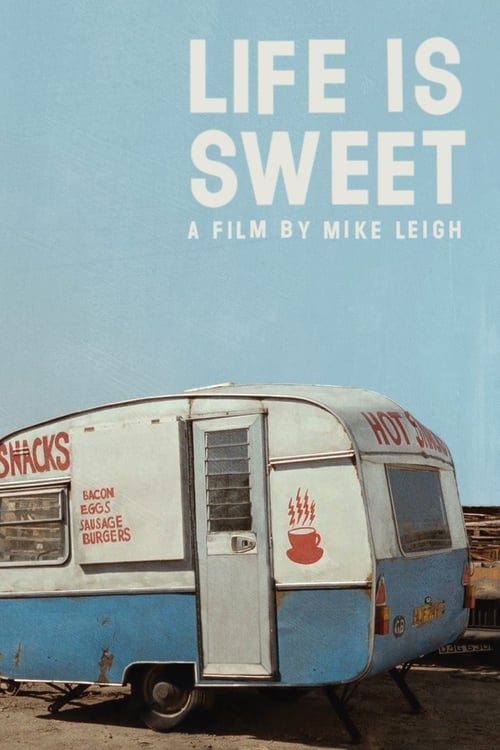
Life Is Sweet
1991 · Mike Leigh
For when you want real life on screen — a laugh and a lump in the throat in the same scene. Comforting in its warmth, but honest enough to sting; good for a night you want to feel connected to ordinary people.
What it's about
A working-class family in the north London suburbs, observed over a few ordinary weeks: Wendy, relentlessly upbeat, clerking in a shop; Andy, a hotel chef full of deferred dreams and unfinished DIY; and their twin twenty-something daughters — Natalie, a practical plumber, and Nicola, jobless, furious, and secretly battling an eating disorder. Around them orbit friends with doomed get-rich schemes, including a spectacularly misguided new restaurant. Nothing enormous happens; everything that matters does.
The experience
Funny and then suddenly not — it lulls you with banter and eccentric comedy, then lands emotional blows you don't see coming. It feels less like watching a film than living with a family until you love them, cringes and all.
Performances
A murderers' row of British acting caught early: Alison Steadman's tirelessly cheerful Wendy, Jim Broadbent's gentle deferred dreamer, Jane Horrocks harrowing and hilarious as the raging Nicola, and Timothy Spall gloriously awful as a would-be restaurateur. The ensemble feels less performed than inhabited.
The craft
Built through Mike Leigh's signature method — months of improvisation with the actors before a script existed — so every gesture and half-sentence feels lived-in rather than written. The comedy and the pain sit in the same frame without the film ever tipping its hand about which you're supposed to feel.
Why it matters
The film where Leigh's mature method fully clicked, opening the run that made him the standard-bearer for British realist cinema through the '90s. Its mix of tenderness and mercilessness became the model for a whole strain of tragicomic family drama.
Snapshot
Life Is Sweet is Mike Leigh's third theatrical feature and the film on which his mature method — months of improvisation and character-building with actors, gradually condensed into a fixed shooting structure — first cohered into something both tender and merciless. Set in a pebbledashed semi in the north London suburbs (the production worked in and around Enfield), it observes a working-class family across a few unremarkable weeks: Wendy (Alison Steadman), relentlessly cheerful; her husband Andy (Jim Broadbent), a hotel chef forever deferring his own ambitions; and their twin daughters, the practical, jeans-and-toolbelt plumber Natalie (Claire Skinner) and the housebound, anorexic-bulimic, rage-filled Nicola (Jane Horrocks). Around them orbit two grotesques of small-time aspiration: Aubrey (Timothy Spall), opening a doomed gourmet restaurant, and Patsy (Stephen Rea), who sells Andy a derelict snack van. The film has almost no plot in the conventional sense; its drama is the slow pressure of love, appetite, disappointment and resilience inside one household. It is a comedy that turns, in its final movement, into one of British cinema's most piercing studies of self-harm and family endurance.
Industry & production
Life Is Sweet was produced by Thin Man Films, the company Leigh formed with producer Simon Channing-Williams, with financing assembled from British Screen, Channel 4 (through its film arm), and other backers in the characteristic patchwork that kept British art cinema alive after the collapse of the old studio infrastructure. Leigh had spent the previous two decades largely in television — landmark plays like Abigail's Party (1977), Nuts in May, and Meantime (1983) — and had returned to cinemas only with High Hopes (1988). Life Is Sweet consolidated the model he would use for the rest of his career: relatively modest budgets, complete creative control predicated on that modesty, and a development process unlike anyone else's in the industry. Because Leigh begins without a finished screenplay — actors are hired on trust, before they know their roles — financiers were effectively investing in a method and a track record rather than a readable script, which constrained budgets but preserved his autonomy. The film opened in the UK and then, crucially, found an enthusiastic arthouse audience in the United States, where it became a sleeper success on the specialty circuit and did much to establish Leigh as an internationally bankable auteur, setting up the run that would culminate in the Palme d'Or for Secrets & Lies (1996).
Technology
There is little to flag here that distinguishes the film technologically, and it would be false to claim otherwise. Life Is Sweet was shot on 35mm color film in 1991 using conventional equipment, finished and distributed photochemically. Leigh's cinema has always been resolutely un-showy at the level of apparatus; his innovations are in process and performance, not in cameras, lenses, or post-production tools. The most "technological" fact worth noting is a negative one: the production's resources went overwhelmingly into time — the long rehearsal and improvisation period — rather than into any visible hardware. The look is naturalistic, available-light-inflected interior work and flat suburban daylight, achieved with craft rather than novelty.
Technique
Cinematography
Life Is Sweet marks the beginning of Leigh's long partnership with cinematographer Dick Pope, who would shoot nearly all of his subsequent films. The visual strategy is one of disciplined plainness: a slightly heightened naturalism that respects the actors' blocking and gives the performances room without editorializing. Pope favors steady, often static or minimally mobile framing, medium and medium-long shots that hold two or three figures in a cramped domestic space, letting the geometry of kitchen, sofa, and bedroom express the family's proximity and friction. Color is keyed to the suburban palette — beige, brick, the bright synthetic hues of cheap consumer goods and Aubrey's appalling restaurant décor — and the lighting stays close to the plausible sources of these interiors. The camera's reticence is a deliberate ethical posture: it watches, it does not pounce, even when the material (Nicola's binge-and-purge, her sexual ritual with chocolate) is at its most exposing.
Editing
Edited by Jon Gregory, the film is cut for behavioral truth rather than momentum. Scenes are allowed to run to their natural, sometimes uncomfortable length; comic exchanges build through accumulation and repetition (Aubrey's monologues, Wendy's nervous laughter) rather than through punchy cutting. The structure is episodic and accretive — a mosaic of domestic encounters whose meaning emerges only cumulatively — and the editing trusts the viewer to assemble the family portrait from fragments. The decisive editorial gamble is tonal: the picture withholds its devastating central confrontation between Wendy and Nicola until late, so that scenes of farce (the restaurant's catastrophic opening night) sit only a few cuts away from raw familial grief. The rhythm of that juxtaposition — comedy and pain held in the same body of the film — is Leigh's signature, and it is realized in the cutting.
Mise-en-scène / staging
The mise-en-scène is documentary-dense with the texture of a real lived-in home: the half-finished extension Andy never completes, the clutter of a working kitchen, the iconography of suburban striving. Staging is theatrically precise beneath the naturalism — unsurprising given Leigh's roots — with characters arranged to dramatize who is included and who is excluded, who can sit at the family table and who eats alone. Aubrey's restaurant, "The Regret Rien," is a masterpiece of designed bad taste, its pretentious Franco-pastiche menu and gaudy fittings externalizing his delusion. Costume and props do enormous characterizing work: Natalie's androgynous work clothes against Nicola's grubby ME-shirt and dark glasses, Wendy's relentless bright knits, the snack van as a rusting emblem of doomed enterprise.
Sound
The sound design is unobtrusively naturalistic, prioritizing the dense, overlapping, often interrupting speech that is the real music of a Leigh film. Rachel Portman's score — an early credit in a career that would become one of the most prominent in film composing — is used sparingly and warmly, lending the suburban material a lyrical, slightly melancholic lift without sentimentalizing it. The film generally lets domestic ambience and dialogue carry the scenes, reserving music to inflect transitions and the more tender beats.
Performance
Performance is the film's reason for being, and the ensemble is extraordinary. Alison Steadman (then married to Leigh) gives Wendy a febrile, giggling optimism that the film gradually reveals as a hard-won discipline rather than mere ditziness — a mother holding a family together by sheer willed brightness. Jim Broadbent's Andy is all deferred dreams and gentle ineffectuality. Claire Skinner and Jane Horrocks, as twins who could not be less alike, anchor the emotional architecture: Skinner's grounded warmth against Horrocks's coiled, stammering, self-lacerating fury. Horrocks's Nicola is one of the great screen portraits of an eating disorder — physically transformed, defended behind sarcasm and dark glasses, terrified beneath the contempt. Timothy Spall's Aubrey and Stephen Rea's Patsy supply comic grotesquerie that never quite tips into caricature. Crucially, these are co-authored performances: under Leigh's method the actors built these people over months, and the depth on screen is the residue of that invention.
Narrative & dramatic mode
The film operates in a mode of observational tragicomedy with almost no externally imposed plot. There is no quest, no crime, no romance to resolve; there is only a family persisting. Narrative information arrives the way it does in life — through overheard exchanges, accumulating habit, and one or two scenes that crack the surface. The dramatic engine is the gap between the family's relentless surface cheer and the despair lodged at its center in Nicola. Leigh structures the film so that the audience laughs for a long time before it understands what it has been watching, then delivers a sustained mother-daughter confrontation that reframes everything preceding it. This is realism in the British social-observational tradition, but pushed toward the heightened and the emblematic: each character carries a relationship to appetite, work, and self-worth that the film quietly orchestrates into a larger argument.
Genre & cycle
Life Is Sweet sits at the intersection of British social realist drama and character comedy — a hybrid Leigh effectively made his own. It belongs to the broader lineage of the British "kitchen sink" tradition descending from the Free Cinema and New Wave of the late 1950s and early 1960s, but it departs from that tradition's earnest sociological seriousness by admitting genuine, sustained comedy and by refusing the angry-young-man heroics. Within Leigh's own filmography it forms part of a cycle of suburban and working-class family studies — High Hopes before it, Secrets & Lies and All or Nothing after — that examine ordinary English lives under economic and emotional pressure. It also participates in the early-1990s renaissance of Channel 4–backed British cinema that prized authorship and social specificity over genre formula.
Authorship & method
The film is unmistakably Leigh's, and understanding it requires understanding his process. Leigh does not write a screenplay in advance. He casts actors who agree to work without knowing their parts, then develops each character individually through extensive one-on-one work and biographical invention, gradually bringing characters into improvised contact, observing what emerges, and only then structuring and scripting scenes that the actors have, in effect, discovered. The dialogue is honed and fixed for shooting — this is not improvisation on camera — but its texture is grown rather than written. The result is a co-authorship in which performance and writing are inseparable, even as final authority remains Leigh's.
His key collaborators here are foundational to his career. Dick Pope (cinematography) begins the partnership that defines Leigh's visual identity. Jon Gregory (editing) shapes the accretive rhythm. Rachel Portman (music) provides the warm, restrained scoring. Producer Simon Channing-Williams, Leigh's partner in Thin Man Films, built the financial conditions that made the method possible. And the actors — Steadman, Broadbent, Horrocks, Skinner, Spall, Rea, with a young David Thewlis appearing as Nicola's frustrated lover — are, by the logic of Leigh's process, genuine creative collaborators in the film's authorship.
Movement / national cinema
Life Is Sweet is a quintessential work of late-twentieth-century British national cinema, and specifically of the social-realist strand that distinguishes British art film internationally. It can be read alongside the contemporaneous work of Ken Loach as the two poles of that tradition — Loach more overtly political and agitational, Leigh more attentive to the comedy and intimate cruelty of family and character. Both depended on the same institutional ecology: Channel 4, British Screen, and the public-service and subsidy structures that sustained authored British filmmaking when commercial production was thin. The film's Englishness is not incidental but constitutive: its class signifiers, suburban geography, idiom, and humor are deeply specific, and part of its achievement is that this specificity traveled — American audiences embraced it precisely as a window onto a textured, recognizable elsewhere.
Era / period
The film is a document of England at the turn from the Thatcher decade into the early 1990s. Its preoccupations — small entrepreneurial dreams (Andy's snack van, Aubrey's restaurant), aspiration curdling into delusion, the dignity and precariousness of working life — register the residue of a decade that exalted enterprise while hollowing out security. Nicola's politicized, half-articulate rebellion and her self-destruction can be read as one generation's response to that climate, set against her parents' older ethic of graft and endurance. Without ever becoming a thesis film, Life Is Sweet captures the emotional weather of its moment: a society told to better itself, and the human cost when the tools for doing so are unequal to the dream.
Themes
Appetite is the film's master metaphor, worked through with remarkable consistency. Food is everywhere — Andy the chef, Aubrey's grotesque haute-cuisine menu, Wendy's nurturing meals, and above all Nicola's binge-and-purge cycle and her disturbing erotic use of chocolate. Eating becomes the index of every character's relationship to desire, control, love, and self-worth: nurture versus self-destruction, consumption versus emptiness. Around this cluster the film develops its other themes: the resilience required to sustain a family; optimism as labor rather than temperament; the dignity of ordinary work; deferred dreams and the danger of dreams pursued without self-knowledge; and the difficulty, between people who love each other, of saying the true thing. The title is double-edged — sincerely affirmative and quietly ironic at once — and the film earns both readings.
Reception, canon & influence
Life Is Sweet was widely and warmly reviewed, and it proved a turning point in Leigh's international standing, performing notably well with American critics and arthouse audiences. It drew particular acclaim for its performances, with Jane Horrocks's Nicola and Alison Steadman's Wendy singled out; the film received significant recognition from U.S. critics' organizations, including honors from the National Society of Film Critics for its acting. (I'd flag that the exact slate of awards is worth verifying against a reference list rather than asserting precisely from memory.) Over time the film has settled into the canon as one of Leigh's essential works and a touchstone of modern British realism, frequently revived and reassessed.
Looking backward, its influences are the British social-realist and kitchen-sink tradition, the character-comedy of Leigh's own television plays, and a humanist documentary impulse that prizes observation over plot. Looking forward, its legacy is twofold. Within Leigh's career it is the proof-of-concept for the method and tone that produced Naked (1993), Secrets & Lies (1996), Topsy-Turvy, Vera Drake, and beyond, and it launched the Pope partnership and Thin Man Films as a durable production base. More broadly, it helped legitimize a strain of tragicomic, performance-driven realism that influenced a generation of British filmmakers and television dramatists, and it remains a reference point for the serious screen treatment of eating disorders and for the idea that the deepest drama can be found in an ordinary family doing nothing more than getting through the week.
A Deleuzian reading
Start with the worst thing in the film, because Mike Leigh makes you wait so long to see it.
The full Deleuzian reading of Life Is Sweet →
Reception
A critical darling on release — the US National Society of Film Critics named it 1991's Best Picture — it then spent years overshadowed by Naked and Secrets & Lies before a 2013 Criterion edition helped restore its standing as one of Leigh's very best.
How Life Is Sweet was received, from release to now →
Influences: the films it descends from and the films it influenced
- Bleak Moments (1971) — Leigh's feature debut establishes the entire method later used here — casting actors who build characters through months of one-on-one biographical improvisation before any scene is scripted.
- Faces (1968) — Pioneers the performance-first ensemble in which sustained, semi-improvised actor behavior — not plot — carries the film, the co-authorship model Leigh formalizes.
- A Woman Under the Influence (1974) — Locates wrenching domestic drama in a single home and a wife's psychological unraveling observed at length, prefiguring Leigh's lived-in kitchen-table breakdowns.
- Kes (1969) — Loach's non-judgmental observational camera and regional working-class naturalism, using behavior and idiom over dramatic incident, is the documentary-humanist impulse Leigh inherits.
- Saturday Night and Sunday Morning (1960) — Founding kitchen-sink text — places undramatized working-class domestic routine and dialect at the center of serious cinema, the genre lineage Life Is Sweet extends.
- A Taste of Honey (1961) — Centers a fraught mother–daughter household and female working-class interiority within kitchen-sink realism, the domestic-female axis Wendy and Nicola occupy.
- Abigail's Party (1977) — Leigh's televised improvised ensemble piece, with Alison Steadman, perfects the suburban tragicomedy of social performance and excruciating hospitality reworked here.
- High Hopes (1988) — Immediate stylistic sibling — same improvised method applied to a post-Thatcher London family, with tonal juxtaposition of comic caricature against tender pathos.
- Loves of a Blonde (1965) — Builds its comedy of embarrassment from dialogue rehearsed to sound improvised and overheard — the direct inheritance of Forman's carefully constructed 'caught' ordinary talk.
- Naked (1993) — Direct method descendant — extends the Pope cinematography partnership and David Thewlis's improvised-character work into a darker register of the same process.
- Secrets & Lies (1996) — Carries forward the delayed-revelation structure and the long, real-time co-authored two-hander built from buried family truth surfacing under emotional pressure.
- Nil by Mouth (1997) — Inherits the lived-in domestic detail and overlapping naturalist dialogue of a working-class household, observed without authorial judgment.
- Ratcatcher (1999) — Extends British social realism into a heightened, sensory naturalism that finds poetic image-making within ordinary working-class environments.
- This Is England (2006) — Builds its ensemble through extensive pre-shoot character improvisation in the Leigh manner, anchoring period social realism in co-authored performance.
- Fish Tank (2009) — Combines heightened naturalism with a fraught working-class mother–daughter household and the body/appetite as a register of class desire, extending Leigh's domestic observation.
- Together (2000) — Models the tonal recipe of satirizing a milieu while loving its people — a family ensemble whose foibles are observed with unsentimental clarity, the exact balance Moodysson strikes with the commune.
- Distant Voices, Still Lives (1988) — Builds a working-class family portrait through accretive, episodic, memory-like vignettes rather than linear plot, paralleling Leigh's accretive editing rhythm.
- Riff-Raff (1991) — Contemporaneous post-Thatcher social realism using overlapping regional dialogue and semi-improvised, near-documentary workplace texture.
Similar films
- Bleak Moments (1971) — influence & lineage
- Secrets & Lies (1996) — influence & lineage
- Naked (1993) — influence & lineage
- A Taste of Honey (1961) — influence & lineage
- Nil by Mouth (1997) — influence & lineage
- Another Year (2010) — shared sensibility
- Meantime (1983) — shared sensibility
- Hard Truths (2024) — shared sensibility
All the films related to Life Is Sweet →