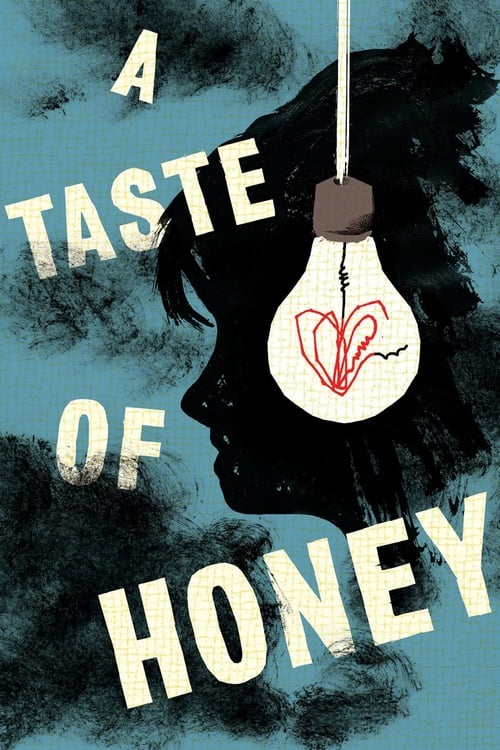
A Taste of Honey
1961 · Tony Richardson
For when you want a small, human film that earns its emotions — a rainy-afternoon watch that leaves you moved rather than wrecked, and thinking about the families we choose.
What it's about
In the industrial north of England, sixteen-year-old Jo lives in shabby lodgings with her self-absorbed, hard-drinking mother, who's more interested in men than in her daughter. A brief romance with a Black sailor leaves Jo pregnant and on her own — until a gentle gay art student named Geoffrey moves in, and the two misfits improvise something like a family.
The experience
Tough and tender at once: unsentimental about poverty and neglect, but full of wit, warmth, and stolen moments of joy along canals and under fairground lights. It sneaks up on you — funny in one breath, quietly heartbreaking in the next.
Performances
Rita Tushingham's debut as Jo is one of the great first performances in British film — all wary eyes and sudden defiance — and Dora Bryan is horribly, hilariously vivid as her negligent mother.
The craft
Shot on real streets and canals of industrial Manchester, it brought documentary grit into fiction filmmaking, and Walter Lassally's black-and-white photography finds bleak beauty in smokestacks and terraced houses. Shelagh Delaney adapted her own groundbreaking play, keeping its salty, working-class voice intact.
Why it matters
A defining film of the British New Wave, it put working-class women's lives — single motherhood, interracial romance, gay friendship — on screen with a frankness that was startling in 1961 and helped reshape what British cinema could be about.
Snapshot
A sixteen-year-old girl in Salford has a brief affair with a Black sailor, becomes pregnant, and finds her only tenderness in the companionship of a gay art student. Adapted by Shelagh Delaney and Tony Richardson from Delaney's landmark 1958 play, A Taste of Honey is one of the defining documents of the British New Wave: an unsentimental yet deeply compassionate portrait of precarity, improvised kinship, and lives shaped by structures they cannot name. Shot on the streets and canals of industrial Manchester by Walter Lassally, the film brought the aesthetics of the Free Cinema documentary into dramatic fiction and produced one of the great debut performances in British cinema history, in Rita Tushingham's Jo.
Industry & production
A Taste of Honey was produced by Woodfall Film Productions, the company Tony Richardson had co-founded in 1958 with playwright John Osborne and producer Harry Saltzman following the success of the stage and film versions of Look Back in Anger. Woodfall would become the institutional engine of the British New Wave, financing low-budget, location-shot features with a creative mandate that put writers and directors ahead of commercial formula. The company worked in the interstices of British film financing, drawing on support from Bryanston Films and, for distribution, British Lion.
Shelagh Delaney had written the original play in 1958 when she was eighteen, reportedly after seeing a Terence Rattigan production and deciding she could do better. Joan Littlewood's Theatre Workshop at Stratford East premiered it that year, giving it the physical, improvisatory energy that would survive into the film. Delaney co-wrote the screenplay with Richardson, and the collaboration was close enough that much of the play's dialogue passes into the film almost verbatim, though Richardson opened the action considerably onto location exteriors that the stage could only gesture toward.
The casting was decisive. Rita Tushingham was an unknown stage actress from Liverpool; her selection over many more established candidates reflected Richardson's preference for freshness and credibility over star quality. Dora Bryan, playing Jo's mother Helen, brought genuine music-hall timing to the role. Murray Melvin reprised his stage performance as Geoffrey, making the journey from Theatre Workshop to the screen with his character's gentle particularity intact. Paul Danquah played Jimmy, Jo's sailor lover, in a piece of casting that was itself a statement of intent. Robert Stephens played Peter, Helen's brash new husband. The ensemble was held together by an ethos of behavioral truth rather than theatrical projection.
Technology
A Taste of Honey was shot in black and white on 35mm, a choice that in 1961 was beginning to read as consciously anti-glamour rather than merely economical. The use of black and white aligned the film with the documentary tradition and with Italian neorealism, and distinguished it from the color entertainments of mainstream British commercial cinema. Walter Lassally, already established through his association with the Free Cinema shorts of the late 1950s, used available or near-available light wherever location conditions permitted. The industrial North of England — the Salford terraces, the Manchester Ship Canal, the amusement parks and fairground lights of Heaton Park — provided a texture that could not have been manufactured on a sound stage.
The location-first methodology required lighter, more mobile camera equipment than studio practice typically demanded, and Lassally worked with a relatively small crew. The film's visual language owes something to the practical experiments of the French New Wave cinematographers, particularly Raoul Coutard's work with Godard, though Lassally's approach remained rooted in the British documentary tradition he had helped to define.
Technique
Cinematography
Lassally's images are among the most carefully composed within a movement that often valued spontaneity over pictorial control. He finds genuine beauty in industrial desolation — reflections in canal water, the latticed ironwork of bridges, the flare of fairground neon against a gray sky — without sentimentalizing or aestheticizing poverty. The domestic interiors are cramped and dim, lit to emphasize the constriction of Jo's life rather than to romanticize it. When outdoor scenes open up, they carry a quality of provisional freedom, the expanses of the coast or the park suggesting possibilities that the narrative will not deliver on. Lassally calibrates the gap between visual openness and social constraint with considerable precision. His lens choices tend toward the normal and slightly wide, keeping figures in relation to their environments rather than isolating them in close-up sentiment.
Editing
The film was edited by Antony Gibbs, who would go on to work repeatedly with Richardson, including on Tom Jones (1963). The editing of A Taste of Honey is less flamboyant than the jump-cut experiments of the French New Wave but shares their willingness to work with ellipsis and tonal discontinuity. Transitions between sequences sometimes privilege mood over strict narrative continuity, allowing the film to breathe and to follow emotional logic rather than expository logic. The pacing in the film's middle section — Jo and Geoffrey's domestic idyll — is deliberately quiet, giving room to character and texture rather than driving toward plot resolution.
Mise-en-scène / staging
Richardson's staging owes much to his theater background and to Joan Littlewood's physical, improvisation-friendly method. Scenes are often blocked to allow actors to move, fidget, and occupy space in ways that feel unplanned, with the camera following rather than dictating. The domestic flat that Jo and Geoffrey share is staged as an active environment — they paint it, dance in it, bicker in it — and becomes a character of its own, a fragile pocket of warmth. The contrast with Helen's sequences is achieved partly through staging: Helen occupies spaces of transit (pubs, doorways, hotel rooms), never settled, never committed to a place, while Jo's flat, however damp, has a stubborn thereness that mirrors Jo's own tenacity.
Sound
John Addison's score is relatively spare, using a small jazz ensemble and folk inflections that sit alongside rather than over the drama. The choice of jazz carries social coding — modernity, youth culture, racial crossover — that was itself readable to a 1961 audience. Addison avoids the lush orchestral commentary of mainstream British films of the period, keeping the music close to the register of the performances: informal, understated, occasionally mournful. Diegetic sound is used purposefully: the sounds of the street, the canal, the fairground, and the factory work together to place and anchor Jo's world without the film having to explain it.
Performance
Tushingham's performance is the film's center of gravity and remains one of the most remarkable screen debuts in British cinema. She plays Jo not as a victim — though Jo is victimized — and not as a plucky survivor — though Jo survives — but as an intelligence making continuous small adjustments to conditions she did not choose. The performance is physical and specific: Jo's angular gestures, her way of holding herself against the world, her capacity for sudden delight in small things (a piece of music, a conversation, the thought of her baby). Dora Bryan's Helen is a complement and a counterweight: entirely self-absorbed yet not quite monstrous, a woman whose charm is real even as her negligence is catastrophic. Murray Melvin's Geoffrey is careful and precise, a gentle man in an unkind world, the performance resisting both pathos and caricature. The dynamic between Tushingham and Melvin — affectionate, occasionally edgy, mutually necessary — is the film's emotional core and was unusual enough in its sympathetic depiction of homosexual companionship to constitute a quiet act of intervention in mainstream representation.
Narrative & dramatic mode
The film works in an episodic, loosely picaresque mode derived from the play, following Jo through a series of attachments and abandonments over roughly a year. Helen leaves and returns and leaves again. Jimmy arrives, gives warmth, and disappears. Geoffrey moves in, creates a functional domestic life, and is expelled when Helen returns. The resolution — if it can be called that — is ambiguous to the point of bleakness: Jo alone, perhaps returning to her mother, the baby's future unaddressed. The narrative resists the redemptive arc that British social problem films of the period often imposed on working-class subjects. There is no improvement, no rescue, no lesson learned that redeems the suffering. What remains is Jo's continued existence and, perhaps, a qualified resilience that the film neither celebrates nor mourns — it simply records it.
Genre & cycle
A Taste of Honey belongs to the Kitchen Sink drama cycle that dominated British art cinema and prestige production between roughly 1958 and 1963: Room at the Top (1959), Saturday Night and Sunday Morning (1960), The Loneliness of the Long Distance Runner (1962), Billy Liar (1963), This Sporting Life (1963). These films share a commitment to working-class Northern English settings, location photography, morally complex protagonists, and an adversarial relationship to the complacencies of middle-class British culture. Within this cycle, A Taste of Honey is distinctive in centering a young woman rather than an angry young man, and in placing race and sexuality at the center of its drama rather than at its margins. The film's generic debts are to social realism, to the British documentary tradition, and indirectly to Italian neorealism; its texture is closer to the Free Cinema shorts of Anderson, Reisz, and Richardson himself than to the commercial thriller or literary adaptation mainstream.
Authorship & method
Tony Richardson came to film through theater and maintained throughout his career a commitment to writers and to the primacy of language and performance. His Woodfall productions were shaped by collaboration — with Osborne, with Delaney, with the actors — and by a consistent distrust of studio convention. His method on A Taste of Honey combined careful preparation (the screenplay was substantially fixed) with space for improvisation on set. Richardson's instinct was to get out of the way of his performers, to create conditions of behavioral freedom and then let the camera find what emerged.
Walter Lassally had developed his visual approach through Free Cinema documentaries including Every Day Except Christmas (1957, dir. Anderson) and We Are the Lambeth Boys (1959, dir. Reisz), where the discipline of shooting real people in real places produced a particular economy and precision of observation. His subsequent career — including an Academy Award for Zorba the Greek in 1964 — confirmed that the aesthetic he helped develop in the late 1950s was translatable to very different contexts.
Shelagh Delaney was nineteen when the play was produced and brought to it a directness of observation and an anger about class, gender, and received ideas that was not mediated by literary convention. Her screenplay work with Richardson preserved the play's voice while expanding its geography. She would write only a handful of subsequent screenplays — Charlie Bubbles (1967) among them — and her influence as a writer has remained proportionally underexamined relative to the male playwrights of the same moment.
John Addison composed scores for numerous British New Wave features and later Hollywood productions. His Academy Award came for Richardson's Tom Jones, where the score is far more exuberant; the restraint he brings to A Taste of Honey is its own kind of accomplishment.
Antony Gibbs edited several Woodfall productions and became closely associated with the New Wave's rhythmic approach to continuity.
Movement / national cinema
A Taste of Honey is a cardinal document of the British New Wave and of the broader Kitchen Sink movement. The British New Wave was not organized as a manifesto movement in the way the French Nouvelle Vague was, but it shared with that movement a generation of filmmakers shaped by criticism (the Sequence journal; then later Sight & Sound), by documentary practice, and by frustration with the social and aesthetic conservatism of mainstream British cinema. The Free Cinema screenings at the National Film Theatre between 1956 and 1959, organized by Anderson, Reisz, and Richardson, were the institutional crystallization of this impulse, and the features that followed — beginning with Look Back in Anger in 1959 — were its commercial and critical realization.
Within British cinema of the early 1960s, the film also participates in a broader turn toward location realism that was enabled by lighter camera technology and encouraged by the example of the Nouvelle Vague and neorealism. The North of England, with its canals, its terraces, and its specific working-class culture, became a kind of landscape of national reckoning in these films — a Britain that official culture had not quite managed to see.
Era / period
The film was made in and belongs to the moment immediately before the British cultural revolution usually dated from 1963 — the Beatles, the decline of deference, swinging London. A Taste of Honey comes from a slightly earlier, darker dispensation, one in which the working class has been noticed but has not yet become fashionable, in which the social structures of postwar Britain — the housing, the class system, the sexual order — are visibly straining but not yet cracking. The film's Salford is not yet permissive; it is hard, cold, and constrictive. The small freedoms that Jo and Geoffrey manage to carve out — their painted flat, their companionship — exist despite the world rather than with its blessing.
Themes
The film's central themes form an interlocking system. Class is ambient and inescapable: the damp flat, the seasonal work, the lack of choices, the way Helen's relationship with Peter represents an attempted upward escape that will inevitably collapse. Motherhood is presented in its ambivalence and its political dimension: Helen is a bad mother, but the film refuses to moralize at her because it is also interested in how she became what she is; Jo will be a mother in circumstances not of her choosing; Geoffrey performs something like maternal care toward Jo with an investment the film treats as genuine rather than comic.
Race is handled with a directness unusual for 1961: Jimmy is not a stereotype or a problem, he is a young man whose warmth and presence are real even if his commitment proves limited. The interracial relationship is depicted without either euphemism or prurience, and the film does not punish Jo for it. Sexuality and specifically homosexuality: Geoffrey's sexuality is established early and without crisis — he is gay, Jo accepts this without difficulty, and their friendship proceeds on terms the film presents as entirely intelligible. This representation was notable in a British cinema that had barely begun to approach homosexuality as a subject; the film predates the Wolfenden Act's enactment by six years.
Finally, female autonomy: Jo is not rescued by any of the narrative's men. She manages, or she fails to manage, on terms that are hers rather than theirs.
Reception, canon & influence
Influences on the film. The most direct precursor is the stage play itself, and behind the play stands the physical theater of Joan Littlewood, whose improvisatory methods shaped how the material understood character and action. Italian neorealism — De Sica, Rossellini — provided a model for dramatic fiction shot on actual locations with non-professional or relatively unknown performers, and its ethical argument (that the poor are worth looking at with care) underlies the Kitchen Sink project as a whole. The French New Wave, particularly the early Godard and Truffaut, offered formal license for discontinuity and spontaneity that the British filmmakers absorbed selectively. Richardson's own Free Cinema shorts were direct preparation.
Critical reception. The film was received with considerable enthusiasm by British critics and did solid business, particularly in the metropolitan circuits. Monthly Film Bulletin praised it; international critics positioned it as evidence of a new British cinema capable of genuine artistic ambition. At the BAFTA Awards in 1962, Dora Bryan won Best British Actress and Rita Tushingham won Most Promising Newcomer — the latter a designation that entirely undersold what Tushingham had actually achieved.
Legacy and forward influence. A Taste of Honey shaped British social realist cinema in ways that are still visible. Its treatment of working-class female experience influenced subsequent British films concerned with similar subjects, from the more schematic social problem films of the later 1960s through to Ken Loach's work in the 1970s and beyond. Its handling of race and sexuality as facts of life rather than narrative problems was noted and, not always, emulated. The film became a touchstone for a particular strand of British cultural identity politics: Morrissey and the Smiths were notably obsessed with the Kitchen Sink cycle, and A Taste of Honey was among the specific texts that shaped the band's aesthetic self-understanding, their preoccupation with Northern bleakness, outsider kinship, and unglamorous honesty. The film's Salford locations were themselves a kind of monument to a vanishing industrial world that the Smiths were also engaged in elegizing.
In terms of performance history, Tushingham's Jo established a type — the gawky, intelligent, unbeautiful young woman as screen protagonist — that was sufficiently unusual to register as a contribution to the possibilities of British film acting. Her subsequent career, and the careers of other actors who came to prominence in the Kitchen Sink cycle, confirmed that the New Wave had genuinely expanded who could be the subject of a film and what a performance was permitted to look like.
Within the Woodfall filmography, A Taste of Honey sits between Saturday Night and Sunday Morning (produced by Woodfall, directed by Reisz) and The Loneliness of the Long Distance Runner, both of which are male-centered, and Tom Jones, which marked a turn toward a different, more exuberant register. As the one Woodfall film with a young woman at its center, it occupies a somewhat isolated position in the canonical narrative of the movement — a position that subsequent feminist film historiography has begun to correct, recognizing in A Taste of Honey a complexity and radicalism that the male-centered account of the New Wave had tended to pass over quickly.
A Deleuzian reading
Start with the walk.
The full Deleuzian reading of A Taste of Honey →
Reception
A hit in its own moment — four BAFTAs including Best British Film — it has since been canonized as one of the crown jewels of the British New Wave, with the reappraisal increasingly crediting teenage playwright Shelagh Delaney's voice as much as Tony Richardson's direction.
How A Taste of Honey was received, from release to now →
Influences: the films it descends from and the films it influenced
- Bicycle Thieves (1948) — De Sica's grammar of tracking a marginal protagonist through working-class city locations with non-professional supporting cast seeded the ethical-visual model that Lassally's available-light photography and Richardson's location-casting directly inherit.
- Umberto D (1952) — De Sica's method of building dramatic pressure through behavioral accumulation in real urban spaces, without plot mechanics, is the staging template for Richardson's direction of Jo's daily improvisations across Salford.
- Momma Don't Allow (1956) — Richardson's own Free Cinema short, filmed observationally in a jazz club with live diegetic sound, is the direct prototype for Honey's jazz-score integration and its method of treating social documentation as dramatic fiction.
- Room at the Top (1959) — Clayton's proof that a British film with unglamorous northern locations and a punishing, unresolved ending could succeed critically and commercially cleared the formal-industrial path for Delaney's equally ambiguous conclusion.
- The 400 Blows (1959) — Truffaut's episodic-picaresque structure following a young misfit through institutional failures, ending on an unresolved freeze-frame that refuses redemption, is the formal model Richardson applied to Jo's picaresque drift.
- Look Back in Anger (1959) — Richardson's first Woodfall feature developed his method of actor-centered direction — camera subordinated to performance, theatrical material recontextualized through location shooting — which he applied unchanged to Delaney's play.
- Breathless (1960) — Coutard's handheld available-light cinematography and Godard's jump-cut discontinuity established expressive ellipsis as formally legitimate, directly licensing both Lassally's visual approach on Honey and Richardson's mood-driven cutting.
- Saturday Night and Sunday Morning (1960) — Woodfall's immediately preceding production established the location-realist grammar and production infrastructure — the same crew networks, the same northern exteriors-as-protagonist principle — that Richardson then redirected from a male to a female working-class subject.
- A Kind of Loving (1962) — Geoffrey Unsworth's B&W available-light photography and the episodic structure of domestic entrapment without escape closely mirror Honey's narrative architecture, deploying the same Kitchen Sink grammar of accumulation-without-resolution.
- Billy Liar (1963) — Denys Coop's B&W location photography and the film's diegetic anchoring in Northern working-class soundscape deploy the same visual grammar as Lassally's Salford work; the episodic structure of a young misfit structurally unable to escape is a direct parallel.
- Kes (1969) — Loach absorbed Richardson's improvisation-friendly staging of working-class non-professionals, and Chris Menges's available-light photography directly continues Lassally's grammar; the no-redemptive-arc ending for Billy Casper is a formal inheritance from Jo's final, unresolved situation.
- My Beautiful Laundrette (1985) — Frears extends Honey's specific formal-ethical move — treating race and sexuality as social facts rather than narrative problems requiring resolution — into Thatcher-era London with the same structural refusal of moral judgment that made Honey's 1961 audiences uneasy.
- Naked (1993) — Leigh's improvisatory staging method, derived through Joan Littlewood's actor-generation process (the same source that shaped Delaney's sense of character), produces the same behavioral-accumulation dramaturgy and episodic picaresque structure without redemptive movement.
- Ratcatcher (1999) — Ramsay's mood-driven ellipsis — scenes cut before their emotional payoff, images that accumulate without explanation — extends Richardson's editing grammar directly, and the film's structural refusal of narrative resolution identifies it as a sustained Free Cinema heir.
- Fish Tank (2009) — Robbie Ryan's handheld available-light photography continues Lassally's visual grammar, while Mia — unglamorous, gawky, intelligent, played by a non-professional cast off the street — is the Tushingham prototype transposed forty years forward without sentimentalization.
- Darling (1965) — Walter Lassally's handheld, available-light black-and-white street shooting establishes the kitchen-sink visual idiom Darling inherits and turns toward chic surfaces.
- Life Is Sweet (1991) — Centers a fraught mother–daughter household and female working-class interiority within kitchen-sink realism, the domestic-female axis Wendy and Nicola occupy.
- Vera Drake (2004) — Pioneers the unsentimental, working-class woman's reproductive/domestic crisis as serious dramatic subject, photographed in austerity-era streets and cramped flats rather than as melodrama.
- Alfie (1966) — Pioneered the New Wave's frank, unsentimental staging of working-class women's pregnancy and abandonment that Alfie's backstreet-abortion sequence darkens further.
- Bleak Moments (1971) — Shelagh Delaney's inarticulate, emotionally stranded English characters model the depiction of loneliness and repression through hesitant, half-spoken kitchen-sink dialogue that Leigh pushes toward near-total inexpression.
- The Loneliness of the Long Distance Runner (1962) — Richardson's next Woodfall film uses Lassally's cinematography again with identical improvisatory staging, mood-driven ellipsis, and refusal of redemption, confirming that Honey's craft approach was a systematic method rather than a one-off accident.
- This Sporting Life (1963) — Denys Coop's B&W available-light photography and the episodic structure of entrapment without resolution extend the Kitchen Sink grammar through the same behavioral-accumulation staging method Richardson used for Jo.
- Beautiful Thing (1996) — Establishes Beautiful Thing's core method — a young dramatist's stage play transposed to real working-class locations, keeping the fond, unmoralised mother figure and matter-of-fact queer presence intact rather than 'opening out' into cinema convention.
Similar films
- The Loneliness of the Long Distance Runner (1962) — influence & lineage
- This Sporting Life (1963) — influence & lineage
- Look Back in Anger (1959) — influence & lineage
- A Kind of Loving (1962) — influence & lineage
- Ratcatcher (1999) — influence & lineage
- Naked (1993) — influence & lineage
- Fish Tank (2009) — influence & lineage
- Billy Liar (1963) — influence & lineage
All the films related to A Taste of Honey →