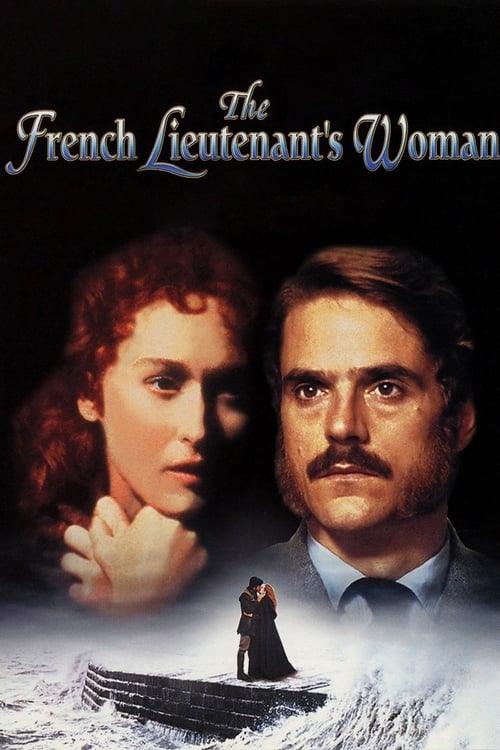
The French Lieutenant's Woman
1981 · Karel Reisz
For a rainy evening when you want a grown-up, brainy romance — one that gives you the sweep of a period love story and then asks what you'd actually do in it. A film to chew on afterward, not just swoon through.
What it's about
Two love stories run in parallel: in Victorian England, a respectable gentleman becomes obsessed with Sarah Woodruff, a disgraced woman who stares out to sea waiting for the French lieutenant who ruined her; in the present day, the two actors playing them — Anna and Mike — drift into an affair of their own between takes. Adapted by Harold Pinter from John Fowles's famously 'unfilmable' novel, the film keeps cutting between the costume drama and the film set where it's being made.
The experience
Slow-burning and elegant, with an undertow of obsession — the period story is all repressed longing and windswept melancholy, while the modern one is cooler and sadder than it first appears. The two halves start to comment on each other in ways that sneak up on you.
Performances
Meryl Streep is remarkable in a double role, playing both the haunted Victorian outcast and the pragmatic modern actress — two entirely different women sharing one face. Jeremy Irons matches her with a portrait of a gentleman coming quietly undone.
The craft
Harold Pinter's screenplay is the star turn: rather than flatten a novel with an intrusive modern narrator, it invents a film-within-a-film frame that puts the nineteenth and twentieth centuries side by side. Karel Reisz shoots the Dorset coast with real romantic grandeur, so the structural game never costs the picture its beauty.
Why it matters
A landmark of literary adaptation — the case study people still cite for how to film an 'unfilmable' book — and a career-defining showcase that confirmed Streep as the major screen actress of her generation.
Snapshot
Karel Reisz's film of John Fowles's 1969 novel is the rare adaptation whose formal solution is more famous than its story. Fowles's book was widely regarded as unfilmable: a Victorian romance narrated by an intrusive twentieth-century voice that quotes Darwin, Marx, Tennyson and Hardy, interrupts its own plot to discuss Victorian sexual hypocrisy, and finally refuses to choose between endings. Harold Pinter's screenplay answered this by inventing something not in the novel at all — a modern frame in which two actors, Anna and Mike, shoot a period film of The French Lieutenant's Woman and conduct an affair of their own between takes. The nineteenth-century story of Charles Smithson (Jeremy Irons), a gentleman amateur palaeontologist, and Sarah Woodruff (Meryl Streep), the disgraced woman of the title, now runs inside a contemporary story with the same actors and a different ending. Where Fowles used a narrator to hold the past at ironic distance, Pinter uses a film crew.
The result was both an art-house structural experiment and a considerable commercial success, and it sits at a hinge point in British cinema: released the same year as Chariots of Fire and the Brideshead Revisited television serial, it belongs to the front edge of the 1980s heritage cycle while quietly refusing that cycle's central pleasure — untroubled immersion in the national past. It also made Jeremy Irons a film star and gave Meryl Streep her first Academy Award nomination for Best Actress.
Industry & production
The novel's rights circulated for roughly a decade before the film was made, passing through several writers and prospective directors without producing a workable script — the recurring obstacle being Fowles's narrator and his multiple endings, which have no obvious cinematic equivalent. The detailed record of who was attached and when is thin and inconsistently reported; what is well established is that the property had a long reputation as a beautiful trap.
The film that emerged was produced by Leon Clore for Juniper Films and financed and released by United Artists, which places it at a peculiar moment in that studio's history: Heaven's Gate had opened in late 1980, and UA was absorbed into MGM in 1981. A modestly budgeted British literary adaptation was not the kind of picture that saved a studio, but it performed well, and its success fed the early-1980s confidence in British production that Goldcrest and, from 1982, Channel 4 would shortly capitalize on.
Production was substantially on location. Lyme Regis in Dorset supplied the Cobb — the curved harbor wall where the hooded figure of Sarah stands looking out to sea, an image that became the film's poster and one of the most reproduced shots in British cinema of the decade — along with the Undercliff, the landslip woodland where Charles hunts fossils and finds Sarah. Exeter provides the hotel where the affair is consummated; the Lake District provides the reunion that ends the Victorian narrative. The modern scenes were shot in and around the same locations, often on the same days, so that the film's two worlds are literally continuous in space.
Technology
Technologically the film is unassuming: 35mm color, conventional widescreen rather than anamorphic scope, no optical trickery, no process work of note. Its ambition is entirely photographic and organisational. The one genuinely technical problem the production had to solve was continuity of a strange kind — the crew had to build, dress and light a period film that would read on screen as a period film being made, including its own lights, tracks, marks and clapperboards, and then step outside it into unremarkable contemporary rooms without the audience losing the thread. Practically this meant two complete visual systems, two costume and design registers, and a shooting schedule that constantly crossed between them.
Technique
Cinematography
Freddie Francis photographed the film, and the choice carries its own history: Francis had shot Room at the Top and Saturday Night and Sunday Morning — the latter for Reisz — at the head of the British New Wave, had won an Academy Award for Sons and Lovers, had made The Innocents for Jack Clayton, and had come off The Elephant Man for David Lynch the year before. He was equally a director of Gothic horror, and that sensibility is visible in the Victorian material: heavy weather, dark interiors organized around single practical sources, faces emerging from surrounding gloom.
The governing decision is differentiation. The nineteenth-century scenes are soft, atmospheric, tonally narrow — sea mist, wet stone, the greens and browns of the Undercliff, candle and lamp light modeled to look like the source of the exposure rather than a supplement to it. The compositional debts are to Victorian painting and early photography: the isolated female figure in landscape, the interior as a box of shadow with one window in it. The modern scenes are flatter, cooler, more evenly lit and more casually framed, with the shallow ordinariness of contemporary daylight. The audience is never in doubt about which century it is in, and never told in words.
Editing
John Bloom cut the film, and the cutting is where the concept either works or collapses. Reisz was uniquely equipped to supervise it: before he directed anything he wrote The Technique of Film Editing (1953), for decades the standard English-language textbook on the subject. A film whose entire meaning lives in the joins between two времени-planes is an unusually apt late assignment for him.
The transitions are mostly quiet rather than showy — a look held a beat too long, a cut on a gesture completed in the other era, a line of dialogue begun in one century and finished in the next, a sound bridge that arrives before the image does. The proportion is roughly four parts Victorian to one part modern, so the frame never becomes the main event; it functions as interruption, and the interruptions are timed to arrive at moments of maximum Victorian intensity, deliberately withholding the romantic payoff the period story is generating. That withholding is the film's argument in structural form.
Mise-en-scène / staging
Assheton Gorton's production design and Tom Rand's costumes — both Academy Award-nominated — do the heavy work of the period world: the crushing propriety of Mrs Poulteney's house, the airless comfort of the Freeman interiors, Charles's fossil cabinets, and Sarah's costume as a piece of deliberate social signaling, the dark cloak that both hides her and announces her. Reisz stages the Victorian scenes with a formality bordering on stiffness: characters held at conversational distances the period would enforce, bodies separated by furniture and doorways, the camera respecting proscenium space. The modern scenes are staged loosely, with actors sprawling, overlapping, occupying rooms without ceremony. The Cobb sequence is the film's signature staging — a figure at the end of a stone finger extending into weather, seen from behind, refusing to turn — and it is repeated across both registers, so that we watch it first as an image and later as a shot being made.
Sound
Carl Davis's score is the other differentiating instrument. Davis, an American composer resident in Britain, was then best known for large-scale scores for silent-film restorations and for television, and he writes here in an unashamedly romantic idiom — strings and piano, long lines, a main theme that behaves like a nineteenth-century concert piece. It belongs almost entirely to the Victorian film. The modern scenes are comparatively bare: room tone, traffic, party noise, conversation. When music vanishes at a cut, the audience feels the deflation before it identifies the cause. Beneath both, the Dorset material carries a near-constant bed of wind and sea, so that the period world is audibly weather-driven and the modern world audibly indoors.
Performance
The double casting is the film's greatest risk and its most durable achievement. Streep plays Sarah with extreme economy — stillness, withheld information, a voice placed carefully and formally, eyes doing nearly all the work — and Anna with contemporary looseness, quick and unguarded and slightly evasive. The distinction is built from diction, tempo and posture rather than from makeup. Irons, then largely unknown to film audiences and about to become famous through Brideshead Revisited, gives Charles a fastidious, arrested quality that curdles into desperation, and Mike a shallower, needier version of the same appetite. The supporting Victorian cast is strong and conventionally drawn — Leo McKern as the worldly Dr Grogan, Lynsey Baxter as the wholly sympathetic fiancée Ernestina, Hilton McRae as the servant Sam, whose parallel courtship supplies the film's class counterpoint.
Streep won the BAFTA and the Golden Globe for the performance and was nominated for the Academy Award for Best Actress, losing to Katharine Hepburn for On Golden Pond. The film received five Oscar nominations in total — Actress, Adapted Screenplay, Art Direction, Costume Design and Film Editing — and won none.
Narrative & dramatic mode
The film runs two incompatible romance plots against each other. The Victorian plot is high melodrama in the fullest sense: obsession, social ruin, a woman who has manufactured her own disgrace as an instrument of freedom, a man who abandons an advantageous engagement and is destroyed socially for it. The modern plot is naturalistic adultery — furtive, awkward, bounded by hotel rooms and other people's marriages. Each comments on the other by proximity alone.
Pinter's real coup is the ending, or endings. Fowles gave his readers a false conventional close and then two alternatives, with the narrator visibly turning back his watch. Pinter distributes this across the two levels: the Victorian story receives the reunion — Charles finding Sarah in the Lake District, rowing her out onto the water into light — while the modern story receives the refusal, Anna driving away from the wrap party as Mike calls out to her, and calling her by the wrong name. That final cry of "Sarah!" is the film's whole thesis compressed into a word: the modern man has fallen in love with a fiction and cannot tell the difference. It converts Fowles's authorial game into a dramatic event without explaining itself.
Genre & cycle
Formally the film is three things at once: a costume melodrama in the Brief Encounter line of doomed English restraint; a literary adaptation of the prestige kind; and a reflexive film-about-filmmaking descended from Fellini's 8½, Godard's Le Mépris and, most directly, Truffaut's Day for Night, which had already dramatized actors falling in love inside the roles they play. What is unusual is the welding — the reflexive art film ordinarily undercuts the fiction it contains, whereas here the contained fiction is allowed to be genuinely, unironically moving, and the frame suffers by comparison.
Authorship & method
Reisz's career is a study in restlessness. Born in Ostrava and brought to Britain on a Kindertransport in 1938, he co-founded Free Cinema with Lindsay Anderson and Tony Richardson, made the documentaries Momma Don't Allow and We Are the Lambeth Boys, produced This Sporting Life, and directed Saturday Night and Sunday Morning, the defining film of British social realism. He then abandoned that mode almost entirely for Morgan, Isadora, The Gambler and Who'll Stop the Rain. His authorship is less a style than a recurring subject: characters who construct a self in defiance of what their society will permit, and pay for it.
Pinter is the film's co-author in every meaningful sense. He had already written The Servant, Accident and The Go-Between for Joseph Losey, the last of which handles a lost English past through a framing device, and his unproduced Proust Screenplay had been an extended experiment in rendering literary time cinematically. His method here is characteristic: compress, remove exposition, let silence carry motive, and find a structural device that dramatizes the novel's argument rather than paraphrasing it.
Francis, Bloom, Davis, Gorton and Rand constitute an unusually senior craft team, and the film is in large part a demonstration of what British technicians of that generation could do with a period subject.
Movement / national cinema
There is a real irony in a Free Cinema founder helping to inaugurate the heritage film. The British New Wave defined itself against the genteel literary adaptation; twenty years later its leading practitioners were making them. The French Lieutenant's Woman arrives at the start of a cycle that would include Heat and Dust, A Room with a View, Maurice and Howards End, and which critics — Andrew Higson's account of the "heritage film" being the most influential — would later attack for offering the national past as beautifully upholstered spectacle emptied of politics. This film is an awkward fit for that indictment. Its Victorian world is shown to be a construction, staffed by technicians, and its modern characters cannot live inside it. The frame is an anti-nostalgia device, whether or not audiences received it as one.
Era / period
1981 is early Thatcher, and the appetite for the Victorian was not innocent: Victorian values were being explicitly invoked in British political rhetoric during the decade. Simultaneously, the academy was in the middle of a Victorian revival — feminist recovery of the "fallen woman," the rise of Victorian sexuality studies, and Foucault's History of Sexuality, newly available in English, with its argument that the nineteenth century did not silence sex but endlessly incited discourse about it. Fowles's novel is a precursor to that argument; the film both reproduces and complicates it, treating Victorian repression as real while showing that its modern successors are no more free.
Themes
The central theme is freedom bought at the price of legibility. Sarah is not a ruined woman but a woman who has chosen ruin, because disgrace is the only available exit from a social system that has no other category for her; her scandal is largely her own invention. Charles's fossils supply the film's controlling metaphor — a man who understands deep time, extinction and adaptation intellectually, and cannot apply any of it to himself. Class runs alongside: Sam's ambitions and Ernestina's trade money mark a society being reorganized by capital while it insists it is eternal.
Set against this, the modern story asks whether anything has changed. Anna and Mike have the freedom Sarah had to destroy herself to obtain, and they use it on an affair that neither can name. The film's answer is bleak and unstated: the Victorians had passion because they had prohibition, and Mike calls out for Sarah because Anna is not enough.
Reception, canon & influence
Contemporary reception was strong, with wide praise for Streep and for Pinter's structural solution, and a recurring reservation that became the standard critical line: the modern story is thinner than the Victorian one, its adultery merely anecdotal beside the passion it frames. Defenders have argued the imbalance is deliberate and load-bearing. The awards record — five Oscar nominations without a win, a BAFTA and Golden Globe for Streep, further BAFTA recognition in craft categories — reflects a film respected rather than embraced.
Its backward influences are legible: Fowles's novel above all; the Losey–Pinter collaborations, especially The Go-Between; Truffaut's Day for Night for the film-within-a-film; Victorian painting and photography for the look; and Reisz's own realist training, which keeps the period material from tipping into pastiche.
Forward, it did three things. It established the reflexive adaptation as a viable commercial form, licensing later films that dramatize reading, writing or filming as part of the story — most obviously the dual-timeline literary adaptations that follow, including Possession, whose source novel is itself in dialogue with Fowles, and, more distantly, the metafictional turn of Atonement. It supplied the 1980s British literary-adaptation boom with proof of concept and with a craft standard. And it launched Jeremy Irons while confirming Streep as the defining screen actor of her generation, in a performance still routinely cited as the clearest demonstration of her technique — two women, one body, no prosthetics, the difference carried entirely in the voice and the stillness.
A Deleuzian reading
A woman stands at the end of the Cobb at Lyme Regis, hooded, facing out to sea.
The full Deleuzian reading of The French Lieutenant's Woman →
Reception
A prestige hit in 1981 — five Oscar nominations and instant acclaim for Meryl Streep — though even then critics split over Harold Pinter's modern-day framing device; today the film has faded from the canon while its reputation as the clever 'solution' to an unfilmable novel has only grown.
How The French Lieutenant's Woman was received, from release to now →
How to watch The French Lieutenant's Woman: what to notice on a first viewing
- Notice the Victorian scenes look softer than the modern ones. The nineteenth-century material stays atmospheric and tonally narrow, sea mist and candlelight, while the modern scenes are flatter, cooler, and more casually lit. You always know which century you're in without the film ever needing to tell you.
- Listen for the score vanish at certain cuts. Davis's romantic strings belong almost entirely to the period story, so when a cut drops into the modern scenes the music simply disappears. You feel the loss before you can say what caused it.
- Watch how far apart bodies stay in Victorian scenes. Period characters are held at formal conversational distances, separated by furniture and doorways, while the modern actors sprawl and overlap without ceremony. How close people are allowed to stand tells you which century's rules you're watching.
- Notice how differently Streep holds herself in each role. She builds one character from stillness and a formally placed voice, the other from contemporary looseness and quick, evasive energy. The difference is built entirely from posture and rhythm, not from costume or makeup.
- Track a line of dialogue crossing from one era to the next. Bloom sometimes begins a sentence in the nineteenth century and finishes it in the twentieth, or lets sound arrive before the picture changes. The film keeps proving its two timelines share a single continuous thread underneath.
The whole guide to watching The French Lieutenant's Woman, with the keys for a rewatch →
Influences: the films it descends from and the films it influenced
- The Go-Between (1971) — Pinter's framing device — a present-tense consciousness cut into the period story so the past is continually being *read* rather than simply re-enacted — is the direct structural precedent for the modern film-shoot frame.
- The Servant (1963) — Establishes Pinter's screen method that Reisz inherits wholesale: strip exposition, cut the connective dialogue, and let a held pause or an unfinished line carry motive that the novel would have stated.
- Day for Night (1973) — The film-crew-as-ensemble structure in which an off-camera affair between the two leads rhymes with the melodrama they are shooting, and clapperboards, rushes and takes are used as narrative punctuation.
- Saturday Night and Sunday Morning (1960) — Reisz's own Free Cinema-derived discipline — real locations, source-motivated light, performances kept under-projected — is what keeps the Victorian material observational rather than pastiche.
- The Innocents (1961) — Freddie Francis's grammar for period interiors: rooms lit as though only by candle and window, with deep-focus wide-screen framing that leaves figures small inside oppressive architecture.
- Barry Lyndon (1975) — Period photographed as painting — practical-source candlelight, frontal symmetrical compositions, and slow reverse moves that pull the viewer back to spectator distance instead of into the scene.
- Vertigo (1958) — One actress carrying two identities differentiated by hair, costume and vocal placement rather than prosthetics, with a man's obsessive looking the only thing binding the two women together.
- A Room with a View (1985) — Takes the proof-of-concept: a senior British craft team applied to a canonical novel, shot in real period locations with source-motivated light, as the house style of the 1980s adaptation boom.
- Orlando (1992) — Extends the reflexive heritage film — a single performer carries one identity across centuries and breaks the Victorian proscenium by addressing camera, doing openly what the modern frame does structurally.
- Possession (2002) — The closest structural heir: modern literary scholars' tentative affair intercut with the Victorian romance they are reconstructing from documents, with the period strand deliberately given the fuller passion.
- The Hours (2002) — Cross-era transitions matched on gesture and object, with a single continuous score (Glass) used as the connective tissue between timelines the way Davis's romantic theme binds the two eras here.
- Atonement (2007) — Relocates the twin-endings device to a single final reversal: a novelist's confession retroactively exposes the preceding romance as an alternative ending she wrote for the lovers.
- Tristram Shandy: A Cock and Bull Story (2005) — The costume drama about its own shoot — period scenes interrupted by crew, monitors and actors' off-set jealousies — pushing the film-within-a-film frame from romance into comedy.
- Ammonite (2020) — Stages a Victorian woman's interiority on the same Cobb and Lyme shingle, and substitutes a wind-and-sea sound bed for score in long unscored stretches — direct location and sonic inheritance.
- The Piano (1993) — Harold Pinter's screenplay uses deliberate structural lacunae — scenes that end before their expected emotional resolution, time gaps without causal explanation — to encode female desire as narrative withholding rather than psychological exposition, the elliptical-lacunae editing grammar Jenet employs in The Piano.
- Damage (1992) — Cut by John Bloom, the same editor: the rhythm of an affair advanced by hard cuts into scenes already underway, with the erotic encounters trimmed of build-up and aftermath, is the cutting pattern Bloom brings intact to Damage.
- Betrayal (1983) — Pinter again solves an adaptation with a structural device rather than paraphrase — scenes run in reverse chronology so each tender moment is watched with its betrayal already known, the same logic as the twin endings.
- Sophie's Choice (1982) — Streep builds a second self out of vocal engineering alone — accented English, then Polish, then German — inside a writer's retrospective frame that keeps the past at one narrative remove.
- The Draughtsman's Contract (1982) — Fixed frontal tableaux, candle and daylight sources, and dialogue delivered at proscenium distance so the historical world is openly displayed as constructed artifice rather than inhabited.
- Heat and Dust (1983) — Dual-timeline literary adaptation that cross-cuts a modern woman researching the period affair she is unknowingly repeating, differentiating eras by palette and by whose voice is narrating.
Similar films
- The Hours (2002) — influence & lineage
- Orlando (1992) — influence & lineage
- Atonement (2007) — influence & lineage
- Day for Night (1973) — influence & lineage
- The Iron Lady (2011) — shared sensibility
- Portrait of a Lady on Fire (2019) — shared sensibility
- Story of Women (1988) — shared sensibility
- Tess (1979) — shared sensibility