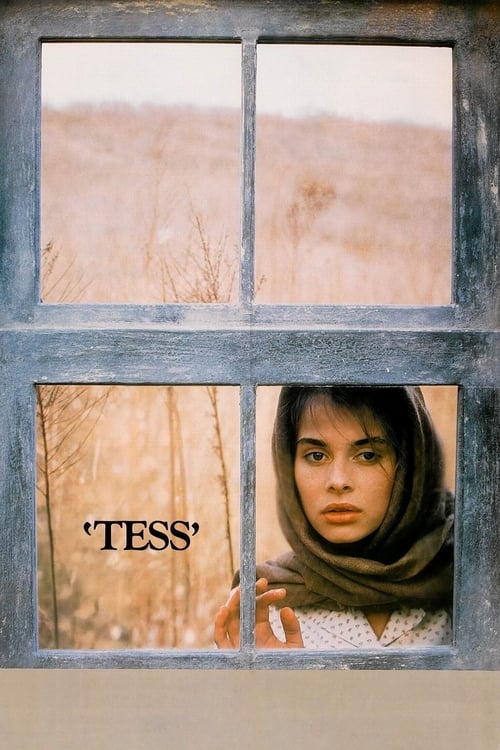
Tess
1979 · Roman Polanski
For when you want to surrender an evening to a big, patient period tragedy — something painterly and immersive that will leave a bruise. This is a challenge film, not a comfort film.
What it's about
In rural 19th-century England, a poor farmer hears his family may descend from an old noble line and sends his daughter Tess to the estate of their supposed aristocratic relatives. That errand sets off an epic of class, desire, and betrayal, as Tess is passed between men who claim to love her and a society that punishes her for what's been done to her.
The experience
Slow, luminous, and quietly devastating — three hours that move at the pace of seasons and farm labor, building a sense of injustice so gradual it feels like weather. It's beautiful to look at and pitiless underneath.
Performances
Nastassja Kinski plays Tess with a stillness that makes her fate harder to watch — she barely raises her voice, and the film lets her face carry what the character can't say.
The craft
Adapted from Thomas Hardy's novel, it's one of the most gorgeously photographed period films ever made — misted fields, candlelit interiors, harvest light — and its Oscar-winning cinematography and design earn every frame. The wide rural landscapes all but demand the biggest screen you can find.
Why it matters
A multiple Oscar winner that stands among the defining literary adaptations of its era, and a startling turn toward classical patience from a director known for claustrophobic psychological horror.
Snapshot
Polanski's adaptation of Thomas Hardy's Tess of the d'Urbervilles (1891) is the strangest kind of masterpiece: a three-hour agrarian tragedy made by the director of Repulsion and Rosemary's Baby, shot in French fields standing in for English ones, by a filmmaker who had fled the United States rather than face sentencing for a sex offense against a minor. Nothing about the film's circumstances predicts its serenity. Yet Tess is patient, luminous and pitilessly clear-eyed — a film about a young woman destroyed less by any single villain than by the slow grinding of property, lineage, sexual double standards and agricultural modernity.
It is dedicated "To Sharon." Sharon Tate had given Polanski Hardy's novel shortly before her murder in 1969, suggesting it would make a good film for him. That dedication is the film's only overt gesture toward its maker's biography, and it reframes everything that follows.
The film won three Academy Awards (Cinematography, Art Direction, Costume Design) from six nominations including Best Picture and Best Director, and swept the major Césars. It remains the most formally classical film in Polanski's body of work and, by some readings, the most personal.
Industry & production
Tess was a Franco-British co-production between Claude Berri's Renn Productions and Timothy Burrill Productions, with Berri as the driving producer. It is frequently described as the most expensive French production undertaken to that date; precise budget figures vary across sources and should be treated as approximate.
The decisive production fact is geographic. Polanski had left the United States in early 1978 after pleading guilty to unlawful sexual intercourse with a thirteen-year-old girl. Shooting Hardy in Hardy's own Dorset would have meant working in the United Kingdom, with attendant extradition exposure. So Wessex was rebuilt in France: Normandy and Brittany supplied the hedgerows, chalk downs, dairy farms and stone villages, and a full-scale Stonehenge replica was constructed for the finale rather than filmed at the monument itself. The substitution is essentially invisible on screen, which is itself an argument about production design — Hardy's Wessex was always a literary invention, and Polanski simply built a different one.
The shoot ran roughly nine months from summer 1978, an unusual luxury that allowed the seasonal cycle to be photographed as it actually happened rather than faked. Hardy's novel is organized by agricultural calendar — the May Day dance, the dairy summer, the winter of Flintcomb-Ash — and the film inherits that structure as literal production schedule.
The film opened in France in October 1979. Its American release came more than a year later, in December 1980, through Columbia, a delay in which the director's legal status was plainly a factor. Polanski could not travel to the United States to promote it or to collect anything at the Academy Awards.
Technology
Tess was shot on 35mm in anamorphic widescreen, using the workhorse Eastman color negative of the period. That stock's modest sensitivity — roughly 100 ASA in tungsten balance — is the technical constraint that shapes the entire look. Anamorphic optics lose light relative to spherical lenses; slow stock loses more. Interiors lit plausibly by window, hearth and oil lamp therefore required either enormous supplementary sources disguised as daylight, or a willingness to let shadows go genuinely dark.
Geoffrey Unsworth's response drew on the toolkit he had refined across Cabaret, Murder on the Orient Express and Superman: heavy bounced and diffused sourcing, low-contrast and fog filtration, and controlled reduction of contrast so that highlights bloom slightly and blacks lift toward gray. The result reads as period softness — as though the image had been fixed on Victorian emulsion — but it is a chemical and optical solution to a lighting problem before it is a stylistic conceit.
The film sits in the same technological moment as Barry Lyndon (1975) and Days of Heaven (1978): the last years before high-speed stocks of the early 1980s made low-light naturalism cheap. Tess achieves its magic-hour and candle-adjacent imagery the hard way, by scheduling and by light-gathering, and the cost of that decision is legible in the nine-month calendar.
Technique
Cinematography
Geoffrey Unsworth died of a heart attack in Brittany in October 1978, weeks into production. Ghislain Cloquet — a Belgian-born cinematographer whose credits include Bresson's Au hasard Balthazar and Mouchette, Becker's Le Trou and Woody Allen's Love and Death — completed the film. The two shared the Academy Award, Unsworth posthumously.
That the seam is undetectable is a genuine achievement, and it means the film's visual signature belongs to a shared grammar rather than to one eye: wide anamorphic compositions in which figures are small against land and sky; a palette that shifts by season from the chalky greens and whites of the May Day dance to the honeyed gold of Talbothays and finally to the bleached, colorless flint of the winter fields; and a camera that moves rarely but decisively.
The film's most quoted images are its landscapes, and they invite comparison with nineteenth-century agrarian painting — Millet's gleaners and harvesters, the Barbizon school's dignifying of rural labor. Whether those were explicit references or convergent solutions to the same problem, the effect is the same: Tess is repeatedly composed as one worker among many, absorbed into a field of labor that will outlast her.
Editing
Cut by Alastair McIntyre and Tom Priestley (the latter best known for Deliverance), Tess is edited for duration rather than propulsion. Shots are held. Scenes are allowed to complete. Dissolves and long lap-transitions carry the seasonal jumps, and the film is unafraid of ellipsis at exactly the points where a conventional adaptation would dramatize — the years between the Chase and Talbothays, for instance, compress hard.
The most consequential editorial decision is the treatment of the assault. Hardy famously elides it, leaving the reader to infer what happens in the fog of The Chase; the novel's ambiguity between seduction and rape has fueled a century of criticism. Polanski neither elides nor sensationalizes: Alec approaches a half-sleeping Tess, and the sequence resolves in withdrawal rather than depiction. Given the director's own conviction, the scene carries a charge that no amount of formal tact can neutralize, and honest criticism of the film has never been able to leave that alone.
Mise-en-scène / staging
Pierre Guffroy's production design — Guffroy had worked with Bresson, Godard and Buñuel — and Anthony Powell's costumes won Oscars for good reason, but their achievement is anti-spectacular. Interiors are cramped, sooty and low-ceilinged; the Durbeyfield cottage is a place of animal proximity and bad light. The d'Urberville estate at The Slopes is by contrast suburban and new-moneyed, which is exactly Hardy's joke: the family that has bought the ancient name has no ancient anything.
Staging repeatedly uses depth and scale to make social argument. The threshing sequence at Flintcomb-Ash — Tess feeding sheaves to a steam-driven machine, deafened, blackened, unrelieved — is the film's clearest thesis: industrial power has arrived in the fields and it sets the tempo of the human body. Hardy wrote that scene as an image of the agricultural depression of the 1870s–90s; Polanski shoots it as something close to horror.
Sound
The soundscape is dominated by wind, birds, hooves, bells, machinery and the ambient noise of labor, with long stretches carrying no music at all. Philippe Sarde's score is used sparingly and mostly pastorally, entering to mark transitions and the film's few moments of released feeling rather than underlining distress. The refusal to score the tragedy is itself a choice: the catastrophe arrives without accompaniment.
As a co-production shot in France with an international cast, the film involved substantial post-synchronization, a common practice at the time; detailed accounts of what was looped and what was recorded live are not well documented.
Performance
Nastassja Kinski, German-born and seventeen when principal photography began, plays Tess with a deliberate, contained flatness. She is not expressive in the conventional sense; her face is used as a surface on which the film's other forces register. Some viewers find this opacity a limitation, others find it exactly right for a character whose defining experience is being read, claimed and interpreted by everyone around her. Kinski was coached in English for the role, and the slightly measured cadence of her line readings is part of the effect.
Polanski's relationship with Kinski, which began when she was fifteen, is documented and is inseparable from any serious account of the film's making. The dossier records this because the film is about the sexual exploitation of a young woman by men with more power than she has, and the record does not permit that context to be omitted.
Leigh Lawson's Alec is smooth rather than monstrous — a man of appetite and entitlement who never once considers that he has done wrong. Peter Firth's Angel Clare is the more disturbing performance: a self-styled freethinker whose enlightenment evaporates the instant it is tested, and whose rejection of Tess on their wedding night is the true fatal blow. The film is careful that Angel is not villainous. He is merely conventional, which is worse.
Narrative & dramatic mode
The film is a tragedy in the fatalistic, materialist mode Hardy pioneered: catastrophe produced not by a flaw in the protagonist but by the accumulated pressure of circumstance, chance and social rule. Its structure follows the novel's phases — the discovery of the d'Urberville name, The Slopes, the Chase, the return home and the child, Talbothays, the marriage and confession, Flintcomb-Ash, Sandbourne, Stonehenge.
Two structural features distinguish the film from ordinary literary adaptation. First, its refusal of interiority: Hardy's narrator editorializes constantly, and Polanski discards nearly all of it, leaving behavior and landscape to carry meaning. Second, the ending. The film closes at dawn at Stonehenge with Tess's arrest; the execution is withheld. Hardy's novel supplies a famously bitter closing image of the black flag; the film's decision to stop earlier makes the ending colder, not warmer.
Genre & cycle
Tess belongs to the literary costume drama, but it arrived at a moment when that genre was being reinvented rather than perpetuated. Against the studio-bound, dialogue-forward adaptations of earlier decades, the late 1970s produced a cycle of period films that treated landscape, labor and weather as primary material: Barry Lyndon (1975), The Tree of Wooden Clogs (1978), Days of Heaven (1978). Tess is the most novelistic of these and the most conventionally structured, but it shares their conviction that a period is a physical environment before it is a set of manners.
It also functions as rural melodrama and, in its final act, as something like a crime film — a genre pivot Hardy himself makes and which Polanski, of all directors, was equipped to handle without embarrassment.
Authorship & method
Polanski co-wrote with Gérard Brach, his collaborator across two decades (Repulsion, Cul-de-sac, The Tenant, later Bitter Moon), with John Brownjohn handling the English dialogue. The Brach partnership is usually associated with claustrophobia and paranoia; Tess inverts the customary geometry — open country instead of sealed apartments — while keeping the essential Polanski situation intact: an isolated protagonist under pressure from a social order that will not be reasoned with.
Read across his filmography, Tess is less a departure than a translation. The vulnerable woman disbelieved and encircled (Repulsion, Rosemary's Baby), the corrupt exercise of sexual power protected by wealth and name (Chinatown), the fatalism in which understanding arrives too late to help — all of it recurs, dressed in muslin.
The key collaborators shape the film as decisively as the director. Unsworth and Cloquet supply its light. Guffroy and Powell supply a material world of persuasive ordinariness. Sarde supplies restraint. McIntyre and Priestley supply the patience.
Movement / national cinema
Tess sits at a crossing point of three cinemas. It is formally an English literary adaptation; industrially a French film, produced by Claude Berri within the French tradition of ambitious, producer-led prestige cinema; and authored by a Polish director trained at Łódź, formed in the Polish school of the late 1950s, matured in Britain, and exiled from Hollywood. Polanski's statelessness is not incidental — it is the condition that made a French Tess necessary in the first place.
The film's French heritage is more than a matter of financing. Berri would go on to direct Jean de Florette and Manon des Sources (1986), rural French literary adaptations built on the same premises: long schedules, landscape as protagonist, peasant labor taken seriously, tragedy driven by land and inheritance. The lineage from Tess to those films is direct and producer-borne.
Era / period
Two periods are in play. The depicted one is the English agricultural depression of the late nineteenth century, when cheap imported grain, mechanization and rural depopulation were dismantling the world Hardy grew up in. Tess's downward path — from village to estate to dairy to the brutal upland farm — is a map of that collapse. Her family's fantasy of aristocratic descent is the period's characteristic delusion: status nostalgia in a moment when status was being redistributed by capital.
The period of production is the tail of the 1970s, when European art cinema still had access to large budgets and long schedules while American cinema was reorganizing around the blockbuster. Tess is a late artifact of that arrangement — a three-hour, star-light, unhurried literary film financed at scale. Within a decade such a project would be considerably harder to mount.
Themes
Purity as social fiction. Hardy's subtitle, A Pure Woman Faithfully Presented, was a deliberate provocation in 1891. The film sustains the argument without stating it: Tess's "ruin" is entirely a matter of what others decide it means.
Lineage and property. The d'Urberville name is the engine of the plot and it is worthless — an antiquarian's aside that a drunk man converts into a claim. Meanwhile the family with the real power simply purchased the name. Inheritance in Tess is a con.
The double standard. Angel confesses his own prior affair and is forgiven within a sentence; Tess confesses and is abandoned. The film gives this exchange its full, unbearable length.
Machine and body. The threshing sequence makes explicit what the rest of the film implies: human labor has become an input to a mechanism whose rhythm nobody controls.
Indifferent nature. The landscape is beautiful and it does not care. The film's loveliest images are almost always of a world proceeding without reference to the person inside it.
Reception, canon & influence
Contemporary reception was broadly admiring, with the recurring reservation that the film's visual composure held its emotions at arm's length and that Kinski's performance was too withheld to carry three hours. That debate has never fully closed, and it is a reasonable one; the film's defenders would argue that the coolness is the point.
Institutional recognition was substantial: three Academy Awards from six nominations, the César for Best Film, Director and Cinematography, and a Golden Globe for Best Foreign Film, with Kinski named New Star of the Year. Commercially it performed well in France and more modestly as an American art-house release; reliable figures vary between sources and are not asserted here.
Backward. The film's primary influences are literary and painterly before they are cinematic: Hardy, and the nineteenth-century tradition of dignified agrarian painting. Cinematically, Barry Lyndon had recently demonstrated that a period film could be built out of available light and painterly composition at extreme length, and Tess clearly operates in the space that film opened. Within Polanski's own work, the film draws on the victim-under-siege structure of his 1960s features.
Forward. Tess is a foundational text for the period-adaptation cycle of the 1980s and 1990s — the Merchant Ivory films, and more directly the strain of Hardy adaptation that takes the novels' materialism seriously: Michael Winterbottom's Jude (1996) and his transposed The Claim (2000), the BBC's 2008 Tess of the d'Urbervilles, Thomas Vinterberg's Far from the Madding Crowd (2015). Its more immediate descendants are French: Berri's Pagnol adaptations of 1986 apply the Tess template almost point for point.
Its longer influence is a look and a tempo — the conviction that a period film should be photographed as weather and worked land rather than as costume, and that a tragedy of social determinism earns its power by refusing to hurry. Restored in 4K by Pathé and reissued by the Criterion Collection, the film now circulates as what it always was under the noise of its making: one of the most rigorous literary adaptations in postwar cinema, and a film whose beauty is inseparable from its coldness.
A Deleuzian reading
A steam threshing machine stands in a field at Flintcomb-Ash, and Tess is on the platform beside it, feeding sheaves into the drum.
The full Deleuzian reading of Tess →
Reception
A prestige triumph on release — three Oscars (including a posthumous cinematography win for Geoffrey Unsworth, who died mid-production) and the César for Best Film — it's now regarded as perhaps Polanski's most beautiful movie, though watching it has only grown more complicated with time.
How Tess was received, from release to now →
How to watch Tess: what to notice on a first viewing
- Notice how small Tess is inside the wide landscape shots. The anamorphic frame keeps placing her as one worker among many in a field, staged the way Millet painted gleaners and harvesters. The camera moves rarely, and when it holds, the land takes up most of the image. The world she is in is beautiful and takes no interest in her, and the compositions keep saying so without a word.
- Look at the color changing as the seasons turn. Chalky green and white at the May dance, honeyed gold at the dairy, bleached flint gray in the winter uplands. Unsworth and Cloquet shoot through diffusion and fog filtration so blacks lift and highlights bloom. Polanski shot across nine months and let the real calendar do the storytelling, stamping a year onto one body.
- Listen for how many scenes carry no music at all. Wind, birds, hooves, bells, machinery, the noise of work. Sarde's score enters sparingly and mostly pastorally to mark a transition. The hardest passages in the film are left unscored. Nothing tells you when to brace, so the bad things arrive at the same volume as an ordinary afternoon.
- Watch how little Kinski's face gives away. She was seventeen at the start of shooting and coached in English, and she plays Tess with a deliberate flatness. The face stays still and holds one quality while everyone around her decides what she is. A face that reflects instead of emitting is the right answer for a character whose whole experience is being read and claimed by other people.
- Compare the Durbeyfield cottage with the house at The Slopes. Guffroy builds the cottage low, sooty and cramped, with animals close by and bad light. The estate that carries the ancient name is new, comfortable and suburban, because the family bought the name and nothing else. Inheritance in this story is a con, and the production design gives the joke away in the first hour.
The whole guide to watching Tess, with the keys for a rewatch →
Influences: the films it descends from and the films it influenced
- Mouchette (1967) — Ghislain Cloquet's unemphatic, source-honest light on farm labor — and his refusal to inflect a rural girl's violation with any camera emphasis — is the exact register Cloquet carried into Tess when he completed the shoot after Unsworth's death.
- Barry Lyndon (1975) — Established that a period film could be built from painterly tableau, near-available-light exposure and three-hour narrative patience, licensing Tess's willingness to hold a harvest wide until duration itself becomes the dramatic event.
- Cabaret (1972) — Geoffrey Unsworth's signature pre-fogging and net/diffusion process — degrading blacks to a milky bloom so light reads as already remembered — is the same lens kit and lab procedure he brought to Tess's dawn fields and lamplit interiors.
- Far from the Madding Crowd (1967) — The immediate Hardy precedent: Nicolas Roeg shooting real Dorset across the seasons with actual sheep-washing, shearing and harvest work, fixing the principle that Wessex must be photographed as worked land — which Tess adopts while relocating Wessex to Normandy and Brittany.
- Ryan's Daughter (1970) — Freddie Young's anamorphic treatment of weather as principal antagonist — storm, gorse and tide filling the frame's full width while the human figure shrinks — is the widescreen grammar Tess uses to let landscape scale replace psychological commentary.
- The Go-Between (1971) — Class transgression staged in real estates and hayfields under Gerry Fisher's flat, oppressive summer light, with Pinter's elliptical time-jumps: the English pastoral filmed as a heat-pressured social trap rather than a costume showcase.
- Repulsion (1965) — The first Polanski–Brach construction of a woman encircled and disbelieved, carried by subjective ambient sound rather than dialogue; Tess keeps the siege architecture intact and merely swaps the sealed apartment for open country.
- Rosemary's Baby (1968) — The violation withheld from the camera and a community that closes ranks around the violator — Tess's cut away from the Chase assault to sleeping woodland is the same refusal to stage the act, so it registers only as irreversible social consequence.
- Chinatown (1974) — Sexual predation shielded by name and property and disclosed too late to save anyone, plotted as slow-release fatalism in anamorphic widescreen; Alec d'Urberville is Noah Cross with a purchased pedigree in place of a water board.
- Jean de Florette (1986) — Applies the Tess template almost point for point: anamorphic seasonal landscape, a tragedy turning on land and water rights rather than character flaw, and Bruno Nuytten's dust-and-drought palette tracking the calendar across a two-part structure.
- Jude (1996) — Pushes Tess's Hardy materialism further into the labor itself — the pig-killing held in one unflinching take, stonemasons' dust, Eduardo Serra's cold northern light — insisting the novels are about work and money before romance.
- The Claim (2000) — Transposes The Mayor of Casterbridge to Sierra snow while keeping Tess's production method: construct the period settlement as a real physical plant and let terrain and weather do the enforcing of social determinism.
- Far from the Madding Crowd (2015) — Charlotte Bruus Christensen's handheld, near-available-light Dorset with a seasonally graded palette is the Tess look modernized — costume subordinated to weather and to the mechanics of shearing, gleaning and ricking.
- Wuthering Heights (2011) — Takes Tess's ambient-labor soundtrack to its limit — wind, boots in mud, animal breath and no score whatsoever — with Robbie Ryan shooting the moor on grainy stock as an unrelieved physical condition rather than scenery.
- The Piano (1993) — Stuart Dryburgh's bruise-toned mud-and-sea palette and the treatment of a woman's body as contested property inside a land bargain, with the sexual violence rendered as ellipsis and aftermath rather than staged act.
- Un dimanche à la campagne (1984) — Bruno de Keyzer lights and blocks directly from the Barbizon and Impressionist canvases Tess borrows from Millet, using long takes and a drifting camera to hold a nineteenth-century painting in motion for the length of a scene.
- Girl with a Pearl Earring (2003) — Cloquet and Unsworth's diffuse natural-light pastoral tableaux made the painterly period landscape a cinematographic argument in itself, a direct precedent for image-led heritage cinema.
- Manon of the Spring (1986) — Shares screenwriter Gérard Brach and the same method: a Hardy pastoral tragedy where wide landscape framing encloses a woman ground down by inherited fate.
- Days of Heaven (1978) — Made in parallel on the same wager: magic-hour and slow-stock exposure on wheat harvest and steam threshing machinery, with ambient labor sound carrying scenes that score and dialogue vacate.
- The Return of Martin Guerre (1982) — Builds an entire working peasant village — thatch, tools, dyes, field rotations — and shoots it as a functioning economy, applying Pierre Guffroy's method of persuasive material ordinariness to the sixteenth century.
Similar films
- The Piano (1993) — influence & lineage · same viewing thread
- Far from the Madding Crowd (2015) — influence & lineage
- Chinatown (1974) — influence & lineage
- Days of Heaven (1978) — influence & lineage
- Repulsion (1965) — influence & lineage · often watched together
- Macbeth (1971) — often watched together
- The Age of Innocence (1993) — shared sensibility
- The White Ribbon (2009) — shared sensibility
All the films related to Tess →
Watch it with: curated runs of related films
- The World Against Her — A run of women worn down or driven to extremity by a merciless community, marriage, or economy — watch them near each other and the sacrifice, the drift, and the violence start to rhyme.