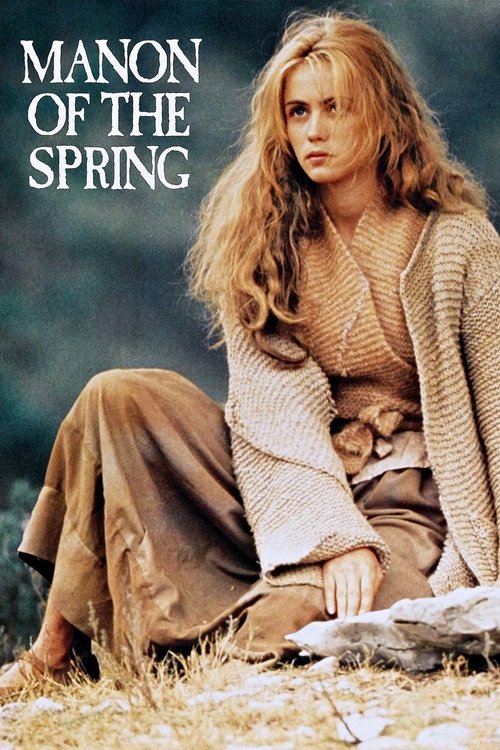
Manon of the Spring
1986 · Claude Berri
For when you want a big, novelistic tragedy to sink into — ideally as a double bill with Jean de Florette, its first half. Reach for it when you're in the mood for justice served slowly, and don't mind being wrecked a little.
What it's about
Years after a pair of Provençal farmers schemed a hunchbacked outsider out of his land and his water, the dead man's daughter Manon has grown into a wild young shepherdess living alone in the hills above their village. When she learns the truth about what was done to her father, she finds a way to make the whole village feel it. It's a revenge story told at the pace of the seasons.
The experience
Sun-drenched and unhurried on the surface, with a slow tightening underneath as old guilt comes due — it builds to an emotional payoff that lands like a hammer wrapped in velvet. Patient viewers get one of the most satisfying and devastating final acts in French cinema.
Performances
Emmanuelle Béart is luminous as Manon, saying more with silence and watchfulness than dialogue could, while Yves Montand's aging schemer curdles from villain into something almost pitiable.
The craft
Claude Berri shoots Provence like a character — golden hillsides, hard light, the preciousness of water made visible in every frame — with a sweeping, melancholy score to match. The two-film structure lets the story breathe like the Marcel Pagnol novel it comes from, so consequences arrive with the weight of a decade behind them.
Why it matters
With its companion film it became a landmark of French prestige cinema in the 1980s and a huge international success, reviving Pagnol's Provence for a worldwide audience and making Béart a star.
Snapshot
Manon des Sources is the second panel of Claude Berri's two-film adaptation of Marcel Pagnol's novel L'Eau des collines, released in France in 1986 only months after its companion, Jean de Florette. Where the first film stages a slow, sun-drenched crime — the peasant César Soubeyran ("le Papet") and his nephew Ugolin secretly blocking a spring so that the hunchbacked outsider Jean de Florette will fail, die, and forfeit his land — the sequel is the machinery of consequence turning over a decade later. Jean's daughter Manon (Emmanuelle Béart), now a wild shepherdess in the Provençal hills, discovers the source of the village's water and the truth of her father's ruin, and engineers a revenge whose reach neither she nor her victims can measure. The film closes on one of French cinema's great tragic ironies, and it functions less as an "action" sequel than as the second movement of a single symphonic work about fate, land, and inherited guilt. Taken together, the diptych became the emblematic French "heritage" production of its era and a landmark of the country's international art-house export.
Industry & production
The two films were conceived, financed, and shot as one enormous undertaking — Berri filmed them back to back on Provençal locations — and this scale is the central industrial fact about Manon of the Spring. It belongs to a moment in the mid-1980s when French producers, Berri prominent among them, were deliberately mounting large-budget literary spectacles to compete with Hollywood on the terrain of prestige and heritage rather than genre. The diptych was widely reported at the time as one of the most expensive French productions yet attempted; I would flag that precise budget figures circulate in several versions and I will not assert a single number as authoritative.
Berri produced through his own Renn Productions, in partnership with French television and other backers — the kind of consortium financing that increasingly underwrote ambitious French cinema in the decade. Distributing a project as two separate theatrical features, released in sequence, was itself a shrewd commercial architecture: audiences who were gripped by Jean de Florette returned for its resolution, and the pairing multiplied the marketing event. Both films drew very large French audiences and traveled unusually well abroad, particularly in Britain and the United States, where the diptych anchored the "quality French cinema" of the specialty circuit for a generation. Concrete grosses vary by source and I decline to invent them, but the commercial success is not in dispute.
Technology
Technically the film is conservative by design: 35mm photography, location shooting in the Provençal garrigue, and a reliance on natural landscape and daylight rather than on any novel apparatus. Its ambitions were logistical and photographic — sustaining a consistent look across a long, seasonally sensitive shoot in real terrain — rather than technological. The documentary record on exact format specifications (lenses, aspect ratio, stock) is thinner in general circulation than the film's fame would suggest, and I will not fabricate those details. What can be said with confidence is that the production's "technology" was essentially the classical toolkit of the well-funded location feature, deployed with great discipline; the film's power comes from craft applied to landscape, not from innovation.
Technique
Cinematography
Bruno Nuytten's photography is the film's most celebrated technical achievement and the connective tissue between the two panels. Nuytten renders the Provençal hills as a living antagonist — the parched limestone, the silvered olive foliage, the punishing clarity of southern light — so that water becomes visibly the most precious thing in the frame. The camera favors wide compositions that set human figures small against geology and sky, reinforcing the Pagnolian sense of people dwarfed and governed by land. Interiors, by contrast, are low and shadowed, the world of the scheming Soubeyrans. The visual continuity across the diptych — the same village, the same slopes photographed a decade "later" in story time — is a large part of why the two films read as one work.
Editing
The cutting is unhurried and classical, built to let landscape, weather, and performance breathe; scenes are allowed to develop at the pace of rural life and of a tragedy that grinds slowly toward its revelation. The editing's decisive job is structural: managing the delayed disclosure on which the whole diptych turns, withholding from the characters (and often from the audience) the knowledge that gives the ending its devastating force. Specific editorial credits for the film are documented in the standard filmographies; because attributions across the two panels are easy to conflate, I flag that a reader should confirm individual editor names against a primary source rather than take a single memory-based attribution here as final.
Mise-en-scène / staging
Berri stages the film with a deliberate, almost novelistic legibility. The village square, the church, the farmhouses, and the hidden springs form a tight moral geography, and blocking repeatedly organizes the community as a watching, gossiping collective — the chorus to the principals' tragedy. Manon herself is staged as a creature of the open hills, physically separated from the enclosed, secretive spaces of the Soubeyrans, so that the geography encodes the film's oppositions: innocence and calculation, height and enclosure, nature and property. The revelation of the blocked spring and the later blocking of the village's own water are staged as concrete, physical acts, keeping the film's metaphysics grounded in soil and plumbing.
Sound
Jean-Claude Petit's score is inseparable from the film's identity. Petit built the music around a theme adapted from Verdi — most famously the melody associated with La forza del destino — a choice that names the diptych's subject outright: the force of destiny. That operatic borrowing lends the rural material a tragic grandeur and binds the two films with a shared musical signature. Around the music, the sound design leans on the ambient world of the garrigue — wind, cicadas, sheep, the trickle and absence of water — so that the film's central absence, water, is registered aurally as well as visually.
Performance
Performance is where Manon of the Spring earns its emotional authority. Yves Montand, as César Soubeyran, delivers one of the signature late roles of his career: a hard, proud patriarch whose villainy in the first film curdles, in the second, into the film's most harrowing suffering. Daniel Auteuil's Ugolin — gap-toothed, twitching, pitiable — carries the sequel's most extreme arc, his obsessive, hopeless love for Manon driving him to self-destruction; the role, across both films, transformed Auteuil's career. Emmanuelle Béart's Manon is deliberately more elemental than psychological, a figure of nature and nemesis whose beauty and silence do much of the dramatic work. Hippolyte Girardot's schoolteacher provides the film's rational, tender counterweight. The ensemble's achievement was recognized at the following year's Césars, where Béart won the award for Best Supporting Actress; Montand and the film received further nominations. (Auteuil's Best Actor César is attached to Jean de Florette.)
Narrative & dramatic mode
The dramatic mode is tragedy in the fullest, near-classical sense — a machine of fate in which characters' concealed actions return to destroy them through consequences they never foresaw. The diptych is structured on dramatic irony: the audience, and eventually Manon, know what the perpetrators do not, and the film withholds its final knowledge until it can detonate. That final turn — the revelation to César that the man he ruined and let die, Jean de Florette, was his own unknown son, born to the woman he had loved and lost — converts the whole two-film arc retroactively into the story of a man who destroyed his own bloodline. The mode is therefore closer to Sophoclean recognition than to the melodrama of ordinary revenge: knowledge arrives too late, and the punishment is comprehension. Manon of the Spring specifically operates as the "recognition and reversal" half of the larger structure.
Genre & cycle
The film sits at the intersection of the rural literary drama and the emergent 1980s cycle of French heritage cinema (le cinéma du patrimoine or "quality" adaptation). It is a period piece — set in an early-twentieth-century Provence already tinged with nostalgia even in Pagnol's own telling — and it participates in a broader European vogue for handsome, faithful adaptations of canonical national literature. Within that cycle, Berri's Pagnol films are often taken as the defining French example, the counterpart to the British Merchant-Ivory and Forster adaptations of the same years. Generically it also draws on the pastoral and on tragedy; it is emphatically not the pastoral idyll its Provençal beauty might advertise, but a dark inversion of it.
Authorship & method
The governing authorial method is Claude Berri's fidelity to Marcel Pagnol. Pagnol's source is itself a hall of mirrors: he first told this story as a two-part film, Manon des Sources, in 1952, then novelized it as L'Eau des collines, from which Berri worked. Berri's screenplay was written with Gérard Brach, the veteran screenwriter long associated with Roman Polanski, and their method was one of expansion and re-balancing — restoring the full two-part scope Pagnol's own 1952 film had strained to contain, and giving Jean de Florette's backstory its proper weight so the sequel's ironies could land. Berri's directorial signature here is one of restraint and taste: he subordinates flourish to landscape, source text, and performance. The key collaborators are essential co-authors of the result — Bruno Nuytten as cinematographer, whose images define the films' look; Jean-Claude Petit, whose Verdi-derived score names their theme; and the ensemble cast, above all Montand, Auteuil, and Béart. This is auteurism of curatorship: Berri's authorship lies in assembling and disciplining a great craft team around a beloved national text.
Movement / national cinema
Manon of the Spring is a central document of 1980s French national cinema at a specific inflection point — the turn toward big-budget heritage production as a strategy of cultural and commercial self-assertion. It stands somewhat apart from the more stylized, youth-oriented cinéma du look (Beineix, Besson, Carax) that shared the decade; where those filmmakers embraced surface and pop modernity, Berri embraced landscape, literature, and the deep past. The diptych also functions as an act of national memory: Pagnol is one of the most beloved figures in French popular culture, and Berri's films re-consecrated a specifically Provençal, terroir-rooted image of Frenchness for a modern audience and for the world. Internationally, the films became for many non-French viewers the very image of "French cinema" in the late 1980s.
Era / period
The film exists in two temporal registers. As a production it is thoroughly of the mid-1980s — the moment of prestige adaptation, television co-financing, and international art-house expansion. As a fiction it is set in an earlier, roughly early-twentieth-century rural France, a pre-modern world of subsistence farming, water rights, superstition, and village consensus where the diversion of a spring can constitute murder. The gap between these two eras is part of the film's meaning: it looks back with a knowing nostalgia at a vanished agrarian order, and its huge contemporary audience registered that longing for rootedness at precisely the moment such rootedness had become historical.
Themes
Water is the master theme — as literal survival, as property, and as moral test. Around it cluster the film's deeper concerns: greed and the corruption of land-hunger; the peasant cult of lineage and inheritance (César's obsession with continuing the Soubeyran name is the engine of the whole tragedy); secrecy and complicity, both individual and communal; and above all fate, the "forza del destino" that the score keeps naming. The sequel foregrounds justice and revenge, but complicates them: Manon's retribution, blocking the village's water, punishes the guilty and innocent alike, so that vengeance itself becomes ambiguous. The final revelation folds all these into a single theme of tragic irony — the idea that in grasping for land and lineage, César annihilated the only lineage he had. The pastoral beauty of Provence is deployed throughout as counterpoint, a paradise photographed to make the human cruelty within it more terrible.
Reception, canon & influence
Critically and popularly, the diptych was a major success and quickly entered the canon of modern French cinema; the pairing was among the most acclaimed and widely seen French films of the 1980s at home and abroad, and it was showered with honors at the Césars and beyond, including Emmanuelle Béart's Best Supporting Actress César for this film. I flag that award and box-office particulars vary between the two panels in the record, and specific figures should be verified against primary sources rather than asserted here.
The influences on the film run backward through a dense chain: Marcel Pagnol's 1952 film and his subsequent novel are the direct sources, and behind Pagnol lies a broader tradition of Provençal regional literature and of classical tragedy, whose fatalism the Verdi score makes explicit. Berri's approach also drew on the reigning international model of the tasteful literary adaptation.
The influence the film shaped going forward is considerable. It helped consolidate the 1980s–1990s wave of French and European heritage cinema, demonstrating that faithful, handsomely mounted literary adaptation could be both prestigious and commercially potent. It was decisive for careers: it cemented Daniel Auteuil and Emmanuelle Béart as major stars and stands among Yves Montand's most revered late performances. For a large international audience it became a defining encounter with French cinema, and its images of Provence fed a durable cultural (and touristic) romance with the region. Within Pagnol's own legacy, Berri's diptych arguably became the version through which modern global audiences know the story, a re-canonization of a national author for a new era. Its lasting reputation rests on the rare completeness of the achievement — a two-film tragedy of land and water whose ending retrospectively transfigures everything before it.
Reception
A blockbuster on release — the payoff half of Berri's Pagnol diptych that helped make 'French heritage cinema' an international export in the late '80s — and while some French critics sniffed at its middlebrow polish then, it's now comfortably beloved, usually consumed as one four-hour double bill with Jean de Florette.
How Manon of the Spring was received, from release to now →
Influences: the films it descends from and the films it influenced
- Manon des Sources (1952) — The literal source film, whose staging of the Provençal village as a public tribunal and of blocked-spring drought as moral verdict Berri restores at full two-part length.
- La Femme du boulanger (1938) — Pagnol's technique of the Provençal village functioning as a gossiping moral chorus that publicly adjudicates a private sin — the community-as-chorus staging Berri inherits wholesale.
- Regain (1937) — From Giono, it establishes the dark-pastoral grammar in which water, soil and fertility are active dramatic forces and drought reads as a judgment rather than weather.
- Toni (1935) — On-location Provençal realism that treats the sun-cracked Midi landscape as a determining agent on the characters, the antecedent for landscape-as-antagonist over painted backdrop.
- Les Sœurs Brontë (1979) — Early Bruno Nuytten cinematography establishing the moody landscape-and-period-interior palette — figures set against austere terrain — that he refines into the diptych's look.
- Tess (1979) — Shares screenwriter Gérard Brach and the same method: a Hardy pastoral tragedy where wide landscape framing encloses a woman ground down by inherited fate.
- Camille Claudel (1988) — Nuytten graduating from DP to director, carrying the diptych's painterly period-landscape lighting into his own prestige biography, with Adjani given the elemental female weight.
- Cyrano de Bergerac (1990) — The commercial-critical proof that Berri's template — handsome, faithful French literary adaptation anchored by a star turn — had become the national norm.
- La Gloire de mon père (1990) — Directly rides the Berri-triggered Pagnol revival, adapting Pagnol's own memoirs with the same sunlit garrigue romance and Provençal ambience track.
- Germinal (1993) — Berri re-applying his own heritage method to Zola: landscape-as-antagonist relocated to the mine, with the exploited collective staged as a tragic chorus.
- Le Hussard sur le toit (1995) — A Giono adaptation extending the Provençal-landscape heritage epic, with Béart carrying the elemental female lead the diptych made her signature.
- Jean de Florette (1986) — The diptych's first panel, shot in the same campaign with Nuytten's camera and Petit's Verdi score, which plants the buried dramatic irony of the stopped spring that Manon detonates through delayed disclosure.
- Days of Heaven (1978) — The purest international cognate for Nuytten's wide-figure-in-landscape framing, where tiny human figures are set against wheat, water and sky as elemental agrarian forces.
- The Tree of Wooden Clogs (1978) — Peasant-community naturalism in which the rural collective is the true protagonist and the turning seasons and land dictate the drama, paralleling the community-as-chorus design.
- The Return of Martin Guerre (1982) — An immediately-prior French rural period piece built on communal recognition and a Sophoclean revelation of hidden identity, the same delayed-disclosure engine.
- A Room with a View (1985) — The reigning international model of the tasteful literary adaptation — prestige mounting, landscape, period fidelity — that Berri consciously matched in scale and finish.
Similar films
- Jean de Florette (1986) — influence & lineage
- Vagabond (1985) — shared sensibility
- L'Argent (1983) — shared sensibility
- The 400 Blows (1959) — shared sensibility
- Children of Paradise (1945) — shared sensibility
- Pierrot le Fou (1965) — shared sensibility
- The Green Ray (1986) — shared sensibility
- Mouchette (1967) — shared sensibility