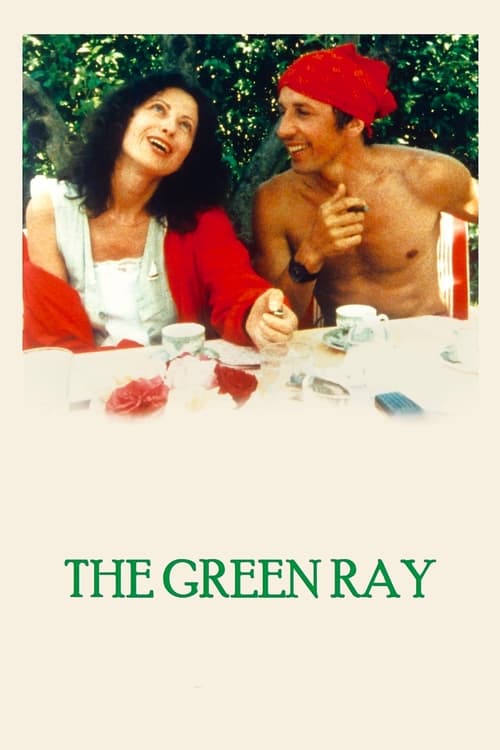
The Green Ray
1986 · Éric Rohmer
For when you're feeling lonely in a crowd, or wondering whether holding out for something real makes you brave or impossible — a summer film that meets melancholy where it lives and gently answers it.
What it's about
Delphine, a Parisian secretary, watches her summer holiday collapse when a friend cancels on her — and spends July and August adrift, too lonely to stay home and too out of step to enjoy the vacations others keep arranging for her. From Cherbourg to the Alps to the Basque coast, she searches for a connection she can't name, pinning a stray hope on a legend out of Jules Verne: the green flash at sunset that grants whoever sees it clarity about their own heart.
The experience
Awkward, funny, and piercingly true — Delphine's flailing can be uncomfortable to watch precisely because it's so recognizable, and the film's patience pays off in one of cinema's most quietly overwhelming final stretches. It feels less written than overheard.
Performances
Marie Rivière, who improvised much of her own dialogue, makes Delphine one of cinema's great difficult heroines — prickly, tearful, self-sabotaging, and completely sympathetic, often all within one lunch conversation.
The craft
Rohmer shot it light and fast on 16mm with largely improvised talk, so the beach chatter and dinner-table debates feel caught rather than staged. Beneath the casual surface the film is built with a jeweler's precision — every stray encounter and scrap of superstition set up for the ending to redeem.
Why it matters
Winner of the Golden Lion at Venice and among the most beloved films of Rohmer's career, it became the touchstone for a whole tradition of talky, sunlit films about young women drifting through summer.
Snapshot
The Green Ray (Le Rayon vert, released in some Anglophone territories as Summer) is the fifth of the six films in Éric Rohmer's "Comedies and Proverbs" (Comédies et proverbes) cycle, and among the most beloved and atypical works of his long career. It follows Delphine (Marie Rivière), a Parisian secretary whose summer holiday plans collapse when a friend backs out, leaving her adrift through July and August — tearful, lonely, unable to enjoy the vacations others arrange for her, and searching for a connection she cannot name. Wandering from Paris to Cherbourg, the Alps, and finally the Basque coast, she pins an inchoate hope to a natural phenomenon out of Jules Verne: the fleeting green flash that sometimes appears as the sun sets into the sea, and which, in legend, grants those who witness it clarity about their own and others' hearts. The film is famous for its near-total improvisation, its documentary-thin surface, and an ending of unusual emotional release. It won the Golden Lion at the 1986 Venice Film Festival and has since become a touchstone for a certain strain of intimate, wandering, emotionally exact European cinema.
Industry & production
The Green Ray was produced by Les Films du Losange, the company co-founded by Rohmer and Barbet Schroeder that had housed nearly all of Rohmer's work since the 1960s; Margaret Menegoz was the central producing figure at Losange during this period. The film was made cheaply, quickly, and with a very small crew, in keeping with Rohmer's lifelong artisanal economy — he ran productions lean by design, not merely by necessity, believing that a small footprint let him film in real locations with minimal disruption. The picture was shot on 16mm and later enlarged to 35mm for theatrical exhibition, and it had a close relationship to television: it was made in association with French television and screened on TV around the same period as its cinema release, part of the era's productive traffic between the two. Precise budget and box-office figures are not something I can state reliably, so I will not invent them; what is well established is that the film's modest means were a deliberate aesthetic choice rather than a compromise, and that its Golden Lion win gave it a critical prominence out of proportion to its scale.
Technology
The defining technological fact of the film is its capture on 16mm using largely available light and a stripped-down kit. The smaller gauge and lightweight camera enabled the loose, semi-documentary shooting Rohmer wanted — the ability to follow Rivière into real streets, real trains, real beaches, and real mountain paths without the apparatus of a conventional production. The grainier, softer 16mm image is not incidental; it gives the film a texture closer to home movies or reportage than to the polished 35mm surfaces of Rohmer's more composed pictures, reinforcing the sense that we are watching life caught rather than staged.
The green flash itself posed a genuine technical problem, because the phenomenon is real, rare, and extremely brief. Accounts of the production indicate that capturing a convincing green ray was difficult and that the shot was obtained through particular effort and patience rather than faked in an obvious way; I want to be careful here, because the exact circumstances of how the final image was acquired are reported inconsistently, and I would rather flag that thinness than assert a specific method as fact. What is certain is that the film stakes its climax on an actual optical event, and that the difficulty of securing it is part of the work's mythology.
Technique
Cinematography
The cinematography is by Sophie Maintigneux, then early in her career, working in a register far removed from the classical elegance of Nestor Almendros, Rohmer's most celebrated earlier collaborator. Here the camerawork is unobtrusive, mobile, and attentive — natural light, handheld and lightly supported setups, framings that keep Delphine within social space rather than isolating her in beautiful compositions. Color, however, is quietly systematic: green recurs as a motif threaded through the mise-en-scène (signs, objects, foliage, playing-card and poster details), a chromatic through-line that rewards the attentive viewer and binds the wandering narrative to its title. The look is deliberately plain so that the final seascape — the sun lowering toward the horizon, the crowd watching, the anticipated flash — lands as an event within an otherwise undramatized visual world.
Editing
The editing, by Rohmer's regular collaborator María Luisa García, serves the film's loose, episodic rhythm. Scenes tend to run long enough to let real-time conversation breathe, and the cutting favors continuity and patience over compression or emphasis. Because so much of the dialogue was improvised, the editorial task was partly one of shaping usable duration and behavioral truth out of extended takes — finding the moments where feeling surfaces and letting them stand. The overall structure is a chain of vacations and false starts, and the editing lets each episode accumulate rather than build conventionally, so that the ending's intensity feels earned by accretion.
Mise-en-scène / staging
Rohmer's staging here is unusually documentary. Rather than blocking actors through carefully designed compositions, he places Delphine among groups — families, holidaymakers, strangers on a beach — and lets her isolation register against their ease. The celebrated Biarritz beach scene, in which a group discusses Jules Verne's novel Le Rayon vert and the meaning of the green flash while Delphine listens at the edge, is exemplary: it is staged as overheard life, the protagonist a peripheral eavesdropper to the very idea that will organize her hope. The recurring image of Delphine as an outsider to other people's leisure — declining, weeping, leaving early — is built entirely through this staging of belonging and exclusion.
Sound
The sound is naturalistic, dominated by location ambience — wind, sea, traffic, the murmur of conversation. Musical scoring is sparse; Jean-Louis Valéro, who provided music across the Comedies and Proverbs, contributes only spare accents, so that the film's texture is overwhelmingly one of real acoustic space rather than underscored emotion. This restraint is essential to the film's honesty: feeling is withheld from the soundtrack and left to the actors and the situations, which makes the final scene's cathartic release all the sharper.
Performance
Marie Rivière's performance as Delphine is the film's center and one of the great achievements of Rohmer's cinema. Because the dialogue was improvised from situations rather than scripted, Rivière is not delivering lines so much as inhabiting a temperament — the tearfulness, the stubbornness, the vegetarian's fastidiousness, the painful honesty about her own unhappiness, the flashes of hope. The performance is credited as a genuine creative collaboration: Rivière is widely recognized as having contributed substantially to her character's dialogue and conception, and the film's emotional authenticity is inseparable from her work. The supporting players — including Vincent Gauthier as the young man Delphine meets near the end — perform in the same improvised, unmannered key, so that the whole film feels populated by real people rather than characters.
Narrative & dramatic mode
The film's dramatic mode is one of drift and accumulation rather than plot. Its "story" is a summer of failed vacations and small encounters, each a variation on Delphine's inability to be at ease. There is almost no external conflict; the drama is internal and social, generated by the friction between Delphine's longing and her incapacity to seize ordinary pleasures. Rohmer structures the film around a proverb — from Rimbaud, "Ah! que le temps vienne où les cœurs s'éprennent" ("Ah, may the time come when hearts fall in love") — which frames the whole as a study in waiting for feeling to arrive. The green ray operates as both a literal natural phenomenon and a symbolic pledge: a promise that clarity and connection are possible, held out to a character who has spent the entire film unable to find them. The ending, in which the pledge appears to be answered, is one of the most quietly overwhelming in Rohmer's work precisely because the preceding film has been so undramatic.
Genre & cycle
Formally the film is a drama and a romance, but only in Rohmer's oblique sense — the romance is deferred until the final minutes, and the drama is almost entirely interior. As part of the Comedies and Proverbs, it belongs to a cycle of six films (from The Aviator's Wife, 1981, through Boyfriends and Girlfriends, 1987) each built around a moral or literary proverb and each concerned with young-to-middle adults negotiating love, self-deception, and choice. The Green Ray is the cycle's most improvisational and arguably its most emotionally direct entry, trading the series' usual talkiness and irony for something more raw. Across Rohmer's larger output — the earlier Six Moral Tales and the later Tales of the Four Seasons — it sits comfortably within his abiding subject: people talking, hesitating, and revealing themselves through the gap between what they say and what they want.
Authorship & method
Rohmer wrote and directed, but the film's authorship is genuinely shared, which is the crucial point about its method. Having spent decades composing precise, literary dialogue, Rohmer here inverted his practice: he devised situations and let the actors, above all Marie Rivière, improvise their speech. The result retains his authorial signature — the moral seriousness, the attention to self-knowledge, the structuring proverb, the patience with everyday duration — while opening onto a spontaneity his scripted films did not have. His key collaborators reinforced this approach: cinematographer Sophie Maintigneux's light, documentary camera; editor María Luisa García's unhurried shaping; composer Jean-Louis Valéro's restraint; and Rivière's co-authorship of her own role. It is a film that demonstrates how completely Rohmer's authorship could survive — even intensify — under conditions of improvisation, because his sensibility lived less in the words than in the situations and the ethical attention he brought to them.
Movement / national cinema
The Green Ray belongs unmistakably to French cinema and to the long afterlife of the Nouvelle Vague. Rohmer, a former editor of Cahiers du cinéma and one of the New Wave's founding critics-turned-directors, carried the movement's ethos — location shooting, small crews, real time, an essayistic attention to how people actually behave — deep into the 1980s. By this point his work had evolved into its own distinct idiom, but the New Wave inheritance is legible in every choice: the refusal of studio artifice, the trust in the camera to observe rather than dramatize, the sense of cinema as a moral and observational instrument. Within 1980s French film, the picture stands as a bracingly intimate alternative to the era's more glossy, design-forward cinéma du look.
Era / period
The film is a document of its exact moment — the France of the mid-1980s, its train networks and package holidays, its dispersal of city dwellers to coast and mountain each summer. Its texture of vacation culture, of friends' apartments and shared holiday plans, of a single working woman navigating the social expectation that summer must be spent somewhere with someone, is period-specific and captured almost ethnographically. Yet the film's concerns — loneliness, the difficulty of connection, the wait for feeling to arrive — are pitched deliberately outside period, which is part of why it has aged so little.
Themes
At its core the film is about loneliness and the search for meaning in a life that refuses to cohere. Delphine's isolation is not tragic but ordinary, and the film treats it with unusual seriousness, honoring the reality that unhappiness can be undramatic and hard to explain even to oneself. Interwoven are themes of chance and sign-reading — Delphine's attention to omens, colors, and coincidences, her hope invested in a playing card found on the ground or in the green flash itself — which the film neither mocks nor fully endorses, holding open the question of whether the universe answers our longing or whether we simply make meaning where we can. Above all it is a film about waiting: for love, for clarity, for the moment when, as the Rimbaud proverb has it, hearts fall in love. The green ray is the perfect emblem of these themes — a real, rare, transient phenomenon onto which a whole inner life can be projected.
Reception, canon & influence
Critically, The Green Ray was received as a high point of Rohmer's late career and was crowned with the Golden Lion at the 1986 Venice Film Festival, along with the FIPRESCI critics' prize; this dual recognition cemented its stature. Its reputation has only grown, and it is now frequently cited among Rohmer's finest films and among the essential works of 1980s European cinema, admired especially for the emotional truth of Rivière's performance and the daring of its improvised method.
Looking backward, the film draws on Jules Verne's novel Le Rayon vert for its central image and legend, on Arthur Rimbaud for its guiding proverb, and on the whole New Wave tradition of location realism that Rohmer himself helped found; it also extends his own decades-long investigation of self-knowledge and desire. Looking forward, its influence is felt wherever filmmakers pursue intimate, wandering, quasi-documentary studies of solitary characters, and its trust in improvisation and real duration anticipates much in later independent and art cinema. Directors and critics have repeatedly invoked Rohmer — and this film in particular — as a model for how to make emotionally profound cinema from the smallest of means. Rather than attribute specific homages I cannot verify, it is safest to say that The Green Ray's legacy lies less in direct quotation than in permission: it demonstrated, durably, that a film could be nearly plotless, cheaply made, and improvised, and still arrive at a moment of genuine transcendence.
A Deleuzian reading
Start with the crying.
The full Deleuzian reading of The Green Ray →
Reception
It arrived a winner — the Golden Lion at Venice in 1986 — but for years it was filed under 'lovely minor Rohmer.' The streaming and Letterboxd era flipped that: it's now the gateway Rohmer, the one everyone's summer-sad friend has logged.
How The Green Ray was received, from release to now →
How to watch The Green Ray: what to notice on a first viewing
- Track the color green wherever it appears on screen. Rohmer threads green through signs, foliage, a poster, a playing card, long before the sunset the title promises, quietly repeating the film's one color everywhere. The film is promising you something long before Delphine or you know what it is.
- Watch Delphine at the edge of every group she joins. Rohmer places her among families and holidaymakers rather than isolating her in a composed shot, letting her discomfort register simply by how she sits at the margin of other people's ease. Her loneliness is staged as a position in a crowd, not as a dramatic scene by herself.
- Listen for how little music this film actually has. Jean-Louis Valéro's score stays almost entirely absent, leaving wind, sea, traffic, and ordinary conversation to carry the whole soundtrack instead of cues telling you what to feel. No music is coaching your reaction, so whatever you feel here you arrive at on your own.
- Track each new place Delphine's vacation takes her. Paris, Cherbourg, the Alps, the Basque coast: the film moves her through one destination after another, each a fresh attempt at a vacation that does not quite work. The trip itself is not going anywhere, and the film lets you feel that instead of skipping past it.
- Watch Delphine's face when nobody in the scene is talking to her. Marie Rivière lets Delphine's tearfulness, stubbornness, and flashes of hope surface in her expression during long, mostly unscripted stretches rather than through anything she is given to say. Her face is doing most of the film's real work, whether or not a single word is being spoken.
The whole guide to watching The Green Ray, with the keys for a rewatch →
Influences: the films it descends from and the films it influenced
- Journey to Italy (1954) — Establishes the template Rohmer inherits: a discontented woman adrift among unstaged real locations until an unplanned external event detonates an unearned emotional revelation, plot subordinated to duration and place.
- Chronicle of a Summer (1961) — Its cinéma-vérité method — a lightweight sync-sound camera capturing subjects improvising their own speech — is precisely the documentary-observation and improvised-collaboration mode Rohmer grafts onto fiction with Rivière.
- Cléo from 5 to 7 (1962) — Pioneers the near-real-time drift of a solitary woman through actual Paris streets, accumulating chance encounters and read signs rather than plot — the wandering-quasi-documentary structure Rohmer adopts.
- La Collectionneuse (1967) — Néstor Almendros's available-light, minimal-crew photography here invents the naturalistic Rohmerian look that Sophie Maintigneux extends on 16mm, light-as-found rather than lit.
- My Night at Maud's (1969) — Codifies Rohmer's structuring device — a moral proverb or maxim framing a protagonist's fumbling pursuit of self-knowledge through long, patient dialogue scenes — that The Green Ray reuses via the Rimbaud epigraph.
- Masculin Féminin (1966) — Its documentary-style interview fragments, letting young actors talk quasi-spontaneously to the camera, model the New Wave habit of harvesting real, unscripted speech that Rohmer pushes toward full improvisation.
- The Mother and the Whore (1973) — Demonstrates post–New Wave that emotional truth can be built from talk in real duration and long takes, dialogue that feels caught rather than written, licensing Rohmer's plotless accretion.
- Before Sunrise (1995) — Builds a whole film from walk-and-talk in near-real-time through real streets, the leads co-authoring improvised-feeling dialogue — a direct extension of Rohmer's trust in duration and actor speech.
- Funny Ha Ha (2002) — Founds mumblecore on Rohmer's permission slip: a low-budget, near-plotless portrait of a drifting young woman built from improvised, halting dialogue and available light.
- In the City of Sylvia (2007) — Extends the wandering-observation mode to near-silence, a solitary figure searching real café-and-street crowds for a face, narrative replaced by patient documentary attention to place and chance.
- Wendy and Lucy (2008) — Carries forward the observational, available-light study of a lone woman with minimal plot, meaning accreting from small real-time incidents rather than dramatic structure.
- Goodbye First Love (2011) — Inherits Rohmer's episodic accretion across time and his naturalistic, unshowy light and performance, tracing a young woman's emotional education through drift rather than plotted event.
- Frances Ha (2012) — Structures itself as episodic accretion around a solitary drifting woman whose improvised-feeling talk and city wandering openly descend from Rohmer's method and rhythm.
- Right Now, Wrong Then (2015) — Extends Rohmer's chance-encounter drift and structuring-repetition into a low-budget, available-light, talk-driven form where lightly improvised conversation and revealing coincidence carry the whole film.
- Summer Hours (2008) — Semi-improvised understatement under available light in a summer-vacation setting, performance directed toward naturalistic ordinariness rather than dramatic peaks.
- Falcon Lake (2022) — Semi-improvised, natural-light vacation malaise that resolves into a single uncanny natural phenomenon — the model for treating an ordinary landscape as a site of the numinous.
- A Summer's Tale (1996) — Its improvised, semi-documentary dialogue method and its protagonist paralyzed by indecision — drifting through seaside settings awaiting a sign — are the direct rehearsal for Gaspard's dithering.
- Before Midnight (2013) — Rohmer generated the dialogue in workshop with Marie Rivière, crediting the actress as effective co-author — the methodological ancestor of the Before films' extended collaborative writing sessions refined through performance.
- Bergman Island (2021) — The holiday-time chronicle built from small undramatic scenes, natural light, no non-diegetic score and performances pitched below theatrical affect — the exact tonal calibration Hansen-Løve uses to keep a week on Fårö from becoming a crisis narrative.
- Full Moon in Paris (1984) — Immediate stablemate in the Comédies et Proverbes cycle, sharing the proverb-epigraph architecture and the study of a solitary woman testing her desire against everyday duration.
- Boyfriends and Girlfriends (1987) — Closes the same proverb cycle a year later, extending the available-light location realism and the theme of chance-and-signs governing romantic self-discovery.
Similar films
- Cléo from 5 to 7 (1962) — influence & lineage · same viewing thread
- Boyfriends and Girlfriends (1987) — influence & lineage
- Chronicle of a Summer (1961) — influence & lineage
- Before Sunrise (1995) — influence & lineage
- Masculin Féminin (1966) — influence & lineage · same viewing thread
- The Mother and the Whore (1973) — influence & lineage · same viewing thread
- Pierrot le Fou (1965) — same viewing thread
- Vivre Sa Vie (1962) — same viewing thread
All the films related to The Green Ray →
Watch it with: curated runs of related films
- Adrift in the Modern World — Watch these when you want to drift through postwar Rome and Paris alongside people who have everything and feel nothing — they rhyme on beautiful boredom, aimless days, and a search for meaning that modern comfort keeps failing to supply.