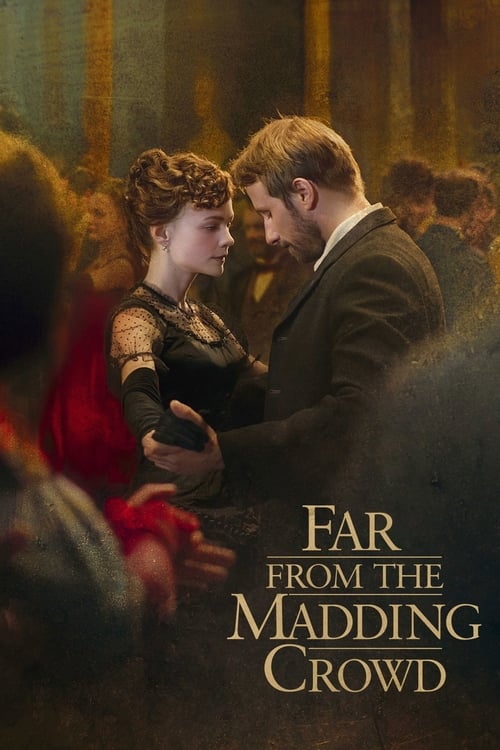
Far from the Madding Crowd
2015 · Thomas Vinterberg
For a cozy night in when you want to fall in love — big landscapes, slow-burn longing, and a heroine worth rooting for. Comfort viewing with enough grit and heartbreak to keep it from going soft.
What it's about
In Victorian rural England, Bathsheba Everdene inherits a farm and insists on running it herself — a scandal in itself — while three very different men pursue her: a steadfast shepherd, a wealthy older landowner, and a dashing, reckless soldier. Adapted from Thomas Hardy's novel, it's the story of a woman trying to keep her independence in a world where marriage is supposed to be her whole plot.
The experience
Sweeping and sun-warmed but with real weather in it — swooning one moment, bruising the next. It moves briskly for a period piece and treats its romance as a genuine gamble with stakes, not a foregone conclusion.
Performances
Carey Mulligan gives Bathsheba a spine — playful, proud, and visibly thinking her way through every choice — and Matthias Schoenaerts's quiet, patient shepherd smolders without ever raising his voice. Michael Sheen brings surprising ache to the lonely landowner.
The craft
Thomas Vinterberg shoots Dorset in green-gold widescreen that makes the countryside a character — harvests, storms, and sheep-farming rendered with real physicality rather than postcard prettiness. Craig Armstrong's score swells at exactly the right moments; this one rewards the biggest screen you have.
Why it matters
It proved a classic could be retold with a modern pulse — a Danish director best known for raw contemporary drama delivering one of the most warmly received British period romances of its decade.
Snapshot
Thomas Vinterberg's adaptation of Thomas Hardy's 1874 novel arrives as one of the more unexpected reclamations in twenty-first-century British heritage cinema: a film shaped by the co-founder of Dogme 95 yet delivered in the full grammar of lush pastoral widescreen, a Danish sensibility folded quietly into the green-gold topography of Dorset. What distinguishes the 2015 version from its predecessors — above all from John Schlesinger's celebrated 1967 film — is a double register of ambition: the landscape is rendered with a grandeur that feels genuinely earned rather than decorative, and Carey Mulligan's Bathsheba Everdene is legible as a woman whose independence is structural to her character rather than incidental to the plot. The film is not revisionist; it is careful. Its intelligence lies in knowing exactly which conventions of the period drama to honor and which to quietly dissolve.
Industry & production
The production was assembled under the banner of BBC Films, DNA Films, See-Saw Films, and Scott Free Productions — a grouping that maps neatly onto the early 2010s model for mid-budget British prestige pictures: public broadcaster capital, independent production infrastructure, and the international credibility of Ridley Scott's Scott Free shingle lending commercial assurance. See-Saw Films had by this point established itself as a reliable house for literary adaptations and Oscar-targeted prestige work, having produced The King's Speech (2010) and The Imitation Game (2014). Fox Searchlight Pictures handled North American distribution, fitting the film into the specialty-cinema pipeline that had become the standard route for films of this scale and ambition. The production shot primarily on location in Dorset and Wiltshire — the Hardyan county of origin — using working farmland and period-preserved agricultural architecture. This commitment to practical geography, unusual in its thoroughness, is one of the film's most consequential decisions, grounding the drama in the actual textures of Victorian land management rather than the managed prettiness of a studio backlot. Budget figures have not been widely reported at a precise level, but the film operated in the range typical of mid-tier BBC Films productions — well below the tentpole threshold, with resources concentrated in location work, costume, and cinematography rather than spectacle.
Technology
The film was photographed in widescreen anamorphic format, a choice that proves dramatically purposeful rather than conventionally prestigious. Cinematographer Charlotte Bruus Christensen, working in close collaboration with Vinterberg as she had done on The Hunt (2012), used the anamorphic frame's horizontal breadth to situate characters within landscape rather than against it — a distinction that matters enormously when the landscape is not backdrop but argument. The precise camera system and lens package have not been publicly itemized in detail, but the image quality and latitude in the exterior work are consistent with high-end digital acquisition, almost certainly on the Arri Alexa platform that had by 2014–15 become the dominant choice for productions requiring fine grain management across extreme natural lighting conditions. Craig Armstrong's score was recorded with live orchestral forces, a commitment to analog warmth that matches the film's overall resistance to electronic pastiche.
Technique
Cinematography
Bruus Christensen's work on this film is the clearest statement of what landscape cinematography can do when it is asked to carry psychological freight. She works consistently with natural and near-natural light, and the results — particularly in the golden-hour exteriors that dominate the film's pastoral sequences — achieve a warmth that avoids sentimentality because it is also allowed to go cold and overcast without apology. The anamorphic compositions frame Bathsheba at moments of decision with the full weight of acreage behind and around her, the land she has inherited presented not as backdrop but as the stakes of every exchange she enters. There is a recurring grammar of scale: intimate two-shots in firelit interiors abruptly opened out into vast field compositions, making the emotional narrowness of Victorian propriety feel claustrophobic by contrast. The sheep-shearing barn sequence — warm amber candlelight, close faces, the eroticism of domestic labor — demonstrates Christensen's control of interior space in a register quite different from her landscape work, suggesting the range the collaboration required. She was nominated for a BAFTA for the work; the nomination reflected a genuine consensus among peers.
Editing
Claire Simpson, whose career stretches back to Oliver Stone's Platoon (1986), cut the film with a rhythm that defers to character over incident. The editing is classical in the finest sense — motivated by dramatic logic rather than pace anxiety — and at 119 minutes the film maintains an unhurried forward movement that risks sluggishness only in a small number of transitional passages. The intercutting between Bathsheba's three concurrent suitors is handled without mechanical parallelism; the film is willing to follow one storyline deep before returning to the others, trusting that the audience carries the emotional state of each suspended thread. The storm sequence, in which Gabriel Oak alone labors to cover the harvest against coming rain while Troy's soldiers sleep off their revelry, is edited with a sustained mounting tension that represents the film's highest gear.
Mise-en-scène / staging
Vinterberg stages scenes with an observational patience that is the visible residue of his Dogme training even when the visual language has moved well beyond it. Actors are given room to occupy space before dialogue begins; exits and arrivals are frequently held a beat too long in conventional terms, which gives them an earned quality — we feel the distance a character has traveled. The three suitors are consistently differentiated through their spatial relationship to Bathsheba: Oak circles at a respectful working distance, always present in the periphery of her activity; Boldwood occupies formal interior spaces, his approaches announced by architecture and ceremony; Troy invades at close range without preparation, his soldier's habit of proximity experienced as a form of assault. The production design by Kave Quinn achieves period specificity without museum inertness — tools are used, stables are dirty, costume fabrics show wear and labor.
Sound
Craig Armstrong's score belongs to a tradition of restrained British-pastoral orchestral writing, more indebted to late Vaughan Williams and Gerald Finzi than to the denser romantic idiom that dominates Hollywood period films. It is applied with discipline — there are extended sequences in which ambient rural sound (wind through crop, animal presence, the mechanical rhythm of farm work) substitutes for score entirely, a decision that makes Armstrong's interventions, when they come, feel genuinely earned rather than regulatory. The sound design throughout privileges the acoustic texture of working land — a choice consistent with Vinterberg's longstanding interest in environments that shape behavior.
Performance
Carey Mulligan's Bathsheba is the film's organizing intelligence. Mulligan refuses sentimentality in both directions — she does not soften the character's stubbornness into endearing quirkiness, nor does she harden it into programmatic feminist statement. The result is a woman who is exactly as contradictory as Hardy wrote her: self-possessed and impulsive, capable of cruelty without malice, genuinely uncertain about what she wants while being entirely certain she will decide for herself. Matthias Schoenaerts brings a physical stillness to Gabriel Oak that is cinematically potent — he communicates interiority through the withholding of expression, and his measured delivery sits in productive counterpoint to the more theatrical registers of his rivals. Michael Sheen's Boldwood is the performance most likely to be underestimated on first viewing: a sustained slow-burn from composed prosperity to obsessive ruin, calibrated so precisely that the final violence arrives as both shock and inevitability. Tom Sturridge's Troy is the most difficult role in the material — a character whose charm must be visible to the audience even as his predatory facility is equally clear — and Sturridge navigates this without either excusing or caricaturing the man.
Narrative & dramatic mode
David Nicholls's screenplay is an act of intelligent selection from a novel dense with incident and social texture. His primary decision — foregrounded more explicitly than in the 1967 adaptation — is to organize the drama around Bathsheba's consciousness rather than distributing the narrative weight more democratically across her suitors. This is not a radical departure from Hardy (the novel is substantially hers) but it produces a film with a distinctly modern shape: a female bildungsroman in period dress, tracking the education of a woman who begins the story overconfident in her independence and ends it having learned what independence, shorn of romanticism, actually costs. Nicholls softens certain elements of the novel's tragedy — the film moves toward qualified hope with more comfort than Hardy strictly warrants — but this is a considered choice rather than a failure of nerve, and it is consistent with the film's interest in Bathsheba as a figure of aspiration rather than cautionary example.
Genre & cycle
The film belongs to the British heritage cinema tradition established in the 1980s by Merchant Ivory productions and consolidated through the Thatcher-era heritage boom — A Room with a View (1985), Howards End (1992), Remains of the Day (1993) — but it participates in a self-conscious revision of that tradition visible across the 2010s. Where the Merchant Ivory mode tended to aestheticize landscape and period detail as objects of uncritical pleasure, the 2015 wave of literary adaptations — including Carol (2015), Brooklyn (2015), and Testament of Youth (2014) — used period setting as a lever for scrutinizing gendered constraint. Vinterberg's film sits squarely in this revisionist cohort: it is gorgeous without being safe, and its emotional seriousness distinguishes it from the more affirmatively nostalgic heritage productions of the previous decade.
Authorship & method
The film represents a significant generic departure for Thomas Vinterberg while remaining fully intelligible within his oeuvre. His consistent preoccupations — the destruction wrought by male desire when it curdles into possession, the moral weight of community witness, the way institutional and social forms (the household, the regiment, the congregation) both protect and imprison — map directly onto Hardy's material. Vinterberg co-founded Dogme 95 with Lars von Trier in 1995; the Vow of Chastity that governed the movement's films — no artificial lighting, no non-diegetic music, location shooting only — was a formal manifesto as much as a practical constraint. By 2015 Vinterberg had long since set those prescriptions aside (The Hunt was conventionally photographed and scored), but the underlying sensibility they expressed — a distrust of beautification as a cover for moral evasion, an insistence on watching characters closely enough to see their capacity for harm — remains legible in his approach to Hardy. Charlotte Bruus Christensen had established herself as his principal visual collaborator through The Hunt; their working relationship is characterized by her account as one of genuine co-authorship on visual strategy, rather than a director-cinematographer hierarchy. David Nicholls brought to the screenplay a novelistic intelligence sharpened by his own fiction writing (One Day, 2009) and a track record in literary adaptation that suggested he understood how to transfer interiority from page to screen without reducing it to exposition.
Movement / national cinema
The film occupies a productive paradox in terms of national cinema: it is definitively a British film — in source material, cast, landscape, and cultural register — made by a Danish director whose entire career has been formed within the Scandinavian tradition of social realism and institutional critique. Vinterberg is not the first European filmmaker to find in British literary material a subject congenial to his thematic concerns — Roman Polanski's Tess (1979), another Hardy adaptation, offers the obvious precedent — but there is something specifically productive in his relationship to English pastoral. He is drawn to it as an outsider, which means he neither romanticizes the tradition uncritically nor dismantles it from a polemical distance. The Dorset landscape is treated with documentary attentiveness; the social world it contains is understood with an ethnographic curiosity that is slightly estranged from the material, and this estrangement generates a useful critical clearance.
Era / period
2015 was a notable year for female-centered period drama in English-language prestige cinema: Carol, Brooklyn, Suffragette, and this film appeared within months of one another, collectively articulating a cultural appetite for stories in which historical constraint on women is examined rather than simply decorated. The convergence was not coordinated but it was not coincidental either; it reflected both changing commissioning priorities in British and American specialty cinema and a wider critical consensus that the heritage film was most interesting when its pleasures were placed in tension with its politics. The film's distribution through Fox Searchlight — the foremost North American specialty-cinema pipeline of the period — places it accurately within the ecosystem of prestige adult drama that characterized the mid-2010s before streaming consolidation reshaped distribution.
Themes
The film's deepest preoccupation is with female autonomy as a working condition rather than a philosophical position — what it actually costs, day to day, for a woman to manage land, labor, and her own desires in a context designed to prevent all three. Bathsheba's independence is repeatedly shown as exhausting and expensive as well as exhilarating; the film takes seriously both the pleasure of self-determination and the loneliness it produces. Against this is set a sustained analysis of masculine desire as possessiveness: Oak's love is patient but also waiting; Boldwood's is respectable before it becomes obsessive; Troy's is predatory from the start. Each suitor represents not a type but a structure of wanting — ways in which men convert attraction into claim. Hardy's landscape carries additional thematic weight: the land Bathsheba inherits is not a romantic setting but a practical entity requiring constant management, and her competence as a farmer is never treated as remarkable within the world of the film in a way that might condescend. The seasonal rhythms — lambing, shearing, harvest, storm — organize the narrative as a cycle of labor in which love is one more thing to be managed alongside the sheep.
Reception, canon & influence
Critical reception on release was broadly favorable, with particular praise directed at Mulligan's performance and Bruus Christensen's cinematography. The film earned an aggregate critical approval in the high seventies to low eighties on review-aggregation metrics, suggesting consensus admiration without the unanimity of a major critical event. Reviewers frequently invoked the 1967 Schlesinger adaptation as the standard of comparison; opinion divided on whether Vinterberg's version surpassed, equaled, or more modestly complemented it, with defenders of the earlier film noting that Nicolas Roeg's cinematography for Schlesinger had a raw visual energy that the 2015 version's lustrous polish occasionally displaced. The film was not a major commercial success in North American markets, fitting the pattern of specialty releases that perform solidly without crossing into the mainstream. It has since found a durable audience in home-viewing contexts, where its sustained pacing is better accommodated than in theatrical settings calibrated for faster-cutting fare.
As a work shaped by influences, the film looks backward to at least three lineages: Hardy's novelistic tradition of rural tragedy and female interiority; the heritage cinema canon from Schlesinger through Ivory; and Vinterberg's own Northern European school of socially analytical drama. The 1967 Schlesinger version remains the primary intertext — a film whose New Wave energy (Roeg was by then a significant cinematographic intelligence in his own right) and charismatic lead performances set the interpretive terms that Vinterberg had to reckon with, even if his approach finally operates in a different key. The forward influence of the 2015 film is more difficult to trace precisely, as is typical of mid-decade prestige productions whose impact is diffuse rather than generative of a specific stylistic movement. What can be said with confidence is that it contributed, alongside its 2015 cohort, to the consolidation of a mode of literary heritage filmmaking in which aesthetic richness and political seriousness were understood as mutually reinforcing rather than competing values — a mode that has remained visible in British prestige production in the years since.
A Deleuzian reading
The image that stays is Bathsheba standing at the edge of her own field, small against a horizon the anamorphic lens stretches wider than any one person should have to stand against.
The full Deleuzian reading of Far from the Madding Crowd →
Reception
Greeted in 2015 as handsome but 'safe' — solid reviews, mild surprise that a Dogme 95 rebel had made a lush costume drama — it has since settled into life as a quietly beloved comfort watch, with Letterboxd affection for it growing steadily.
How Far from the Madding Crowd was received, from release to now →
Influences: the films it descends from and the films it influenced
- Far from the Madding Crowd (1967) — Nicolas Roeg's handheld, New Wave-inflected location cinematography established the visual terms Vinterberg and Bruus Christensen deliberately inverted with their lustrous anamorphic polish — the 2015 version's craft identity is defined in negative against Roeg's raw kinetic register.
- Festen (1998) — Dogme 95's available-light, mid-distance observational staging — letting scenes run without editorial acceleration, watching characters rather than cutting to close-ups for affect — is the direct formal DNA of FFTMC's 'Dogme-observational-patience' in performance and scene construction.
- Jagten (2012) — Charlotte Bruus Christensen's first full collaboration with Vinterberg developed the technique of sustained close framing on faces to externalize guilt, desire, and the way male possession corrodes community witness — a method transferred intact to FFTMC's staging and performance approach.
- Tess (1979) — Geoffrey Unsworth and Ghislain Cloquet's anamorphic widescreen photography of English pastoral as a space of female entrapment — long lenses compressing the protagonist into the landscape rather than liberating her within it — established the visual grammar for Hardy adaptation that Bruus Christensen inherits and refines.
- The Remains of the Day (1993) — Tony Pierce-Roberts' interior/exterior contrast cinematography — high-key windows against shadow-heavy rooms — and the staging of all dramatic weight through physical restraint rather than dialogue are the direct heritage-mode antecedents for FFTMC's lighting philosophy and performance register.
- The Piano (1993) — Michael Nyman's sparse score functions as an externalization of Ada's inner life rather than dramatic commentary from outside, establishing the template for period-film music that substitutes for ambient silence — the direct precursor to FFTMC's ambient-pastoral-substitution approach to sound design.
- Bright Star (2009) — Greig Fraser's window-sourced natural-light interiors — directional beams through gauze, no supplementary fill — in a British period literary adaptation established the specific visual language of interior-contrast-as-consciousness that Bruus Christensen develops with greater anamorphic sweep in FFTMC.
- Jane Eyre (2011) — Adriano Goldman's strict all-practical-source photography — candles and windows only, no additional fill — in anamorphic widescreen for a female-consciousness literary adaptation is the immediate technical template for Bruus Christensen's philosophy: light registers emotional and social temperature rather than flattering the subject.
- Breaking the Waves (1996) — Von Trier's Dogme-adjacent close observation of female interiority under male possession, combined with his chapter-dividing landscape sequences that function as ambient-score substitution rather than diegetic pause, directly anticipates two of FFTMC's most distinctive facets — the sound strategy and the male-possession-as-central-craft-concern.
- Lady Macbeth (2016) — Ari Wegner's static, fixed-distance framing of the protagonist within Victorian domestic architecture — refusing editorial close-ups, holding the full body inside the room's geometry — is the most austerely direct descendant of FFTMC's Dogme-observational-patience applied to British period material.
- Colette (2018) — Giles Nuttgens' natural-light period photography and the narrative structure centering a woman's consciousness against male appropriation (Willy's legal ownership of Colette's writing mirrors Troy's and Boldwood's possession of Bathsheba) extends FFTMC's female bildungsroman-through-male-possession architecture into a French-literary analog.
- Portrait of a Lady on Fire (2019) — Claire Mathon's strict natural-light-only cinematography — all sources physically present or logically implied within the frame, no motivated cheating — in an anamorphic period film organized entirely around female consciousness pushes to a formal extreme the same natural-light philosophy Bruus Christensen applies in FFTMC.
- The Power of the Dog (2021) — Ari Wegner's anamorphic landscape framing in which terrain externalizes male desire and psychological coercion — mountains and valley as index of emotional pressure on other characters — develops the facet of anamorphic-landscape-as-psychological-surface that Bruus Christensen established in FFTMC's Dorset compositions.
- Suffragette (2015) — Eduard Grau's desaturated, physically grounded cinematography rejects heritage-mode gloss in favor of material authenticity; alongside FFTMC in the same release year, the film co-defines the 2010s British female period drama mode in which aesthetic richness and political seriousness reinforce rather than cancel each other.
- Carol (2015) — Ed Lachman's Super 16 blown-up photography — selecting analog grain and muted color temperature to achieve period texture through the photochemical surface itself — is an analogous strategy to Bruus Christensen's Arri Alexa tuning for tonal richness over digital sharpness: both prioritize the sensory skin of the past over legibility.
Similar films
- Tess (1979) — influence & lineage
- Carol (2015) — influence & lineage
- Breaking the Waves (1996) — influence & lineage
- Portrait of a Lady on Fire (2019) — influence & lineage
- "Wuthering Heights" (2026) — shared sensibility
- Bergman Island (2021) — shared sensibility
- Dreams (2024) — shared sensibility
- Sense and Sensibility (1995) — shared sensibility