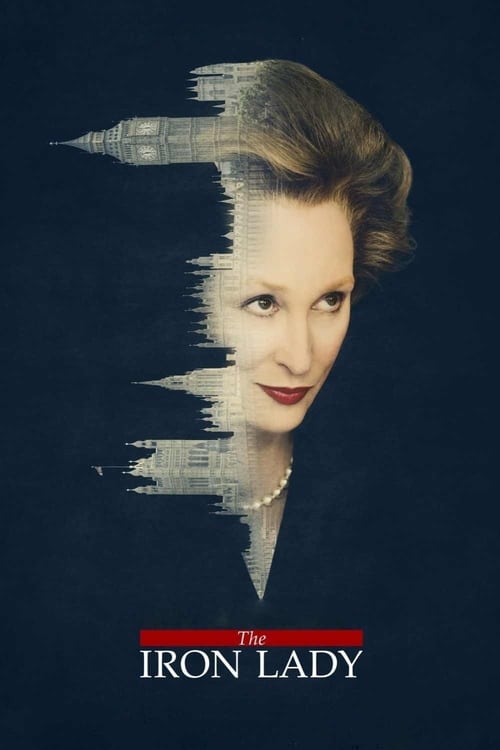
The Iron Lady
2011 · Phyllida Lloyd
For a thoughtful, actorly evening — when you want a great performance more than a history lesson, or a meditation on ambition and old age. A comfortable watch about an uncomfortable figure.
What it's about
Margaret Thatcher, Britain's first woman prime minister, seen from the far end of her life: elderly, widowed, and slipping into dementia, sorting through her late husband's belongings while his imagined ghost keeps her company. From that quiet flat the film drifts back through her rise — the grocer's daughter forcing her way into a men's club of a party, the battles in Parliament, the Falklands War — asking what the climb cost her.
The experience
More melancholy than political — intimate, memory-haunted, and moving in its portrait of decline, with bursts of steel whenever the younger Thatcher takes the screen. It's gentler than its subject.
Performances
Meryl Streep's Thatcher — spanning four decades of the woman's life — won her a third Academy Award and is the reason to watch: voice, posture, and frailty rendered with eerie precision. Jim Broadbent brings warmth and mischief as Denis.
The craft
The structure is the gamble: history refracted through an unreliable, grieving memory rather than a chronological march. The transformative makeup work is remarkable in its own right, aging Streep convincingly from ambitious newcomer to frail widow.
Why it matters
It became the defining screen portrait of Thatcher and a landmark in Streep's late career, while stirring real controversy in Britain over depicting a then-living leader's dementia.
Snapshot
The Iron Lady is a British biographical drama about Margaret Thatcher, Britain's first woman prime minister, built around an audacious and divisive structural conceit: rather than march chronologically through a political life, it observes an elderly, widowed Thatcher in the grip of dementia, sorting through her late husband's clothes, conversing with his hallucinated ghost, and drifting back across memory into the formative and triumphant episodes of her career. Directed by the theater and opera director Phyllida Lloyd from a screenplay by Abi Morgan, the film is in practice a vehicle for Meryl Streep, whose impersonation of Thatcher — across roughly four decades of the character's life — won her a third Academy Award and dominated the film's reception so completely that the picture itself is often discussed as an appendage to the performance. The film is simultaneously ambitious in form and notably cautious in politics, and that tension defines it: a memory-drama of remarkable intimacy wrapped around a public life whose substance it frequently declines to engage.
Industry & production
The Iron Lady was a mid-budget British production assembled from the country's standard prestige-film financing apparatus of the period: Pathé, Film4, and the UK Film Council were the principal backers, with Canal+ involvement and production by Damian Jones's DJ Films. It belongs to the late cohort of films supported by the UK Film Council before that body was wound down, and it sits squarely in the Pathé/Film4 tradition of internationally exportable British biopics and period dramas. The budget was modest by Hollywood standards — in the range associated with British prestige drama rather than studio tentpoles — and I would caution against citing a precise figure, as the published numbers vary.
The decisive creative fact of the production is that it reunited Lloyd and Streep after the enormous commercial success of Mamma Mia! (2008), the relationship that made a Streep-led Thatcher film bankable in the first place. Streep's casting — an American playing a totemic British figure — was itself a marketing and critical talking point, and the film was openly engineered as an awards contender, opening late in 2011 in the United States to qualify for the season and rolling out in the United Kingdom in early 2012. Commercially it performed strongly for a film of its scale, traveling well internationally on the strength of Streep's reviews and the awards campaign; I'll avoid quoting specific grosses, but its theatrical performance comfortably exceeded what a Thatcher biopic might otherwise command, an outcome attributable almost entirely to the lead performance and its trophy momentum.
Technology
The film's signature technical achievement is not in capture or post-production but in prosthetic and age makeup. The transformation of Streep into Thatcher — and, crucially, the convincing rendering of the character from middle age into advanced old age — was the work of prosthetic designer Mark Coulier and Streep's longtime personal makeup artist J. Roy Helland, and it won the Academy Award for Best Makeup. The effect depended on subtle silicone appliances and dentition work rather than heavy masking; the design goal was to let Streep's facial performance read through the prosthetics rather than be buried under them, and the success of the elderly-Thatcher scenes in particular rests on that restraint.
Beyond makeup, the film's technological profile is conventional for a 2011 British drama of its budget. It mixes original photography with archival news footage to situate the dramatized Thatcher against the documentary record of strikes, riots, the Falklands, and Commons confrontations. I cannot reliably confirm the exact capture format, so I will not assert one; the visual texture is that of a polished contemporary drama rather than a film foregrounding any particular imaging technology.
Technique
Cinematography
Elliot Davis photographed the film, and his approach is keyed to the memory structure rather than to a single consistent register. The present-day scenes of the aged Thatcher are intimate and often slightly destabilized — close, hand-inflected framing that keeps the viewer inside her disordered subjectivity, with Denis materializing and dissolving at the edges of the frame. The flashbacks are warmer and more conventionally composed, sometimes integrating or imitating the grain and aspect of archival material to suture the staged drama to the historical record. The film leans on the device of the subjective hallucination — Denis appearing in mirrors, in the passenger seat, across the breakfast table — and the cinematography's chief task is to make those apparitions feel continuous with ordinary domestic space rather than flagged as fantasy.
Editing
Justin Wright's editing carries the film's most distinctive formal burden, because the screenplay is associative rather than linear. The cutting moves by emotional and sensory triggers — an object, a sound, a phrase prompting a slide from the present into a memory — so that the structure mimics the workings of an unreliable, failing mind. This is the film's boldest gambit and also the source of much critical unease: the montage compresses entire political epochs (the 1979 victory, the Falklands, the miners' strike, the poll tax, the 1990 fall) into briskly assembled passages, often scored over rather than dramatized, which lets the film cover an enormous historical span but at the cost of analytical depth.
Mise-en-scène / staging
Lloyd's background in theater and opera is visible in the staging. The Commons and Cabinet scenes are blocked for confrontation and spectacle, with Thatcher repeatedly framed as the lone woman in rooms of gray-suited men — a recurring compositional motif that does much of the film's thematic work about gender and isolation. The domestic spaces, especially the present-day flat, are rendered with a melancholy, shrunken intimacy that contrasts pointedly with the grandeur of the political flashbacks. Production and costume design track Thatcher's deliberate self-fashioning — the hardening of the hair, the voice, the suits, the handbag — as a constructed public persona.
Sound
Thomas Newman's score is central to the film's tone, supplying both propulsion in the montage sequences and an elegiac, fragile register for the dementia scenes. The sound design also exploits the memory structure — voices, crowds, and chants bleeding across the cut between present and past — to render Thatcher's porous relationship to her own history. Streep's vocal performance is itself a sound-design achievement: the famously coached lowering and steadying of Thatcher's voice is reproduced and, in the late scenes, allowed to fray.
Performance
The film is, by near-universal agreement, a performance event. Streep's Thatcher is a study in two registers — the imperious, fully armored stateswoman and the frightened, grieving, cognitively unmoored widow — and the achievement lies in making them legibly the same person. Jim Broadbent's Denis is the film's warmth and its structural engine, a ghost who is both comic and unbearably sad. Olivia Colman plays the daughter Carol with bruised patience; Alexandra Roach plays the young Margaret in the Grantham and early-career passages, with Harry Lloyd as the young Denis. The supporting bench of British character actors populates the political world — Richard E. Grant as Michael Heseltine and Anthony Head as Geoffrey Howe among them — though the screenplay gives them little to do beyond orbiting the central figure.
Narrative & dramatic mode
The film's mode is memory-play rather than chronicle. Its narrative present is a single, roughly contemporary stretch of days in which the aged Thatcher, hallucinating Denis, is gently coaxed by family and staff to relinquish his belongings and, with them, her hold on the past. The political life arrives entirely as flashback, summoned by the present-day action. This makes the controlling drama not "how did Thatcher gain and wield power" but "how does a person who defined herself wholly through public will confront the loss of self." It is, structurally, a film about dementia and grief that uses one of the twentieth century's most consequential political careers as its material. That choice is the film's originality and its central controversy: it subordinates history to interiority, and many viewers across the political spectrum found the substitution either evasive or, given that its subject was alive and reportedly frail at the time, intrusive.
Genre & cycle
The Iron Lady sits in the prestige biopic, and more specifically in a strong early-2010s cycle of British "great figure" pictures designed around transformative star performances and awards campaigns — kin to The Queen (2006) and The King's Speech (2010) in their treatment of British public life as intimate human drama. Like those films it locates the political in the personal and the institutional in the individual. It also belongs to a smaller subset of biopics organized around illness and unreliable memory, where the framing of a declining mind reshapes the genre's usual cradle-to-triumph arc into something fragmentary and elegiac.
Authorship & method
Phyllida Lloyd came to film from a distinguished career in theater and opera, and The Iron Lady was only her second feature after Mamma Mia!. Her direction favors performance, spectacle, and bold emotional staging over political analysis, and the film's strengths and weaknesses both flow from that sensibility: it is alive to character and tableau and comparatively incurious about argument.
The screenplay is by Abi Morgan, one of the most prominent British screenwriters of the era, who in the same period wrote Shame (2011) and the television series The Hour, and who would later write Suffragette (2015). Morgan's script is responsible for the memory architecture and the decision to frame the life through the husband's ghost; the resulting structure is genuinely inventive, even where its political reticence has drawn criticism. Elliot Davis (cinematography) and Justin Wright (editing) execute that structure visually and rhythmically, while Thomas Newman's score binds it emotionally. The makeup partnership of Mark Coulier and J. Roy Helland is, in effect, a fourth authorial element, since the film's central illusion is inseparable from their work.
Movement / national cinema
The film is firmly a product of British national cinema's prestige sector — the Pathé/Film4/UK Film Council pipeline that produced the country's exportable awards dramas. It is not affiliated with any aesthetic movement; its lineage is institutional and industrial rather than stylistic. Notably, it represents British cinema dramatizing its own most contested recent political history, and it does so with an American star at the center — a casting choice that itself became part of the national conversation about who may interpret Thatcher and how.
Era / period
The film's depicted span is unusually wide. Its flashbacks reach to the 1930s–40s of Thatcher's Grantham girlhood as a grocer's daughter, through her Oxford years and 1950s marriage, her entry into Parliament and the cabinet, the 1979 general election, the premiership of the 1980s — the Falklands War, the miners' strike, the IRA campaign and the Brighton bombing, the poll tax — and her 1990 removal by her own party. Its narrative present is set in the years immediately before the film's release, around 2008–2011. The film thus collapses some seventy years into a memory-driven mosaic, with the present-day frame functioning as the vantage from which the whole century-spanning life is refracted.
Themes
The film's dominant theme is power and its price — the literal subject of the framing synopsis. It reads Thatcher's life as a study in the cost of total self-investment in public will: the erosion of family ties, the loneliness of conviction, and finally the cruelty of a mind that built itself on command losing command of itself. Closely bound to this is the theme of gender — the recurring image of the lone woman among men, the deliberate remaking of voice and appearance into an instrument of authority, the film's clear interest in what it took for a woman to seize and hold that role. A third strand is grief and memory: the picture is genuinely a widow's story, with Denis's ghost as the figure through which loss, guilt, and the relinquishing of the past are dramatized. What the film conspicuously does not foreground is ideology — Thatcherism as a political and economic program, and its human consequences, remain largely off-screen, a choice that is itself the most discussed thematic decision in the film.
Reception, canon & influence
Critical reception split cleanly along a fault line that has come to define the film. Streep's performance was met with near-unanimous acclaim and swept the major acting awards of the season, culminating in the Academy Award for Best Actress — her third Oscar and her first in nearly three decades — with the film also taking the Oscar for Best Makeup. Around that performance, however, the film itself drew markedly cooler and more divided notices. Critics on the left objected that the film sanitized or evaded the destructive social consequences of Thatcher's policies, treating the miners' strike, mass unemployment, and the poll tax as montage rather than reckoning. Critics on the right, and some commentators across the spectrum, found the central decision to portray a living, ailing former prime minister in the throes of dementia distasteful or exploitative. A substantial middle position praised the formal daring of the memory structure while judging the film politically timid — brilliant performance, evasive picture.
The influences on the film are legible in the contemporaneous British prestige biopic, especially The Queen and The King's Speech, which had recently demonstrated the commercial and awards viability of intimate, character-first treatments of British public figures; the Lloyd–Streep partnership forged on Mamma Mia! was the proximate enabling cause. Its forward influence is harder to trace and largely runs through Streep's performance, which became a benchmark reference point in discussions of screen impersonation and prosthetic acting, and through the ongoing debate it sharpened about the ethics of dramatizing living or recently deceased political figures — Thatcher died in 2013, not long after the film's release, which retrospectively intensified those questions. As a piece of filmmaking the picture is not widely regarded as canonical; as a performance, Streep's Thatcher has a secure place in the record. The honest summary is that The Iron Lady endures less as a film about Margaret Thatcher than as the occasion for one of the most celebrated impersonations in recent cinema, and as a case study in the limits of the prestige biopic when it approaches a subject too contested, and too recent, to be safely sentimentalized.
A Deleuzian reading
Denis is at the breakfast table again, buttering toast, chatting, and Margaret answers him.
The full Deleuzian reading of The Iron Lady →
Reception
Landed in 2012 as the textbook 'great performance, so-so film' — Streep won her third Oscar while critics on both the left and right in Britain panned the movie around her. It hasn't been reappraised; it's settled into memory as the ultimate case study of a performance outliving its film.
How The Iron Lady was received, from release to now →
Influences: the films it descends from and the films it influenced
- The Queen (2006) — Established the template the film inherits directly — an intimate, character-first dramatization of a living British political figure built around archival news integration and a single bravura impersonation rather than political argument.
- The King's Speech (2010) — Proved the immediate commercial-and-awards viability of the British prestige biopic staged as therapy-room intimacy, the model Lloyd and Morgan consciously work inside.
- Citizen Kane (1941) — Originated the public-life-as-fractured-recollection structure: a powerful figure's career reassembled through associative montage and partial, contradictory memory rather than chronological narration.
- Wild Strawberries (1957) — Pioneered the aged protagonist who revisits a whole life through hallucinatory waking dreams in which the dead reappear and walk beside the present — the exact device of Denis's ghost.
- Nixon (1995) — Modeled the fallen political leader haunted in decline, with the life delivered as fragmented, subjective associative montage and archival bleed cut to a recurring emotional score.
- La Vie en Rose (2007) — Immediate precursor in fusing a non-linear deathbed/dementia memory architecture with a total prosthetic-aging impersonation that itself won Best Actress — Cotillard's Piaf to Streep's Thatcher.
- Iris (2001) — Set the British illness-biopic pattern of intercutting a celebrated mind's vivid youth against its dementia-stricken present, dramatizing cognitive decline as the film's central formal subject.
- The Hours (2002) — Bequeathed the associative cross-temporal editing and the use of subtle prosthetic transformation on a major actress (Kidman) in a Streep-led prestige ensemble.
- Mrs. Brown (1997) — Earlier model of the lone powerful figure rendered through private grief and a guiding male confidant, prioritizing tableau and performance over the public-historical record.
- Mamma Mia! (2008) — The proximate enabling cause — Lloyd's theater-and-opera sensibility for bold emotional staging and her working partnership with Streep, carried directly into this second feature.
- The Gathering Storm (2002) — Carries forward the formula of a single bravura impersonation (Streep) framing a Prime Minister through domestic, interior moments rather than the public record.
- Jackie (2016) — Extends the lone-woman-among-men political portrait built from non-linear, subjective memory and archival reconstruction, anchored entirely by a performance-as-impersonation (Portman) of a contested public widow.
- Darkest Hour (2017) — Carries forward the British prestige biopic in which a Best-Actor-winning prosthetic transformation (Oldman's Churchill) and the makeup work become a fourth authorial element inseparable from the illusion.
- The Theory of Everything (2014) — Continues the illness-biopic-as-actor's-showcase, with a progressive-decline performance and physical transformation winning Best Actor much as Streep's Thatcher won Best Actress.
- Suffragette (2015) — Abi Morgan's later screenplay revisits her signature subject — a woman pressing against an all-male power structure — extending the lone-woman-among-men staging into the historical-political register.
- Shame (2011) — Written by Abi Morgan the same year, sharing her method of building a portrait through fragmented psychological interiority rather than expository plotting.
- Lincoln (2012) — Contemporary prestige political biopic organized around a single isolated leader and an actor's total impersonation, foregrounding intimate domestic scenes over the sweep of policy.
- J. Edgar (2011) — Released the same year, it dramatizes a controversial political figure through old-age prosthetic makeup and a retrospective framing device of the subject narrating and misremembering his own life.
- Amour (2012) — Parallel treatment of cognitive-and-physical decline in old age as the dramatic core, the dignity-stripping intimacy of dementia observed at close range.
- De Gaulle: Liberté (2026) — A leader biopic that treats the statesman as interior psychological subject rather than monument, a sibling approach to humanizing a twentieth-century national figure.
Similar films
- The Queen (2006) — influence & lineage
- The Hours (2002) — influence & lineage
- Darkest Hour (2017) — influence & lineage
- The King's Speech (2010) — influence & lineage
- Lincoln (2012) — influence & lineage
- Amour (2012) — influence & lineage
- The French Lieutenant's Woman (1981) — shared sensibility
- TÁR (2022) — shared sensibility