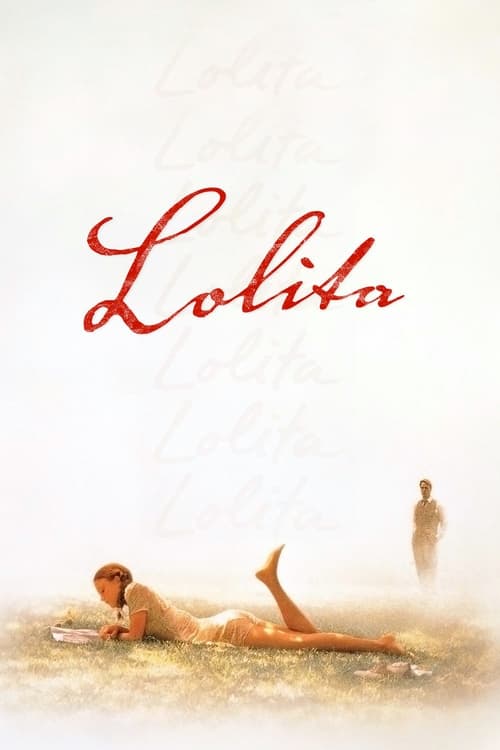
Lolita
1997 · Adrian Lyne
For when you want serious, morally difficult drama to sit with and argue about afterward — a challenge, not a comfort. Best approached as a companion piece to the novel rather than an easy evening.
What it's about
A middle-aged British novelist, both repelled and fascinated by America, takes a room in a widow's New England boarding house and becomes obsessed with her teenage daughter. What follows is a story of predatory obsession dressed up as love — a marriage of convenience, a long restless road trip across postwar America, and a rival lurking at the edges — told from inside the mind of a man justifying the unjustifiable.
The experience
Lush, melancholy, and deliberately uncomfortable — the film's beauty keeps rubbing against the ugliness of what you're watching, and it never lets you settle. It's slow-burning and literary, closer to a tragedy of self-deception than to anything sensational.
Performances
Jeremy Irons narrates and embodies Humbert with silky self-pity that never asks for forgiveness, and Dominique Swain is remarkable as Lolita — mercurial, childish, and heartbreaking in ways that keep the film honest about who the victim is.
The craft
This is Adrian Lyne at his most restrained: burnished period photography, a mournful Ennio Morricone score, and a screenplay that stays closer to Nabokov's book than the earlier adaptation. The road-trip stretches turn postwar Americana — motels, highways, diners — into a landscape of guilt.
Why it matters
Completed in 1996 with no American distributor willing to touch it, it premiered on cable two years later — a defining case of the 1990s collision between serious literary filmmaking and distribution politics, and it remains a lightning rod in debates about adapting difficult books.
Snapshot
Adrian Lyne's Lolita is the second screen adaptation of Vladimir Nabokov's 1955 novel, made thirty-five years after Stanley Kubrick's, and it arrived into a distribution climate that had shifted so far beneath it that the film became better known for its release troubles than for its images. Financed independently at a reported budget in the region of $60 million — a large sum for a literary adaptation with no studio behind it — it was completed in 1996 and then went roughly a year without an American distributor before Showtime premiered it on cable in August 1998, with a limited theatrical run through the Samuel Goldwyn Company following. That sequence is the film's central industrial fact and shaped everything about how it was received.
Aesthetically, the film is Lyne's most restrained and most literary work, and also his most conventionally beautiful: honeyed period Americana photographed by Howard Atherton, scored by Ennio Morricone, adapted by the playwright and screenwriter Stephen Schiff, and anchored by Jeremy Irons as Humbert Humbert — a performance built on a voice, and on the voice's capacity to make monstrousness sound like grief. Dominique Swain, fourteen at the time of casting, plays Dolores Haze; Melanie Griffith plays Charlotte; Frank Langella plays Clare Quilty as an oily, half-glimpsed doubling of Humbert's own appetite.
The film's critical position remains unsettled. Where Kubrick's 1962 version turned the material into arch social comedy under the constraints of the Production Code, Lyne's plays it as tragedy and, crucially, allows Dolores to register as a wounded child rather than a comic pretext. Its detractors argue that the surface — soft light, romantic score, Irons's mellifluous narration — aestheticizes what it depicts, and that lush filmmaking is the wrong instrument for this subject. Its defenders argue the opposite: that the beauty is Humbert's, that the film is consistently inside a liar's account, and that the moments where the camera catches Dolores crying at night are precisely the fractures in that account. Both readings are legible in the finished film, which is part of why it has never settled into a stable canonical place.
Industry & production
The production history is inseparable from the American culture-war climate of the mid-1990s. Nabokov's novel had itself been a publishing scandal in the 1950s — refused by American houses, first published in Paris by Olympia Press in 1955, then issued in the U.S. by Putnam in 1958 to enormous sales. By the 1990s the novel was securely canonical, but the subject matter had become newly untouchable in American film. Congress passed the Child Pornography Prevention Act of 1996, which broadened federal definitions in ways that made distributors cautious about any depiction — real or simulated — of minors in sexual contexts. The law's most expansive provisions were later struck down by the Supreme Court in Ashcroft v. Free Speech Coalition (2002), but that came years after the film needed a distributor.
The project was developed independently, produced by Mario Kassar's Pathé/Chargeurs-associated financing structures and shepherded by producers including Kassar and Joel B. Michaels, with shooting taking place largely in North Carolina, Texas, and Louisiana, standing in for the novel's cross-country American sprawl. Several writers reportedly took passes at the adaptation before Stephen Schiff — a former Vanity Fair and New Yorker writer with little prior screen credit — delivered the draft that was shot. Accounts have circulated of earlier attempts by other novelists and dramatists; the specific sequence of drafts is not reliably documented in the public record, and I won't assign attributions I can't verify.
What is well documented is the caution built into the shoot. Dominique Swain was a minor, and the production used a body double, a movement coach, and closed-set protocols for the sexual material; Lyne has described in interviews the layered restrictions under which those scenes were staged. The film was submitted to and passed by American ratings and legal review, and Lyne has said the completed picture was vetted by attorneys before it was offered to distributors. None of this made distributors willing. Every major American studio and the significant independents passed. The film opened in Europe in 1997 — first in Italy and Spain, then elsewhere — and earned respectable but not spectacular returns; it was in the U.S. that it stalled, until Showtime acquired it and aired it on 2 August 1998. The subsequent Goldwyn theatrical release was small and late.
The economic outcome is straightforward: on a budget of that size, a cable premiere plus a token theatrical window could not recoup. The film is one of the clearest late-century cases of a completed, legally cleared, star-led American picture effectively denied ordinary distribution by anticipated controversy rather than by censorship in the formal sense — a distinction worth holding onto, since no board banned it. Distributors simply declined the risk.
Technology
Technically the film is conservative by design. It was shot on 35mm anamorphic-adjacent widescreen with conventional photochemical finishing; there is no significant digital intervention, no compositing of note, and none of the optical trickery that marked Lyne's advertising-derived style in Flashdance or Jacob's Ladder. The relevant technological question in 1997 was not production but exhibition and delivery — and here the film sits at a genuine hinge point.
By premiering on premium cable, Lolita joined a small set of films that reached American audiences first through a subscription channel rather than theaters. Showtime and HBO were at that moment beginning to position themselves as venues for material studios wouldn't touch, a strategy that within a few years would produce The Sopranos and Six Feet Under and reorganize the prestige economy of American screen drama. Lolita is a minor but real data point in that shift: proof that a subscription platform could absorb content the theatrical market had refused, because its revenue came from subscribers rather than from ticket buyers, advertisers, or exhibitors with local community pressures.
The film's afterlife on DVD — it circulated widely on home video in the following years, in some territories in versions with minor trims — also reflects the period's realignment, in which a picture's canonical form became the disc rather than the print.
Technique
Cinematography
Howard Atherton, who had shot Fatal Attraction for Lyne a decade earlier, photographs the film in a register of warm, low-contrast nostalgia: amber interiors, curtains and dust motes, the diffused summer light of the Haze house, road-movie exteriors of motels and neon in a palette that owes something to postwar color photography and to the Americana of Norman Rockwell filtered through European longing. The lens choices favor shallow focus and soft edges — Humbert's world is optically as well as morally out of focus at its periphery.
The key formal decision is that this beauty is attributed. The camera does not observe Dolores; it desires her, and its desire has an author inside the fiction. The famous first sight of her on the lawn — sprinklers, wet dress, sunlight — is composed as a swoon, and the film's counter-strategy is to periodically break that spell with images Humbert would not have chosen: her chapped mouth, her braces, her boredom, her tears heard from the next bed. Whether the counter-strategy is sufficient is the film's central critical dispute, and it is a real dispute rather than a settled one. Atherton's later road photography, as the pair drive across an America of diners and courts, turns progressively colder and grayer, the honeyed light draining out as the arrangement becomes captivity.
Editing
Julie Monroe's cutting is patient and largely classical — long-held two-shots, few showy transitions — a deliberate retreat from the montage-driven, cut-fast style Lyne had brought from television commercials. The film is structured as retrospective confession, and the editing serves the voice: scenes are permitted to run to their discomfort rather than being clipped at the point of maximum effect. The exception is the final movement, where the recovery of Quilty and the killing at Pavor Manor are handled with a bleary, elongated rhythm that lets the murder become farcical and pitiful at once — an approach that answers Kubrick's opening with the same scene, but in a different key.
Mise-en-scène / staging
Jon Hutman's production design gives the Haze house a claustrophobic doily-and-linoleum specificity, and the motel chain that follows is deliberately anonymous: identical rooms, identical beds, the repetitions of a captivity dressed as a holiday. Judianna Makovsky's costumes are precise about the difference between what Dolores actually wears — hand-me-down cotton, sneakers, a retainer — and what Humbert's narration implies she wears. That gap is one of the film's most reliable ironies.
Staging is frequently built around thresholds and sightlines: doorways, porches, rear-view mirrors, the space between two beds. The most-discussed staging choice is the sofa scene, where Humbert conceals his arousal beneath a newspaper while Dolores, oblivious, eats and chatters — a sequence played for excruciating comedy that is also an anatomy of predation, since the joke is entirely at the expense of a child's unawareness.
Sound
Ennio Morricone's score is one of the last major American commissions of his late career and one of his most romantic: a principal theme for strings and piano of great tenderness, deployed almost entirely as Humbert's emotional weather. It is the single most contested element of the film. To hostile critics it is the score of a doomed love story laid over a crime; to sympathetic ones it is the sonic equivalent of Nabokov's prose — gorgeous, seductive, and belonging to the narrator, not to the film's judgment. The score's tenderness is at its most disquieting when the images beneath it are at their most predatory, and there is good reason to read that dissonance as deliberate.
Irons's voice-over, drawn closely from Nabokov's sentences, is the film's spine. Sound design elsewhere is unobtrusive and naturalistic: cicadas, screen doors, the ambient radio of period pop that grounds Dolores in a 1947 teenage present Humbert refuses to see.
Performance
Jeremy Irons gives a performance of controlled disintegration — fastidious, courtly, physically diminishing across the film's span. He resists the temptation to make Humbert charming in the manner of James Mason's wittier turn for Kubrick; his Humbert is sadder, wetter-eyed, more visibly ill. Dominique Swain's Dolores is the film's genuine departure from precedent: adolescent in a way that reads as gawky and unstable rather than knowing, alternating boredom, cruelty, need and terror, and — critically — legible as a child throughout. Where Sue Lyon's 1962 Lolita was played and photographed as older, Swain's is not, which is precisely what made the film unreleasable and what makes it, arguably, more faithful.
Melanie Griffith's Charlotte is broader, a portrait of aspirational loneliness that risks caricature but earns its pathos in the letter scene. Frank Langella's Quilty is deliberately withheld — glimpsed, blurred, mostly a voice and a silhouette until the finale — a structuring absence rather than Peter Sellers's structuring presence.
Narrative & dramatic mode
The film adopts, as the novel does, first-person retrospective confession by an unreliable narrator writing from custody. This is its most consequential formal choice and the origin of most arguments about it. Everything shown is nominally Humbert's memory, which licenses the romanticism of the images and score; the film's ethics depend on the viewer maintaining that frame.
Lyne and Schiff make the frame explicit at the edges — the bloodied opening drive, the closing acknowledgment that what Humbert stole was a childhood — but decline to interrupt it in the body of the film with any external voice. There is no counter-narrator, no adult Dolores testifying, no dramatized outside perspective. That restraint is faithful to Nabokov and is also the source of the charge that the film is complicit in Humbert's account. The dramatic mode is tragedy in the strict sense: an inevitability set in motion by a character's constitutive flaw, played to a foreseeable ruin, with the crucial complication that the ruin belongs mostly to someone else.
Genre & cycle
The film sits at an intersection of literary adaptation, period melodrama, and the road picture, and it belongs to a distinct 1990s cycle of erotically charged prestige adaptations — a lineage running through The Piano (1993), The English Patient (1996) and The Wings of the Dove (1997) — in which serious literary source material licensed explicit adult content within an art-house frame. Lolita is the case where that license failed, because the erotic content concerned a child.
It is also, unavoidably, an entry in the Lyne filmography: a director whose career is a sustained examination of transgressive desire (9½ Weeks, Fatal Attraction, Indecent Proposal, later Unfaithful). Read within that cycle, Lolita is the film where Lyne's characteristic subject stops being provocative and becomes criminal, and where his glossy technique is placed under a strain it may not survive.
Authorship & method
Lyne came out of British television advertising alongside Ridley and Tony Scott and Alan Parker, and his signature — backlight, texture, shallow focus, sensuality as surface — was formed there. Lolita is his attempt at literary seriousness, and he has been candid in interviews about pursuing the project for years and about the difficulty of the shoot. His method here is notably deferential to the source: the film's dialogue and voice-over lean heavily on Nabokov's own sentences.
Stephen Schiff's screenplay is the film's most underrated element. It compresses the novel's two halves cleanly, preserves the prose voice without letting narration substitute for scene, and finds dramatic equivalents for interior material — most successfully in the Charlotte discovery sequence and in the final Coalmont encounter, where the pregnant, married, seventeen-year-old Dolores refuses Humbert's version of their history in the plainest language in the film.
Howard Atherton's photography, Julie Monroe's editing, Jon Hutman's design and Judianna Makovsky's costumes form a coherent unit of period romanticism. Morricone's score, composed late in a career that had already encompassed Leone, Bertolucci and De Palma, is the strongest single authorial signature in the film after Irons's voice — and the element that most clearly pulls the picture toward elegy.
Movement / national cinema
The film is a transatlantic hybrid: a British director and British star, European financing, an American subject shot on American locations, and a European theatrical release preceding its American one. It belongs less to any movement than to a late-1990s condition — the internationally financed, English-language prestige picture made outside the studio system, dependent on foreign presales and on a domestic distributor to complete the equation. When the domestic distributor did not materialize, the model broke.
Its reception also exposed a genuine transatlantic asymmetry: the film played in European cinemas in 1997–98 with controversy but without existential difficulty, while in the United States it was commercially quarantined. That gap between the two markets' tolerance is itself part of the historical record the film documents.
Era / period
The film is set in 1947 and after, and reconstructs a postwar America of motor courts, soda fountains, station wagons and summer camps — the same iconography that mid-century American advertising used to sell innocence. Lyne's period reconstruction is knowingly complicit in that iconography; the film's America is the one Humbert consumes, and consuming it is of a piece with consuming Dolores. Nabokov's own satire of American vulgarity survives mainly in the production design rather than the dialogue.
The film's production period — the mid-1990s — is at least as legible in it. This was the era of the Communications Decency Act (1996), the Child Pornography Prevention Act, the NEA funding fights, and a broad American anxiety about media and children. Lolita is a document of that moment as much as of 1947.
Themes
Obsession as narrative capture. The film's structural argument is that Humbert's greatest crime may be the story he tells: he takes Dolores's life and converts it into his aesthetic experience, and the film's beauty is the evidence of the theft.
The unreliability of eloquence. Nabokov's central provocation — that the most beautiful prose in the book belongs to a child rapist — is transposed into images and music. The film asks whether an audience can enjoy a surface and simultaneously indict it.
Childhood as something taken. Swain's performance and Schiff's Coalmont scene together insist on Dolores as a person with her own trajectory, damaged and continuing. The film's closing recognition — that what is missing from the world is the sound of her voice among other children — is the point at which Humbert's account finally admits its own cost.
America as object of desire. Humbert's appetite for Dolores and his simultaneous contempt for and fascination with American vulgarity are the same appetite. The motels and diners are not backdrop; they are the second body of the film's obsession.
Reception, canon & influence
Critical reception. Reviews on the film's belated American release were divided and often visibly uncomfortable. A substantial body of critics praised Irons's performance and Swain's, and credited the film with a fidelity to the novel's tragedy that Kubrick's version had sidestepped; another substantial body found the film's lushness fundamentally at odds with its subject, arguing that Morricone's score and Atherton's light do romantic work the material cannot bear. European notices in 1997 were somewhat warmer, and the film performed adequately in those markets. It did not become an awards presence — a consequence in part of its release pattern, since a cable premiere disqualified or disadvantaged it in most theatrical categories.
Influences on the film (backward). The primary source is Nabokov's novel, and the adaptation is unusually deferential to its language. The secondary presence is Kubrick's 1962 film, against which Lyne's is a sustained, deliberate correction: where Kubrick, constrained by the Production Code, aged the character up, played the material as black comedy, and gave Sellers's Quilty enormous screen presence, Lyne restores the character's age, plays tragedy, and reduces Quilty to a shadow. Beyond those, the film draws on the postwar American road picture and on the visual vocabulary of mid-century color photography and advertising; and Lyne's own Fatal Attraction supplied both his cinematographer and his practiced grammar of desire escalating into catastrophe.
Legacy (forward). The film's most durable influence is industrial rather than aesthetic. It stands as a case study — cited regularly in discussions of American self-censorship — of a completed, legal film that no domestic distributor would handle, and of premium cable's willingness to take what theatrical distribution rejected. That trajectory prefigured the subsequent migration of adult, difficult drama from cinemas to subscription television, a movement that within a decade had reorganized where serious American screen storytelling happened.
Aesthetically, its influence is more diffuse. It sharpened a critical argument that has only grown more central since: whether beautiful filmmaking can depict abuse without endorsing it, and whether attributing a gaze to a character is sufficient to disarm it. That argument recurs around later films that stage predatory or transgressive desire in seductive registers, and Lolita (1997) is a standard reference point in it — usually as the hard case rather than the settled example.
The film's canonical position remains genuinely unresolved. It is not a rediscovered masterpiece and has not been substantially revalued upward; nor has it been dismissed. It survives as the more faithful of the two Lolita films and the less successful one — a picture whose central problem, the seductiveness of its own surface, may be either its deepest fidelity to Nabokov or its most serious failure, and criticism has not agreed on which.
A Deleuzian reading
On the lawn, under the sprinkler, in a wet dress.
The full Deleuzian reading of Lolita →
Reception
In 1997 no American distributor would touch it — a $62 million film that ended up premiering on Showtime — and critics mostly held it up unfavourably against Kubrick. Since then it's been partially reappraised as the more faithful, more openly tragic adaptation, even as post-#MeToo viewers scrutinize it harder than ever.
How Lolita was received, from release to now →
How to watch Lolita: what to notice on a first viewing
- Watch the light turn soft whenever Dolores is on screen. The camera repeatedly shoots her in diffused, glowing light, close to a swoon, even though nothing marks the shot as literally Humbert's point of view. The prettiness belongs to the narrator's perspective, not to the film's own judgment of what is happening.
- Notice how identical each motel room looks. The production design makes the road's motels deliberately anonymous, the same beds and walls repeating so a holiday starts to read as confinement. Repetition turns a road trip into something closer to captivity, staged through nothing but the sameness of the rooms.
- Listen for tender strings under an uneasy scene. Morricone's romantic score plays almost entirely as the narrator's own emotional weather, regardless of what the images beneath it are actually showing. The music tells you how the narrator feels about his own story, which is not the same as telling you how to feel.
- Watch the color drain out as the road trip continues. The warm, amber tones of the early scenes gradually cool into gray as the journey goes on, without a single line of dialogue announcing the shift. The palette itself tracks the arrangement curdling from a holiday into something closer to confinement.
- Listen to how measured and courtly Irons's narration stays. Irons plays the narrator with a fastidious, controlled voice that grows physically more diminished across the film, never raising itself to match what is happening. A voice this composed is doing a lot of work to make an ugly story sound like grief.
The whole guide to watching Lolita, with the keys for a rewatch →
Influences: the films it descends from and the films it influenced
- Lolita (1962) — The negative template Lyne works against shot-for-shot in conception: Kubrick's Code-forced solutions — aging Dolores up, pitching the material as black comedy, and letting Sellers's improvised Quilty carry the picture's energy — define by inversion Lyne's choices to restore the age, play straight tragedy, and reduce Quilty to a peripheral blur.
- Fatal Attraction (1987) — Supplied both Howard Atherton and the working grammar Atherton reuses here — long lenses wide open so the frame holds one face in focus inside a soft luminous surround, practical-source backlight through curtains and blinds, and a slow escalation structure in which each domestic interior is restaged later as a trap.
- Damage (1992) — Establishes the exact Jeremy Irons instrument Lyne casts: a hushed, grammatically immaculate first-person narration that frames catastrophic sexual transgression as elegy, with the voice-over bookending the film so the ruin is heard as retrospective self-explanation rather than seen as it happens.
- Dead Ringers (1988) — Cronenberg discovered the technique Lyne depends on — Irons's cultivated diction and stillness used as anesthetic, so that pathology is delivered in a register of refinement and the audience's ear keeps granting sympathy the content does not earn.
- Days of Heaven (1978) — The direct source of the Morricone/Americana combination: elegiac strings laid over magic-hour prairie photography while a girl's plain, unreliable voice-over misdescribes the exploitation the images contain — the score-image dissonance Lyne reproduces with the same composer.
- Badlands (1973) — The road-picture half's structural model: motel-to-motel repetition across flattening American landscape as a folie-à-deux, with the girl's narration romanticizing the flight in magazine-prose cadences and Orff's celesta figure attached to violence so the music refuses to comment.
- Sunset Boulevard (1950) — The condemned-narrator architecture Schiff adopts — a man already destroyed at the film's opening narrating his own case in polished literary sentences, so every scene is heard twice, once as event and once as the defense he is building out of it.
- Peeping Tom (1960) — The subjective-camera precedent for Lyne's defense strategy: the apparatus is handed to the predator so the audience looks along his sightline, and Powell first proved the counter-argument the 1997 film inherits — that attributing the gaze to a character does not neutralize it, it implicates the viewer.
- Death in Venice (1971) — The prestige-literary solution to filming pederastic obsession that Lyne follows: shoot the object of desire in long-lens haze and backlight from the watcher's fixed position, and let a borrowed romantic score (Mahler's Adagietto) supply the exaltation the narrator claims and the film declines to disown.
- Pretty Baby (1978) — Nykvist's Storyville interiors set the precedent for photographing a sexualized child in painterly period light — the film's ethics located entirely in the beauty of its own surface, which is the precise problem Atherton's mid-century-advertising palette reproduces two decades later.
- Once Upon a Time in America (1984) — Morricone's own prior demonstration of the device Lyne hires him for: the lush memory theme continues undisturbed across the protagonist's sexual violence, binding the audience to a rapist's self-flattering recollection rather than to what the frame shows.
- The Virgin Suicides (1999) — Takes over the premise that the film's prettiness is the narrator's symptom: Lachman's gauzy diffusion and 1970s catalog light are explicitly the product of a retrospective male voice-over that admits it never knew the girls, formalizing what Lyne leaves as an unresolved argument.
- American Beauty (1999) — Runs the same two devices together — a posthumous confessional voice-over structuring the film, and a middle-aged man's fantasy of a teenage girl rendered in saturated advertising imagery (Conrad Hall's petal reveries) that visually endorses the desire the narration later disavows.
- Mysterious Skin (2004) — Inherits the seductive-surface problem directly: the abuse scenes are staged as slow, warm, subjectively beautiful memory-images with a Budd/Guthrie ambient score, forcing the viewer to register that the loveliness belongs to the survivor's distorted recall.
- Notes on a Scandal (2006) — The clearest heir to the confessional-diary structure plus score-image dissonance — a predator's fluent, self-justifying voice-over read off the page while Philip Glass's churning strings supply a tragic grandeur the banal events cannot support, exactly the objection critics raised against Morricone here.
- An Education (2009) — Uses Lyne's bait-and-withdraw method deliberately: the grooming is photographed as glamour from the girl's point of view, then the film strips the light and lenses for a final plain-spoken confrontation that answers Lolita's Coalmont scene, where Dolores states the history in flat language the images had prettified.
- May December (2023) — Makes the score-image dissonance polemical rather than atmospheric — Legrand's Go-Between melodrama theme crashes over trivial domestic images so the audience feels the music manufacturing significance, turning Lyne's contested technique into the film's explicit subject.
- Unfaithful (2002) — Lyne's refinement of the same long-take discomfort: the train-ride sequence intercuts the affair's physical detail against the woman's face in real time, holding the shot past the point of pleasure into shame — the technique Lolita rehearses in its sustained, unbroken motel scenes.
Similar films
- Lolita (1962) — influence & lineage · often watched together
- Fatal Attraction (1987) — influence & lineage
- American Beauty (1999) — influence & lineage
- Damage (1992) — influence & lineage
- Sunset Boulevard (1950) — influence & lineage
- Manhattan (1979) — often watched together
- Tess (1979) — often watched together
- Interview with the Vampire (1994) — shared sensibility