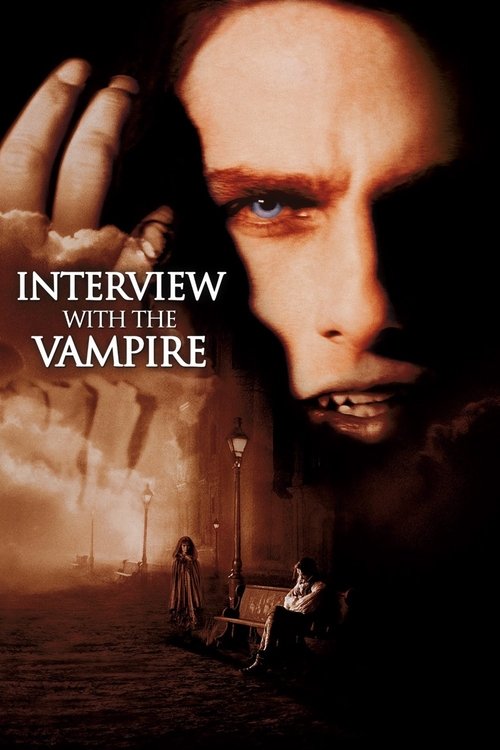
Interview with the Vampire
1994 · Neil Jordan
For when you want to sink into something lush, gothic, and sad — velvet-and-candlelight viewing for a long autumn night, more seductive than frightening. Reach for it when you want atmosphere you can drown in.
What it's about
A two-hundred-year-old vampire sits down with a modern reporter and tells his whole story: how a grieving Louisiana plantation owner was turned in the 1790s by the magnetic, amoral Lestat, how the two of them made a child into a vampire to hold their strange household together, and how immortality curdled into centuries of guilt, longing, and loneliness stretching from New Orleans to Paris.
The experience
Sumptuous and melancholy rather than scary — a horror film whose real engine is grief. It moves like a fever dream through candlelit rooms, with sudden flashes of violence and a streak of wicked humor courtesy of Lestat.
Performances
Tom Cruise, cast against furious public skepticism, is a genuinely surprising Lestat — preening, cruel, and funny — while Brad Pitt anchors the film's sorrow as Louis. Eleven-year-old Kirsten Dunst is the revelation: a child vampire whose rage at being frozen in a little girl's body gives the film its most haunting scenes.
The craft
A lavish studio production that treats vampirism as prestige drama: opulent period sets and costumes, painterly candlelit photography, and practical effects that still hold up. Anne Rice adapted her own novel, and Neil Jordan directs it as a confession rather than a monster movie — it rewards a dark room and patience.
Why it matters
It pulled the vampire out of B-movie territory and back into the mainstream as a tragic, romantic figure, paving the way for decades of sympathetic-vampire stories on film and TV.
Snapshot
Neil Jordan's Interview with the Vampire is the film that dragged the vampire out of the drive-in and back into the salon. Adapted by Anne Rice from her own 1976 novel — the book that effectively invented the modern first-person vampire confession — it arrived in November 1994 as a lavish Warner Bros. prestige production, carrying David Geffen's long-cultivated development effort, a reported budget in the region of $60 million, and the most publicly contested casting decision of the decade. It was a hit: a strong opening and a global gross well above its cost, enough to make a franchise plausible even as the sequel took eight years to materialize.
What makes it a hinge film is not its commercial performance but its posture. Jordan and Rice built a horror picture whose engine is not fear but grief, and whose monsters do not stalk so much as narrate. Louis de Pointe du Lac (Brad Pitt) is a vampire who cannot stop mourning his own humanity; Lestat de Lioncourt (Tom Cruise) is a vampire who cannot stop performing his freedom from it; Claudia (Kirsten Dunst) is a child made immortal at the exact age when that is most unbearable. The picture spends two centuries and three cities on a domestic tragedy — a family of predators failing at family — and it films that tragedy in candle-tone chiaroscuro, with Elliot Goldenthal's dissonant, liturgical score pressing at the edges.
Its influence runs in two directions at once. Backward, it consolidates a literary-gothic lineage from Stoker through Universal and Hammer to Coppola's Bram Stoker's Dracula (1992), which two years earlier had proven that operatic, expensive, adult vampire cinema could open big. Forward, it is a load-bearing beam under everything from Buffy's brooding Angel to The Vampire Diaries to Twilight to the AMC series that in 2022 finally re-adapted the novel with the racial and sexual subtext made text. The film's central formal decision — vampirism as interviewed testimony, monstrousness as a story the monster tells about himself — is now so standard that it takes effort to remember it was once a choice.
Industry & production
The production history is a study in the difficulty of adapting a book whose author will not go quiet. Rice's novel appeared in 1976 and became a phenomenon across the late seventies and eighties; screen rights moved through more than one configuration before David Geffen took the project to Warner Bros. and set Jordan to direct. Rice wrote the screenplay herself — a rarer arrangement than it sounds for a property of this scale — and the credited script is hers, though Jordan has spoken over the years about reworking material during production, which is ordinary practice on a director-driven adaptation.
The casting furor is the part of the story that entered general culture. Rice, who had for years spoken about her own imagined casting for Lestat, objected publicly and vehemently when Tom Cruise was announced, and the dispute played out in the press through the shoot — an unusually visible fight between a novelist and a studio production. After seeing the finished film, Rice reversed herself, publicly and at length, endorsing Cruise's performance in terms as emphatic as her earlier objections had been. That reversal was itself covered as news and functioned, whatever its sincerity, as extraordinary pre-release publicity. It is worth being precise here: the outline of this sequence is well documented, but the specific commercial effect of Rice's about-face is not something anyone has measured.
Around the two leads, the film assembled an ensemble that reads in retrospect as a snapshot of mid-nineties casting: Kirsten Dunst, eleven at the time of shooting, in the role that made her; Christian Slater as the interviewer Daniel Malloy, cast after River Phoenix's death in October 1993 — Slater donated his fee to charities associated with Phoenix, and the film carries a dedication to him; Antonio Banderas as Armand, in one of the roles that moved him into English-language work; Stephen Rea, a Jordan regular, as Santiago.
Production ran across locations in and around New Orleans and Louisiana plantation country, with Paris and London-area studio work, principally at Pinewood, for the Théâtre des Vampires and the extensive period Paris material. This mixed approach — real Southern locations for the American first act, controlled stages for the European second — is legible in the finished film's shift of register from humid naturalism to theatrical enclosure.
The commercial outcome was decisive enough that Warner Bros. continued with the property, though the follow-up, Queen of the Damned (2002), was made without Jordan, Cruise, or Pitt and is generally treated as a break rather than a continuation. The film received Academy Award nominations for art direction and for Goldenthal's score.
Technology
Interview sits at a specific technological moment: the last years before digital effects became the default answer to any question. Released in November 1994 — sixteen months after Jurassic Park — it belongs to a cohort of films that could have gone digital and largely chose not to.
The vampire transformations, the aging and desiccation effects, the burning bodies, the wounds and feedings are overwhelmingly practical: prosthetics, contact lenses, dental work, wire work, in-camera fire, and old-fashioned optical and mechanical trickery, with digital used sparingly for cleanup and specific augmentations rather than as a primary tool. Stan Winston's involvement in the makeup and character effects places the film in the lineage of practical-creature work that ran from The Thing through Aliens and Terminator 2, and the choice pays a specific dividend: the vampires' skin, veins, and eyes behave like matter that exists in the same light as the actors' faces, because it does.
The pallor is the technological signature. The film's vampire look — bluish translucence, visible vasculature, reflective irises — is achieved through makeup, lens work, and lighting rather than post-production grading, which was in 1994 still a photochemical process with far less local control than the digital intermediate would later provide. Color timing was done the old way, which means the film's celebrated candlelit gloom is a photographic achievement — exposure, stock, filtration, and lamp choice — rather than a grade applied afterward.
This matters historically because within five years the same material would almost certainly have been handled differently. Interview is thus a useful late specimen of a craft tradition, and part of why it has aged better visually than many effects-forward films of the following decade.
Technique
Cinematography
Philippe Rousselot shot the film, and his work is its most durable achievement. Rousselot came to it having won the Academy Award for A River Runs Through It (1992) and with a body of work — Diva, Thérèse, Henry & June, The Bear — that had already established him as a cinematographer of surfaces and weather.
The governing problem is that vampires are creatures of the dark and film requires light. Rousselot's solution is to make the light sources diegetic and warm — candle, fire, oil lamp, gaslight, moon — and then to let them fall off fast, so faces emerge from black rather than sitting inside an evenly lit space. The result is a chiaroscuro that is genuinely painterly rather than merely dim: figures modeled from one side, deep unlit space behind them, and a color palette that runs amber and ochre in the interiors against blue-black exteriors.
The two great set-pieces of the photography are the burning of Pointe du Lac and the Théâtre des Vampires sequence. The former uses real fire as a light source, with the actors' faces lit by the thing that is destroying them. The latter, staged as a performance within a performance, is lit like a stage — footlights, hard shadows, a proscenium separating the paying audience from the murder they believe is theater — so that the cinematography becomes an argument about spectatorship.
The camera is patient. Jordan and Rousselot favour slow, weighted movement — dollies that glide rather than punch, crane moves that survey rather than swoop — and a good deal of the film plays in sustained two-shots. This restraint reads as classicism, and it is part of why the film feels older than its release date.
Editing
Mick Audsley cut the film, bringing a background from Stephen Frears's pictures (My Beautiful Laundrette, Dangerous Liaisons, The Grifters) — a lineage of literate, dialogue-driven British filmmaking rather than horror.
The structure is a frame narrative: San Francisco, present day, a tape recorder, a hotel room. Everything else is testimony. Audsley's central task is managing the return to that frame — how often, and at what emotional cost — and the film uses it sparingly, generally to mark chapter breaks or to let Malloy's interruptions puncture Louis's self-mythologizing. The frame is thus both a structuring device and a critical one: it keeps reminding us that we are hearing a version.
Within the flashback, the cutting is unhurried, favouring longer takes and letting performances play. The violence is the exception: feedings and killings are cut faster and more elliptically, often withholding the moment of contact. This is a horror film with remarkably little gore given its subject, and the restraint is an editorial decision as much as a photographic one.
The film's most-discussed structural problem is its middle — the long Paris section, where Armand and the Théâtre arrive and the narrative's momentum shifts from the Louis-Lestat-Claudia triangle to a wider vampire society. Contemporary reviews noted a slackening there; whether it is a fault of the cut or of the source material's own shape is a fair critical dispute.
Mise-en-scène / staging
Dante Ferretti designed the film, and his contribution is inseparable from its identity. Ferretti — whose work with Fellini and Pasolini preceded a long association with Scorsese — brings a specifically Italian sense of decadent interior: rooms that are over-furnished, textured, and slightly rotten.
The film moves through three principal worlds. Louisiana, 1791: plantation and swamp, humid, candlelit, with the specific American gothic of a slaveholding society rendered as decaying luxury. New Orleans across the nineteenth century: the townhouse Louis, Lestat, and Claudia share, which is staged as a domestic space — parlor, dressing table, dolls — occupied by predators, so that every ordinary object becomes uncanny. And Paris: the Théâtre des Vampires, a subterranean world of catacomb and stage, where vampires perform being vampires for an audience that thinks it is watching artifice.
Claudia's rooms are the design's sharpest instrument. The accumulation of dolls, the dressing table, the child's clothes on a body that has been an adult for decades — this is production design doing the film's thematic work, staging arrested development as an interior.
The costumes, by Sandy Powell — early in the career that would later bring her multiple Oscars — track two centuries of change while keeping the vampires slightly out of step with each period, over-formal and over-preserved, dressed a little in the past. It is a quiet way of showing immortality as a failure to keep up.
Sound
Elliot Goldenthal's score is one of the most distinctive horror scores of the decade and earned an Academy Award nomination. Goldenthal, whose background is in concert music, refuses the standard gothic-horror vocabulary. Instead the score works in dissonant orchestral masses, choral writing that shades toward the liturgical, and passages of genuine ugliness — brass clusters, string glissandi — set against moments of unexpected lyricism. The effect is less "scary music" than sacred music gone wrong: a requiem for people who cannot die.
The sound design favours intimacy over shock. Breath, heartbeat, the wet detail of feeding, cloth, rain, insects in the Louisiana night. There are few stings. What frightens is proximity — the sound of a mouth close to a throat, mixed forward.
The film's most-remembered sonic gesture is its closing needle-drop: Guns N' Roses' cover of the Rolling Stones' "Sympathy for the Devil" over the end credits, a violent tonal rupture after two hours of Goldenthal that functions as a deliberate ejection from the past into the present — an announcement that the vampire is now a rock star, which is precisely what the film's cultural afterlife made of him.
Performance
Cruise's Lestat is the film's live wire and the reason the casting controversy is now a footnote. He plays Lestat as a performer — theatrical, wounded, funny, cruel — with a physical lightness that reads as genuine inhumanity, and he commits fully to the character's queerness and vanity. The performance works because Cruise, then the most conventionally heroic star in American film, understood that Lestat's charisma is a weapon rather than a virtue.
Pitt's Louis has always been the harder sell, and some contemporary critics found him monotonous. That reading undersells the design: Louis is written as a man in permanent mourning, and Pitt plays the flatness of grief rather than its dramatics. Whether that reads as depth or as vacancy has divided viewers for thirty years, which is itself a kind of achievement.
Dunst's Claudia is the performance history has settled on. She is required to play a woman's intelligence, appetite, and rage inside a child's body, and to make the horror of that condition legible without ever winking at it. Her scenes with Cruise and Pitt carry the film's central moral weight, and the role established her as a major actor at eleven.
Banderas's Armand supplies a different register — stillness, ancient calm — while Rea's Santiago provides the film's most conventionally frightening presence.
Narrative & dramatic mode
The film's dominant mode is confession. Everything is filtered through Louis's account, given at a specific place and time to a specific listener with a tape recorder, which means the film is formally a testimony rather than a story. Jordan keeps this alive: Malloy interrupts, doubts, gets excited at the wrong moments, and his hunger for the story is treated as a character flaw that the ending punishes.
Beneath the frame, the dramatic mode is domestic tragedy in gothic dress. The Louis–Lestat–Claudia triangle is structured exactly like a failing family: a reluctant partner, a controlling one, and a child made to hold the marriage together, who eventually turns on the parent who made her. The film's most disturbing material is not the killing but the parenting.
The pacing is elegiac and episodic rather than propulsive — the film moves through decades in dissolves, and the emotional continuity is Louis's inability to change. There is no quest and no antagonist in the ordinary sense; the conflict is between a creature and its own nature. That the film sustains two hours on this without a plot engine is a real structural gamble, and the critical split over its middle section is where the gamble shows.
The ending's turn — the interviewer's response to the testimony, and Lestat's return — converts the whole film retroactively into a seduction. Louis intended a warning; his listener heard an advertisement. It is a sharp joke about the appeal of the vampire story, aimed squarely at the audience.
Genre & cycle
Interview belongs to the early-nineties revival of prestige literary horror. The immediate context is Coppola's Bram Stoker's Dracula (1992), which demonstrated that a major studio could mount an expensive, adult, design-forward vampire film and open it wide; Kenneth Branagh's Frankenstein (1994) was the same season's other entry, and the cycle also produced Wolf (1994) and, in a different key, Jordan's own later gothic work.
Within vampire cinema specifically, the film marks a decisive shift in point of view. The Universal and Hammer traditions positioned the vampire as an object — a thing to be hunted, staked, and explained by a Van Helsing figure. Rice's novel had already relocated the camera behind the vampire's eyes; the film industrializes that move. There is no vampire hunter in Interview. There is no cure, no crucifix that works, no restoration of order. The genre's entire apparatus of resistance is simply absent, because the vampires are the protagonists and the humans are food or audience.
The other cycle it belongs to is the nineties star-vehicle prestige picture: a big literary property, two of the largest male stars alive, a European director with art-house credibility, awards-season positioning, and a November release. Interview is as much a product of that industrial cycle as of any horror tradition.
Its genre hybridity — horror, yes, but also period drama, family tragedy, and something close to a doomed romance — is the template that the subsequent decades of vampire media would take up almost wholesale.
Authorship & method
Jordan came to the film with a body of work already preoccupied with monstrousness, transformation, and desire that cannot be spoken plainly: The Company of Wolves (1984), his Angela Carter adaptation, is a direct ancestor, and The Crying Game (1992) had just won him an Academy Award for its screenplay and given him the leverage to take on a studio production of this size. His method is to treat fantastic material with complete literalism and emotional seriousness — no camp, no distancing irony — and to locate the horror in intimacy rather than threat. He is also, consistently, a filmmaker of Irish Catholic formation, and the film's preoccupations with damnation, confession, communion, and the impossibility of absolution are recognizably his as much as Rice's.
Rice's authorship is unusually direct for an adaptation: she wrote the screenplay from her own novel, and the film's fidelity to the book's voice — the elaborate, mournful, first-person register — is a consequence. The tension between Rice's ornate literary sensibility and Jordan's more restrained visual instincts is productive; the film is less purple than the novel and more grounded.
Rousselot's contribution has been described above and is arguably co-authorial: the film's identity is its light.
Goldenthal, then a relative newcomer to film scoring after concert work, would go on to a long collaboration with Julie Taymor and an Oscar for Frida. His approach here — treating the score as a modernist sacred work rather than genre underscore — is the single most important departure from horror convention in the film.
Audsley's cutting brings the rhythms of literary British drama to a horror picture, which accounts for the film's willingness to sit still. Ferretti and Powell supply an authorship of surfaces that is at least as legible as the director's.
Movement / national cinema
The film sits awkwardly across national categories, and that awkwardness is informative. It is an American studio production, financed by Warner Bros., set in Louisiana and San Francisco, starring American stars. But its direction, its literary sensibility, and a significant portion of its craft team are European — an Irish director, a French cinematographer, an Italian production designer, a British costume designer and editor, a Spanish co-star.
This is characteristic of a particular nineties arrangement: Hollywood importing European art-cinema personnel to lend prestige and visual sophistication to genre material. Coppola's Dracula did something similar with Ishioka's costumes; the pattern recurs across the decade.
The film's American content is more specific than it is usually given credit for. Its first act is set on a Louisiana plantation in 1791, and the wealth Louis mourns is slave wealth — the enslaved people on his estate appear in the film, and Louis's early feeding on them is depicted. The film registers this and then largely declines to examine it, treating slavery as gothic atmosphere rather than as the moral center it plainly is. This is the most substantial critical charge against the picture, and it is the gap that the 2022 AMC series was explicitly designed to address by relocating the story and making its protagonist a Black Creole businessman in early-twentieth-century New Orleans.
Era / period
November 1994 places the film at a precise cultural intersection. Vampire fiction had been building through the eighties — Rice's Vampire Chronicles, The Lost Boys, Near Dark, The Hunger, the White Wolf role-playing game Vampire: The Masquerade (1991), which had already recoded vampirism as gothic subculture rather than folk horror. The film arrives as the mainstream consolidation of a subcultural taste that had been forming for a decade.
It also arrives in the middle of the AIDS era, and it is impossible to watch it outside that frame. A film about blood-borne intimacy, about a condition transmitted by an act of love that condemns the recipient to a half-life, about beautiful young men wasting and dying and mourning — made in 1994, when the epidemic's American toll was at its height — carries that reading whether or not it was intended. The film never states it. Critics at the time and since have consistently read it there anyway, and the reading is strengthened by Rice's own long engagement with New Orleans's gay culture and by the film's refusal to make the vampires' desire for one another heterosexual.
Industrially, 1994 is late in the pre-digital studio era and near the peak of the star-driven prestige picture — a configuration that would not survive the following decade's shift toward franchise IP intact.
Themes
Immortality as sentence, not gift. The film's foundational inversion: eternal life is depicted as an unending accumulation of loss. Louis's tragedy is that he outlives everything he loves, repeatedly, and learns nothing that makes it bearable.
Grief as identity. Louis becomes a vampire because his wife and child died. He then spends two hundred years being a man who cannot stop grieving. The vampirism is almost incidental — a metaphor for a condition of arrested mourning that the film takes entirely seriously.
Queer desire, coded and uncoded. Lestat's pursuit of Louis is a courtship; their shared household with Claudia is a family; the film's erotics are unmistakably between men, expressed through feeding rather than sex. In 1994 this was near the outer edge of what a major studio would put on screen with two stars of that magnitude, and part of the film's historical significance is how little it flinches. It never says it, and it never disguises it either.
Parenthood and the child who cannot grow. Claudia is the film's moral engine. Made a vampire out of Lestat's need to bind Louis to him, she is a child weaponized to save a relationship — and her rage at her makers, when she understands what has been done to her body, is the film's most genuinely horrifying material.
Testimony and complicity. The frame narrative implicates the listener. Malloy wants the gift, not the warning, and the ending's turn suggests that every audience for a vampire story is doing what he is doing.
Faith and its absence. Jordan's Catholicism surfaces in Louis's search for God, his desperation to find another of his kind who can explain the metaphysics of what he has become, and Armand's flat answer that there is no plan. The film is a horror picture whose deepest fear is meaninglessness.
Reception, canon & influence
Critical reception. Reviews in November 1994 were substantially positive but not unanimous. Praise concentrated on the production design, cinematography, score, and — with visible surprise, given the pre-release fight — on Cruise's Lestat, along with near-universal admiration for Dunst. The recurring reservations were the film's pace, particularly the Paris section, and Pitt's Louis, whom several critics found inert. Roger Ebert was notably unenthusiastic, faulting the film's relentless gloom and lack of dramatic development. The Academy nominated it for art direction and original score. Dunst's work drew the strongest performance notices and won her a Golden Globe nomination.
Commercially, it opened strongly and finished as one of the year's substantial hits worldwide.
Critical standing has risen since. The film is now routinely cited as one of the best vampire films of its era and as a formative text for modern gothic screen fiction, with revisionist attention paid to its queerness — which reads as considerably more overt in retrospect than contemporary reviews generally acknowledged — and, in the other direction, to its handling of slavery.
Influences on the film (backward). Rice's novel, obviously and directly. Beneath it: Stoker's Dracula and its epistolary, testimonial structure, which Rice modernized into the tape-recorded interview; Le Fanu's Carmilla for the queer vampire; the Universal cycle for iconography; Hammer for lush color and eroticism; Roman Polanski's The Fearless Vampire Killers and, more seriously, Werner Herzog's Nosferatu the Vampyre (1979) for the vampire as suffering rather than menacing figure; Tony Scott's The Hunger (1983) for glamorous, contemporary, sexually ambiguous vampirism. Coppola's Bram Stoker's Dracula (1992) is the immediate industrial precedent. Jordan's own The Company of Wolves is the closest ancestor within his filmography. Visually, the film draws on Georges de La Tour's candlelit painting and on the American Southern gothic tradition.
Legacy (forward). The film's forward influence is enormous and mostly diffuse.
The most direct line runs to television. Buffy the Vampire Slayer (1997– ) and its spinoff Angel built the brooding, guilt-stricken vampire hero directly on Louis's template; True Blood, The Vampire Diaries, and The Originals extended it. Twilight (2005 novel, 2008 film) inherits the whole architecture of the sympathetic, abstinent, romantically tortured vampire from Rice by way of this film's mainstreaming of her. The AMC series Interview with the Vampire (2022– ) is the most substantial engagement: a re-adaptation that keeps the interview frame, makes the queerness explicit, and reconstructs the story's racial politics — a direct critical response to the 1994 film's most-noted evasion.
Within cinema, the film's practical-effects gothic look influenced the design of subsequent period horror, and its demonstration that a serious European-inflected craft team could elevate genre material became a repeated studio play. The vampire-as-narrator structure it popularized is now the default: audiences expect the monster's interiority, and the hunter's-eye-view vampire film has become the exception rather than the rule.
Its cultural afterlife is broader still. The film consolidated the modern goth-adjacent aesthetic in mainstream media, and it is a foundational text for the enormous body of contemporary paranormal romance in fiction, film, and television. What Rice wrote in 1976 and Jordan filmed in 1994 is now simply the shape the vampire has.
A Deleuzian reading
Pointe du Lac burns, and the only light on the actors' faces is the fire that is eating the house.
The full Deleuzian reading of Interview with the Vampire →
Reception
In 1994 it was a hit but a lightning rod — Anne Rice loudly trashed the Tom Cruise casting sight unseen, and Oprah walked out of a screening saying it was too dark. Three decades on it's been reclaimed as a lush queer-gothic classic, a reappraisal turbocharged by the 2022 AMC series sending fans back to the source.
How Interview with the Vampire was received, from release to now →
How to watch Interview with the Vampire: what to notice on a first viewing
- Look at where the light in each room is coming from. Rousselot keeps every source inside the scene. Candle, oil lamp, gaslight, fire, moon. The light falls off fast, so a face surfaces out of black while it stays near the flame and disappears when it moves away. The light is the only mortal thing in the room. It burns down while the people standing in it do not.
- Compare how much Pitt's face moves with how much Cruise's does. Pitt plays Louis with one held quality, grief, and almost no variation. Cruise plays Lestat as constant motion, appetite and display, never settling. Jordan lights them the same way and lets the difference do the characterization. Lestat does not feel things so much as perform having them. The part needed a face built for performance, which is why the casting works.
- Listen for the tape recorder and the reporter's interruptions. Everything you see is Louis talking into a machine in a San Francisco hotel room. Malloy breaks in, doubts him, gets excited at the wrong moments. Jordan uses the returns sparingly, to mark chapters and puncture Louis's self-mythologizing. Every image in the film is somebody's claim. You are not watching two hundred years, you are watching one man's version of them.
- Watch for the moment a mouth actually reaches a throat. Audsley cuts the feedings faster than the rest of the film and usually away just before contact. For a horror picture about people who drink blood, there is remarkably little gore. What you remember is mostly what you supplied. Withholding the moment of contact is what keeps the film intimate rather than gruesome. The horror is proximity, not spectacle.
- Look at the dolls piling up in Claudia's rooms. Ferretti gives her a dressing table, child's clothes, and more and more dolls across the decades. Powell dresses all three vampires slightly out of period, over-formal and over-preserved, as though nobody kept up with the century. The design carries the idea the dialogue avoids. A body stopped at eleven with decades stacked inside it, surrounded by objects meant for a child.
The whole guide to watching Interview with the Vampire, with the keys for a rewatch →
Influences: the films it descends from and the films it influenced
- The Company of Wolves (1984) — Jordan's own template for filming a literary fabulist verbatim: nested tale-within-a-tale framing, studio-built artificial landscapes, and practical in-camera transformation effects that treat metaphor as physical event rather than subtext.
- Dangerous Liaisons (1988) — The direct crew rehearsal — Philippe Rousselot's candle- and firelight-motivated period interiors cut by Mick Audsley, whose habit of trimming away from an act of cruelty just before impact becomes the elliptical-violence grammar of the vampire kills.
- Bram Stoker's Dracula (1992) — The immediate industrial precedent: testimonial/epistolary narration reconstructed as spoken confession, in-camera practical opticals over digital work, and production design led hard enough to become the film's argument — the prestige-crew-on-genre-material play the studio ran again two years later.
- Nosferatu the Vampyre (1979) — Reframes the vampire as an exhausted sufferer photographed in long, unhurried holds — the slow contemplative move on a mourning immortal, rather than the shock cut on a predator, is the shot Louis inherits.
- The Hunger (1983) — Establishes the vampire seduction as a two-hander lit like a fashion plate — backlit smoke, shallow focus, ambiguity of gender and appetite held in the cutting rather than stated — the register Lestat's recruitment of Louis works in.
- Barry Lyndon (1975) — Proves candles and fire can be the only source in a wide period frame; Rousselot's practical-flame chiaroscuro and painterly staging after Georges de La Tour descend from Kubrick's large-aperture, painting-as-lighting-reference method.
- The Innocents (1961) — Freddie Francis's deep-focus candlelit gothic paired with an unreliable narrator, and the corrupted child performed with adult knowledge — the exact combination Dunst's Claudia is built on.
- Dracula (1958) — Hammer's saturated-color blood and the bite staged as consummation rather than attack — the erotic choreography of feeding, throat offered upward into warm key light, that Jordan reproduces almost as ritual.
- The Adventures of Baron Munchausen (1988) — Dante Ferretti's proscenium-as-world design — a theater stage whose painted illusion bleeds into the diegesis and whose audience is implicated in the spectacle — is the direct blueprint for the Théâtre des Vampires.
- Alien 3 (1992) — Elliot Goldenthal's breakthrough idiom: requiem-mass choral writing soured by cluster dissonance and non-tonal brass, scored to a doomed body rather than to threat — the liturgical vocabulary he carries straight into the vampire film.
- Byzantium (2012) — Jordan's own re-run of the machine: a confession set down and read aloud as the film's spine, a female immortal permanently arrested at an age she did not choose, and violence resolved by cutting to its aftermath.
- Let the Right One In (2008) — Extends the Claudia problem — the immortal fixed in a child's body, played for the horror of unaging appetite rather than cuteness — and keeps the kills largely off-frame or in long shot, refusing the gore beat.
- Only Lovers Left Alive (2013) — Takes the vampire-as-connoisseur interior — centuries of accumulated objects dressed as autobiography — and closes on a curated needle-drop doing the emotional summation the score refuses, the same last-reel move as the film's closing pop cue.
- What We Do in the Shadows (2014) — Literalizes the device: vampires seated for a recorded interview, narrating their own centuries to a mortal with equipment — the frame is quoted structurally, then deflated by letting the confessors be boring.
- Crimson Peak (2015) — The full-build practical gothic — a standing set lit by fire and lamp, designed to be photographed rather than composited — deployed as the studio's argument that literary-gothic romance deserves prestige craft money.
- Nosferatu (2024) — Jarin Blaschke's firelight- and moonlight-only exposures push the practical-source discipline further than Rousselot could, and the film again treats the vampire's interior suffering as the subject the camera is patient with.
- Interview with the Vampire (2022) — A re-adaptation that keeps the tape-recorded interview frame but makes the interviewer an active, skeptical antagonist who catches the confession in contradictions — turning the 1994 film's implied unreliability into explicit, cross-examined testimony, and rebuilding the plantation's racial politics the earlier film elided.
- Twilight (2008) — Codified the beautiful, brooding, interiorized male vampire — melancholy stillness and flattened affect as romantic allure — the performance register Robert Pattinson operates in.
- Cinderella (2015) — Ferretti's candlelit, gilded European grandeur and appetite for hand-built theatrical opulence supply the Old-World, operatic design language he applies to Cinderella.
- Dracula (2025) — Codified the lush, sympathetic vampire-as-tragic-lover melodrama built on lavish period production design and interiority — the tonal register Besson inherits.
- Mary Shelley's Frankenstein (1994) — Same-season entry in the studio literary-monster cycle: a European-inflected craft team, built period interiors, and a monster granted first-person testimony — the creature argues its own case in the same year Louis does.
- Queen Margot (1994) — Rousselot's own same-year period gothic, applying the identical low-key, flame-lit available-light palette to candlelit interiors.
Similar films
- Nosferatu (2024) — influence & lineage · same viewing thread
- Nosferatu the Vampyre (1979) — influence & lineage · same viewing thread
- Crimson Peak (2015) — influence & lineage · same viewing thread · often watched together
- Bram Stoker's Dracula (1992) — influence & lineage
- Only Lovers Left Alive (2013) — influence & lineage
- Beauty and the Beast (1946) — same viewing thread · often watched together
- Dracula (2025) — same viewing thread
- Frankenstein (2025) — same viewing thread
All the films related to Interview with the Vampire →
Watch it with: curated runs of related films
- Haunted Castles and Restless Ghosts — A run of enchanted ruins, restless dead, and grief that won't stay buried — watch these when you want dread and reverie sharing the same frame.