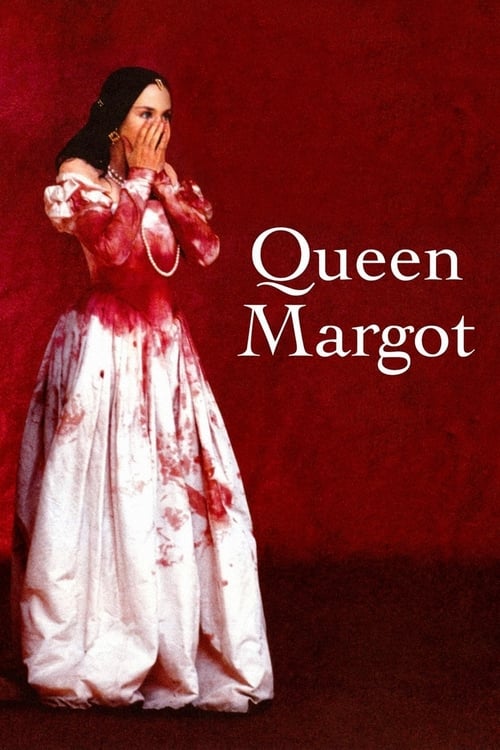
Queen Margot
1994 · Patrice Chéreau
When you want a big, passionate, blood-and-velvet epic that plays for keeps — a full-immersion evening, not background viewing. Choose it when you're up for intensity, not comfort.
What it's about
Paris, August 1572. To paper over a religious war, the Catholic princess Marguerite de Valois is married off to the Protestant Henri de Navarre — a political wedding that instead becomes the trigger for the St. Bartholomew's Day Massacre, a state-sanctioned slaughter of Protestants in the streets. Adapted from Alexandre Dumas's novel, it follows Margot through the corridors of a poisonous royal family — her scheming mother Catherine de' Medici, her unstable brother the king — as marriage, massacre, and an illicit passion entangle her in the court's survival games.
The experience
Feverish and physical — history rendered as sweat, blood, candle smoke, and bodies pressed together in dark corridors. It's intense, sensual, and grueling in stretches, closer to a nightmare than a costume drama.
Performances
Isabelle Adjani burns at the center as Margot, and Virna Lisi's chilling Catherine de' Medici won the Best Actress prize at Cannes; Daniel Auteuil gives Navarre a wary, survivor's intelligence.
The craft
Patrice Chéreau, a giant of French theater and opera, shoots the court like a fever dream — handheld closeness, crowded frames, opulent costumes deliberately soiled with sweat and gore. The massacre sequence is staged with a physicality that still shocks, and the whole film rewards the biggest screen you can find.
Why it matters
A landmark of 1990s French cinema that redefined how brutal and carnal a period epic could be, its influence visible in the grittier historical dramas that followed.
Snapshot
Queen Margot (La Reine Margot) is Patrice Chéreau's incandescent, blood-drenched adaptation of Alexandre Dumas père's 1845 historical novel, set against the St. Bartholomew's Day Massacre of August 1572. It stages French history as a claustrophobic family war: the Catholic princess Marguerite de Valois (Isabelle Adjani) is married off to the Protestant Henri de Navarre (Daniel Auteuil) as a gesture of reconciliation between crown and Huguenots, only for the wedding to become the prelude to a state-orchestrated slaughter of Protestants in the streets of Paris. Chéreau, principally a man of theater and opera, brought a director's-eye physicality to the material — sweat, candle smoke, corridors thick with courtiers — turning a costume epic into something closer to a fever. Released in France in 1994 and internationally by Miramax in a shortened cut, it earned Virna Lisi the Best Actress prize at Cannes for her spectral Catherine de Médicis and a clutch of Césars. It stands as one of the defining French heritage productions of the 1990s and, simultaneously, a deliberate assault on the genteel conventions of that very tradition.
Industry & production
The film was a major French production of its moment, produced under the aegis of Claude Berri's Renn Productions with the international scale typical of France's ambitious 1990s "heritage" cinema — a period when generous budgets, subsidies, and co-production financing underwrote a cycle of literary and historical adaptations meant to rival Hollywood in scope. The cast assembled a summit of French screen talent: Adjani (also credited as a producer through her involvement) as Margot, Auteuil as Navarre, Jean-Hugues Anglade as the disintegrating Charles IX, Vincent Perez as the Huguenot lover La Môle, Dominique Blanc as Henriette, and Pascal Greggory as the Duc d'Anjou. Italian veteran Virna Lisi was cast against her glamorous 1960s image as the poisoning matriarch Catherine de Médicis.
A significant industrial fact of the film's life is the existence of two principal cuts. The French theatrical version runs substantially longer than the version Miramax prepared for the American market, where the distributor — following its well-documented house practice under Harvey Weinstein — trimmed the film considerably and reworked its presentation. This is a matter of record rather than speculation, though the precise minute-by-minute differences are best verified against the specific releases; later home-video restorations have returned to fuller versions. The upshot is that "the film" exists in more than one authorized shape, and reception in the U.S. was partly a reception of an abridged object.
Technology
Queen Margot is a photochemical, 35mm production of the mid-1990s, made before digital intermediate grading or digital effects were standard tools of prestige European cinema. Its imagery is achieved through the traditional means the period demanded: candlelight and available-source lighting augmented by careful film-stock exposure, practical crowds and physical sets and locations rather than composited augmentation, and optical/photochemical control of a deliberately desaturated, bruised palette. The massacre sequences rely on practical prosthetics, stage blood, and choreographed physical staging rather than any digital enhancement. In short, the film's technological register is that of late-analogue prestige filmmaking, and its texture — grain, smoke, the warm falloff of flame — is inseparable from that fact.
Technique
Cinematography
Philippe Rousselot, one of the most celebrated French cinematographers of his generation, shot the film, and his work is central to its identity. The photography favors mobile, handheld and Steadicam-inflected camerawork that plunges into the throng — weddings, corridors, and the massacre are filmed from within the crowd rather than at stately remove. The palette is dark, warm, and unhealthy: deep blacks, sallow flesh, gold candlelight guttering against stone. Chéreau and Rousselot repeatedly isolate faces in close-up out of a churning mass, so that intimacy and violence share the same visual grammar. The massacre itself is rendered as a hellish, near-abstract passage of firelight, bodies, and smeared blood. This is heritage cinema stripped of its habitual pictorial serenity.
Editing
Cut for propulsion and disorientation rather than tableau, the editing (the assembly credited to the film's editorial team, with François Gédigian among the principals) accelerates sharply in the massacre, where rapid, fragmentary cutting produces a sense of engulfing chaos, then relaxes into longer-held two-shots for the chamber scenes of intrigue and desire. The contrast between these tempos structures the film: public catastrophe rendered as delirium, private intrigue as slow poison. Because two significant cuts exist, the film's rhythm is itself variable between versions — a point worth naming rather than glossing.
Mise-en-scène / staging
Here Chéreau's theatrical and operatic training is most legible. The Louvre is staged as a maze of thresholds, antechambers, and eavesdropping bodies; power is spatialized as proximity and access. Crowds are directed with an operatic sense of mass and flow, and the frame is characteristically dense — attendants, guards, and courtiers press at the edges of private moments. The film insists on the body: sweat, blood, illness, and physical desire are foregrounded to a degree unusual in the costume genre. Catherine de Médicis's poisonings and Charles IX's bloody sweats give the corruption of the court a literal, corporeal form.
Sound
Goran Bregović, the Sarajevo-born composer known for his work with Emir Kusturica, wrote the score, and its Balkan-inflected, folk- and chant-derived textures are a striking, deliberately anachronistic choice for a 16th-century French setting. Rather than pastiche period music, Bregović supplies a keening, ritualistic sound that universalizes the material into something like a lament over sectarian slaughter. The sound design pairs this with an aggressive materiality — the din of crowds, bells, blades, and bodies — so that the aural world is as visceral as the visual one.
Performance
Performance is the film's beating heart. Adjani plays Margot as a woman awakening from dynastic pawn to moral agent, her celebrated beauty deployed and then complicated by grief and revulsion. Auteuil's Navarre is watchful, ironic, and self-preserving. Anglade gives a harrowing, physically extravagant turn as the doomed, guilt-poisoned Charles IX. But the film's most honored performance is Virna Lisi's Catherine de Médicis — pale, close-cropped, and reptilian in her calm — a portrait of maternal power as pure political calculation that reversed her earlier screen persona and won her Cannes' Best Actress award.
Narrative & dramatic mode
The narrative fuses two modes that Dumas himself braided: the sweeping political-historical chronicle and the intimate tragic romance. On one axis it dramatizes statecraft — the marriage of convenience, the Guise faction, Catherine's manipulations, the decision to unleash the massacre. On the other it follows Margot's forbidden love for the Huguenot La Môle, a private passion that the public catastrophe both enables and dooms. The dramatic mode is tragic rather than triumphal: characters are trapped inside history, and the film's momentum is toward loss, severed heads, and poisoned bodies rather than reconciliation. Chéreau treats the historical record less as a set of dates to be honored than as a machine for generating irony and grief, compressing and heightening events for dramatic force in the manner the source novel already licenses.
Genre & cycle
The film belongs, at once, to two overlapping categories. It is a "heritage film" — the transnational European cycle of lavish literary and historical adaptations that flourished in the 1980s and 1990s, of which France's Berri-produced Jean de Florette/Manon des Sources (1986) and Germinal (1993) were touchstones. But Queen Margot is also, pointedly, an anti-heritage heritage film: where the cycle was often criticized for nostalgic pictorialism and tasteful restraint, Chéreau's film is violent, sensual, dark, and physically confrontational. It thus sits at the intersection of the costume epic, the historical tragedy, and the tradition of French cinéma de qualité — while deliberately roughening the surfaces those traditions had polished.
Authorship & method
Chéreau (1944–2013) came to the film as one of Europe's foremost stage and opera directors — internationally famous for his centenary Bayreuth Ring cycle and his theater work — and only intermittently a filmmaker. Queen Margot is arguably his most ambitious cinema project, and it bears the marks of his method: an emphasis on the actor's body, on ensemble staging, on emotional and physical extremity, and on the choreography of groups in architectural space. The screenplay was written by Chéreau with Danièle Thompson, adapting Dumas; their approach favors compression and psychological intensity over exhaustive fidelity.
His key collaborators shaped the film decisively. Cinematographer Philippe Rousselot supplied the mobile, candlelit visual scheme. Composer Goran Bregović provided the anachronistic, ritualistic score that is one of the film's boldest authorial gestures. Costume designer Moidele Bickel — a longtime theater and Chéreau collaborator — created the celebrated, texturally rich period wardrobe, work widely honored in the film's award haul. The editorial team, with François Gédigian among the principal editors, gave the massacre its delirium and the court its slow burn. The producer Claude Berri connected the film to the dominant French prestige-production apparatus of the era.
Movement / national cinema
The film is a landmark of 1990s French national cinema, situated within the state-supported, high-budget prestige sector rather than any avant-garde movement. It is best understood against the French heritage boom that Berri did much to define, and as an example of France asserting its own historical and literary patrimony on a scale meant to compete internationally. At the same time, Chéreau's outsider position — a theater and opera eminence rather than a career film director — gives the film a distinctive stance within that national cinema: inside the prestige system, yet temperamentally at odds with its decorum.
Era / period
Queen Margot is doubly periodized. Diegetically it belongs to the French Wars of Religion — specifically the events surrounding the royal wedding of 18 August 1572 and the St. Bartholomew's Day Massacre that followed days later, with the Valois court of Charles IX and Catherine de Médicis at its center. As a production it belongs unmistakably to the mid-1990s European prestige moment: the last flowering of fully photochemical costume epics, made under Cannes-facing, subsidy-supported conditions, and mediated (for Anglophone audiences) through the Miramax distribution machine that shaped so much "foreign prestige" release in that decade.
Themes
Several themes braid through the film. Sectarian violence and the manufacture of massacre is the largest: the film anatomizes how political expedience, factional fear, and dynastic calculation convert a wedding into a pogrom, and it refuses to make that slaughter picturesque. Family as a site of political horror runs alongside it — the Valois are a household of poisoners, rivals, and incestuously charged intimacies, with Catherine's maternal power the film's darkest engine. The body is thematic, not merely textural: illness (Charles's bloody sweats), desire, and death are insistently physical, collapsing the distance between eros and mortality. Tolerance and its betrayal shadows the marriage plot, as the film's one gesture toward reconciliation is immediately drowned in blood. And the woman as pawn who becomes an agent structures Margot's arc, as she moves from instrument of state to mourner and moral witness. Contemporary readings frequently noted the resonance of the film's sectarian slaughter with the ethnic and religious wars of the early 1990s, a resonance Bregović's Balkan-inflected score arguably underscores; that connection is interpretive rather than a stated authorial claim, and is best framed as such.
Reception, canon & influence
Critically, the film was received as a major, divisive event. It was widely praised for its visual and physical daring, its performances, and its refusal of costume-drama gentility; some critics found it exhausting or narratively congested, particularly in the abridged international cut, where the dense web of factions could read as confusing. Its most concrete honors are well documented: Virna Lisi won Best Actress at the 1994 Cannes Film Festival, where the film was warmly received and recognized among the competition's prize-winners, and it went on to win multiple Césars, with Isabelle Adjani honored for Best Actress among them and further awards recognizing its design and supporting performances. (Readers should confirm the full award slate against the official records, as the exact list is easy to misstate.)
The influences on the film run backward through Dumas's Romantic historical novel and its prior screen adaptations, through the European art-cinema tradition of physically intense, body-centered filmmaking, and through Chéreau's own operatic staging practice. Its own legacy is twofold. Within French cinema it helped define — and complicate — the 1990s heritage film, demonstrating that the costume epic could be brutal, sensual, and formally aggressive rather than nostalgically composed; it is regularly cited as a benchmark for the "dark," anti-decorous historical film. For its makers it was consolidating: it burnished Rousselot's and Bickel's reputations, reintroduced Virna Lisi to international audiences, and stands as the peak of Chéreau's intermittent film career alongside Intimacy (2001) and Son frère (2003). Its broader influence on subsequent violent, intimate historical dramas is real but diffuse, and honesty requires naming it as an atmosphere the film helped legitimate rather than a lineage that can be traced through named, documented citations.
Reception
A Cannes prize-winner in '94 (Jury Prize, plus Best Actress for Virna Lisi), it reached America in a Miramax-shortened cut that left critics lukewarm and audiences confused. The 2013 restoration of Chéreau's full version triggered a real reappraisal, and it's now routinely hailed as one of the great modern costume dramas.
How Queen Margot was received, from release to now →
How to watch Queen Margot: what to notice on a first viewing
- Watch the camera push into the middle of every crowd. Rousselot shoots weddings, corridors, and gatherings handheld and Steadicam-close, from inside the throng rather than at a stately distance. You're placed among the bodies instead of observing the spectacle from a safe remove.
- Watch how dark and sallow every candlelit room looks. Rousselot lights interiors in deep blacks and unhealthy gold, skin tones read faintly sick even in the film's most ceremonial scenes. The court looks unwell, sallow and airless, in every candlelit room.
- Listen for music that doesn't belong to this century. Goran Bregović's score is Balkan-inflected, chant-derived, and deliberately anachronistic for a sixteenth-century French setting, closer to a lament than to period music. The score is telling you this is about sectarian slaughter in general, not only 1572.
- Watch how many rooms you have to pass through to reach anyone. The Louvre is staged as a maze of antechambers and thresholds, with courtiers and guards pressing at the edges of every supposedly private conversation. Power in this film is a matter of who can get close to whom, not who holds a title.
- Watch Catherine de Médicis's face give away nothing at all. Virna Lisi plays her pale, close-cropped, and reptilian in her calm, a portrait of maternal power as pure political calculation rather than visible cruelty. Her stillness is scarier than any outburst another actress might have chosen instead.
The whole guide to watching Queen Margot, with the keys for a rewatch →
Influences: the films it descends from and the films it influenced
- Barry Lyndon (1975) — Established the candlelit available-light period interior — fast lenses rendering flame as the only key source with no electric fill — the exact photographic scheme Rousselot adapts for Margot's court.
- The Devils (1971) — Model for anti-decorous religious-war cinema: sectarian massacre and mass hysteria staged as operatic bodily frenzy rather than tasteful costume-drama pageant.
- Chimes at Midnight (1965) — The Battle of Shrewsbury's fragmentary, spatially disorienting, close-cut carnage is the editing template for the St. Bartholomew's massacre delirium.
- The Leopard (1963) — Operatic choreography of crowds through architectural space and the historical chronicle as sensuous epic — the stage-director's ensemble blocking Chéreau inherits.
- The Damned (1969) — Poisoned-dynasty court intrigue rendered as decadent operatic tableau of bodies moving through thresholds, feeding Margot's staging of the Valois family's rot.
- Andrei Rublev (1966) — Mud-and-flesh medieval physicality; the Vladimir sack sequence's tactile, body-centered violence models history as something suffered on skin rather than composed.
- Time of the Gypsies (1988) — Source of Goran Bregović's ritualistic Balkan-folk scoring method — the very composer and idiom Chéreau imports as the film's anachronistic score.
- Danton (1983) — The political-historical chronicle staged as claustrophobic ideological chamber drama with legible warring factions and a tragic mode, a French-revolution precedent for Margot's court intrigue.
- Cyrano de Bergerac (1990) — Pushes the same French-history costume mode toward visceral hand-held camerawork, a darker heir to Cyrano's opened-out heritage spectacle.
- Elizabeth (1998) — Extends the dark anti-heritage court thriller: murderous Catholic-Protestant intrigue tracked by a mobile camera through doorways, arches and architectural thresholds.
- The Princess of Montpensier (2010) — Returns to the same Wars of Religion milieu, marrying court intrigue to brutal bodily physicality and body-centered performance in Margot's anti-decorous register.
- Intimacy (2001) — Chéreau pushes his own body-centered acting method to raw, unsimulated physical extremity, stripping period costume to expose the bare performing body.
- The Favourite (2018) — Anti-heritage court cruelty shot in candlelit natural available light with wide, mobile lenses, deflating costume-drama gentility exactly as Margot did.
- The Count of Monte Cristo (2024) — A Dumas-source costume drama whose low-key, candle-and-shadow chiaroscuro and blood-and-brocade tactility model the painterly period surface Bolduc supplies here.
- Interview with the Vampire (1994) — Rousselot's own same-year period gothic, applying the identical low-key, flame-lit available-light palette to candlelit interiors.
- Marie Antoinette (2006) — Deploys anachronistic pop scoring against pristine period images as a deliberate anti-heritage authorial gesture, the boldest inheritance of Bregović's score-against-image tactic.
- Underground (1995) — Bregović-scored, delirious crowd choreography turning national-historical chronicle into frenzied tragic spectacle, a parallel use of the same composer's ritual music.
- Braveheart (1995) — Contemporaneous historical epic built on fragmentary hand-to-hand battle cutting and visceral, meaty sound design to make mass killing felt rather than admired.
Similar films
- The Devils (1971) — influence & lineage · often watched together
- Marie Antoinette (2006) — influence & lineage
- The Favourite (2018) — influence & lineage
- Braveheart (1995) — influence & lineage
- Blue Is the Warmest Color (2013) — same viewing thread
- Portrait of a Lady on Fire (2019) — shared sensibility
- The Count of Monte Cristo (2024) — shared sensibility
- The Passion of Joan of Arc (1928) — shared sensibility
All the films related to Queen Margot →
Watch it with: curated runs of related films
- Love Against the Grain — A run of films where desire refuses the shape its world demands — opera stages, drought-struck Taipei, an honor-bound Lahore household, drenched Buenos Aires — and burns brighter, and more dangerously, for the refusal.