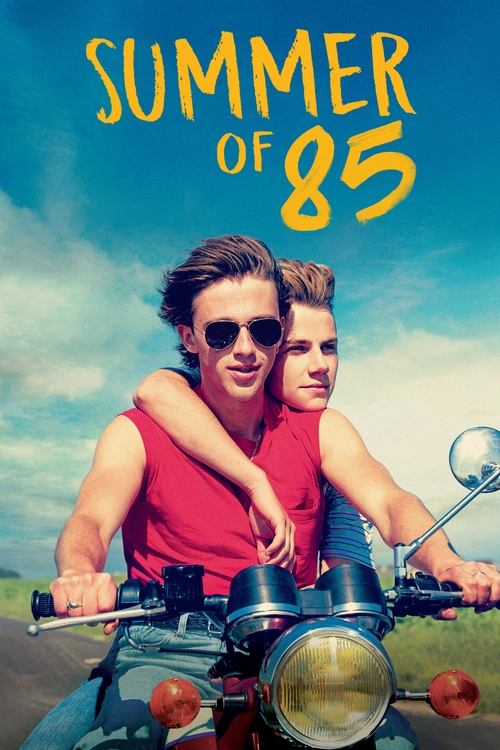
Summer of 85
2020 · François Ozon
When you want a summer romance with teeth — for an evening of nostalgia, longing, and a good cathartic ache rather than pure escapism.
What it's about
Normandy coast, summer of 1985. Sixteen-year-old Alexis capsizes a borrowed dinghy in a squall and is pulled from the water by David, eighteen, magnetic, and a little dangerous — and within days the rescue has become a friendship, then a first love lived at motorbike speed. But the story is told from the wreckage of that summer: Alexis is looking back, trying to explain to adults how something so bright went so wrong, and a reckless pact the boys made hangs over every sunlit scene.
The experience
Sun-soaked and headlong, with the giddiness of first love shadowed the whole way by a sense of something ending — you watch it half swooning, half braced. It plays like a pop song about grief: fast, gorgeous, and sadder than it first sounds.
Performances
Félix Lefebvre and Benjamin Voisin have real, unforced chemistry — Lefebvre all wide-open first-timer's wonder, Voisin doing effortless charisma with an edge of danger you can't quite trust.
The craft
Ozon shoots the eighties on grainy film with a lover's eye for the period — the ferry docks, the nightclub, the seaside light — and cuts the romance to a needle-drop pop soundtrack that turns certain scenes into instant memories. The dual-timeline structure keeps the sweetness and the sorrow in constant conversation, and the whole thing moves like the six weeks it depicts: too fast, on purpose.
Why it matters
A passion project the director carried for over thirty years, from a novel he loved as a teenager, and one of the defining French entries in the modern wave of queer coming-of-age cinema.
Snapshot
Été 85 is François Ozon's adaptation of Aidan Chambers' 1982 young-adult novel Dance on My Grave, transposed from the English seaside to the Normandy coast and set across six weeks of the summer of 1985. Alexis, sixteen, capsizes a borrowed dinghy in a squall and is pulled from the water by David, eighteen, who works in his widowed mother's ship chandlery. What follows is a first love conducted at the speed of a motorbike, a pact — whoever dies first, the other must dance on his grave — and the keeping of that pact, which is why the film opens with Alexis in judicial custody rather than in love.
Ozon has said in interviews that he read Chambers' novel as a teenager in the mid-1980s and wanted it to be his first film; he made it more than thirty years and twenty features later. That delay is legible in the finished work. This is a film about adolescence made by someone who has stopped being able to reach it directly, and it uses a doubled structure — the boy living it, the boy writing it down — to say so.
Industry & production
The film was produced by Mandarin Production (Éric and Nicolas Altmayer), Ozon's most consistent industrial partners, alongside the director's own company FOZ, with Playtime handling international sales and Diaphana releasing in France; Music Box Films took it into North America the following year. This is the standard architecture of a mid-budget French auteur film: CNC support, a broadcaster pre-buy, an established director whose name secures financing without stars. Both leads were effectively unknown at the time of casting, which is a risk the French system absorbs more easily than most because the director's name is the asset being sold.
Shooting took place in the summer of 2019 around Le Tréport and Mers-les-Bains, twin resort towns facing each other across the mouth of the Bresle on the Normandy–Picardy coast — chalk cliffs, a working port, belle-époque villas, a beach that is stones rather than sand. The project was announced under a slightly different title before settling on Été 85, a small shift of year that matters more than it seems, for reasons the Era section takes up.
The release is the genuinely unusual part of the film's industrial story. Selected for the Official Selection of Cannes 2020 — a festival that was canceled, its lineup announced as a label rather than staged as an event — the film opened in French cinemas on 14 July 2020, three weeks after France permitted theaters to reopen following the first COVID-19 lockdown. It was therefore one of the first significant French auteur titles to test a reopened market, playing into an exhibition calendar stripped of studio competition. It performed respectably in that peculiar landscape; precise admissions and grosses are a matter of public record but are not worth reciting from memory, and I won't invent them. At the 2021 Césars it drew a substantial spread of nominations, including recognition for both young leads in the Most Promising Actor category — the kind of institutional endorsement that converts a casting gamble into two careers.
Technology
Ozon and cinematographer Hichame Alaouié shot on Super 16mm, finishing digitally. The decision is the film's central technical argument: 16mm grain is not merely "period-looking," it is period-sized, a texture that puts a visible membrane between the viewer and the image and thereby stages the whole film as recollection. The blown-up negative carries halation in the sun, mushy blacks in the disco, and a slight instability in skin tone that no digital emulation quite reproduces. Against the pristine 4K default of 2020 European production, this is a deliberate downgrade in resolution purchased as an upgrade in memory.
The other technology in play is diegetic and just as structural. 1985 is the era of the personal cassette player, and the Walkman is the film's key object — a machine for privatizing sound, for carrying an interior life through public space. A mixtape is the film's love-token and its murder weapon of feeling. Equally important is what does not exist: no mobile phones, so David's whereabouts are unknowable and jealousy has nowhere to go but the body; no messaging, so a quarrel cannot be repaired at distance; no images of the beloved except the ones you make yourself. The plot depends absolutely on 1985's information scarcity. A version set in 2020 would not have a third act.
Technique
Cinematography
Alaouié — who had shot Ozon's By the Grace of God the previous year, a film of institutional grays and telephone calls — works here in a register of proximity and heat. The camera is frequently handheld and close, riding at shoulder height with the two boys, cutting the frame down to necks, hands, the back of a head. Sunlight is allowed to flare and bleach; the palette runs to saturated primaries in costume (Pascaline Chavanne's clothes do a great deal of the period work) against the chalk-and-slate neutrals of the coast. The disco is lit in raw red and blue, the morgue in a flat clinical white that arrives as a physical shock after ninety minutes of warmth. The sea recurs in wide, still compositions that function as breathing space and, retrospectively, as omen. Compared with the lacquered classicism of Frantz, the shooting here is looser, more available to accident — appropriate to a film narrated by someone who is not in control of his material.
Editing
Laure Gardette, Ozon's regular editor across Frantz, L'Amant double, By the Grace of God and the films that followed, builds the picture on a two-track crosscut: the affair, moving forward through six weeks, and the aftermath, in which Alexis is questioned, held, and eventually made to write. The film tells us at the outset that there is a corpse and that Alexis is responsible for what happened to the grave; it withholds the death itself for a long time. This converts suspense into dread — we are not asking what happens but how we get there — and it keeps the romance permanently shadowed, so that even the happiest scenes are already being read as evidence. The affair itself is compressed elliptically: a swim, a shop counter, a bedroom, a nightclub, with the connective tissue of ordinary days removed. That is how six weeks are actually remembered.
Mise-en-scène / staging
Ozon organizes the film around a small number of charged locations — the chandlery, the boat, the Gorman house, the beach, the club, the cemetery, the mortuary — and moves the boys through them in a tightening spiral. Staging is consistently about asymmetry of attention: David is usually in motion, addressing the room, being looked at by more than one person; Alexis is usually watching David. Ozon, whose eroticism has always been frank, films the male body as an object of open appetite, but the crucial staging decision is that we almost never get David alone. He exists in the film very largely as Alexis constructs him, which is the formal expression of the film's central idea.
Sound
The score is by Jean-Benoît Dunckel, one half of Air — a choice that quietly annexes the sonic memory of The Virgin Suicides (1999), the other great synth-scored film about adolescents who die before they can become ordinary. Dunckel's cues are sparse, analog, tonally unresolved. Around them Ozon deploys period pop, with Rod Stewart's "Sailing" functioning as the film's emblem: it is what plays in Alexis's headphones, and the sequence in which the Walkman's private soundtrack becomes the film's public one — most famously in the nightclub, where the mix collapses to what one boy hears — is the most sophisticated thing in the picture. The soundtrack also reaches into British new wave of the moment, The Cure among them; the fine detail of the licensing and cue placement is documented in the film's credits rather than reliably in memory, and I flag rather than embroider it. Language is itself a sound design: Kate is English, David's mother is English, and the film's bilingualism keeps a small permanent friction in the dialogue.
Performance
Félix Lefebvre plays Alexis almost entirely inward — a face organized around watching, whose few eruptions land hard because the baseline is so contained. Benjamin Voisin's David is the harder assignment: he must be irresistible and, on second look, careless, a boy who needs to be loved by everyone and is therefore faithful to no one, without the performance ever tipping into calculation. Voisin would break out fully the following year in Xavier Giannoli's Lost Illusions. Valeria Bruni Tedeschi, as David's mother, executes a difficult tonal pivot from brittle comedy to grief that has hardened into cruelty. And the casting of Melvil Poupaud as the teacher who tells Alexis to write is a piece of citation: Poupaud was the drifting hero of Rohmer's Conte d'été (1996) and, in Ozon's own Le Temps qui reste (2005), the young man given months to live. He arrives carrying both of the film's subjects — the summer, and the dying — inside his casting.
Narrative & dramatic mode
The mode is confessional retrospection, formally motivated: Alexis writes because a court and a social worker require an account, and because a teacher persuades him that writing is the only way through. The narration is first-person, occasionally direct-address, and openly manages the audience — it warns us at the start that this is a story about a corpse and invites anyone uninterested to leave. That gesture establishes the narrator as a maker of effects, not a neutral reporter, and licenses the film's most productive ambiguity: what we see is not the affair but Alexis's version of it, produced under legal duress, for an audience with power over him.
Chambers' novel used the same device — a report compiled by a boy under investigation — and Ozon keeps it nearly intact while relocating everything else. The result is a romance whose dramatic engine is not "will they" but "what is he leaving out." Some critics found the framing over-explicit, the writing-as-therapy resolution too tidily literary. The counter-reading is that the tidiness is the point: Alexis survives by converting David into prose, which is exactly what the film is.
Genre & cycle
Summer of 85 sits at the intersection of three cycles. First, the French summer-holiday film — a lineage running from Jacques Rozier through Rohmer's Pauline à la plage (1983) and Conte d'été (1996), where a fixed span of leisure permits moral experiment before term resumes. Second, the amour fou tradition in which desire and death are not opposed but identical. Third, and most conspicuously to 2020 audiences, the late-2010s wave of queer adolescence films — Moonlight (2016), God's Own Country and Beach Rats (both 2017), and above all Guadagnino's Call Me by Your Name (2017), whose sunlit European summer of first gay love the Ozon film could not avoid being measured against. Ozon has been consistent that his project long predates that comparison, and the two films differ fundamentally: Guadagnino's ends in survivable sorrow, Ozon's begins with a body.
Within Ozon's own filmography it belongs to his mourning cycle — Sous le sable (2000), Le Temps qui reste (2005), Frantz (2016) — films about people bound to a dead man, often sustained by a fiction. Frantz is the closest relative: both are about a survivor who invents the dead in order to keep living near them.
Authorship & method
Ozon is a La Fémis-trained director who has released work at close to a film a year since the late 1990s, alternating registers with unusual freedom — Fassbinder pastiche (Water Drops on Burning Rocks, 2000; later Peter von Kant, 2022), musical comedy (8 femmes, 2002), literary chamber piece, social-issue procedural. Two of his habits converge here. One is adaptation of British fiction transposed to French settings: Elizabeth Taylor for Angel (2007), Ruth Rendell for The New Girlfriend (2014), Chambers here. The other is his enduring interest in masquerade, substitution and the erotics of disguise — which in this film produces the mortuary sequence, where Alexis's need to see and touch the body is achieved through a borrowed feminine appearance, a scene that is simultaneously his most transgressive act and his most childlike.
He wrote the screenplay alone. The key collaborators are Alaouié on camera, Gardette in the cutting room, Chavanne on costume, and Dunckel on score, with production design by Benoît Barouh. It is worth noting that Ozon's method with the young leads was to cast unknowns and build the film's temperature around their inexperience; the tenderness of the film, which surprised critics accustomed to Ozon's irony and perversity, appears to be a genuine change of register rather than a pose.
Movement / national cinema
The film is a product of the mature French auteur system: state advance-on-receipts funding, broadcaster investment, a director-centred production culture that permits a personal 1980s memory-piece to be financed at a scale unavailable to an equivalent film almost anywhere else. Ozon emerged in the late 1990s alongside a generation — Gaspar Noé, Bruno Dumont, the reinvigorated Claire Denis and Catherine Breillat — associated with a confrontational cinema of the body. He has always been the most classical and most commercially fluent of that cohort, and Été 85 shows the double inheritance clearly: Rohmer's moral tale of a young man's summer, filtered through a Fassbinderian conviction that love is a mechanism of power and that someone always pays.
Era / period
1985 is chosen with precision. In France, the law of 4 August 1982 had repealed the provision setting a higher age of consent for homosexual acts; by this summer, the relationship between a boy of sixteen and one of eighteen carries no criminal weight, and Alexis's legal jeopardy is for desecrating a grave, not for whom he loved. That is a considerable and deliberate reordering of what a story like this would have meant even a few years earlier.
The second, larger fact about 1985 is the one the film declines to speak. AIDS was becoming public knowledge in France across exactly these months; Rock Hudson's death that October is conventionally the hinge at which the epidemic entered general consciousness worldwide. Summer of 85 is set in the last weeks before that shadow reached a provincial French beach town, and it says nothing about it. This is best read as a structuring silence rather than an evasion: Ozon situates his memory of adolescent desire in the final summer when death could still be imagined as a romantic pact rather than a demographic fact. The boys can afford to fetishize dying because they do not yet know what dying is about to mean.
Themes
The governing theme is the gap between the beloved and the image of the beloved. Alexis does not fall in love with David; he falls in love with a rescue, and spends six weeks assembling a person to match it. David's actual carelessness — his need for universal admiration, his refusal of exclusivity — is available to us throughout, and the film's second half is the education in which Alexis learns that the boy was never the story he was telling.
Around that: the pact, and the terrible literalism of adolescent promises. Grief as a form of trespass — Alexis is excluded from the funeral, from the body, from the mother's mourning, and so he takes his rites by force. Class runs quietly under everything, with Alexis's modest family expecting him to leave school for work while the Gormans' shop and the teacher's encouragement both, in different ways, offer exit. And finally, writing: not as consolation but as the only container capacious enough to hold what happened. The film's last position is that Alexis survives because he becomes the author of David, which is a bleaker proposition than it first appears.
Reception, canon & influence
Critical response was warm but not rapturous. The recurring praise was for the leads, for the sensory precision of the period reconstruction, and for the sincerity of a filmmaker whose queerness on screen had usually been ironic, perverse or blackly comic; a genuinely tender Ozon romance was noted as a departure. The recurring reservation was that the material is familiar and the framing device didactic — that the film's shape is more conventional than its best sequences deserve, and that the writing-as-salvation ending resolves too neatly. In France, its release into a near-empty post-lockdown market gave it an outsized cultural presence relative to its ambitions; its César nominations confirmed institutional approval, and I'd note that the specific slate of wins versus nominations is easily verified and not worth reconstructing from memory.
Looking backward, the influences are legible and mostly acknowledged: Chambers' novel above all, which was a landmark of gay adolescent fiction precisely because it declined to pathologise its lovers; Rohmer's summer tales for the structure of a holiday as moral laboratory; Fassbinder for the power asymmetry inside desire; Air's Virgin Suicides score for the sound of teenage mortality; and Ozon's own Time to Leave and Frantz for the mourning architecture.
Looking forward, the record is genuinely too short to assess honestly, and the responsible thing is to say so. Its clearest measurable effect is on careers: it launched Benjamin Voisin, who moved directly into Lost Illusions, and established Félix Lefebvre. It belongs to a European cluster of films about queer youth and early death that continued through the early 2020s — Lukas Dhont's Close (2022) shares a great deal of its emotional structure — though there is no evidence of direct influence and it would be wrong to claim any. Within Ozon's filmography it functions as a hinge: the mortality he treats here as adolescent fantasy returns immediately and unromantically in Everything Went Fine (2021), a film about a daughter helping her father die. Whether Summer of 85 enters the canon as a major Ozon or as a minor, beautifully made personal detour is a question the next twenty years will settle, and the safest current judgment is that it is the most emotionally direct film of a career built on indirection.
A Deleuzian reading
The nightclub is lit in raw red and blue.
The full Deleuzian reading of Summer of 85 →
Reception
Launched with the 'Cannes 2020' label the year the festival was canceled, it was received warmly but filed under 'minor Ozon' by many critics — since then it's quietly become a queer-cinema staple, one of the films Letterboxd users actually keep returning to from that lost Cannes year.
How Summer of 85 was received, from release to now →
How to watch Summer of 85: what to notice on a first viewing
- Listen for when the music becomes only one boy's headphones. In the nightclub the mix collapses from the room's music down to what Alexis alone hears on his Walkman, while the dancing around him keeps going. Sound stops being a record of the room and becomes a record of one boy's private feeling.
- Notice how close and low the camera stays to the boys. Alaouié shoots handheld at shoulder height, cropping the frame down to necks, hands, and the backs of heads rather than giving you a full, composed view of either boy. You get fragments of a body, the way a memory keeps pieces instead of a whole picture.
- Notice you almost never see David without Alexis watching him. David is always in motion, addressing a room, being looked at by more than one person, and Alexis is always the one doing the looking. You are never shown David alone, only the version of him Alexis is constructing as he watches.
- Notice the film tells you at the start there is a corpse. Alexis is writing this account for a court and a social worker, not remembering it freely for you, and the film keeps cutting between the summer and that interrogation. Every warm scene you watch is already being shaped by someone with a reason to shape it a certain way.
The whole guide to watching Summer of 85, with the keys for a rewatch →
Influences: the films it descends from and the films it influenced
- Pauline at the Beach (1983) — Rohmer's Normandy-coast structure — a fixed holiday duration as a closed moral laboratory in which an adolescent observer's erotic education is staged in daylight conversational blocks against sand, wind and rented rooms — is the exact architecture Ozon borrows for the Alexis/David summer, down to the seaside-town geography and the compressed calendar.
- The Go-Between (1971) — Losey and Pinter's method of splicing brief, unexplained future-tense fragments into a golden summer idyll — so the audience carries dread the boy on screen doesn't yet have — is the template for Ozon's dual-timeline crosscut between the affair and the post-mortem confession.
- Purple Noon (1960) — Henri Decaë's saturated Mediterranean primaries and the sailboat staged as an erotic pressure chamber — the wealthier boy commanding the tiller, the poorer one recruited as crew — supply the visual and power grammar of the storm/rescue sequence that opens the affair.
- Fox and His Friends (1975) — Fassbinder's insistence that desire between men be photographed as an economic transaction — the poorer lover framed inside the richer family's shop, furniture and mother — gives Ozon the asymmetry-of-attention blocking in the Gorman household scenes.
- Water Drops on Burning Rocks (2000) — Ozon's own Fassbinder adaptation is where he first built a film out of the older/dominant partner's domestic control over a dazzled younger one, and where he rehearsed the apartment-as-trap staging he later opens up onto the Dieppe coast.
- Wild Reeds (1994) — Téchiné's method of casting unknown teenagers and shooting close to their unrehearsed faces in a period-specific French provincial summer — river, bicycles, radio — established the register of inexperience-as-texture that Ozon explicitly reproduces with Lefebvre and Voisin.
- À nos amours (1983) — Pialat's handheld proximity to an untrained adolescent face (Bonnaire), holding on the moment performance breaks into something unperformed, is the acting-direction model behind Ozon's build of the film's temperature around his leads' inexperience.
- The Virgin Suicides (1999) — Direct sonic debt: Jean-Benoît Dunckel's Summer of 85 score extends the analog-synth idiom he wrote with Air for Coppola — warm arpeggiated pads scoring teenage death as reverie — and shares its structure of a surviving narrator reconstructing a dead beloved he never fully knew.
- My Summer of Love (2004) — The same folie-à-deux engine driven by class asymmetry and two unknown leads, shot handheld in available summer light, with the poorer partner's fantasy of the richer one curdling into a near-fatal reckoning at a body of water.
- Time to Leave (2005) — Ozon's earlier mourning architecture — a young man, a beach, and death treated as a matter of images and last gestures rather than illness — supplies the elliptical compression by which Summer of 85 lets a death happen off-screen and be felt only in its administrative aftermath.
- The New Girlfriend (2014) — The literal precedent for the mortuary masquerade: a mourner who assumes a borrowed feminine appearance to remain in contact with a dead beloved, played straight rather than for camp, with costume (Chavanne's line of work here) doing the psychological argument.
- Frantz (2016) — Frantz builds a whole film on a survivor performing an invented relationship with the dead for the bereaved family, with an unreliable narrator whose confession is withheld and re-told — the same retrospective-testimony machinery Ozon reuses for Alexis's written account.
- Everything Went Fine (2021) — The immediate inversion within Ozon's own method: the mortality treated in Summer of 85 as adolescent fantasy and masquerade is restaged as procedural, unromantic logistics, using the same withheld-death editing but stripped of score and saturation.
- Peter von Kant (2022) — Ozon returns to the Fassbinder power-asymmetry grammar he tested here — an older man's obsession with a beautiful, indifferent younger one — this time as declared pastiche, confirming the earlier film's Fassbinder debt as a working method rather than a citation.
- The Stranger (2025) — First pairing of Ozon with both Dacosse and Voisin; the blown coastal highlights and heat-flared skin developed there are carried directly into the Algiers exteriors, and the actor's flat-surfaced screen presence is the one Ozon later empties out.
- Blue Is the Warmest Colour (2013) — Kechiche's shallow-focus handheld pursuit of an unknown lead's face at conversational distance, letting skin, sweat and mouth carry the erotic information the dialogue withholds, is the same proximity protocol Alaouié applies to Lefebvre.
- Beach Rats (2017) — Shot on Super 16 by Hélène Louvart, it pursues the identical craft equation — grainy small-gauge stock plus a first-time lead plus a seaside working-class summer — so that queer adolescent desire registers as physical texture rather than plot.
- Call Me by Your Name (2017) — The parallel use of period pop as the lovers' unspoken interior monologue — needle-drops carrying what the boys cannot say — and of a Mediterranean summer's heat and water as the medium of a compressed, terminal affair.
- Aftersun (2022) — The same retrospective grammar: analog media as a memory object, a holiday reconstructed by a survivor from fragments, and a death that the film refuses to dramatize, letting the crosscut present tense do the mourning.
- Close (2022) — Independently arrives at the same emotional architecture — handheld intimacy with two unknown adolescent boys, an early unshown death, and a survivor's guilt worked out through an act of confession to the dead boy's mother — with no evidence of direct influence.
- Young Hearts (2024) — Seaside teenage first infatuation scored to diegetic period pop, using a specific era's music as the affective engine of the romance the way schlager works here.
Similar films
- Call Me by Your Name (2017) — influence & lineage
- Close (2022) — influence & lineage
- Aftersun (2022) — influence & lineage
- Falcon Lake (2022) — shared sensibility
- Eyes Full of Sun (1970) — shared sensibility
- Young Hearts (2024) — shared sensibility
- People We Meet on Vacation (2026) — shared sensibility
- The Stranger (2025) — shared sensibility