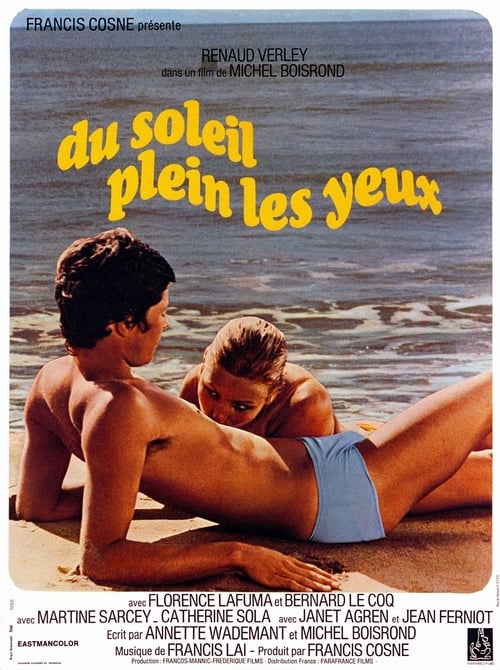
Eyes Full of Sun
1970 · Michel Boisrond
For when you want a lazy, low-stakes summer escape — sailboats, tanned shoulders, old-fashioned romantic entanglement — and you're happy to drift rather than be gripped. Pure comfort, with a period-piece curiosity bonus.
What it's about
Vincent, a young medical intern, and his brother Bernard — freshly bruised from failing his exams — sail from Brittany to their estranged father's villa in Morocco for a summer of consolation, with Vincent's fiancée Geneviève aboard. Between regattas and long sun-drunk afternoons, affections start to drift, and the holiday becomes a quiet contest of loyalties between brothers, lovers, and a father living apart from the family.
The experience
Unhurried and sun-bleached, like flipping through someone's vacation photos from 1970 — romance played as a holiday sport, but one with real bruises. It's light on its feet and a little melancholy underneath.
The craft
Michel Boisrond, once René Clair's assistant and a veteran of polished French star vehicles, films leisure with the smooth professional craft of the commercial tradition the New Wave rebelled against — unfussy compositions, warm Mediterranean light, romance staged like choreography. It's late-afternoon filmmaking: relaxed, sunlit, easy on the eye.
Why it matters
A period curio rather than a rediscovered classic, it's a snapshot of mainstream French cinema's twilight glamour circa 1970 — and an early screen appearance for Bernard Le Coq, decades before his acclaimed character work.
Two brothers sail from Brittany to their estranged father's villa in Morocco, a fiancée aboard and a summer of regattas, tanned shoulders and shifting affections ahead of them. Michel Boisrond — once René Clair's assistant, then the reliable craftsman behind Brigitte Bardot vehicles like Naughty Girl — was by 1970 a veteran of the commercial French cinema the New Wave had defined itself against, and this is that tradition's late-afternoon light: sun-bleached leisure filmed with unhurried professional polish, romance treated as a holiday sport with real bruises. The picture is a period curio rather than a rediscovered masterpiece, but curios have their pleasures — an early role for Bernard Le Coq, decades before his run of César-honored character work; the Swedish starlet Janet Agren en route to Italian genre cinema; and above all a score by Francis Lai, written in the very year Love Story made him the most hummed composer alive. What survives best is the atmosphere: Agadir's harbor, white sails against hard blue, a vanished idea of European youth on the water — French popular cinema catching the last of the pre-crisis sun.
Reception
Sniffed at by French critics in 1970 as glossy commercial 'eye candy' and quickly forgotten at home, it now survives mostly as a rediscovery item — a DVD reissue and, above all, its Francis Lai soundtrack keep it circulating.
How Eyes Full of Sun was received, from release to now →
Influences: the films it descends from and the films it influenced
- Les Grandes Manœuvres (1955) — Boisrond served as assistant director to Clair and carried over Clair's découpage of bittersweet romance staged with choreographed, light-comic elegance and a fatalistic melancholic turn.
- Le Blé en herbe (1954) — The tradition-de-qualité template Boisrond works in: an Aurenche-Bost-style literate seaside-summer romance of adolescent awakening, polished studio craftsmanship over New Wave rawness.
- Cette sacrée gamine (1956) — Boisrond's own breakout star-vehicle established his method of glossy, professionally lit romantic comedy built entirely around a luminous young lead — the craftsman's showcase reprised here.
- And God Created Woman (1956) — Set the sun-bleached Mediterranean-leisure idiom of tanned idle youth photographed as erotic landscape, the sensual holiday gaze Boisrond adopts for his harbor idyll.
- Plein Soleil (1960) — Henri Decaë's harsh sun-flooded harbor-and-yacht cinematography of wealthy drifting youth is the direct visual model for the sun-bleached Mediterranean-port staging.
- A Man and a Woman (1966) — Francis Lai's breakthrough score — a hummed, circling romantic leitmotif carrying the whole emotional arc — is the exact scoring method Lai brings to Boisrond's film.
- Love Story (1970) — Same-year proof of Lai's scoring method going global: a single piano-led romantic theme (Oscar-winning) engineered to drench an unabashed weepie, extending Lai's Boisrond-era template.
- Emmanuelle (1974) — Extends the sun-bleached exotic-tourist leisure aesthetic into soft-focus glossy commercial sensuality, foreign locales as erotic postcard, descended from this leisure-cinema surface.
- Bilitis (1977) — Pushes the sun-flared, hazy Mediterranean youth-romance photography to its soft-focus extreme, the leisure-and-affection image style taken to pure pictorialism.
- La Collectionneuse (1967) — From the opposing New Wave camp but the same subgenre: a sun-drenched summer-vacation idyll of listless youth, natural light and languor as the film's true subject.
- Benjamin (1968) — Fellow anti-New Wave craftsman working the same lush, elegantly-lit popular romance mode, prizing decorative surface and star charm over auteur roughness.
- La Piscine (1969) — The definitive late-60s languid-leisure film — tanned bodies, Côte d'Azur heat, idle desire rendered through slow sunlit compositions — a direct stylistic peer.
- Un homme qui me plaît (1969) — Another Francis Lai romantic-drama collaboration where Lai's melodic theme and sunny travelogue lyricism structure the love story, contemporaneous with Boisrond's.
- Les Choses de la vie (1970) — Shares the 1970 French popular-cinema register of unshowy middle-class emotional realism and sun-lit provincial-coast settings, craft in service of feeling.
- Summer of '42 (1971) — The nostalgic summer-holiday coming-of-age romance shot in golden lyrical light, mourning vanished youth — the same elegiac holiday-romance craft in an American key.
- L'Homme de Rio (1964) — Kindred anti-New Wave popular craftsman whose exotic-location filmmaking (Rio, then Morocco-type harbor settings) treats foreign ports as buoyant tourist spectacle for a star vehicle.
Similar films
- A Man and a Woman (1966) — influence & lineage
- The Swimming Pool (1969) — influence & lineage
- Summer of 85 (2020) — shared sensibility
- The Young Girls of Rochefort (1967) — shared sensibility
- Jean de Florette (1986) — shared sensibility
- Jules and Jim (1962) — shared sensibility
- Soleil O (1973) — shared sensibility
- Just an Illusion (2026) — shared sensibility