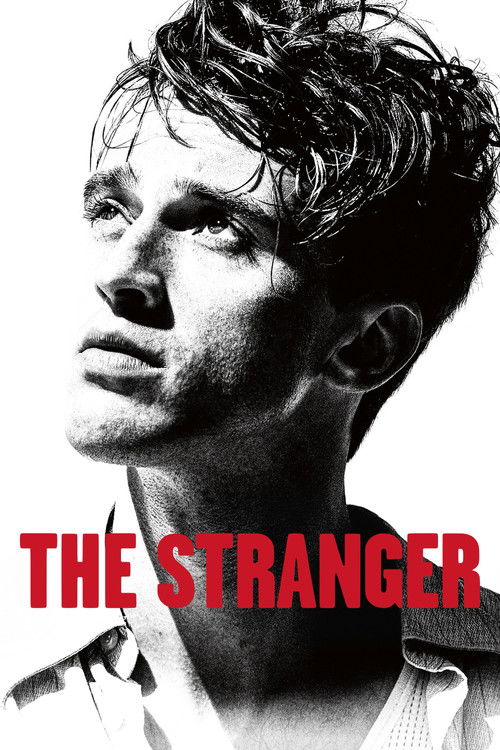
The Stranger
2025 · François Ozon
For a night when you want a film to chew on for days — a slow, severe, beautiful object rather than a comfort watch. Reach for it when detachment itself sounds interesting, not when you need warmth.
What it's about
Algiers, 1938. Meursault, a quiet office worker in his early thirties, buries his mother without shedding a tear, then slips straight back into routine — a casual affair with a colleague, sun, swimming, work. His detachment, harmless enough at first, drifts toward an act of violence on a beach, and the question the film circles is not what he did but why he feels so little about any of it.
The experience
Cool, spare, and quietly hypnotic — the high-contrast black and white gives the Algerian sun a glare you can almost feel, while the film itself stays as unreadable as its hero. It works on you slowly, leaving a philosophical chill that lingers well after it ends.
The craft
Ozon shoots in luminous, high-contrast black and white that turns 1930s Algiers into blazing light and hard shadow, and he holds close to the two-part shape of Camus's novel — a drift, then a reckoning. It's precise, controlled filmmaking that rewards a dark room and full attention.
Why it matters
The first French-language feature adaptation of Camus's novel — only the third screen version ever — and it premiered in competition at Venice 2025 to a rapturous reception, marking one of Ozon's most ambitious literary undertakings.
Snapshot
François Ozon's L'Étranger is the first French-language feature adaptation of Albert Camus's 1942 novel, and only the third screen version of any kind, after Luchino Visconti's Lo straniero (1967) and Zeki Demirkubuz's loose Turkish transposition Yazgı (2001). It premiered in competition at the 82nd Venice International Film Festival on 2 September 2025, where Deadline reported a seven-minute ovation, and opened in France through Gaumont on 29 October 2025. Shot in color and released in high-contrast black and white, it runs roughly two hours and follows the novel's two-part architecture closely: the drift toward a killing on a beach, then a trial that convicts a man less for the killing than for failing to weep at his mother's funeral.
The film's defining departure from Camus is a matter of naming. The murdered man, "the Arab" in the novel, is given a headstone; his sister, the "Moorish woman" of the text, is called Djemila and given a face at the trial. That single structural revision — made in explicit acknowledgment of Kamel Daoud's 2013 counter-novel Meursault, contre-enquête — is what turns a fidelity exercise into an argument.
Industry & production
L'Étranger was produced by Ozon's own company FOZ in partnership with Gaumont, France 2 Cinéma, Macassar Productions and the Belgian outfit Scope Pictures, with Gaumont distributing in France. This is a conventional mid-budget French configuration — auteur-owned production shell, a major distributor fronting the risk, a broadcaster pre-buy, a Belgian co-production partner for the tax structure — and it reflects Ozon's unusual position in the industry: prolific, punctual, and reliably bankable enough to be handed one of the most exposed properties in French letters.
Casting was announced in stages through spring 2025, with Benjamin Voisin confirmed in March and the full ensemble in April. Principal photography began in April 2025, not in Algeria but in Morocco, with Tangier standing in for the Algiers of 1938. The substitution is worth stating plainly: Visconti shot Lo straniero in Algeria itself, and the difference between a film made in the place and a film made in a neighboring stand-in is not only logistical. Morocco's production infrastructure and the practical difficulty of a French period shoot in Algiers made the choice close to inevitable, but it leaves Ozon's colonial Algiers as a reconstruction at one remove.
Commercially the film performed respectably rather than spectacularly for a literary adaptation of this profile: roughly 752,000 admissions in France and around $9 million worldwide. Music Box Films released it in the United States in April 2026, with a United Kingdom release the same month.
Public reporting on the rights negotiation with the Camus estate is thin. The novel remains in copyright, and the estate's historically protective posture is part of why Visconti's version circulated so poorly for decades; but the specifics of Ozon's arrangement have not been detailed in the sources available.
Technology
The single technological decision that organizes the film is also the simplest: Manu Dacosse photographed it in color, and it was delivered in black and white. This is now standard practice for monochrome features — the digital grade offers control over channel weighting that a monochrome negative does not, letting the colorist decide after the fact how a blue sky or a tanned face resolves into gray. Ozon has described chasing hautes lumières, a bright-end exposure strategy that pushes the Mediterranean glare toward blown white rather than protecting highlight detail. The result reads less like a facsimile of 1940s stock and more like a photochemical memory reconstructed by digital means.
The publicly available record does not specify capture format, camera package, or projection aspect ratio, and I will not guess at them.
Technique
Cinematography
Dacosse, a Belgian who made his name on the hyper-stylized giallo pastiches of Hélène Cattet and Bruno Forzani and has since become one of Ozon's closest collaborators, works here against his own reputation for delirium. Critics at Venice converged on the same observation: the compositions are severe and deliberately still, each frame "subtly but strongly composed," with passages that could plausibly pass for 1940s filmmaking. The monochrome is not softly nostalgic. It is contrasty to the point of hostility, and it does specific work on the novel's central physical fact — the sun. Camus makes the light an agent; Meursault kills, as he later says, because of the sun. A color film risks making that beach beautiful. Dacosse's blown whites make it punishing.
The camera generally holds rather than roams. Where the novel's prose withholds interiority through syntax, the photography withholds it through distance: Meursault is frequently observed rather than accompanied, and the film reserves its closest attention for faces other than his.
Editing
Clément Selitzki cuts the film to the novel's asymmetry rather than to conventional dramatic build. Part one is a sequence of discrete, weakly causal episodes — funeral, swim, film, affair, neighbor, beach — and the editing declines to smooth them into momentum. Part two compresses into the machinery of the trial. The most consequential editorial gesture is the one the sources single out: cutting to Djemila in close-up during the courtroom scenes, a shot pattern with no basis in a novel narrated entirely from inside Meursault's head. Each return to her face is a small structural act, inserting a witness the book does not have.
Mise-en-scène / staging
Katia Wyszkop's production design and Pascaline Chavanne's costumes — both longtime Ozon collaborators — build a colonial Algiers of whitewash, shutters, office ledgers and cheap linen. The film is explicit about something the novel leaves ambient: that the French in Algiers are the strangers. Ozon has said the adaptation emphasizes the alien quality of the French population on Algerian soil, and the staging carries that reading, keeping Arab presence in the frame — in streets, in doorways, at the edges of the pieds-noirs' leisure — rather than letting it evaporate as it does in Camus's prose.
Sound
The sound team of Emmanuelle Villard, Julien Roig and Jean-Paul Hurier builds the film largely from environment: sea, cicadas, the scrape of chairs, the flat acoustics of small rooms. Against this, Fatima Al Qadiri's score is a genuine intervention. Al Qadiri — the Senegal-born, Kuwait-raised composer best known to film audiences for Mati Diop's Atlantics — writes in a register that fuses electronics with Arabic instrumentation, and reviewers repeatedly noted that its power comes from restraint: it is used sparingly, and the electronic timbres refuse to date the images to 1938. The choice has a critical edge. The film's only musical voice is one that sounds Maghrebi and contemporary at once, scoring a French story from outside it.
Ozon's handling of the novel's first person is equally pointed. Rather than run Camus's narration under the film, he uses voiceover only twice, reserving it for the murder — the moment where Camus's famously flat prose abandons behavioral report for lyric intensity. The registral break in the book becomes an audible break in the film.
Performance
Ozon directed Benjamin Voisin toward Bresson's idea of the modèle: presence rather than interpretation, being rather than playing. By Ozon's account Voisin found the method difficult, resisting repeated takes on the grounds that multiple versions of a gesture contradicted the nature of a man who has only one. Whatever the friction, the result carried Voisin to the Lumière for Best Actor and a César nomination.
Around him Ozon assembled what is by now a repertory company. Voisin had led Été 85 (2020); Rebecca Marder, here Marie Cardona, came from Mon crime (2023); Pierre Lottin, whose Raymond Sintès won the 2026 César for Best Supporting Actor, had worked with Ozon on Grâce à Dieu (2019) and Quand vient l'automne (2024). Denis Lavant plays Salamano, the old man with the beaten dog — casting that imports two decades of Carax-derived physical strangeness into a small part. Swann Arlaud, also from Grâce à Dieu, plays the priest; having cast him in a film about clerical sexual abuse, Ozon returns him as the chaplain Meursault throws out of his cell. Hajar Bouzaouit plays Djemila, and Mireille Perrier the mother.
Narrative & dramatic mode
The novel's problem for any adaptor is that its meaning lives in its grammar. Sartre's 1943 "Explication de L'Étranger" identified how Camus's use of the passé composé severs one instant from the next, producing a world without causal connective tissue; Barthes later named the style écriture blanche. None of this survives translation into images by default. A camera cannot decline to link shots the way a sentence can decline to link events.
Ozon's answer is to accept the loss of the prose and rebuild the withholding at the level of behavior and structure. He keeps the two-part form: a first half of episodes that refuse to accumulate, a second half in which those same episodes are retrieved by a prosecutor and reassembled, retroactively, into a portrait of a monster. The film's dramatic engine is that reassembly. Nothing new happens at the trial; the audience simply watches a set of facts it has already seen acquire a meaning it knows to be false. The mode is closer to procedural irony than to tragedy, and it culminates where Camus culminates — in the cell, with Meursault refusing the chaplain's consolation, a scene the Camus scholar Debra Kelly has called key to Ozon's own vision of the material.
Genre & cycle
Nominally this is prestige literary adaptation, the film de patrimoine that French cinema produces steadily and exports well. Structurally it is a crime film with the crime in the middle and a courtroom drama in which the trial is a fraud. It belongs to at least three overlapping cycles: the monochrome art-house period film of the last fifteen years (The White Ribbon, Ida, Cold War); the French courtroom film in which a trial adjudicates character rather than act, of which Alice Diop's Saint Omer (2022) is the most rigorous recent example; and the ongoing run of French features reckoning with Algeria, alongside Lucas Belvaux's Des hommes (2020) and Philippe Faucon's Les Harkis (2022).
Authorship & method
Ozon is among the most productive auteurs in Europe, and his method is defined by speed, genre promiscuity, and an unusually stable crew. Across a career that has moved from Fassbinder pastiche to Douglas Sirk melodrama to Chabrolian comedy, the continuity has been in collaborators rather than in style: Wyszkop and Chavanne have designed his worlds for years, Dacosse has shot his recent run, and his casts recur.
He wrote the adaptation alone, and the personal stake is documented rather than inferred. In his director's statement for Venice, Ozon noted that his maternal grandfather was an examining magistrate in Bône — now Annaba — and escaped an attack there in 1956, adding that French families all have some connection with Algeria. The judicial apparatus of the novel's second half is, in other words, his own family's trade.
On the colonial question Ozon has been careful. He has argued that Camus was not a racist but a writer recording a colonial way of seeing, while accepting that an adaptation made now cannot simply reproduce that blindness — hence Djemila, who in the film carries an Arab consciousness the novel does not admit, and hence the closing headstone bearing the name Moussa Hamdani, lifted from Daoud. He has described the monochrome as serving both the beauty of a colonial paradise and the sense of a vanished world. On Al Qadiri's contribution and the specifics of their working process, the public record is limited.
Movement / national cinema
The film sits in the long afterlife of French auteurism — a writer-director with a personal production company, broadcaster financing and festival access — but its most interesting national position is transnational. It is a French film about French Algeria, shot in Morocco, scored by a Gulf-raised composer, photographed by a Belgian, and constructed partly in response to an Algerian novelist writing in French. That configuration is itself a statement about who now holds the story.
Era / period
Three periods are in play: 1938, the setting, fourteen years before the war of independence and well inside the settler order; 1942, the publication, in Occupied France, which conditioned the novel's first reception as a parable of absurdity rather than a document of colonialism; and 2025. The last is not neutral. French memory politics around Algeria have been under active official revision since the Stora report of 2021, the far right is a governing-scale force in French politics, and Kamel Daoud — whose novel supplies Ozon's final image — won the Prix Goncourt in 2024 amid considerable controversy. Ozon has said Meursault's cry still echoes and linked the novel's anti-ideological stance to a resurgent conservative revolution. That is a claim about now, not 1938.
Themes
The absurd, in Camus's technical sense: not meaninglessness as mood but the collision between a human demand for meaning and a universe that does not supply it. Around it the film organizes several more concrete concerns. The tyranny of legible emotion — a society that requires grief to be performed and punishes its absence more severely than homicide. The body as the site of truth, with heat, light, salt water and sex carrying the sincerity that language withholds. Capital punishment, which Camus attacked directly in "Réflexions sur la guillotine" (1957) and which the novel's ending stages as institutionalized absurdity. Refusal of consolation, in the chaplain scene, where Meursault's atheism becomes the only thing he will argue for.
And, added by Ozon, the politics of the name. To call a man "the Arab" for eighty years and then carve "Moussa Hamdani" on his stone is to make erasure visible as erasure — the film's clearest argument, and the one that will determine how it is read.
Reception, canon & influence
Reception was strongly positive without being rapturous. The film holds 89% at Rotten Tomatoes across 35 critics and 84/100 at Metacritic across 17, indicating near-consensus approval. Variety called it a sharply cinematic enigma; The Hollywood Reporter judged it bold and beautiful; dissent tended, as in Damon Wise's Deadline notice, toward finding it a perfectly crafted but laborious stab at the novel's darker material — the charge of tastefulness that almost always attends a faithful adaptation of a canonical text. It won no prize at Venice. Domestic recognition was substantial: Best Film, Best Actor and Best Cinematography at the Lumière Awards in January 2026, and a César for Pierre Lottin in February, with further César nominations for Voisin, Dacosse and Al Qadiri.
Looking backward, the film's lineage runs through Camus first, but also through Bresson, whose modèles Ozon invoked as a direction to his lead and whose method of moral seriousness without psychology is the closest cinematic analogue to écriture blanche; through Visconti's 1967 version, which Ozon's film largely defines itself against — Mastroianni played Meursault with pathos and emotivity, where Voisin plays emptiness, and Visconti's sun-glared color Algeria is answered by Dacosse's monochrome Tangier; and through the postcolonial critical tradition that has reshaped the novel's meaning since Conor Cruise O'Brien's 1970 study and Edward Said's Culture and Imperialism (1993), arriving in the film through Daoud.
Looking forward, honesty requires restraint. The film is one year old. It has settled the question of whether Camus's novel can be filmed in French without either betraying or embalming it, and it has established a template — name the erased, cut to the witness, let the score speak from the other side — that future adaptations of colonial-era canon will find hard to ignore. Whether that becomes a genuine line of influence or remains a well-reviewed single instance cannot yet be determined.
A Deleuzian reading
The beach goes white before anything happens on it.
The full Deleuzian reading of The Stranger →
Reception
Fresh from its Venice 2025 competition premiere, it landed to a respectful but divided reception — admirers called it Ozon's most rigorous film in years, skeptics found it a handsome illustration of an unfilmable book. Too new for a reappraisal arc yet.
How The Stranger was received, from release to now →
Influences: the films it descends from and the films it influenced
- Lo straniero (1967) — The film Ozon builds against point for point: the same two-part novel architecture (Algiers, then assize court) is retained while Mastroianni's emotive, pitiable Meursault is answered by Voisin's drained affect and Visconti's sun-saturated Eastmancolor Algeria by Dacosse's monochrome Tangier.
- Pickpocket (1959) — Supplies the modèle Ozon explicitly named as direction to Voisin — a lead instructed to strip inflection from face and voice so hands, objects and gesture carry the film, with first-person narration that reports acts flatly instead of explaining motive.
- Le Procès de Jeanne d'Arc (1962) — The trial rendered as flat frontal depositions cut on the rhythm of speech rather than of reaction, transcript language delivered without dramatic emphasis — the template for the seed's second-half courtroom, where the cutaway replaces the close-up as the unit of judgment.
- La Bataille d'Alger (1966) — Established that the Algerian crowd be individuated in the frame rather than used as decor and that Casbah geography be staged as lived space — the formal precedent for Ozon's insistence on Arab presence in frame and for naming Moussa Hamdani on the closing headstone.
- Pépé le Moko (1937) — Fixed the whitewash-and-shadow Casbah graphic that French patrimoine cinema still quotes; Ozon's Tangier reconstruction deliberately reproduces that picturesque colonial framing in monochrome in order to expose it as a way of seeing.
- Das weiße Band (2009) — The exact technical and moral procedure of the seed — a period world captured in color and graded to black and white, held at static observational distance, with a sparing retrospective voiceover that narrates a moral catastrophe without ever psychologizing it.
- Frantz (2016) — Ozon's own prior color-shot/monochrome-delivered patrimoine film, and his first use of a two-part asymmetry in which the second movement rereads the first through a national guilt the protagonist refuses to articulate.
- Été 85 (2020) — First pairing of Ozon with both Dacosse and Voisin; the blown coastal highlights and heat-flared skin developed there are carried directly into the Algiers exteriors, and the actor's flat-surfaced screen presence is the one Ozon later empties out.
- Mon crime (2023) — The immediately preceding Ozon–Dacosse courtroom film, staging the tribunal as a performance space where the verdict follows the defendant's manner rather than the evidence — the comic rehearsal of the seed's tragic version of the same mechanism.
- Amer (2009) — Where Dacosse built his signature of light as physical assault — deliberately clipped highlights, sun-struck skin shot in macro, exposure pushed past the sensor's latitude — the grammar he converts to monochrome for the seed's coastal and Casbah scenes.
- Atlantique (2019) — Fatima Al Qadiri's scoring method originates here: keening synthetic tones that voice the dead and the disappeared rather than underscore the living protagonist, the device Ozon imports so the score speaks from the Arab side of a frame the dialogue never gives to Arabs.
- Beau travail (1999) — The French colonial afterlife in the Maghreb filmed as bodies in hard white light at observational distance, narration withheld to a few flat lines, the ex-colonial gaze made legible as composition and blocking rather than stated as theme.
- Saint Omer (2022) — The identical courtroom device: long static frontal takes of testimony intercut with a silent listening woman of African descent whose reaction shots carry the consciousness the tribunal structurally excludes — the precise formal precedent for the Djemila cutaways.
- Anatomie d'une chute (2023) — French assize-court construction in which the defendant is tried for affect rather than act, and the film's first movement is retroactively reassembled by the testimony of its second — the same retrospective-reassembly structure worked on a woman's insufficient grief.
- Le Procès Goldman (2023) — Keeps nearly the entire film inside the courtroom and lets trial transcript supply the dialogue, with the accused's refusal to perform contrition as the sole dramatic engine — the same wager that procedure filmed without embellishment is enough.
- Dahomey (2024) — Restores speech to what the colonial archive silenced by giving a looted object a non-diegetic first-person voice from the other side — the same restitution device as the seed's closing headstone, which returns a name to Camus's unnamed Arab.
- Les Harkis (2022) — Reconstructs late-colonial Algeria in a stripped procedural register — Arabic-speaking actors cast for presence rather than star affect, no score, no crescendo, scenes ended before catharsis — the anti-sentimental discipline the seed's patrimoine surface is measured against.
Similar films
- Summer of 85 (2020) — influence & lineage
- Anatomy of a Fall (2023) — influence & lineage
- Pickpocket (1959) — influence & lineage
- The Man Who Sleeps (1974) — same viewing thread
- Black Girl (1966) — same viewing thread
- Hiroshima Mon Amour (1959) — same viewing thread
- Misericordia (2024) — shared sensibility
- Sirāt (2025) — shared sensibility
All the films related to The Stranger →
Watch it with: curated runs of related films
- The Vanishing Self — A run of 1960s–70s modernist art cinema where identity comes undone — people simply vanish, faces are remade, memory bleeds into hostile landscape — that rewards being watched in a stretch, each film deepening the last's dread.