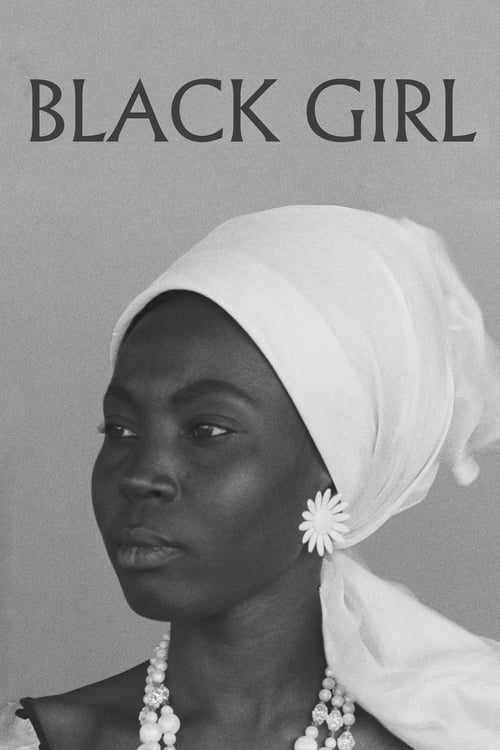
Black Girl
1966 · Ousmane Sembène
For when you want a short film that hits with the force of a long one — something honest and heavy that you'll be arguing with in your head for days. This is a challenge, not a comfort watch, and worth every minute of it.
What it's about
A young Senegalese woman leaves Dakar for the French Riviera, hired by a white French couple and dreaming of the life abroad she's been promised. Instead of France, she gets a cramped apartment she almost never leaves, where the family that once employed her as a nanny now treats her as an all-purpose servant — and, increasingly, as a decoration. The film follows her days inside that shrinking world, her memories of home, and the widening gap between how she's seen and who she is.
The experience
Quiet, stark, and quietly furious — you hear her rich inner voice while the household talks over her, and the disconnect becomes almost unbearable. At barely an hour, it moves with total economy, and it lands like a punch you saw coming and couldn't dodge.
Performances
Mbissine Thérèse Diop is magnetic in near-silence — the film denies her character a voice in the room and she makes you feel everything through posture, stillness, and her eyes.
The craft
Shot in stark black and white with a lean, New Wave-style economy, the film's masterstroke is on the soundtrack: the heroine's interior monologue runs against the chatter of employers who barely register her existence. Sembène restages colonialism at the scale of a kitchen, and every object in the apartment — a mask on the wall, an apron — carries weight. Simple means, devastating precision.
Why it matters
Widely regarded as the first feature by a sub-Saharan African director to reach international audiences, it announced Ousmane Sembène — the so-called father of African cinema — and opened the door for a continent's filmmakers.
Ousmane Sembène — dockworker, novelist, then filmmaker in his forties — made what is widely held to be the first feature by a sub-Saharan African director to reach international audiences, and it remains one of the most devastating hours in cinema. A young Senegalese woman leaves Dakar for the French Riviera, imagining a life abroad; what she finds is a shrinking apartment and employers who see her as furniture. Shot in stark black and white with a French New Wave economy, the film gives Diouana (Mbissine Thérèse Diop, magnetic in near-silence) a rich interior voice on the soundtrack while the white household talks over and around her — colonialism restaged at the scale of a kitchen. Sembène, often called the father of African cinema, spent the next four decades building a body of work of unmatched moral clarity, but the essentials are already here, condensed into a single recurring object: a carved African mask, passed from hand to hand, whose changing ownership tells the whole history the characters cannot say aloud.
A Deleuzian reading
A carved mask hangs on a white wall in an apartment on the French Riviera, above the furniture, where the family who lives there can look at it every day without seeing it.
The full Deleuzian reading of Black Girl →
Reception
A small, hour-long debut that won the Prix Jean Vigo in 1966 but circulated mostly in cinephile and academic circles for decades — until Scorsese's World Cinema Project restoration and a Criterion release pushed it firmly into the global canon, capped by a spot in the Sight & Sound top 100 in 2022.
How Black Girl was received, from release to now →
Influences: the films it descends from and the films it influenced
- Bicycle Thieves (1948) — Sembène builds Diouana from the neorealist toolkit — a non-professional lead, real locations, and a plot pared to one marginal worker's economic humiliation observed without melodrama.
- Les statues meurent aussi (1953) — Its essay on African masks dying once wrenched into European collections prefigures Black Girl's central object — the gifted mask Diouana reclaims from her employers' wall as a colonized artifact refusing appropriation.
- Diary of a Country Priest (1951) — The film's interior monologue over a near-silent, affect-suppressed protagonist descends directly from Bresson's diary-voiceover method, where withheld speech and a flat performance force the drama inward.
- Moi, un Noir (1958) — Rouch's technique of post-dubbing a displaced African subject's first-person voiceover onto silent footage is the exact formal device Sembène adopts — then turns against Rouch's ethnographic gaze by giving Diouana her own inner narration.
- The 400 Blows (1959) — Sembène's 'New Wave economy' — lightweight cameras, available light, a slim runtime built from a single figure's confinement — is lifted from the low-budget location shooting that launched the Nouvelle Vague.
- Cléo from 5 to 7 (1962) — Varda's model of a woman moving through the city while her subjective interior voice contradicts her composed surface is the template for Diouana's split between silent servitude and volcanic inner monologue.
- Borom Sarret (1963) — Sembène's own first short already fused Dakar street locations with a poor protagonist's continuous interior voiceover carrying the film's social critique — the method he expands to feature length here.
- Umberto D. (1952) — Its patient dignifying of a discarded servant-class figure through small domestic routine, staged in cramped interiors, anticipates Sembène's refusal to let Diouana be mere pathos.
- Touki Bouki (1973) — Mambéty extends the Dakar-to-France axis of longing, but where Diouana crosses to the Riviera and finds servitude, his lovers only dream the crossing — a direct Senegalese rejoinder to Black Girl's migration disillusion.
- Sambizanga (1972) — Maldoror carries forward the near-silent African woman as center of gravity, her withheld interiority made political, within the same austere Francophone-African social-realist register Sembène founded.
- Moolaadé (2004) — Sembène's late film keeps his signature method — a woman's quiet resistance framed in domestic-compound interiors, social critique delivered through staging rather than speech — proving the craft line runs the length of his career.
- Roma (2018) — Cuarón's black-and-white portrait of a near-mute domestic servant, whose inner life is rendered through observation of household labor rather than dialogue, restages Black Girl's central problem of the servant seen but unheard.
- Atlantics (2019) — Diop returns to Sembène's Dakar-to-Europe crossing and the woman left behind, using voiceover-adjacent interior register and the sea as the migration threshold Diouana once traversed toward ruin.
- Camp de Thiaroye (1988) — Pioneered his interiorized study of assimilation and the psychology of the colonized subject, the alienation-of-the-Frenchified-servant that returns as Sergeant Diatta and the mute, damaged Pays.
- Hyenas (1992) — The founding African-cinema moral fable, distilling neocolonial exploitation into a single allegorical figure and an unadorned parable structure that Mambéty inherits and then inflates to carnivalesque scale.
- Emitaï (1973) — Its terse, frontal framing of a single exploited African body as a political emblem develops the didactic mise-en-scène Emitaï scales up to a whole village.
- White Mangrove (2020) — Establishes the template of a Black domestic worker's invisible labor rendered under a leisure-class/tourist gaze, with interior voiceover set against an alien coastal-resort geography.
- Daughters of the Dust (1991) — Foundational Third Cinema text using interior monologue voiceover to restore subjectivity to a diasporic Black woman, a narrational strategy Dash extends into her choral, unborn-child narration.
- Lingui, the Sacred Bonds (2021) — Founds the Francophone-African committed-realist mode Haroun inherits — an unadorned observational camera trained on a single woman's constrained agency as an index of social structure.
- Sugar Cane Alley (1983) — Models the anti-rhetorical showing of colonial structure — no speeches, the hierarchy legible purely from who occupies which room and who is permitted to speak French — and pioneers the split between spoken French on the soundtrack and an interior vernacular consciousness that Palcy rebuilds as Creole/French diglossia.
- Xala (1975) — Sembène again organizes a social-realist satire around a single loaded object (the curse/impotence) mirroring the mask, using it as a recurring motif that indicts the postcolonial bourgeoisie.
- Jeanne Dielman (1975) — Akerman's structural staging of a woman's domestic labor in fixed, unhurried interior shots — routine as prison, silence as pressure — parallels Sembène's use of the confining apartment to entomb Diouana.
Similar films
- Moolaadé (2004) — influence & lineage
- Touki Bouki (1973) — influence & lineage
- The 400 Blows (1959) — influence & lineage
- The Stranger (2025) — same viewing thread
- Hyenas (1992) — often watched together
- Camp de Thiaroye (1988) — shared sensibility
- Emitaï (1973) — shared sensibility
- Chocolat (1988) — shared sensibility
All the films related to Black Girl →
Watch it with: curated runs of related films
- The Vanishing Self — A run of 1960s–70s modernist art cinema where identity comes undone — people simply vanish, faces are remade, memory bleeds into hostile landscape — that rewards being watched in a stretch, each film deepening the last's dread.