Touki Bouki
1973 · Djibril Diop Mambéty
For when you want to be jolted awake by something genuinely unlike anything else — an adventurous night, not a comfort watch. Best when you're open to a film that plays by its own rules.
What it's about
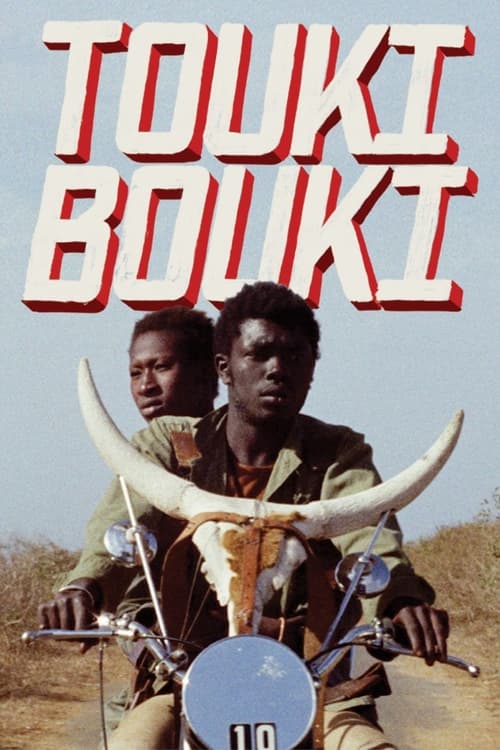
In Dakar a decade after independence, Mory — a cowherd who rides a motorcycle crowned with a zebu's horned skull — and Anta, a university student, dream of escaping to Paris. The film follows their schemes and hustles to raise the boat fare, but it tells the story sideways: as a swirling collage of fantasy, memory, ritual, and street life, with Josephine Baker's 'Paris, Paris, Paris' looping like a siren song.
The experience
Wild, funny, jagged, and hypnotic — it jump-cuts between gritty reality and gorgeous daydream until you stop asking which is which. It asks you to ride along rather than follow a plot, and it rewards you with images and juxtapositions you won't shake.
The craft
Mambéty shoots Dakar in blazing color and cuts with anarchic freedom — sound and image split apart, fantasies erupt mid-scene, a recurring song becomes the whole theme of longing made audible. Made young and cheap, it feels more daring than most films with a hundred times the money.
Why it matters
A foundational work of African cinema and its great modernist landmark — proof the continent's filmmaking could be formally radical, not just realist — and a touchstone restored and championed worldwide, its motorcycle-and-horns image now iconic.
Snapshot
Touki Bouki — "The Journey of the Hyena" in Wolof — is the debut feature of the Senegalese filmmaker, actor, and poet Djibril Diop Mambéty, and one of the foundational works of African art cinema. Its ostensible story is simple to the point of fable: Mory, a herdsman who rides a motorcycle mounted with a zebu's horned skull, and Anta, a university student, scheme to raise the money that will carry them from Dakar to Paris, the imagined paradise of their longing. What Mambéty builds on this armature is anything but simple. Shot in and around Dakar barely a decade after Senegalese independence, the film fractures its narrative into a collage of desire, memory, ritual slaughter, colonial hangover, and pop fantasy, set to the recurring strains of Josephine Baker singing "Paris, Paris, Paris." It stands as the great modernist, avant-garde counterweight to the social realism that dominated early African filmmaking, and it has grown over half a century into a canonical text — restored under Martin Scorsese's aegis and regularly cited among the greatest films the continent has produced.
Industry & production
Touki Bouki emerged from the first generation of independent Senegalese cinema, a milieu shaped overwhelmingly by Ousmane Sembène, whose Borom Sarret (1963) and Black Girl (1966) had established that a distinctly African cinema could exist. That cinema was built on scarcity. There was no domestic studio infrastructure, no established distribution network across the newly independent states, and financing depended heavily on a mixture of state support, French cooperation-era funding, and personal resourcefulness. Mambéty, a self-taught director who had been expelled from a Dakar theater troupe and never attended film school, made the film outside the conventional funding routes; the production was famously threadbare, assembled with borrowed means and non-professional performers. The precise budget is not reliably documented, and I will not invent a figure, but every account of the film's making stresses its poverty of means and the corresponding audacity of its ambition.
The film was completed in 1973 and reached the international festival circuit that year, where it drew immediate attention from critics even as it puzzled audiences accustomed to more legible narratives. The historical record consistently reports that it won the International Critics' Award at the Cannes Film Festival in 1973 and a prize at the Moscow International Film Festival; readers should treat the finer details of these citations with the caution any decades-old festival record deserves. Commercially the film was marginal in its own moment — its reputation is almost entirely a matter of critical and scholarly reassessment rather than box office, and no trustworthy commercial figures survive to cite.
Technology
Touki Bouki was shot on 35mm color film, and color is central to its effect: the reds of the slaughterhouse, the ochres of the Dakar landscape, and the blues of the sea are deployed with a painter's deliberation rather than as neutral recording. The production worked with modest, portable equipment consistent with low-budget location shooting of the early 1970s, favouring available light and real environments over built sets. The technology of the film is inseparable from its economics: the lightweight, run-and-gun apparatus that had been liberated by the French New Wave a decade earlier made possible exactly the kind of location-driven, improvisatory filmmaking Mambéty practiced.
The film's later life is itself a technological story. In 2008 it was restored by the World Cinema Foundation — the preservation initiative founded by Martin Scorsese, now the Film Foundation's World Cinema Project — with laboratory work carried out at Cineteca di Bologna's L'Immagine Ritrovata. That restoration returned the film's color and sound to something approaching their intended state and was instrumental in the film's contemporary rediscovery, bringing a once hard-to-see title into circulation on restored prints and home video.
Technique
Cinematography
The photography, credited to Georges Bracher, is one of the film's glories. It moves between two registers that the film keeps in productive tension: a documentary attention to Dakar's streets, markets, cliffs, and shoreline, and a stylized, almost surreal pictorialism in which images are held for their symbolic charge rather than their narrative function. Compositions repeatedly isolate figures against the horizon — Mory's horned motorcycle silhouetted on a headland above the ocean — turning the frame into an emblem. The camera is unafraid of the arresting graphic image: the sea as a screen for fantasy, the animal skull as totem, the crowds and traffic of the city rendered as a churning, indifferent field through which the lovers move.
Editing
Editing is where Touki Bouki announces itself as a modernist work. Mambéty rejects continuity in favour of collision and association, cutting across time so that memory, premonition, and present action interpenetrate without signposting. The film's most notorious device is its interlacing of ritual cattle slaughter with human action — throats cut, blood running — so that violence, death, and appetite bleed into the story of two young people's flight. Fantasy sequences (the lovers imagined returning to Dakar in triumph, showered with acclaim) are cut against squalid reality, and the promised departure is undercut by repetition and delay. The result is a rhythm closer to poetry or dream than to plot, in which the film's meaning accumulates through juxtaposition. The specific editing credit is not something I can attribute with confidence from the available record, so I will not guess at it.
Mise-en-scène / staging
Mambéty stages his film in the real textures of postcolonial Dakar and its margins — the herders' grounds, the university, the well-off villa the lovers rob, the port. The single most concentrated object in the mise-en-scène is the motorcycle crowned with a zebu's horns, a fusion of pastoral tradition and modern machine that condenses the film's entire thematic argument into one prop. Costume carries similar weight: the lovers' shifting dress marks their oscillation between local identity and imagined European sophistication, and the recurring imagery of cattle and slaughter grounds the film in an agrarian, sacrificial order that the characters are trying to escape. Staging is frequently frontal and emblematic, presenting tableaux to be read rather than merely inhabited.
Sound
The soundtrack is as disjunctive and expressive as the cutting. Its signature is the repeated use of Josephine Baker's "Paris, Paris, Paris," whose ironic sweetness turns the lovers' dream of France into something both seductive and hollow — the colonial fantasy voiced by an African-American icon who herself became a Parisian idol. Against and around this the film sets Wolof speech, ambient city noise, animal sounds, and passages of local music, so that sound is layered rather than synchronized, often deliberately at odds with the image. The soundtrack also draws on the presence of Aminata Fall, the singer and performer who appears in the film; the finer details of the music credits are not something I can source precisely, and I will not fabricate a composer attribution.
Performance
The film is carried by non-professional actors, chiefly Magaye Niang as Mory and Mareme Niang as Anta, whose unforced, sometimes opaque presences suit a film more interested in emblem than psychology. Their performances are physical and reactive rather than declarative; the film asks them to embody restlessness and desire more than to articulate them. Aminata Fall, as the aunt, brings a vivid, earthy theatricality that contrasts with the leads' cool. Mambéty draws from all of them a quality of the real that anchors the film's flights of stylization.
Narrative & dramatic mode
Touki Bouki's dramatic mode is anti-realist and elliptical. Its plot — acquire money, escape to Paris — is a picaresque thread on which Mambéty hangs a series of set pieces, fantasies, and ritual interludes. The film withholds conventional causality and psychological interiority; motives are gestured at rather than explained, and time is treated as malleable. It is best understood as a lyric or essayistic narrative, closer to a poem or a piece of music than to a well-made story, in which recurrence (the sea, the slaughter, the song, the promise of departure) does the work that plot mechanics do elsewhere. The famous ending — in which the passage to France is finally within reach and cannot be taken, the dream refusing to consummate — is less a plot resolution than a thematic verdict on the whole fantasy of flight.
Genre & cycle
Nominally a drama and romance, the film resists genre as it resists narrative convention. It can be read as a road movie (two lovers, a journey, a vehicle), as a heist-tinged picaresque, and as a coming-of-age tale of thwarted departure, but each of these frames is deliberately undercut. More usefully, it belongs to a cycle of postcolonial African cinema preoccupied with the pull between Africa and Europe, tradition and modernity, staying and leaving — a body of work in which the sea and the emigrant's dream recur as central images. Within that cycle Mambéty occupies the experimental, poetic wing, distinct from the didactic realism that was the dominant mode.
Authorship & method
Touki Bouki is a profoundly authored film. Djibril Diop Mambéty (1945–1998) came to cinema from the theater, without formal training, and brought to it a poet's sensibility and a jester's appetite for provocation. His method was intuitive, associative, and image-driven; he distrusted the pedagogical mission that others assigned to African cinema and pursued instead a personal, allusive, sometimes hermetic style. He described his own vantage in terms of marginality and the figure of the outsider, and his films return obsessively to those on the edges of a society. Touki Bouki was his first feature; he would not complete another until Hyenas (1992), a loose companion piece adapted from Dürrenmatt, and he left a further body of shorter work at his early death.
His key collaborator behind the camera was cinematographer Georges Bracher, whose photography realizes the film's dual documentary-and-dream aesthetic. The film's musical identity rests on the borrowed voice of Josephine Baker and the on-screen presence of Aminata Fall, though I cannot responsibly attribute a formal score or name the editor from the reliable record. Where technical credits are genuinely thin, that thinness should be acknowledged rather than papered over with invention.
Movement / national cinema
The film is a cornerstone of Senegalese cinema, which in the 1960s and 1970s was the most vital national cinema in sub-Saharan Africa. That movement is inseparable from Ousmane Sembène, whose Marxist-humanist realism set the terms of the debate about what African film should do. Mambéty's Touki Bouki is the great alternative answer: where Sembène pursued clarity, legibility, and political instruction, Mambéty pursued ambiguity, poetry, and formal risk. Read alongside contemporaneous currents — the legacy of the French New Wave, the emerging pan-African film culture institutionalized at FESPACO in Ouagadougou — the film represents African cinema claiming the right to modernist experiment, not merely social witness. It is routinely positioned as one of the two poles, with Sembène's work, between which early Francophone African cinema is understood.
Era / period
The film is a document of a specific historical moment: Senegal roughly a dozen years after independence in 1960, under the presidency of Léopold Sédar Senghor, when the euphoria of liberation had curdled into disappointment for many young people who found the promised transformation unrealised. The desire to emigrate to the former colonial metropole — to Paris specifically — is the period's great structuring fantasy and the film's central subject. Touki Bouki captures the disillusionment of a generation caught between an agrarian past it is shedding and a European future that is at once alluring and false, making it one of cinema's sharpest portraits of the postcolonial 1970s in West Africa.
Themes
The film's governing theme is the dream of departure and its impossibility — the seductive, corrupting fantasy of Europe as escape and fulfillment, exposed as a colonial mirage even as its pull is honestly felt. Around this cluster several others: the tension between tradition and modernity, fused in the horned motorcycle; the persistence of ritual, sacrifice, and death, made literal in the recurring slaughterhouse imagery; the disillusionment of postcolonial youth and the failure of independence to deliver its promise; and the ambivalence of belonging, dramatized in Mory's final inability to leave. The film neither condemns nor endorses its lovers' longing; it holds the fantasy up to the light and lets its beauty and its emptiness coexist.
Reception, canon & influence
Critically, Touki Bouki was recognized early by international critics — the festival prizes of 1973 attest to that — even as its difficulty limited its wider circulation. Its true canonization came later, accelerating dramatically after the 2008 World Cinema Foundation restoration made the film properly visible again. In the years since, it has been widely regarded as one of the greatest African films ever made: it has featured in polls of African critics naming the finest films of the continent, and it appeared in the Sight & Sound critics' balloting that periodically surveys the international canon. (I'd flag that the exact placements in such polls shift from edition to edition, and specific rankings should be checked against the source rather than taken from memory.)
Looking backward, the influences on the film are legible and openly worn: the montage-driven modernism of the European art cinema, and above all the French New Wave — Jean-Luc Godard's jump cuts, essayistic digressions, and pop-culture collage are frequent and apt reference points — refracted through a specifically Senegalese and postcolonial sensibility. The dialogue Mambéty conducts with Sembène's realism is equally formative, defined as much by rejection as by inheritance.
Looking forward, the film's legacy is substantial and still unfolding. It licensed a poetic, non-realist strain within African filmmaking and became a touchstone for later directors interested in migration, the sea, and postcolonial longing. Its most direct heir is arguably Mati Diop — Mambéty's niece, who acted in her own right before directing Atlantics (2019), a film whose preoccupation with departure across the ocean and with those left behind reads as an explicit conversation with her uncle's masterpiece. Contemporary filmmakers outside Africa have named it an influence as well, and it is now a fixture of world-cinema syllabi and repertory programming. More than fifty years on, Touki Bouki endures less as a historical artifact than as a living work — its horned motorcycle and its ironic refrain of "Paris, Paris, Paris" among the indelible images and sounds of modern cinema.
A Deleuzian reading
Start with the motorcycle.
The full Deleuzian reading of Touki Bouki →
Reception
Feted at Cannes' Directors' Fortnight in 1973 but barely distributed for decades, it survived mostly as a rumor among cinephiles — until Scorsese's World Cinema Project restored it in 2008 and it climbed into the Sight & Sound top 100, now routinely called the crown jewel of African cinema.
How Touki Bouki was received, from release to now →
How to watch Touki Bouki: what to notice on a first viewing
- Watch the horned motorcycle held still against the sky. Mambéty repeatedly poses the zebu-skull-mounted bike in silhouette on a headland above the ocean, presenting it to be looked at rather than letting it do anything within the scene. The bike stops being a vehicle and becomes an image you are meant to read.
- Watch for cattle slaughter cut straight into the love story. The film interlaces ritual cattle slaughter, throats cut, blood running, directly with scenes of the two lovers, with no narrative bridge explaining why the two belong together. Death and appetite get welded straight onto the story of two people trying to escape.
- Listen for the same French song returning again and again. Josephine Baker's 'Paris, Paris, Paris' recurs throughout as the couple's musical leitmotif, its sweetness running against the Wolof speech and city noise it never quite matches. The song and the picture on screen are telling two different stories at the same time.
- Watch a triumphant homecoming get cut against dusty reality. Fantasy sequences show the lovers imagined returning to Dakar in triumph, showered with acclaim, spliced directly against the poorer, dustier world they actually inhabit. The film never marks which version is the wish and which is simply what happened.
The whole guide to watching Touki Bouki, with the keys for a rewatch →
Influences: the films it descends from and the films it influenced
- Un Chien Andalou (1929) — Its Surrealist shock-cutting — the razor across the eye, dream logic yoked by graphic matches rather than causality — is the template for Mambéty's associative editing and his cross-cut slaughterhouse imagery.
- Strike (1925) — Eisenstein's intellectual montage intercutting cattle being butchered with human massacre is the direct precedent for Touki Bouki's graphic-match cuts between the abattoir and the human world.
- Breathless (1960) — Its jump cuts, ironic pop-culture collage, and refusal of continuity editing supply the New Wave grammar Mambéty adopts, refracted through a Dakar-specific sensibility.
- Week End (1967) — The savage road-movie-as-social-autopsy structure, ironic source-music stings, and essayistic digression prefigure Touki Bouki's postcolonial road movie and its 'Paris, Paris' refrain.
- Hiroshima mon amour (1959) — Resnais's elliptical montage that fuses documentary texture with subjective fantasy, cutting on association across time, models Touki Bouki's documentary-surreal tension and dream inserts.
- Black Girl (1966) — The Senegalese realist emigration drama — the dream of departure to France and its disillusion — is the model Mambéty both inherits and pointedly rejects by replacing realism with poetic ellipsis.
- Borom Sarret (1963) — The founding Senegalese short's use of Dakar streets and non-professional performers as documentary raw material establishes the location-and-casting practice Touki Bouki reworks.
- Meshes of the Afternoon (1943) — Deren's trance-film construction, where repeated objects and impossible spatial cuts externalize a character's interior desire, anticipates Touki Bouki's fantasy sequences of triumphant return.
- Hyenas (1992) — Mambéty's own companion feature reprises the ironic staging, emblematic horizon compositions, and tradition-versus-modernity satire, again built from allegorical props and asynchronous sound.
- Yeelen (1987) — Cissé's mythic, non-didactic African art cinema extends the license Touki Bouki granted for a poetic, image-driven mode over the pedagogical realism then dominant.
- Daughters of the Dust (1991) — Its non-linear, elliptical diasporic montage and emblematic seaside horizon framing carry Mambéty's associative editing and dream-of-departure imagery into the Black Atlantic.
- Beau Travail (1999) — Denis's elliptical, choreographic postcolonial montage in Djibouti — meaning built from bodies, landscape and ironic source music rather than plot — descends from Mambéty's rhythmic, gapped construction.
- Karmen Geï (2001) — This Senegalese musical reworks Touki Bouki's ironic-source-music strategy, scoring Dakar transgression against borrowed and diegetic performance in the same subversive spirit.
- Aujourd'hui (Tey) (2012) — Gomis's dreamlike single-day wander through Dakar, suspended between documentary observation and surreal reverie, extends Touki Bouki's documentary-surreal tension and elliptical drift.
- Mille soleils (2013) — Diop literally revisits Touki Bouki's lead actor Magaye Niang, folding the original's footage and its dream-of-departure into a documentary-fiction essay on what became of the film's promise.
- Atlantics (2019) — Mambéty's niece answers his film directly: the same longing for departure across the ocean, the ones left behind, and emblematic horizon-and-sea compositions, now inflected with the supernatural.
- The Little Girl Who Sold the Sun (1999) — Mambéty's own foundational grammar — elliptical jump-cutting, sun-blasted saturated color, and Dakar's hustle-economy filmed as sensory montage — is the visual language he strips to fable simplicity here.
- I Am Not a Witch (2017) — Pioneered the elliptical, surrealist-collage editing and ironic distance in Senegalese cinema that license Nyoni's non-realist gestures like the tethering ribbons.
- On Becoming a Guinea Fowl (2024) — African surrealist juxtaposition and a recurring animal motif (the slaughtered zebu) threaded through the edit as symbolic refrain — the montage logic behind Nyoni's guinea-fowl interpolations.
- Mandabi (1968) — A contemporaneous Wolof-language Dakar portrait whose bureaucratic-money plot and non-professional cast form the realist pole against which Touki Bouki defines its poetic difference.
- Emitaï (1973) — The same-year Senegalese counterpart — where Sembène builds sober wide tableaux, Mambéty fragments them, but both forge a national cinema from indigenous performers and settings.
- West Indies: The Fugitive Slaves of Liberty (1979) — A parallel African avant-garde that shatters colonial narrative convention through disjunctive montage and anti-realist form, sibling in the project of decolonizing film language itself.
- This Is Not a Burial, It's a Resurrection (2020) — The seed inherits Mambéty's collision of griot oral-tale rhythm with saturated, near-surreal African color, staging myth and departure as image rather than plot.
- Soleil O (1973) — Arrives independently at the same desynchronised-sound grammar — slaughterhouse and ocean audio laid across images that do not contain them, emigration fantasy assembled by elliptical collision cuts — applied to departure where Hondo filmed arrival.
Similar films
- Hyenas (1992) — influence & lineage
- Black Girl (1966) — influence & lineage
- Yeelen (1987) — influence & lineage
- Breathless (1960) — influence & lineage
- Weekend (1967) — influence & lineage
- Un Chien Andalou (1929) — influence & lineage
- Soleil O (1973) — shared sensibility
- Camp de Thiaroye (1988) — shared sensibility