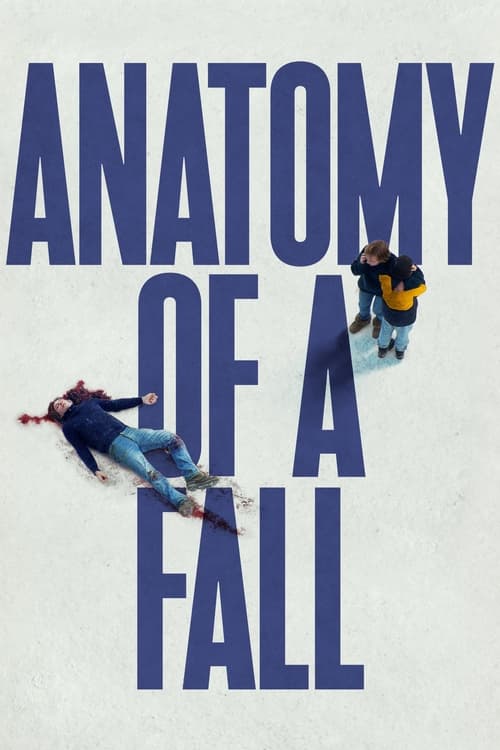
Anatomy of a Fall
2023 · Justine Triet
Anatomy of a Fall won the Palme, the screenplay Oscar, and the internet (Messi the dog, the 50 Cent cover, "did she do it" forever) — and her Cannes speech attacking the French government made her a political flashpoint at home.
For when you want a film to chew on for days and argue about over dinner — a smart, adult thriller that treats you like a juror. Choose it when you're up for concentration, not comfort.
What it's about
A successful novelist is put on trial for the death of her husband, found in the snow beneath their remote chalet in the French Alps — a fall that could be accident, suicide, or murder. The only person who might know something is their eleven-year-old son, who is partially blind, and who must decide what he believes about his own parents. The courtroom becomes an autopsy of the marriage itself.
The experience
Gripping in a talky, forensic way — two and a half hours that fly by on the tension of testimony, cross-examination, and one devastating argument replayed in the courtroom. It doesn't hand you certainty, and the ambiguity follows you out of the room.
Performances
Sandra Hüller is extraordinary — controlled, prickly, opaque and sympathetic at once, often acting in her character's second and third languages — and young Milo Machado Graner is quietly shattering as the son caught between loyalty and truth.
The craft
The screenplay is the star: courtroom scenes written with novelistic precision, where the shifting between French and English becomes its own power struggle within the marriage. Triet directs with cool restraint, letting long unbroken confrontations play out, and a blaring instrumental cover of a rap song becomes an unlikely, unforgettable piece of evidence.
Why it matters
Winner of the Palme d'Or at Cannes 2023 and an Oscar for its screenplay, it became a genuine international crossover hit and cemented Justine Triet among the leading European directors of her generation.
Snapshot
Anatomy of a Fall (Anatomie d'une chute) is a 152-minute French-language courtroom thriller set in the French Alps, in which Sandra Voyter (Sandra Hüller), a German novelist, is tried for the murder of her French husband, Samuel Maleski (Samuel Theis), who is found dead in the snow beneath the balcony of their remote chalet. The sole potential witness is the couple's partially-sighted eleven-year-old son, Daniel (Milo Machado Graner), who must decide what he believes — and what he will testify — about a death that may have been accident, suicide, or homicide. The film unfolds as both a scrupulous legal procedural and an excavation of a marriage's interior life, refusing at every turn to deliver the verdict its genre architecture promises. It won the Palme d'Or at the 2023 Cannes Film Festival; Sandra Hüller's performance anchored one of the decade's most discussed European releases, and the film won the Academy Award for Best Original Screenplay at the 96th ceremony (2024), becoming one of the few French-language productions to receive that recognition.
Industry & production
The film was produced by Les Films Pelléas and co-financed with Arte France Cinéma, the publicly supported broadcaster that has backed much of contemporary French auteur cinema — Desplechin, Dumont, Mati Diop — providing the kind of institutional shelter that allows long, formally uncompromising films to reach production without commercial reconfiguration. Producers Marie-Ange Luciani and David Thion had worked with Triet on her earlier features, representing a continuity of trust that enabled the film's deliberate pacing and refusal of genre resolution.
The film was shot in the Chartreuse massif near Grenoble. The chalet at the center of the story is a real structure in a genuinely remote location, which Triet has cited as essential to the film's atmosphere of claustrophobic isolation: the mountain setting functions architecturally rather than pictorially, as a place where no help is near and no witness is neutral. Interior courtroom sequences were staged on purpose-built sets in Paris, constructed with attention to the specific spatial grammar of French criminal procedure.
The casting of Sandra Hüller — already an arthouse fixture following Maren Ade's Toni Erdmann (2016) — was a structural decision as much as a creative one. Her nationality embeds in the film's premise the problem of translation, both linguistic and legal: Sandra must negotiate French juridical culture in a second or third language, a disadvantage the prosecution's advocate is not above exploiting. Samuel Theis, who plays the husband, is a director and actor primarily known within French independent cinema. Milo Machado Graner, cast as Daniel, was a non-professional child actor. The dog Snoop, played by a Border Collie named Messi, became an unlikely public figure during the film's awards campaign, appearing at ceremonial events alongside the principal cast — a piece of press-circuit theater that Triet handled with evident amusement.
Technology
The film was shot digitally; detailed documentation of specific camera systems has not been prominently entered into the production record at the time of writing. The sound design, by contrast, was a documented priority. The critical piece of audio evidence at the center of the trial — a recording Samuel made of a bitter domestic argument — required both convincing diegetic texture and sufficient legibility to sustain an extended playback sequence during which the film's entire dramatic weight balances on what the recording might mean. The use of portable digital voice-memo technology as courtroom evidence is integrated into the film's broader interest in the evidentiary status of recorded reality: the question of what a recording proves, and who gets to interpret it, is not incidental but constitutive.
Technique
Cinematography
Simon Beaufils, who shot Triet's Sibyl (2019), works in a register held in suspension between the composed long take and the mobile close-up. The mountain setting is established with economy rather than spectacle: the chalet's isolation is architectural and emotional, not scenic. There is no lingering on the landscape for its own sake. Beaufils's camera frequently operates at a middle distance that refuses the optical-point-of-view conventions of thriller cinematography; we do not see through any single character's eyes with reassuring consistency, and the camera's relative neutrality is itself a formal enactment of the film's epistemological position — nobody's perspective is privileged.
The early scene in which Sandra's interview with a female student is suddenly drowned by the deafening sound of 50 Cent's "P.I.M.P." blaring from the floor above — Samuel's apparent act of domestic sabotage — is shot with a documentary-like attention to the social awkwardness of the moment. The camera registers embarrassment rather than menace. This tonal calibration, in which neither thriller grammar nor domestic-drama grammar fully takes hold, is consistent throughout the film and is substantially achieved at the cinematographic level.
Editing
Laurent Sénéchal's editing is structured around accumulation rather than revelation. The courtroom sequences, which constitute the film's largest and most extended environment, resist the rhythmic cutting of the conventional legal thriller. Testimony is allowed to land and sit; questions echo without immediate editorial punctuation. Witnesses are held in close-up after they stop speaking, so the viewer continues to watch a face process what it has just said.
The extended playback of the recorded argument is the editing sequence the film turns on. We hear a version of the couple's marriage that is simultaneously raw documentation and potentially selective or staged; the edit refuses to tell us how to receive it. Reaction shots are deployed sparingly — the film does not use the jury as a surrogate for the audience's emotional direction. The 152-minute running time is a deliberate formal statement: the film will not be cut to reassurance.
Mise-en-scène / staging
The chalet is a key staging choice: a narrow, multi-storey structure in which floors correspond to psychological registers — public interview and private creative labor, marital life and individual interiority. The courtroom is rendered with unusual fidelity to the procedural texture of French criminal proceedings, including the role of the presiding judge as an active interrogator rather than a neutral arbiter. (French procédure accusatoire has, since reforms of the late twentieth century, moved closer to adversarial procedure, but the juge retains a more active role than a common-law judge, and the film captures this with evident research behind it.) Triet stages testimony scenes so that lawyers, judge, and witnesses occupy the same visual plane as often as possible, a staging choice that distributes institutional authority across the frame rather than concentrating it in a single interlocutor.
Daniel's near-blindness — he navigates with a cane and guide dog — produces a recurring staging question about what he can perceive and thus what his testimony can mean. The film is careful never to use his disability as melodrama. His presence in court scenes anchors a philosophical point: here is the witness who must testify most precisely about what he did not, could not, see.
Sound
Sound is the film's most conceptually charged technical register. The argument recording — roughly four minutes of bitter, exhausted marital combat, played back on courtroom speakers with no accompanying image beyond the listening faces of lawyers, jury, and public — is the film's dramatic and philosophical pivot. The prosecution presents it as evidence of Sandra's controlling violence; the defense reads the same audio as evidence of Samuel's psychological fragility and suicidal ideation. The audience, positioned identically to the jury, cannot settle the question either.
The use of 50 Cent's "P.I.M.P." as diegetic sound is a bravura choice: hip-hop's swaggering ironism colliding with bourgeois intellectual domesticity, the music functioning as the bluntest possible instrument of marital warfare. The score, where present, is deployed sparingly; silence and ambient texture — wind, snow, the acoustics of institutional spaces — carry much of the atmospheric weight between the sequences of verbal combat.
Performance
Sandra Hüller's performance is the film's central achievement. In 2023 she appeared in two of the year's most discussed films — Anatomy of a Fall and Jonathan Glazer's The Zone of Interest — a coincidence of major work from a single actor within one calendar year that has few recent precedents in arthouse cinema. Hüller performs Sandra in at least three registers simultaneously: the German intellectual adapting to French juridical culture at a structural disadvantage, the wife defending a version of her marriage that may or may not correspond to what actually occurred, and the woman who may or may not be guilty. She rarely signals which of these she is performing at a given moment. The performance's power is precisely its refusal to cue sympathy or guilt.
Milo Machado Graner's work as Daniel is remarkable for its restraint: the child actor does not perform distress but embodies it, and his climactic scene on the witness stand — in which a legal system asks a child to adjudicate between his parents — is among the most carefully calibrated child performances in recent French cinema. Swann Arlaud, as defense attorney Vincent Renzi, brings an anxious, almost parental intimacy to a role that might have been merely functional.
Narrative & dramatic mode
The film deploys the formal architecture of the legal procedural to conduct a philosophical inquiry into the nature of evidence and testimony. Its organizing question — what actually happened on the morning of Samuel's death? — is never answered. Instead, the trial reconstructs the marriage from fragments: recordings, manuscripts, forensic reports, psychological histories, and the conflicting interpretations placed upon each by prosecution and defense. This is a film about the impossibility of knowing another person's interior life, using a courtroom as the instrument of that inquiry. Marriage here functions as the site where the problem of intersubjectivity becomes legally actionable.
The third act shifts register significantly. Daniel's internal deliberation — what he chooses to believe about his parents, and why, and what that choice costs him — transforms a legal thriller into something closer to a bildungsroman conducted under duress. The film ends on a note that refuses resolution while acknowledging that the law, unlike consciousness, must produce one.
Genre & cycle
Anatomy of a Fall belongs to the courtroom thriller tradition with an art-house inflection. The title conspicuously echoes Otto Preminger's Anatomy of a Murder (1959), the ur-text of American legal cinema, and like that film it is preoccupied with what the law can and cannot access. Where Preminger's film is ultimately a celebration of adversarial procedure's capacity to generate reasonable doubt as a civic value, Triet's is far more skeptical: the French judicial system is shown capable of staging the intimate life of a marriage for public consumption in ways that produce a spectacle of truth without necessarily approaching it.
The film also belongs to a loose European cycle of films about marriage's unraveling under institutional pressure: Ruben Östlund's Force Majeure (2014), which also locates marital crisis in a snowy Alpine setting, is a partial adjacency; Bergman's television serial Scenes from a Marriage (1973) is a more distant but persistent structural reference. The figure of the foreign woman subjected to a juridical gaze in a country not her own has precedents in Margarethe von Trotta and, further back, in European melodrama's recurring interest in displaced femininity.
Authorship & method
Justine Triet studied at the École nationale supérieure des Arts Décoratifs in Paris and began her career adjacent to documentary before making her fiction debut with La Bataille de Solférino (2013), a partly improvised film shot during the 2012 French presidential election results. Victoria (2016) and Sibyl (2019) developed her interest in female protagonists under professional and psychological pressure, and her tendency toward long takes and scenes allowed to exceed their obvious end point.
Anatomy of a Fall was co-written with her partner Arthur Harari, himself a filmmaker of note — his Onoda: 10,000 Nights in the Jungle (2021) demonstrated a comparable interest in enclosed systems and the costs of ideological commitment. The collaboration gives the screenplay an unusual structural confidence: the legal procedure is scrupulously researched, the marital dynamics are psychologically specific, and the film's central ambiguity is architecturally rather than merely thematically produced. It is built into the form of the film — not a mystery withheld but a condition demonstrated to be intrinsic. Triet has spoken about her interest in how the law forces private experience into public language, and in the gendered dynamics by which a woman's sexuality, ambition, and domestic conduct become admissible evidence. Cinematographer Beaufils and editor Sénéchal are ongoing collaborators within the project.
Movement / national cinema
The film is squarely within the tradition of French auteur cinema as institutionally sustained through Arte, the CNC, and the prestige festival circuit. But Triet's work resists easy placement within the dominant currents of recent French cinema: she is neither a practitioner of the cinéma du corps associated with Dumont or Breillat, nor a social realist in the Dardenne-adjacent mode, nor a genre filmmaker in any commercial sense. Her filmmaking has more in common with the intelligent mainstream of directors like Claude Chabrol — marriage, bourgeois guilt, cold surfaces over hot interiors — than with the radicalized minimalism of the Nouvelle Vague generation.
The film's trilingual texture — French, German, and English all spoken by central characters, with language itself becoming a marker of power and vulnerability — positions it as pan-European rather than narrowly national. Sandra's imperfect French is not incidental local color; it is a structural condition of her disadvantage in the courtroom and, by extension, of the film's exploration of institutional belonging.
Era / period
The film is of a piece with a mid-2020s European art cinema that takes genre seriously as a vehicle for philosophical inquiry without capitulating to genre's demand for resolution. Its willingness to sustain a 152-minute courtroom procedural without providing a verdict situates it within a period interest in long-form institutional realism — the procedural as a mode for examining how systems of knowledge fail. Its attention to the gendered dynamics of juridical judgment reads as explicitly contemporary, registering the aftermath of #MeToo as a cultural moment that made the weaponization of a woman's sexuality and professional ambition newly visible as institutional operations, even if the film refuses to make this reading automatic or programmatic.
Themes
The film's thematic core is the epistemology of intimacy: the trial asks whether another person can ever truly be known, and answers, consistently, that they cannot. Marriage is the institution that makes this impossibility most acutely painful, because it is premised on a claim to mutual knowledge that the film methodically dismantles.
The question of authorship runs through the film with particular intensity. Samuel accuses Sandra of having appropriated his experience and transposed it into her published fiction — using his lived suffering as creative material without acknowledgment. She does not fully deny it. This accusation is shown to be both a legitimate grievance and potentially a symptom of Samuel's own creative paralysis and depression; the film refuses to adjudicate. The economy of a literary marriage — who owns experience, who gets to narrate it — is examined with more specificity here than in most films that touch the subject.
Language, perception, and testimony are sustained formal themes. Daniel's visual impairment means he experiences events through sound and proximity rather than sight, making him a figure for the film's broader interest in what kinds of evidence the law can receive, and how much is necessarily lost in translation from lived experience to admissible testimony.
Reception, canon & influence
Critical reception. The film received the Palme d'Or at Cannes 2023, awarded by a jury presided over by Ruben Östlund — a choice that generated near-universal critical approval. It was subsequently nominated for five Academy Awards at the 96th ceremony (2024): Best Picture, Best Director, Best Actress, Best Film Editing, and Best Original Screenplay, winning in the screenplay category. Sandra Hüller received nominations across all major awards bodies; the dual coincidence of Anatomy of a Fall and The Zone of Interest — both 2023 Cannes prize-winners, Hüller central to both — made her the year's most discussed screen presence in international arthouse circles. End-of-year critical polls placed the film near the apex of 2023 rankings across major anglophone and European outlets.
Influences on the film (backward). The most direct formal ancestor is Anatomy of a Murder (Preminger, 1959), whose interest in what the law can stage — rather than simply find — is directly inherited. Claude Chabrol's domestic crime films, especially La Cérémonie (1995) and Merci pour le chocolat (2000), provide a French-language model for the bourgeois household as a site of obscured violence and social performance. Ingmar Bergman's Scenes from a Marriage (1973) haunts the film's excavation of intimate resentment turned adversarial. The procedural patience of Frederick Wiseman's institutional documentaries — the willingness to let institutional process run at its own pace without editorializing — is a plausible formal precedent for the courtroom sequences, though the record of direct influence is thin. Christian Metz's and later scholars' work on the interrogative structure of cinema (the film that poses a question it refuses to answer) provides theoretical context that the film seems to consciously inhabit.
Legacy and forward influence. As a film whose widest reception dates from 2023 to 2024, direct downstream influence remains difficult to trace with confidence: the record is still forming. What can be said is that the film has already shifted conversations about what European legal drama can achieve commercially and critically — a 152-minute courtroom film without resolution commanding mainstream awards attention suggests an appetite that will not go unregistered by producers and distributors. The figure of Sandra Hüller as a kind of pan-European female complexity — morally opaque, linguistically displaced, professionally formidable — feels likely to remain a reference point in discussions of contemporary performance and of how female interiority is constructed and denied within institutional frames. Whether Anatomy of a Fall generates direct successors in French or European cinema will depend on factors that cannot yet be assessed, but its status as an immediate landmark of the decade's arthouse output is secure.
A Deleuzian reading
For four minutes the screen gives you almost nothing to look at.
The full Deleuzian reading of Anatomy of a Fall →
Reception
No flop-to-classic arc needed — it won the Palme d'Or, then kept snowballing from arthouse courtroom drama into a genuine crossover hit, capped by the Best Original Screenplay Oscar. The one sour note was France itself, which controversially declined to submit it for the International Feature Oscar, a snub that only boosted its underdog aura.
How Anatomy of a Fall was received, from release to now →
Influences: the films it descends from and the films it influenced
- Anatomy of a Murder (1959) — Preminger structures the courtroom as a machine that stages rather than recovers truth — the marital event that legal procedure can never reconstruct intact — establishing the formal premise Triet directly inherits, down to the title's echo.
- Scenes from a Marriage (1973) — Bergman's technique of extended adversarial dialogue in which each partner compiles competing testimony about shared history is the structural template for the domestic archaeology the trial performs; the bedroom becomes a courtroom before the actual courtroom appears.
- Le Boucher (1970) — Chabrol's middle-distance neutral camera withholds moral assignment from a potentially lethal provincial protagonist by refusing subjective alignment — the same distancing mechanism Triet deploys to suspend the viewer's adjudication of Sandra throughout.
- The Conversation (1974) — The formal device of forensic audio replay: a recording made without awareness of its future evidentiary use is rewound and re-analyzed under the belief it contains decisive evidence, yet resists stable interpretation — Triet directly inherits this structure for the courtroom playback of the couple's argument.
- La Cérémonie (1995) — The bourgeois French household held in a camera register that withholds sympathetic or condemnatory framing; the social performance of domestic normalcy as a surface beneath which violence accumulates without directorial editorial intervention on guilt.
- Caché (2005) — The static long-take borrowed from surveillance aesthetics as epistemological device: a camera that refuses to identify the agent of harm while registering the anxiety of being watched; the bourgeois family under a gaze they cannot locate or interpret.
- A Separation (2011) — The domestic legal procedural structured around competing testimonies that the film formally refuses to adjudicate; institutional machinery shown to produce verdicts uncorrelated with truth; epistemological refusal as structural commitment rather than narrative sleight of hand.
- Toni Erdmann (2016) — Sandra Hüller's casting draws directly on the multi-register performance economy Toni Erdmann established internationally — charming and cold, truthful and performed simultaneously — while the courtroom accumulation structure extends Ade's method of building interpretive uncertainty through sustained behavioral duration rather than revelation.
- Gett: The Trial of Viviane Amsalem (2014) — A marriage litigated in court, with extended courtroom argument scenes turning the trial into a forensic dissection of a relationship — the same procedural-as-marital-autopsy device Gett pioneered a decade earlier.
- All Your Faces (2023) — Contemporaneous French drama that lets adversarial testimony play out at length, privileging the reactive face and the unresolved argument over verdict — sibling in the 2023 conversation-as-drama mode.
- Kishkindha Kaandam (2024) — Contemporary fair-play construction where the truth is assembled entirely from contested testimony and ambiguous domestic detail, refusing an omniscient camera so the audience must adjudicate the evidence themselves.
- April (2024) — A female protagonist under a gendered institutional gaze that cannot account for her interiority; documentary-register long takes held past narrative comfort; the structural refusal of resolution as a formal commitment to what institutions cannot adjudicate about women's inner experience.
- The Seed of the Sacred Fig (2024) — The domestic space organized around the husband's judicial function becomes a surveillance architecture in which family members are transformed into competing witnesses whose testimony the film refuses to stabilize — extending the epistemological legal-domestic format into an explicitly political register.
- The Hunt (2012) — The structural maintenance of epistemological suspense across a community legal process; the film's refusal to confirm the protagonist's innocence to the viewer while the institution generates its own certainty — staging the gap between legal verdict and the truth the film withholds.
- Force Majeure (2014) — The European marital autopsy format: a single contested act deconstructed through extended dialogic scenes in which each partner constructs a self-serving account; the scene pressed past its obvious endpoint as a formal instrument of pressure on the viewer's allocation of blame.
- Elle (2016) — A French-language film in which a female protagonist is processed through layered gendered juridical gazes — police, community, media — while maintaining moral opacity; the refusal to stabilize female interiority through either victimhood or culpability is the same formal commitment Triet makes.
- Marriage Story (2019) — The dissolution of a marriage channeled through institutional legal machinery; extended performance sequences in which characters simultaneously address legal audiences and perform genuine emotional revelation — the legal process as a device converting intimate knowledge into adversarial evidence.
- Saint Omer (2022) — Shot with documentary-register neutrality in the actual Cour d'assises de Saint-Omer, staging a fictionalized real infanticide trial; accumulative procedural fidelity — courtroom architecture, lawyer cadence, institutional space — treats the legal process as the film's formal spine rather than its backdrop.
- Monster (2023) — The Rashomon-derived multiple-account structure in which three incompatible versions of a single event are rendered equally credible before being partially undone; the epistemological project of staging irreconcilable testimony without granting the viewer a stable or privileged account.
- After the Hunt (2025) — Constructs a prestige drama on the structural refusal to confirm guilt or innocence, anchored by an opaque protagonist, advancing the withheld-revelation form into the streaming-prestige register.
- Belén (2025) — Builds its courtroom as an arena where a woman's private life is forensically dismantled, with the performance constructed almost entirely from reaction to accusation.
- The Beloved (2026) — An extended recorded marital argument is replayed as evidence rather than dramatized as truth, and a child's testimony is left to carry a verdict the film declines to confirm.
- Case 137 (2025) — Builds its case on a degraded recording replayed and re-interpreted inside an institutional setting, where compressed audio and its transcription become the contested evidence — the French procedural of interpretation rather than of discovery.
- Yellow Letters (2026) — Builds an entire film on an event the camera never shows and a child positioned as the frame's ethical witness, sustaining a lead performance under juridical pressure while systematically withholding the verifying shot that would settle it.
- The Stranger (2025) — French assize-court construction in which the defendant is tried for affect rather than act, and the film's first movement is retroactively reassembled by the testimony of its second — the same retrospective-reassembly structure worked on a woman's insufficient grief.
Similar films
- A Separation (2011) — influence & lineage · same viewing thread
- Force Majeure (2014) — influence & lineage
- Caché (2005) — influence & lineage
- Fjord (2026) — same viewing thread · often watched together
- Amour (2012) — same viewing thread
- Sentimental Value (2025) — same viewing thread
- Winter Sleep (2014) — same viewing thread
- The Father (2020) — same viewing thread
All the films related to Anatomy of a Fall →
Watch it with: curated runs of related films
- When the Family Comes Undone — Watch these when you want intimate, one-household dramas where love and grief are the same thing — a parent fading, a marriage on trial, a child at the center of the wreckage.