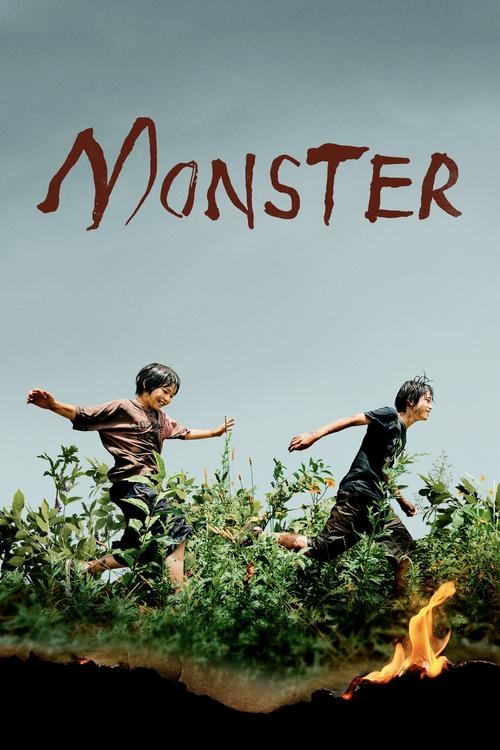
Monster
2023 · Hirokazu Kore-eda
The gentle humanist whose Monster (with a posthumous Sakamoto score and queer-childhood reveal) generated real festival argument; invoked in every conversation about family, ethics, and whether kindness can be an aesthetic.
For when you want a film to chew on — one that makes you reexamine your own snap judgments — and to end up unexpectedly emotional. A challenge that pays off in tenderness, not bleakness.
What it's about
After her eleven-year-old son starts behaving strangely — a lost shoe, odd answers, an outburst — a single mother marches into his elementary school demanding to know what happened, and gets a wall of bows and non-apologies. But the film then rewinds and replays the same weeks from other points of view, and each pass quietly rewrites what you thought you saw. At its center are two boys and a friendship the adults around them can't see clearly.
The experience
It starts as a tense institutional mystery and gradually turns into something tender and quietly devastating; the shifts in perspective keep pulling the ground out from under you. You leave moved rather than shattered — but it lingers for days.
Performances
Sakura Ando is fierce and heartbreaking as the mother, and the two young leads give unguarded, remarkably natural performances that the whole film ultimately rests on.
The craft
The screenplay's three-pass structure, which won Best Screenplay at Cannes, is the marvel: the same events replayed until suspicion dissolves into understanding. Kore-eda directs children with his signature patience and naturalism, and Ryuichi Sakamoto's final completed score gives the film a spare, aching beauty.
Why it matters
A Cannes prize-winner (it also took the Queer Palme) and Sakamoto's musical farewell, it stands as one of the most acclaimed recent films about childhood and how badly adults misread it.
Snapshot
A single mother notices something wrong with her eleven-year-old son after an incident at school. She confronts the institution; the institution deflects. What begins as a recognizable anatomy of institutional failure — the bowing principal, the non-apology, the closed ranks — is then rewound and replayed twice more, each repetition revising what the audience believed it understood. By the third pass, the mystery of who the "monster" is has dissolved into something quieter and more devastating: two boys, each carrying an interior life the adult world cannot see, finding shelter in each other. Hirokazu Kore-eda's Monster (Japanese: Kaibutsu, 怪物) won the Best Screenplay prize and the Queer Palme at Cannes 2023, arrived bearing Ryuichi Sakamoto's final completed score, and confirmed Kore-eda's standing as the most formally adventurous naturalist working in Japanese cinema.
Industry & production
Monster was produced by Toho with co-production support from Fuji Television and distributed theatrically in Japan from June 2, 2023. Genki Kawamura served as lead producer; he and Kore-eda had collaborated on several previous projects. The film marked a deliberate return to Japanese-language, Japan-set filmmaking after Kore-eda's international excursions: the French-language The Truth (2019) and the Korean-language Broker (2022). Both films were warmly received but prompted some critical discussion about whether working outside his home language slightly muffled Kore-eda's ear for the texture of domestic life. Monster silenced that conversation.
The most consequential production decision was the engagement of Yuji Sakamoto as screenwriter. Kore-eda has, for the bulk of his career, written his own scripts — a practice that ties his authorial sensibility directly to the film's architecture. Sakamoto is a prominent figure in Japanese television drama, and his appointment introduced a more intricate structural design than Kore-eda's typically observational approach permits. The script's triptych construction required an external hand willing to impose formal rigor. The collaboration is credited as productive precisely because each party held different competencies: Sakamoto's structural confidence met Kore-eda's granular attentiveness to performance and space.
The film was Japan's official submission for Best International Feature Film at the 96th Academy Awards.
Technology
Monster was shot on digital cinematography in a manner continuous with contemporary Japanese art-cinema production. No unusual technological departures have been documented in the available production record. The film's effects — the darkening sky of the incoming typhoon, the flooded landscape in the final sequence, the children emerging into sudden, sharp morning light — appear to rely primarily on location shooting timed to weather and on naturalistic lighting design rather than visual-effects elaboration. The restraint is characteristic: Kore-eda has consistently resisted the spectacularisation of grief or crisis that digital compositing can tempt.
Technique
Cinematography
The film was lensed by Ryuto Kondo, who had previously shot Shoplifters (2018) with Kore-eda. Kondo's work throughout Monster is calibrated to perspective in a literal sense: the image does not merely show us events but selects, frames, and withholds in alignment with whose consciousness we currently inhabit. The mother's section favours anxious, slightly compressed framings of institutional spaces — corridors, conference rooms, the facade of the school — that make the built environment feel adversarial. The teacher's section opens the frame slightly, admitting more ambient light, though his sequences carry their own claustrophobia of misunderstanding. The children's section, set largely in the overgrown terrain around an abandoned rail car, is the most spatially liberated: longer lenses open to wider vistas, natural light floods the frame, and the handheld register loosens. Kondo's color work is subdued throughout, the palette running toward the grays and humid greens of provincial Japan, which makes the closing shots — saturated, golden — feel almost hallucinatory in their departure.
Editing
Kore-eda edited the film himself, as is his long-standing practice. His editing is inseparable from his structural intelligence: the triptych requires that certain scenes be revisited with near-identical setups, and the discipline with which he manages those repetitions — showing just enough new information to retroactively reframe what passed earlier — demonstrates an editorial precision that is easy to underestimate because it never calls attention to itself. There are no shock cuts, no manipulative accelerations. The cuts are quiet, sometimes slow, and the effect is accumulative. The decision to return to previously "explained" scenes and allow them to mean something different is handled through framing and emphasis rather than new coverage, keeping the formal architecture legible without making it didactic.
Mise-en-scène / staging
Kore-eda's mise-en-scène has always operated through accumulation of small, specific detail — the particular way a kettle is placed, the worn heel of a shoe — and Monster extends this sensibility into a more architecturally loaded context. The school is staged as a space of ritual performance: the repeated apologies, the calibrated deployments of institutional language, the way adults arrange themselves in relation to one another all carry the oppressive weight of social choreography. Against this, the derelict rail car and its surrounding scrubland are staged with deliberate informality, the children moving through tall grass and dim interior space with the autonomy that the adult world withholds from them. The contrast between these two visual registers — ordered, lit institution and wild, unstructured refuge — carries much of the film's thematic argument without requiring explication.
Sound
The film's sound design is a considered companion to Ryuichi Sakamoto's score. Environmental sound is privileged: rain on rooftops, the ambience of empty classrooms, the distant sound of traffic giving way to wind as the film moves toward its wilder locations. The typhoon sequence is rendered primarily through sound before it becomes image. Sakamoto's score, which he completed while gravely ill with cancer and which was delivered shortly before his death on March 28, 2023, is spare to the point of asceticism — primarily solo piano with occasional orchestral support. Its thinness is not impoverishment but precision. The music does not explain emotional states; it arrives alongside them and then withdraws. Several sequences of high emotional intensity are deliberately left unscored, the absence itself becoming expressive.
Performance
Kore-eda's direction of child actors is among the most discussed aspects of his practice, and the performances he draws from Soya Kurokawa (Minato) and Hinata Hiiragi (Yori) rank with the finest in his filmography. His documented method involves not sharing the complete script with child performers, allowing them to inhabit each scene as discrete experience rather than as a position in an arc they intellectually grasp. This produces a quality of genuine unknowing — the children appear not to be playing narrative function but to be living in each moment. Kurokawa, in particular, is required to sustain radically different external presentations across the three perspectives, and does so without apparent calculation. Sakura Ando, who won the Cannes Best Actress award for Shoplifters in the film's ensuing release, here plays Saori with a controlled, accumulative grief — her performance in the first section is the performance of a person who has correctly identified that something is wrong but has misidentified its nature. Eita Nagayama's work as the teacher is perhaps the most quietly demanding, requiring sustained performance of a man whose apparent guilt must read as plausibly genuine before it dissolves.
Narrative & dramatic mode
The film deploys a tripartite Rashomon-adjacent structure: three perspectives on the same period of time, with each section initially appearing complete before being shown to be partial. The critical distinction from Kurosawa's Rashomon (1950) is that Kore-eda's three accounts do not fundamentally contradict one another — each is substantially accurate as far as it goes. The mystery is not epistemic (what actually happened) but perceptual (what was missed, what went unasked). The effect is closer to the structural approach of Michael Haneke or certain puzzle-films of the 2000s, but the tone is entirely different: where those films often use structural fragmentation to produce dread or irony, Kore-eda uses it to produce compassion. Each reset is an invitation to suspend judgment formed in the previous section.
The film's dramatic mode is fundamentally realist in texture — the dialogue rarely lifts above the conversational, crisis scenes resist melodramatic escalation — while its architecture is formally stylized. This combination is unusual and is among the film's most discussed achievements.
Genre & cycle
Monster arrives in complex relation to genre. Its first section deploys the apparatus of the institutional-scandal thriller, a mode with deep roots in Japanese cinema and an especially vigorous contemporary presence in television drama — the genre from which Yuji Sakamoto came. The audience is given every reason to expect that the film will confirm its apparent genre, before that expectation is comprehensively revised. The film might also be located within a loose cycle of Japanese films and series addressing ijime (bullying) as systemic rather than individual failure, and within an emerging international body of work addressing LGBTQ+ adolescence with non-sensationalising directness. The Queer Palme — awarded by an independent jury at Cannes to films that advance queer representation — recognized the film's treatment of Yori and Minato's emerging intimacy as among the most sensitively rendered in recent memory.
Authorship & method
Kore-eda emerged from documentary practice, and his fiction films retain a documentary attentiveness: the texture of daily life, the specificity of domestic space, the irreducibility of children's experience. His major works — Nobody Knows (2004), Still Walking (2008), Like Father Like Son (2013), Our Little Sister (2015), Shoplifters (2018) — form a sustained meditation on family, its biological and chosen forms, its failures and improvisations. Monster is continuous with these preoccupations while being, structurally, his most ambitious film.
Ryuichi Sakamoto's contribution as composer extends beyond this film. He scored several important Japanese films over a fifty-year career and brought to Monster a musical economy he had been developing through his concert and collaborative work in his final years. That this is his last film score has inevitably shaped its reception, though critics have noted that the score's restraint and beauty stand independently of the biographical fact.
Ryuto Kondo's cinematography and Kore-eda's own editing complete a collaborative unit of significant continuity. Kore-eda's practice of self-editing is relatively rare among directors working at his level of international prominence and gives his films an unusual consistency between structural intention and structural execution.
Movement / national cinema
Monster operates at the intersection of two currents in Japanese cinema: the humanist social realism associated with postwar directors such as Mikio Naruse and Yasujiro Ozu, whose influence runs through virtually everything Kore-eda has made, and a more formally experimental strand that has gained international recognition since the 1990s. Kore-eda is often positioned as the primary inheritor of the Ozu line — the quiet domestic observation, the pillow shots, the preference for suggestion over statement — while Monster's structural ambition marks a step beyond what that tradition alone could contain. The film's success at Cannes continues a pattern: Japanese cinema has maintained a significant presence in the festival circuit across the past three decades, with Kore-eda as perhaps its most consistently decorated figure in that period.
Era / period
The film belongs to a moment of consolidation for a particular mode of prestige world cinema: the careful, slow-burn drama that uses formal innovation to deepen humanist concerns rather than to problematize them. It sits alongside — without being derivable from — films such as Asghar Farhadi's moral-puzzle dramas or the work of Nuri Bilge Ceylan in its concern with the gap between institutional and subjective truth. The Cannes 2023 competition in which it screened was notably strong, and the Best Screenplay award was widely regarded as a measured recognition of a film that could have competed for the Palme d'Or itself.
Themes
The film's central question — who or what is the monster? — operates on several registers simultaneously. The most immediate answer proposed by the first section is: the teacher who abused a child. The second section revises this to: the system of conformity and non-communication that destroys innocent people. The third section further revises it to: a world that cannot accommodate children who fall outside its normative categories. The title also gestures toward a children's game the boys play involving the concept of a monster who switches bodies — a game that doubles as a figure for the film's own structural method and for the boys' own tentative explorations of identity.
Queerness, in the film's treatment, is not primarily a problem to be solved but a condition of interiority that adults systematically fail to perceive. The film's argument is that the violence done to Yori and Minato is not spectacular but ambient: the ordinary, unremarkable pressure of a world that has decided in advance what they should be.
The film is also deeply concerned with parental love as a form of projection: Saori loves Minato intensely but, in the film's first section, her love takes the form of protecting him from the wrong thing. This is presented without accusation — her misreading is entirely understandable given what she is given to work with — and it is this structural compassion toward characters in error that most distinctly marks the film as Kore-eda's.
Reception, canon & influence
Critical reception was strongly positive across major festivals and international release. The Cannes jury, presided over by Ruben Östlund, awarded Yuji Sakamoto the Best Screenplay prize. The Queer Palme was separately awarded by its independent jury. Reviews in Sight & Sound, The Guardian, Cahiers du Cinéma, and major American outlets placed the film among the strongest of the year, with particular praise directed toward Sakamoto's structural invention and the performances of the child actors.
Backward influences are numerous and legible. The multi-perspective structure invokes Rashomon as an inescapable reference, though Kore-eda has noted the distinction between Kurosawa's irresolvable contradictions and his own layered accumulation of partial truths. The film's concern with children navigating an adult world that misreads them continues a line running through Nobody Knows and reaches back to Ozu's explorations of generational misalignment. The institutional-critique framework has precedents in Kore-eda's own Still Walking and in Japanese social-problem cinema more broadly. Farhadi's dramaturgical method — the sustained accumulation of moral complexity through information management — is a plausible international reference point, though direct influence is unconfirmed in the available record.
Forward influence remains to be fully measured, given the film's recency. Its intervention into Japanese mainstream cinema on the question of LGBTQ+ adolescence has been noted by critics of Japanese cultural production; the film's wide theatrical success in Japan alongside its Cannes recognition may give it leverage on how such stories are told domestically. As Ryuichi Sakamoto's final work, the score occupies an immediately canonical position within his discography and will likely be returned to as a terminus for assessments of his long career in film music. The film's structural approach — the sympathetic multiple-perspective drama that reveals innocence through accumulated context rather than exoneration — offers a template with evident generative potential, though whether other filmmakers will adopt or develop it is not yet established.
A Deleuzian reading
A mother sits across a low table from a row of teachers who will not look at her.
The full Deleuzian reading of Monster →
Reception
Premiered at Cannes 2023 to strong reviews, winning Best Screenplay and the Queer Palm, and its stature has only grown since — it's settled in as one of the most beloved international films of its year, with many calling it Kore-eda's best in a decade.
How Monster was received, from release to now →
Influences: the films it descends from and the films it influenced
- Rashomon (1950) — Established the formal template of replaying the same event from incompatible subject positions; Monster inherits the triptych-scene-repetition device while inverting Kurosawa's epistemological irresolvability into an accumulation of partial sympathies rather than permanent contradiction.
- Tokyo Story (1953) — Ozu's tatami-level camera placement — consistently aligned with the sightlines of the scene's emotional center — is the direct antecedent of Monster's perspective-aligned framing, where camera height shifts between sections to encode whose interiority the audience inhabits.
- Merry Christmas Mr. Lawrence (1983) — Ryuichi Sakamoto's film scoring methodology — sparse piano motifs set against extended ambient silence — was established here and carried forward to Monster, his final score, where the same economy of musical statement creates negative space for the actors to fill behaviorally.
- Elephant (2003) — Van Sant's practice of trailing different students through the same school corridors on the same day, with temporal overlaps where characters pass each other unknowingly, anticipates Monster's re-entry into institutional space from successive perspective-angles using the same scene-repetition technique.
- Nobody Knows (2004) — Kore-eda developed his withheld-script child method here — disclosing narrative information to child actors only at the moment of shooting to obtain unrehearsed behavioral responses — a practice Monster deploys with Minato and Yori throughout all three sections.
- Caché (2005) — Haneke's perceptual-mystery structure — systematically exploiting the gap between what the camera shows and what the audience can verify — is a formal ancestor of Monster's triptych, which weaponizes the audience's habit of trusting the perspective they have been assigned.
- Still Walking (2008) — Kore-eda's self-editing practice crystallized here into its mature form: cutting on ambient environmental sound rather than music, holding shots past conventional exit points to capture behavioral residue — the editorial grammar Monster inherits for its unscored emotional sequences.
- The White Ribbon (2009) — Haneke's inversion of the institutional-thriller genre — placing children under institutional suspicion while gradually reversing the moral charge — is the clearest formal precedent for Monster's genre subversion, where the school's disciplinary apparatus is revealed as the instrument of misreading rather than detection.
- A Separation (2011) — Farhadi's information-management dramaturgy — withholding specific facts across multiple scenes so that each revelation forces a retrospective re-reading of moral positions — is directly operative in Monster's triptych architecture, where the same dialogue lands differently depending on which section's perspective the audience carries.
- Like Father, Like Son (2013) — Kore-eda developed here his specific practice of using location sound — children at play, kitchen background noise, ambient domestic texture — as the film's primary affective register in place of underscore; Monster's environmental ambience method inherits this directly.
- Shoplifters (2018) — The delayed revelation that retroactively reframes the entire film's moral architecture — who these people legally and emotionally are to each other — is a structural device Kore-eda refined here and redeploys in Monster's disclosure of what Minato and Yori mean to each other and to the adults who have misread them.
- The Past (2013) — Farhadi's structural device of staged moral re-reading — each new disclosure forcing the audience to mentally re-watch prior scenes with revised assignments of blame — is the closest international formal analog to Monster's triptych logic, where information withheld in section one retroactively reframes section two.
- Moonlight (2016) — Jenkins structures a gay male coming-of-age story across three chapters, each with a distinct chromatic palette and lighting temperature marking psychological state; Monster's deployment of the naturalistic golden-lit final section as emotional release operates an analogous triptych-palette logic in its LGBTQ adolescence narrative.
- Portrait of a Lady on Fire (2019) — Sciamma's commitment to naturalistic light sources combined with her structural discipline of withholding the emotional peak of a queer relationship until its absence becomes the subject is a formal sibling to Monster's restraint in staging the Minato–Yori bond, where the color-shift golden finale is the only permitted release.
- Wheel of Fortune and Fantasy (2021) — Hamaguchi's domestic triptych — three unconnected vignettes each withholding a key emotional disclosure until it reshapes the scene already in progress — is a contemporaneous Japanese development of the same multi-perspective, accumulative-disclosure formal approach that Monster employs at feature scale.
- Drive My Car (2021) — Hamaguchi's practice of using extended ambient sound design — traffic, wind, the acoustic environment of enclosed space — in place of underscore during scenes of maximum emotional pressure is a direct sibling to Monster's environmental ambience method, both operating within the Ozu-derived tradition of affective restraint through acoustic texture.
- Anatomy of a Fall (2023) — The Rashomon-derived multiple-account structure in which three incompatible versions of a single event are rendered equally credible before being partially undone; the epistemological project of staging irreconcilable testimony without granting the viewer a stable or privileged account.
Similar films
- Shoplifters (2018) — influence & lineage · often watched together
- Still Walking (2008) — influence & lineage · often watched together
- Nobody Knows (2004) — influence & lineage
- Like Father, Like Son (2013) — influence & lineage
- Close (2022) — same viewing thread · often watched together
- Rashomon (1950) — influence & lineage · often watched together
- Tokyo Story (1953) — influence & lineage · often watched together
- Portrait of a Lady on Fire (2019) — influence & lineage · often watched together
All the films related to Monster →
Watch it with: curated runs of related films
- The Unspoken Between Boys — Watch these together for the way each lets a boyhood friendship curdle into longing, grief, or something neither kid can quite name.