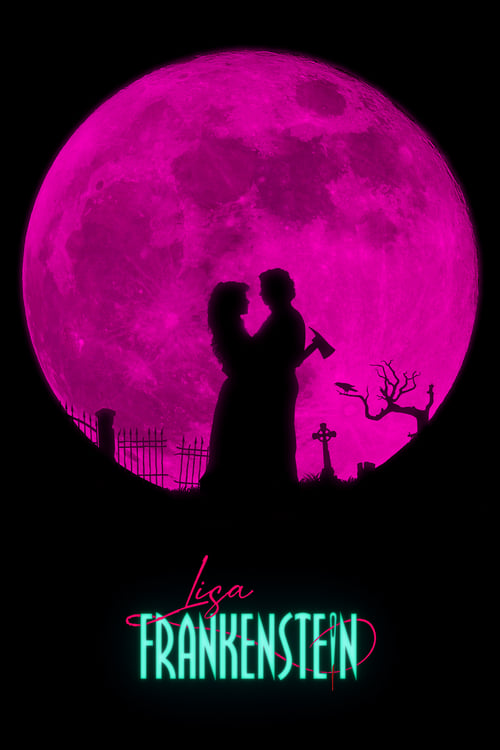
Lisa Frankenstein
2024 · Zelda Williams
For when you want your romance weird and your comedy dark — a sleepover movie for people who grew up goth. Reach for it on a night that calls for fun-macabre rather than actually frightening.
What it's about
It's 1989, and Lisa Swallows — grieving her mother, invisible at her new high school, saddled with a nightmare stepfamily — spends her time talking to a handsome young man's grave in an abandoned Victorian cemetery. Then a freak storm brings him back, mute and falling apart, and the two strike up an unlikely courtship built around finding him some replacement body parts. The donors, conveniently, are the people who've made Lisa's life miserable.
The experience
A candy-colored gothic comedy that plays murder for laughs and grief for real — wisecracking, blood-slicked, and oddly sweet underneath the carnage. It's more mischievous than scary, with a deadpan teen-movie rhythm that keeps the darkness bouncy.
Performances
Kathryn Newton commits fully to Lisa's transformation from wallflower to gleeful accomplice, and Cole Sprouse does expressive, funny work as the Creature despite barely speaking — a whole courtship played in grunts and gestures.
The craft
Diablo Cody's script runs female adolescence through a gothic filter with her trademark barbed one-liners, while first-time director Zelda Williams dresses the whole thing in a heightened, pastel-and-neon 1989 — teased hair, synth cues, thrift-store gothic — that treats the era as a fairy-tale setting rather than mere nostalgia.
Why it matters
A feature directing debut that extended the growing cult reappraisal of Cody's brand of horror-comedy about teenage girls, and quickly found its own midnight-movie audience.
Horror · Horror comedy & camp · Teen horror · Gothic. A pastel-and-neon 1989 gothic romp: a grieving goth girl, a reanimated Victorian corpse, deadpan jokes and bloody revenge with a sweet heart.
Snapshot
Lisa Frankenstein is a horror-comedy romance set in a candy-colored 1989 that filters Mary Shelley's Frankenstein through the grammar of the 1980s teen movie. It marks the feature directorial debut of Zelda Williams and reunites the sensibility of screenwriter Diablo Cody with the register she established in Jennifer's Body (2009): female adolescence rendered as gothic body-horror, wisecracking and blood-slicked at once. Kathryn Newton plays Lisa Swallows, a grieving, socially exiled teenager who spends her free time in an abandoned Victorian cemetery; a freak electrical storm reanimates the corpse she has been talking to (Cole Sprouse, credited as "The Creature"), and the two set out to reassemble him — and Lisa's sense of self — by harvesting replacement body parts from the people who have wronged her. Released by Focus Features in February 2024, the film underperformed theatrically and drew mixed reviews, but its DNA — reanimated-boyfriend romance, Reagan-era pastel, feminine rage played for camp — positioned it squarely as a candidate for the same delayed cult afterlife that Jennifer's Body eventually enjoyed.
Industry & production
The film was produced for and distributed by Focus Features, the specialty arm of Universal, placing it in the mid-budget studio-genre space that Focus has cultivated. It is a modestly scaled production rather than a tentpole; I will not cite a specific budget or gross figure, as I cannot confirm exact numbers, but the commercial record is clear that the film opened softly and did not recoup strongly in theaters, a fate widely attributed to a February release window, a hard-to-market tonal hybrid, and an R-oriented sensibility packaged with a PG-13 rating.
The project's central industrial fact is its pairing of two lineages. Diablo Cody, an Academy Award winner for Juno (2007), had by 2024 an established brand as a writer of stylized, verbally dense scripts about young women, and she has repeatedly framed Lisa Frankenstein as a spiritual companion to Jennifer's Body. Zelda Williams, making her first feature after short-form and acting work, brought an outsider-to-the-director's-chair profile freighted with public knowledge of her lineage as the daughter of Robin Williams — a biographical fact that critics inevitably read against the film's preoccupation with grief. The producing apparatus included Cody herself alongside Mason Novick, a longtime Cody collaborator; other production-company and producer credits exist but are less consistently documented in the critical literature, and I will not invent specific banners.
Technology
Lisa Frankenstein was shot digitally and finished as a contemporary digital-cinema release; I cannot confirm the specific camera system used and will not guess at a model. Its more interesting technological story is one of deliberate period simulation. The film reconstructs 1989 not through documentary fidelity but through a heightened, art-directed version of the decade — saturated gels, MTV-era compositional flourishes, and needle-drop pop — so that the "technology" on display is largely the technology of nostalgia manufacture.
Practically, the creature effects are the film's signal technical achievement. Cole Sprouse performs beneath prosthetic corpse makeup, and the makeup design is engineered as a reverse-decay arc: the Creature begins desiccated and ruined and grows progressively more human and handsome as Lisa restores him via a repurposed tanning bed that stands in for Shelley's galvanic apparatus. This gag — electricity plus 1980s consumer appliance as agent of resurrection — is both a comic idea and a practical-effects problem, requiring makeup continuity that runs the arc backward from the usual monster-movie logic. The film leans on practical prosthetics and mechanical staging over conspicuous digital creature work, consistent with its Amblin-and-Burton reference set.
Technique
Cinematography
The look is high-key and hyper-saturated, organized around a gothic-pastel palette that sets bubblegum suburbia against cemetery blues and lightning-storm greens. The camera favors the clean, poppy compositions of 1980s studio comedy while smuggling in horror framing — low angles on the Creature, symmetrical Burtonesque tableaux, and expressionist storm sequences. I cannot confirm the director of photography's name with certainty and will flag rather than fabricate it; the below-the-line technical credits for this film are comparatively thinly documented in the critical record. What is stylistically legible on screen is a consistent decision to shoot the horror material in the bright, candied register of teen comedy, so that gore arrives inside a frame that looks like a John Hughes movie.
Editing
The film's most discussed formal gesture is its opening: an animated prologue rendered in a storybook, silhouette-and-line style openly indebted to Edward Gorey and Tim Burton, which narrates the Victorian death of the young man who will become the Creature. This sequence sets the register — arch, fabular, tongue-in-cheek — before a frame of live action. From there the cutting follows teen-comedy rhythms punctuated by horror beats, and the escalating body-count structure gives the edit a picaresque, episodic drive: each act adds a body part and a corpse. I cannot reliably attribute the editor by name and will not guess.
Mise-en-scène / staging
Production and costume design carry an enormous share of the film's meaning. Lisa's arc is staged as an inverted makeover narrative: she moves from mousy, muted pastels toward full gothic glamour — dark lips, structured black clothing, a reconstructed self — as the Creature moves from monster toward man. The two transformations are choreographed against each other, so that costume and makeup do the thematic work of the script. The domestic interiors code the wicked-stepmother household in aspirational 1980s consumer sheen, against which Lisa's darkness reads as both rebellion and authenticity. I cannot confirm the production and costume designers by name and will flag that rather than invent attributions, but the design strategy — transformation legible entirely through wardrobe and set — is unmistakable on screen.
Sound
The soundtrack is built on 1980s needle-drops, the Cody-era house style of using pop songs as ironic and emotional counterpoint. The score is credited to Isabella Summers, co-founder of Florence + the Machine; her contribution threads synth-inflected, romantic-gothic textures under the pop cues. The Creature is essentially mute, communicating in grunts and gesture, which throws expressive weight onto sound design and music to carry the romance — a deliberately silent-film-adjacent choice for the male lead.
Performance
Kathryn Newton anchors the film with a performance that has to modulate from repressed grief to deadpan homicidal confidence, and the makeover arc lives or dies on her ability to make Lisa's hardening feel like liberation rather than mere villainy. Cole Sprouse performs almost entirely physically, a near-wordless turn built from Buster Keaton-ish physical comedy and Boris Karloff-inflected pathos. The supporting register is broadly comic and heightened: Carla Gugino plays the monstrous stepmother Janet at full camp pitch, while Liza Soberano's cheerleader stepsister Taffy is written against type as unexpectedly kind, complicating the movie's revenge geometry.
Narrative & dramatic mode
The film operates in an ironic, self-aware comic mode with genuine melodramatic undercurrents of grief. Its structure is a wish-fulfillment fable: an isolated girl's imaginary intimacy with a dead boy becomes literal, and the ensuing plot is organized around accumulation — each murder yields a body part that both completes the Creature and advances Lisa's transformation. The tone deliberately refuses stable ground, holding sincerity (Lisa's mourning for her murdered mother, her longing to be seen) inside heavy irony (splatter gags, one-liners, camp staging). This is the Cody register: dialogue as armor and performance, comedy that curdles into horror and back, with the emotional truth smuggled underneath the archness.
Genre & cycle
Lisa Frankenstein sits at the intersection of several cycles. It belongs to the "reanimated / undead boyfriend" romance lineage and to the broader monstrous-feminine tradition in which female adolescence is figured as literal horror. More specifically it participates in a 2010s–2020s reclamation of the 1980s teen movie through a horror and feminist lens, and in the post-Jennifer's Body re-evaluation of the female-authored teen-horror-comedy as a serious form rather than a marketing failure. Its immediate genre siblings are Frankenhooker and the Frankenstein-comedy tradition of reassembling a mate from parts; Return of the Living Dead and Beetlejuice for its comic-macabre tone; and the Burton corpse-romance of Corpse Bride and Edward Scissorhands.
Authorship & method
The authorship here is genuinely doubled. Diablo Cody is the auteur of the screenplay and its worldview — the verbal texture, the feminist body-horror conceit, the framing of the film as a Jennifer's Body companion. Zelda Williams is the visual and tonal author, translating Cody's script into a specific Gorey-Burton-Hughes idiom and managing the film's difficult tonal calibration in her feature debut. Among key collaborators, composer Isabella Summers shapes the film's sonic-romantic identity, and Cole Sprouse's near-silent physical performance is itself an authorial contribution to the movie's silent-cinema-meets-MTV texture. The cinematographer, editor, and production/costume designers are less securely documented in the critical record, and I have flagged rather than fabricated those names; the film's below-the-line credits deserve a fuller accounting than the available synthesis reliably supports. Williams has spoken about the film in relation to grief, and critics have read her own history of loss into its treatment of a girl who cannot let go of the dead — a biographically inflected reading the film itself invites without confirming.
Movement / national cinema
This is an American studio genre film with no meaningful claim to a national art-cinema movement. If it belongs to a "movement" at all, it is the loose, largely North American current of female-directed, female-authored genre cinema that gained institutional traction in the 2010s and 2020s — an industrial and critical shift more than a formal school. Its cultural coordinates are entirely American: Reagan-era suburbia, MTV, the mall, the high school as social battlefield.
Era / period
Two eras matter. Diegetically, the film is a 1989 period piece, using the twilight of the 1980s as a stylized playground and as a specific pop-cultural memory bank. Industrially, it is a product of the mid-2020s, arriving in a moment shaped by the streaming-era reappraisal of once-dismissed female-led genre films and by a marketplace increasingly hostile to mid-budget, tonally unusual theatrical releases — the exact conditions that made its soft opening predictable and its potential cult afterlife plausible.
Themes
Grief is the film's engine: Lisa's mother was murdered, and her attachment to a dead boy literalizes an inability to move through loss. Around that core the film organizes a cluster of related themes — female desire and its social punishment; bodily autonomy and reconstruction (both the Creature's and Lisa's); transformation and self-authorship, staged as an inverted makeover in which becoming "monstrous" is becoming free; and the monstrous-feminine as a vehicle for adolescent rage against a controlling stepmother, cruel peers, and predatory men. The Creature — mute, assembled, devoted — functions as a fantasy of a partner who listens and is quite literally made to fit, which the film treats with a knowing mix of romance and critique. Underneath the camp runs a sincere argument that reinvention and revenge can be indistinguishable from healing.
Reception, canon & influence
Critical reception was mixed. Reviewers consistently praised the production and costume design, Newton's and Sprouse's performances, and the audacity of the tonal experiment, while a substantial share found the tonal balance uneven and the film less sharp than its clear model, Jennifer's Body. I will not cite specific aggregate scores or box-office figures I cannot verify, but the consensus is fairly characterized as respectful of the film's ambition and divided on its execution, alongside a theatrical run widely reported as commercially disappointing.
The influences on the film (backward) are legible and openly acknowledged: Mary Shelley's Frankenstein as source myth; Tim Burton's Edward Scissorhands, Beetlejuice, and Corpse Bride for corpse-romance and gothic-suburban tone; John Hughes and the 1980s teen movie for structure and setting; Heathers for the acid-comic teen register; Weird Science and Frank Henenlotter's Frankenhooker for the reassembled-partner conceit; Edward Gorey for the animated prologue; and, most directly, Cody's own Jennifer's Body as the immediate template.
The influence of the film (forward) is, as of this writing, still emerging and should be described honestly as thin and in progress. Its most likely legacy is participation in — and reinforcement of — the ongoing critical rehabilitation of female-authored teen horror-comedy, and its trajectory toward cult status on streaming among a young, largely female and queer audience mirrors the delayed canonization of Jennifer's Body. It also stands as Zelda Williams's calling-card debut and as further evidence of Diablo Cody's durable, distinctive voice. Whether Lisa Frankenstein becomes a genuinely generative touchstone or remains an admired curio is not yet settled, and the honest scholarly position is that its afterlife, not its opening weekend, will determine its place.
A Deleuzian reading
A girl gets a corpse into a tanning bed and closes the lid.
The full Deleuzian reading of Lisa Frankenstein →
Reception
Opened Valentine's weekend 2024 to shrugging critics and soft box office, then almost immediately picked up the 'instant cult classic' tag — fans invoked Jennifer's Body's redemption arc and vowed not to wait fifteen years this time.
How Lisa Frankenstein was received, from release to now →
How to watch Lisa Frankenstein: what to notice on a first viewing
- Notice the candy-pastel colors against cemetery blue and green. Williams sets a hyper-saturated, high-key suburbia against storm greens and cemetery blues, so the palette itself swings between teen-comedy brightness and horror-movie gloom. The two worlds share one color scheme, which is the film's way of saying they were never really separate.
- Watch the animated storybook prologue before any live action. The film opens with a silhouette-and-line animated sequence narrating the Creature's Victorian death, setting an arch, fable-like register before a single live-action frame appears. It tells you upfront not to expect realism; you are being handed a fairy tale, not a case file.
- Notice Lisa's clothes getting darker as the film goes on. Lisa moves from mousy, muted pastels toward structured black clothing and dark makeup, a transformation staged entirely through wardrobe rather than dialogue explaining her change. You can track her whole arc just by watching what she is wearing scene to scene.
- Watch the Creature communicate only through grunts and gesture. Cole Sprouse plays the role almost entirely physically, closer to silent-film comedy than to a talking part, so his whole performance has to land through posture and timing. He carries half the romance without ever saying a word, which is a different kind of acting than the dialogue-heavy scenes around him.
- Listen for period pop songs commenting on the scene. The soundtrack leans on 1980s needle-drops used as ironic or emotional counterpoint, doing feeling-work that dialogue or score alone would otherwise carry. The music is often telling you how to feel about a scene the characters are playing completely straight.
The whole guide to watching Lisa Frankenstein, with the keys for a rewatch →
Influences: the films it descends from and the films it influenced
- May (2002) — The lonely girl who literally builds a companion from harvested body parts is the closest sibling to Lisa's project, sharing the monstrous-feminine grief-into-fabrication arc.
- Jennifer's Body (2009) — The immediate authorial template: same Diablo Cody voice, feminist body-horror-comedy conceit, and needle-drop-driven teen-horror texture, explicitly framed as its companion piece.
- Humanist Vampire Seeking Consenting Suicidal Person (2023) — Extends the death-positive teen-girl-and-undead romance played deadpan, pairing a depressed adolescent outsider with a corpse-suitor in mordant comedy.
- Bride of Frankenstein (1935) — Establishes the reanimated-mate as a wordless, jerkily physical performance and the source myth's camp-macabre register that Sprouse's near-silent creature and the film's title conceit directly rework.
- Vincent (1982) — Burton's Poe/Gorey-styled black-and-white stop-motion short is the direct template for Lisa Frankenstein's Edward Gorey animated prologue — narrated gothic-child fable in stark linework.
- Sixteen Candles (1984) — Supplies the 1980s teen-movie architecture the film pastiches: suburban high-school social strata, the yearning-outsider heroine, and diegetic needle-drop scoring as emotional shorthand.
- Weird Science (1985) — The teens-fabricate-an-ideal-partner conceit, played as 80s comedy with a literal act of creation, is the structural ancestor of Lisa assembling and animating her ideal boy.
- Heathers (1988) — Model for the acid-comic teen register — arch, quotable cruelty and casual body-count black comedy in a candy-colored high-school world — that underwrites Cody's dialogue and the episodic killings.
- Beetlejuice (1988) — Sets the candied-horror framing and camp-supporting-cast idiom — the macabre treated as gaudy suburban farce — that Williams adopts for tone and production-design palette.
- Edward Scissorhands (1990) — The wordless, gentle, artificial-man love object set against a pastel-saturated suburbia is the closest visual and performance ancestor for Sprouse's mute creature and the gothic-pastel look.
- Frankenhooker (1990) — Trash-camp precedent for the reassembled-partner-from-body-parts premise rendered as gory comedy, prefiguring the film's reverse-decay prosthetics that rebuild the creature part by part.
- Ginger Snaps (2000) — Ancestor in fusing female adolescence with body-horror metaphor — the monstrous-feminine as coming-of-age text — that Cody's teen-horror mode descends from.
- Corpse Bride (2005) — Burton's literal corpse-romance — tender love between the living and a reanimated dead partner — is the acknowledged template for the film's grief-driven romance with a resurrected body.
- Excision (2012) — Sibling in staging teen female interiority through pastel-lit dream/fantasy sequences and clinical body-horror imagery as the outsider heroine's monstrous-feminine escape.
- Warm Bodies (2013) — Descendant sharing the reanimated-corpse-as-romantic-lead device played for comedy, with a largely nonverbal undead love interest who gradually 'improves' toward humanity.
Similar films
- Jennifer's Body (2009) — influence & lineage
- Beetlejuice (1988) — influence & lineage
- Ginger Snaps (2000) — influence & lineage
- Beetlejuice Beetlejuice (2024) — often watched together
- Freaky (2020) — shared sensibility
- The Bride! (2026) — shared sensibility
- Teenage Sex and Death at Camp Miasma (2026) — shared sensibility
- Abigail (2024) — shared sensibility
All the films related to Lisa Frankenstein →
Watch it with: curated runs of related films
- When Love Gets High-Concept — Watch these when you want a love story with a speculative or absurdist hook — an AI girlfriend, an afterlife way-station, a reanimated corpse, a marriage under siege — comedies that use a wild premise to say something real about coupling.