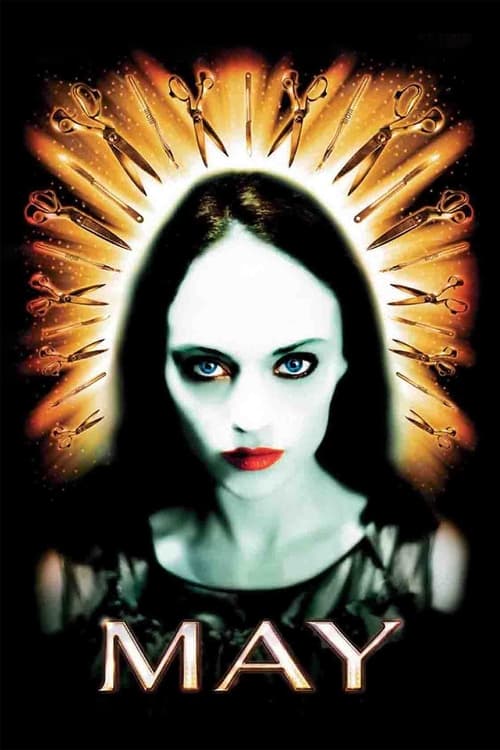
May
2003 · Lucky McKee
When you want horror that breaks your heart more than it jumps at you — a lonely-person movie for a night you can sit with something sad and strange.
What it's about
May is a painfully shy veterinary assistant whose only lifelong friend is a porcelain doll in a glass case, a gift from a mother obsessed with perfection. When she works up the nerve to reach for real connection — a mechanic with beautiful hands, a flirty coworker — every attempt goes humiliatingly wrong. Loneliness, rejection, and the doll's silent example push her toward a very literal solution to friendlessness.
The experience
It plays like an awkward, tender indie romance for a long stretch — funny in a way that makes you cover your eyes — before sliding into genuine horror. The dread comes from caring about May even as you watch her come apart, and the ending lands like a bruise.
Performances
Angela Bettis is extraordinary — twitchy, hopeful, and heartbreaking, she makes May sympathetic right up to and past the point where she shouldn't be. Anna Faris and Jeremy Sisto give the people around her just enough careless charm to make their rejections sting.
The craft
Lucky McKee's script walks a razor line between cringe comedy and tragedy, and the film's handmade, thrift-store texture suits its heroine perfectly. The violence, when it comes, is sparing and intimate rather than spectacular, which makes it hit harder.
Why it matters
A Sundance discovery that barely got a theatrical release and then became one of the defining cult films of 2000s indie horror, a touchstone for character-driven horror about lonely women.
Snapshot
May is Lucky McKee's first solo feature as writer-director. It tells the story of May Dove Canady (Angela Bettis), a shy veterinary assistant with a lazy eye. Her only lifelong companion is a porcelain doll in a glass case, given to her by a mother who prized perfection. When May's awkward attempts at love and friendship fail, first with Adam (Jeremy Sisto), a mechanic with beautiful hands, and then with Polly (Anna Faris), a flirtatious receptionist, she decides to follow the doll's implied advice: if you can't find a friend, make one. The film turns from a gentle, painfully funny character study into a Frankenstein story in which May assembles a companion from the "pretty parts" of the people who rejected her.
The film premiered at Sundance in 2002 and was barely released in theatres by Lions Gate in early 2003. It found its audience on home video and became one of the defining cult horror films of the decade. Critics praised Bettis's performance and the film's mix of tenderness and gore, and it has come to be read as a key early work in what later critics called female-centred or "outsider" horror. It also matters as an origin point for a group of collaborators from the University of Southern California (USC): its editor, Rian Johnson, and its cinematographer, Steve Yedlin, went on to make Brick (2005) together.
Industry & production
May belongs to the low-budget American independent sector of the early 2000s. McKee had come out of USC's film school, where he met the collaborators who would crew the film. Before May he had co-directed, with Chris Sivertson, the shot-on-video All Cheerleaders Die (2001), a no-budget calling card that he later remade with Sivertson in 2013. May was a step up in scale but still modest: it was shot in and around Los Angeles with a small cast and few locations. Published accounts of the exact budget vary and are not well sourced, so this account does not give a figure.
The film's festival debut came in Sundance's midnight programming in January 2002. Lions Gate picked it up but gave it only a token theatrical run in early 2003, which was common for genre titles of the period whose real market was DVD. Its box-office performance was negligible by any measure. Its life came almost entirely from home video, cable, and word of mouth among horror fans and critics, which is the classic path of the twenty-first-century cult film.
Technology
Technically, the film is a straightforward photochemical production of its moment. It was shot on film and finished in the traditional way, before digital intermediate grading became routine for independent features. Its makeup and gore effects are practical and used sparingly. The climactic "doll" of Amy, stitched together from body parts, is a physical prop shown in deliberately restrained glimpses rather than a showcase of effects. The film's technological interest lies less in innovation than in economy: it gets its effect from performance, design, and editing rather than from spectacle. Its eventual home on DVD, with commentary and supplementary material, was central to how it built its reputation, as with many cult titles of the format's peak years.
Technique
Cinematography
Steve Yedlin, who later became Rian Johnson's regular cinematographer, gives the film a clean, softly lit, slightly storybook look rather than the murky palette common in early-2000s horror. Interiors, especially May's apartment and the animal hospital, are lit evenly and brightly. This makes the eventual violence feel intrusive rather than atmospheric. The camera often holds May in isolating frames: alone in doorways, at the edge of groups, or framed against the doll's glass case. Many shots line up with May's own way of looking, which breaks bodies into parts. Close-ups of Adam's hands, Polly's neck, and Ambrosia's legs turn the act of looking into the film's central problem, so that the camera's fragmenting gaze anticipates what May will literally do.
Editing
Rian Johnson co-edited the film. Its rhythm is notably patient for a horror film. The first two-thirds are built like a romantic comedy about social failure, with cuts timed to land on awkward pauses and misjudged gestures, so that the comedy comes from duration and discomfort. The violence in the final act arrives in compact, unsentimental bursts. The editing also handles the film's key tonal shift, from cringe comedy to tragedy to horror, as a gradual slide rather than a jarring break. One much-discussed sequence crosscuts, or builds tension around, the blind children at the school where May volunteers as they crawl toward the shattered glass of the doll's case. It is the film's darkest set piece of suspense before any murder takes place.
Mise-en-scène / staging
Production design does a great deal of the storytelling. May's apartment is full of handmade objects, sewing materials, and dolls, and the space reads as a child's room that never grew up. The doll Suzie sits in her glass case as a constant, watchful presence. The cracks that spread across the glass serve as a visual barometer of May's breakdown. Clothing marks her changing self-presentation: she sews her own dress and later turns herself into a makeover version of the woman she thinks others want. The final tableau, with the assembled body of "Amy" laid out in May's home, is staged as a grotesque domestic intimacy, a bedroom for a companion who cannot reject her. The film's humour often comes from staging, for example the flat, deadpan placement of figures in a room just after a social mistake.
Sound
The score is by Jaye Barnes Luckett, and the soundtrack also uses indie and alternative rock songs that suit the film's suburban-bohemian Los Angeles setting. The music tends toward the delicate and melancholy rather than the shrill stingers of horror, which strengthens the film's identity as a sad character piece. Sound design is used precisely in the moments of violence and in the small, intimate noises of May's world: the doll's case, the tinkle of breaking glass, the noises of the animal clinic. Which songs are used and how they were licensed is documented on the soundtrack release and in the credits. This account does not list them.
Performance
The film rests on Angela Bettis's performance, which is widely counted among the great lead performances in modern horror. She plays May's social incompetence with real vulnerability rather than as a caricature: the halting voice, the over-eager smile, the misread cues, the sudden flashes of intensity. The audience laughs at May and aches for her at the same moment. Her late transformation, in makeup, costume, and a feverish lightness, is played as a terrible blossoming rather than a simple turn into a monster. Bettis had played the title role in the 2002 television remake of Carrie, and the two performances are often discussed together.
Jeremy Sisto plays Adam as charming but shallow. He is a self-styled fan of extreme cinema who is horrified when he meets the real thing. Anna Faris, then best known for the Scary Movie comedies, gives Polly a loose, predatory warmth that hints at the comic range she later used more fully. James Duval and Nichole Hiltz fill out the cast of people May collects.
Narrative & dramatic mode
The narrative follows a clear three-movement structure. A prologue shows May's childhood: her mother's fixation on perfection, the eye patch, and the gift of Suzie. Then comes the adult May's tentative courtship of Adam. It is a romantic comedy of errors that peaks when May, aroused and excited, bites Adam's lip during a make-out session. This happens soon after he has shown her his student film about two lovers who eat each other. Adam's revulsion sets up the film's central irony: the young man who professes to love dark, transgressive art cannot cope with someone who takes it to heart. A second, briefer relationship with Polly ends with the same sense of being used and discarded. The final movement turns May's craft skills and her clinical work toward building the perfect companion.
The dramatic mode is tragicomic. The film keeps the audience's sympathy with May even as she kills, which turns the slasher structure inside out. The victims are not innocents being stalked by a monster but people who have each, in small ways, treated May carelessly. The protagonist is the killer, and the film's emotional climax is not a final chase. It is an act of self-mutilation: May gouges out her own lazy eye to complete her creation, after which the doll seems to respond to her touch.
Genre & cycle
May is generically hybrid. TMDB tags it as drama, horror, and comedy, and all three describe it. It is a Frankenstein narrative, retelling the man-made companion myth through female loneliness and handicraft rather than science. It is also an outsider coming-of-age story, a dark romantic comedy, and in its last act a slasher with the conventions reversed. Its closest generic relatives are the psychological horror films about women's breakdown, such as Roman Polanski's Repulsion (1965), and Brian De Palma's Carrie (1976), an affinity strengthened by Bettis's casting.
In the cycle of its time, May stood apart from the self-aware teen slashers that followed Scream and the remakes then arriving. It also came out just before the "torture porn" wave that Saw (2004) and Hostel (2005) would set off. Its gore is purposeful and limited, and its focus on character set it against both trends.
Authorship & method
Lucky McKee (writer-director) became, on the strength of May, one of the most distinctive American horror directors of his generation. His later work returns repeatedly to women in conflict with the structures that confine them and to the fragility of social belonging. That work includes The Woods (2006), the Masters of Horror episode "Sick Girl" (2006), Red (2008, co-directed with Trygve Allister Diesen), The Woman (2011, co-written with Jack Ketchum), the All Cheerleaders Die remake (2013), and Kindred Spirits (2019). May shows his method in its purest form: a small cast, careful tonal control, close collaboration with actors, and a willingness to let the audience stay uncomfortable for long stretches.
Angela Bettis became McKee's key creative partner. She appeared in "Sick Girl" and The Woman, and she directed Roman (2006) from McKee's script, with McKee in the lead role, a gender-reversed companion piece to May.
Steve Yedlin (cinematography) and Rian Johnson (co-editor) were part of the same USC circle. Their next major project, Brick, directed by Johnson and shot by Yedlin, started a long partnership that led to Looper, Star Wars: The Last Jedi, and Knives Out. As a result, May is now often cited as an early credit for a significant strand of twenty-first-century American filmmaking talent. Jaye Barnes Luckett composed the score. Further details of producers, production companies, and the remaining crew are in the film's credits. This account does not set them out beyond what is well established.
Movement / national cinema
May is an American independent film that bridges two traditions: the Sundance-era indie character study and the genre underground. It does not belong to a formal movement. It is best understood as part of a loose, informal surge of auteur-driven American horror in the 2000s, a generation of directors who used low budgets and festival exposure to make personal genre films. Its setting matters too. May depicts a non-glamorous Los Angeles of clinics, garages, small apartments, and art-school bohemia, a setting that ties it to the city's long tradition of alienation stories.
Era / period
The film belongs to a specific moment in the early 2000s. DVD was then a major revenue stream, and this allowed small genre films with tiny theatrical releases to find large and loyal audiences. Festival midnight sections were becoming a showcase for horror auteurs. Adam's character, a fan of Dario Argento who makes gory student films, is itself a period marker: he stands for a generation of cinephile horror fans formed by video, and the film satirises the distance between enjoying transgression on screen and being able to cope with intimacy. The film's practical effects, its indie-rock soundtrack, and its pre-smartphone social awkwardness also date it in a way that has since come to feel like part of its charm.
Themes
- Parts and wholes. May's line "So many pretty parts, and no pretty whole" states the film's thesis. Desire that breaks people into features (hands, necks, legs) cannot add up to love for a whole person. May turns this objectifying gaze, which the film links to cinema itself, into a literal practice.
- Loneliness and the made friend. The mother's advice, "If you can't find a friend, make one," is the poisoned seed of the story. The Frankenstein myth is relocated into the domestic crafts traditionally assigned to women, such as sewing and doll-making.
- Perfection and the body. May's lazy eye and her mother's insistence on concealing it link damaged self-image to a demand for perfection. The ending, in which May sacrifices her own "imperfect" eye, completes the logic as tragedy.
- The hypocrisy of transgressive taste. Adam and Polly are both drawn to May's "weirdness" as a pose and are repelled by it as a reality. The film's critique of edgy aesthetics consumed as lifestyle has proved prescient.
- Seeing and blindness. The blind children's scene, the glass case, and the final act of self-blinding make vision, and its failure, the film's governing metaphor.
- Sympathy for the monster. The film asks the audience to keep caring for May through acts of violence, extending the long tradition of the sympathetic monster in horror.
Reception, canon & influence
Critical reception. Despite its minimal release, May drew notably warm reviews. Critics singled out Bettis's performance, McKee's control of tone, and the film's emotional seriousness. It played widely on the genre-festival circuit and gained a strong reputation through DVD. Reviewers and horror fans regularly place it on lists of the best horror films of the 2000s. Detailed festival award histories are not reproduced here because they could not be verified for this account. The film's standing rests mainly on long-term critical and fan consensus rather than on any single prize.
Influences on the film (backward). The film's most visible ancestors are the following:
- Frankenstein in its literary and cinematic forms, for the made-companion premise.
- Carrie, for the bullied, isolated young woman whose rejection ends in violence.
- Repulsion, for its study of a woman's psychological breakdown confined to a domestic space.
Adam's fandom openly points to Dario Argento and the Italian horror tradition. In its mix of deadpan comedy with grief, the film also draws on the American indie character study of the 1990s. McKee has acknowledged genre influences in interviews and commentary, but a more detailed list of his stated sources would go beyond what this account can confirm.
Legacy (forward). May is now regularly cited as a precursor to the twenty-first-century wave of horror centred on female interiority, adolescence, and the body. Critics have linked it to films such as Teeth (2007), Jennifer's Body (2009), Excision (2012), and later Raw (2016) and the broader "elevated" or art-horror turn. These are lines of critical association rather than documented direct influence. Within McKee's own career, it set up the themes and the Bettis collaboration that led to Roman, "Sick Girl," and The Woman. Within American filmmaking more broadly, the McKee–Yedlin–Johnson connection makes May a small but significant node: a film whose crew list predicts a decade of later work. Above all, its reputation shows how cult canons formed in the DVD era. A film that almost nobody saw in theatres became, through home viewing and critical advocacy, one of the period's essential horror films.
Influences: the films it descends from and the films it influenced
- Bride of Frankenstein (1935) — Whale's mix of arch, almost camp comedy with real pathos in a story about assembling a mate from corpses is the tonal model for May's tragicomic finale, where the stitched-together companion is both absurd and heartbreaking.
- Peeping Tom (1960) — Powell asks the audience to sympathise with a shy, socially stunted killer whose violence comes from a fixation on looking; May builds its inverted slasher, and its link between seeing and killing, on the same design.
- Repulsion (1965) — The walls that literally crack in Carol's apartment to chart her collapse are the direct ancestor of May's cracking glass doll case, a physical object in the set that measures the heroine's breakdown.
- Deep Red (1975) — Argento's extreme macro inserts of dolls, eyes and isolated objects give May its fetishising, fragmenting close-ups, and the film names that debt directly through Adam's Argento fandom.
- Carrie (1976) — De Palma builds a lonely, mocked young woman's humiliation slowly, then releases it in a blood-soaked social ritual; May follows that structure exactly, with its Halloween night standing in for the prom.
- Welcome to the Dollhouse (1995) — Solondz's deadpan, held-too-long scenes of a socially awkward girl being humiliated set the 1990s indie cringe-comedy timing that McKee stretches across May's first two acts.
- Sick Girl (2006) — In this Masters of Horror episode McKee brings back Bettis as a stammering, collector-minded misfit in a romance that turns monstrous, repeating May's mix of quirky comedy and body horror on a television budget.
- Teeth (2007) — It takes up May's flat, faux-innocent tone and bright suburban look to stage female sexual body horror as black comedy, letting the jokes and the gore share the same unhurried shots.
- The Woman (2011) — McKee casts Bettis against type as the cowed wife and turns May's study of domestic space into a family-horror satire, again moving gradually from awkward suburban comedy into graphic violence.
- Excision (2012) — An alienated young woman with surgical fantasies and a deadpan, cringe-comedy register heads toward a shocking act of bodily 'repair', which is May's parts-and-wholes plot moved into a family drama.
- Raw (2016) — Ducournau treats a young woman's emerging appetite as both a coming-of-age awakening and a horror, mixing awkward social comedy with intimate body close-ups much as May does.
- Pearl (2022) — West pairs a lonely woman's murderous breakdown with saturated, storybook-bright lighting and lets Mia Goth's performance run in long, uncomfortable takes, a near-match for May's bright look and the way Bettis's performance carries the film.
- Lisa Frankenstein (2024) — An outcast girl literally assembles her ideal boyfriend from body parts collected through murder, played as a candy-coloured tragicomedy; it is May's domestic-craft Frankenstein made explicit as a teen romance.
- Brick (2005) — May's co-editor and cinematographer, Johnson and Steve Yedlin, carried its method into their next film: a genre lifted wholesale into a teenage setting, with deadpan dialogue and crisp, unsaturated suburban images.
- Roman (2006) — McKee wrote it and stars in it, and Bettis directed it as a gender-reversed mirror of May: a lonely young man who kills the woman he loves and keeps her body, told with the same hushed, awkward pacing.
Similar films
- Oddity (2024) — shared sensibility
- Sorry, Baby (2025) — shared sensibility
- Obsession (2026) — shared sensibility
- Strange Darling (2024) — shared sensibility
- My First Summer (2020) — shared sensibility
- Me and You and Everyone We Know (2005) — shared sensibility
- Die My Love (2025) — shared sensibility
- The Ugly Stepsister (2025) — shared sensibility