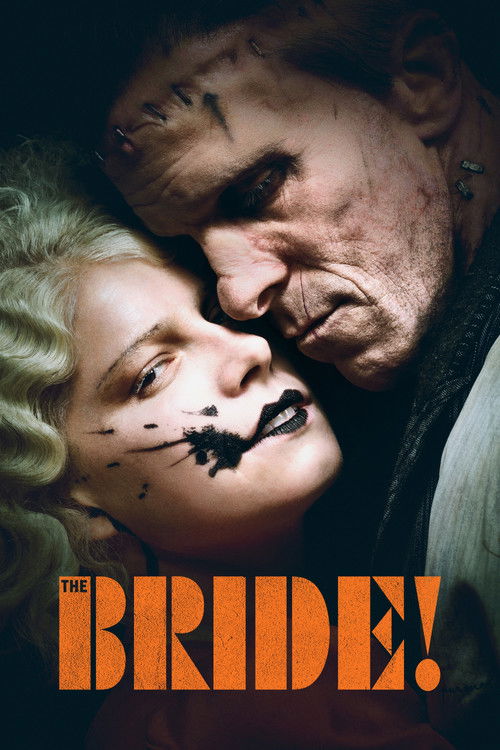
The Bride!
2026 · Maggie Gyllenhaal
When you want a bold, maximalist night at the movies — something gorgeous and unhinged rather than safe — and you're in the mood for a monster story told from the monster's side. A challenge more than a comfort, and better for it.
What it's about
In Depression-era Chicago, a lonely Frankenstein's creature seeks out a brilliant scientist and asks her to build him a companion. Together they reanimate a murdered young woman — and the Bride who wakes up has no memory, a new name she chooses herself, and no intention of being anyone's gift. What she becomes is far beyond what either of her makers imagined.
The experience
Feverish, romantic, and defiantly strange — a monster movie that keeps breaking into song and sensation, swinging between horror, dark comedy, and full-throated melodrama. It's the kind of big, risky vision you argue about on the way home.
Performances
Jessie Buckley is ferocious and tender as the Bride, building a whole person out of a character who historically got only a hiss and a scream; Christian Bale plays the creature as a wounded romantic, and Annette Bening relishes the mad-scientist role.
The craft
Maggie Gyllenhaal's second feature is a big-studio gamble that reimagines the classic Bride myth with musical numbers, 1930s Chicago period design, and genre-blending nerve. The scale of the production — and its swings between horror imagery and showstopper staging — makes a strong case for the biggest screen you can find.
Why it matters
A landmark of the current wave of classic-monster revivals told from the creature's perspective, and a statement of ambition for Gyllenhaal as a filmmaker willing to spend studio money on something genuinely eccentric.
Snapshot
Maggie Gyllenhaal's second feature is a $80–90 million Warner Bros. gamble that treats Bride of Frankenstein (1935) less as a property to be remade than as a wound to be reopened. Relocating the myth to a Depression-era Chicago of 1936, the film gives Mary Shelley's destroyed female creature — torn apart by Victor before completion in the 1818 novel, granted a hiss and a scream but no interiority in James Whale's film — a body, a voice, a criminal record and a political afterlife. Jessie Buckley plays Ida, a murdered young woman reanimated at the request of a lonely, lovelorn "Frank" (Christian Bale) by Dr. Cornelia Euphronius (Annette Bening), a gender-flipped descendant of Whale's Dr. Pretorius. Amnesiac, self-renamed Penelope Rogers, she does not become Frank's companion so much as his accomplice: the film curdles into a Bonnie and Clyde road picture with a detective (Peter Sarsgaard) in pursuit, then detonates into nightclub musical, media satire and gothic romance by turns.
Released March 6, 2026 after a two-year slide through the release calendar, the 126-minute film grossed roughly $24 million worldwide against a budget that, with marketing, was reported to have exceeded $100 million — one of the year's most conspicuous studio losses. Its critical reception split almost exactly down the middle (57% on Rotten Tomatoes across 335 reviews; 55 on Metacritic), and the Rotten Tomatoes consensus — that the film "lurches in so many different creative directions that the overall effect is both sloppy and inspired" — is an unusually fair summary of the argument it provoked. The Bride! is a fascinating object precisely because its commercial failure and its formal ambition are inseparable.
Industry & production
The project's development history is itself a document of the mid-2020s studio economy. Netflix announced the film in August 2023 as a Bride of Frankenstein reimagining; by January 2024 the film had moved to Warner Bros., with reporting attributing the split to creative disagreements including Gyllenhaal's insistence on location shooting. Warner Bros. film chiefs Michael De Luca and Pamela Abdy picked up the financing — a decision consistent with their stated appetite for director-driven swings, and one that made The Bride! an unusually pure test case: an original-voice auteur film at franchise scale, released wide and in IMAX, with no existing fanbase beyond a ninety-year-old Universal monster the studio did not own.
Principal photography began March 4, 2024 in New York City, with Chicago built and found across the New York metropolitan area: ballroom sequences at Steiner Studios in Brooklyn, the underground nightclub in the former trolley tunnels beneath the old Hahne & Co. department store site in Newark, a nocturnal car chase staged in a Long Island park. Gyllenhaal produced alongside Emma Tillinger Koskoff (a longtime Scorsese producer), Talia Kleinhendler and Osnat Handelsman-Keren, under the First Love Films and In the Current Company banners.
The release history reads as escalating studio anxiety: dated for October 3, 2025, moved to September 26, 2025, then pushed to spring 2026. Reporting also indicates that Gyllenhaal recut the film after poorly received test screenings, removing violent material including sequences of sexual violence. The film premiered February 26, 2026 at the Empire Leicester Square in London, opened March 4 in France and South Korea and March 6 in the United States. Against opening-weekend projections of $16–18 million from 3,304 theaters, it took $7.3 million domestically; a 70% second-weekend drop confirmed the outcome. Final worldwide gross was approximately $24 million ($13 million domestic, $11 million international), with trade estimates of studio losses reaching $90 million. Digital release followed April 7, physical media May 19 — an accelerated window that itself reflects a title the studio had stopped defending.
Technology
The Bride! is one of the more technically curious wide releases of its year, and its format strategy is central to its meaning rather than decorative. The film was shot entirely on IMAX-certified digital cameras — principally the Sony VENICE 2, with the Sony FX3 deployed for extreme low-light work (notably the Long Island car chase, where available darkness was preserved rather than lit through), plus RED Raptor and Phantom bodies for select sequences.
The lens package was deliberately hybrid. Standard 2.39:1 material was captured on Technovision 1.45x anamorphics (40mm through 150mm, with 40–70mm and 80–200mm zooms); the expanded IMAX passages — 1.90:1 and the full 1.43:1 — were shot spherical, on a scavenged assortment of rehoused stills glass including Leica R primes from 35mm to 280mm, Sigma wides, Nikon optics up to 600mm, a vintage 350mm and Hasselblad-derived primes. Lawrence Sher, ASC, reportedly brought Gyllenhaal to IMAX headquarters before production to demonstrate what vertical expansion could do, and the film uses it as a dramatic instrument: the frame grows at Ida's death on the stairs, at Frank's discovery of Euphronius's laboratory, at Frank in a movie theater watching his screen idol Ronnie Reed, and at his first contact with the reanimated Bride. In places the ratio shifts across as few as three cuts — an aggressive, almost subliminal application of a format usually reserved for spectacle establishing shots.
Lighting technology was handled with comparable license. Sher has described abandoning strict period authenticity once the film's fantasy register asserted itself: strobes and colored fluorescents appear in a 1936 setting without apology. The reanimation sequence was lit with carbon arc, explicitly referencing Sven Nykvist's work on Bergman's Persona (1966), producing near-blinding whiteouts. A drive-in sequence used an LED wall as both screen and sole light source. For the film's "movie-within-a-movie" passages, Bale and Jake Gyllenhaal were composited into original Gold Diggers of 1933 and Broadway Melody footage via blue screen and matched physical set pieces, with grain, density and depth characteristics duplicated to hold the seam.
Technique
Cinematography
Sher's governing idea, developed with Gyllenhaal, was a film that "lived in the 30s, the 80s, and today" — a Lynchian subversion of the romance picture. The reference list they exchanged is unusually legible on screen: Wild at Heart, True Romance, Lost Highway, Bonnie and Clyde, The Third Man, the Universal Frankenstein films, and 1930s musicals. Two decisions define the look. First, long lenses: Gyllenhaal pushed for extreme focal lengths, and the fugitive stretches are covered from great distance at close apparent proximity — an "observational intimacy" that keeps the lovers watched even when alone, which is thematically exact for a story about a woman who is never not being looked at. Second, deeper stops than contemporary practice, borrowed from the deep-focus Capra-era Hollywood image, which puts the period world in hard, unromantic legibility behind faces. For Bale's heavy prosthetics, Sher favored high-contrast frontal keys rather than the concealing side light such makeup usually invites — a confidence that reads as respect for the design.
Editing
Dylan Tichenor — Paul Thomas Anderson's editor on Boogie Nights, There Will Be Blood and Phantom Thread — cuts the film, and the tension between his patient, breath-based rhythm and Gyllenhaal's mode-switching structure is where most critical disagreement lives. Richard Brody's line that "the movie has the form of mismatched pieces stitched together" is offered as a criticism but describes a strategy: the film is assembled the way its heroine is. Owen Gleiberman's counter-verdict in Variety — that "the movie doesn't move" — locates the real cost, which is that the IMAX expansions and register shifts arrive as punctuation in a narrative whose forward drive keeps stalling. The post-preview recut, which excised violent and sexually violent material, likely contributed: the surviving film gestures at brutality it no longer contains.
Mise-en-scène / staging
Karen Murphy's production design (after A Star Is Born and Elvis) and Sandy Powell's costumes build a Chicago that is period-accurate in silhouette and deliberately wrong in texture — a Depression underworld that also contains goth clubs and neon-lit raves. The Steiner Studios ballroom sequence sets jerking, reanimated-body choreography against formal social dance, with the movement vocabulary drawn from Michael Jackson's Thriller. The Newark trolley tunnels give the underground club a genuine subterranean weight that no set could fake. Buckley's makeup — a black splotch of blood across the face, electrically shocked hair — reworks Elsa Lanchester's iconography into something closer to a punk sigil than a hairdo.
Sound
Hildur Guðnadóttir's score, replacing Jonny Greenwood after his May 2025 departure, is the film's most widely praised element. Her stated approach — "punk and romance" — was executed by recording orchestras like rock bands, running them through amplifiers with live distortion, and enlisting guitarists Lee Ranaldo (Sonic Youth), Amedeo Pace (Blonde Redhead) and Marc Ribot for electric texture and psychoacoustic tension. Randall Poster supervised a soundtrack that runs from Fever Ray's two originals, "Wrong Flower" and "The Lake" (the artist also appears performing in the film), through four period vocals by Jake Gyllenhaal backed by Vince Giordano and the Nighthawks, a Buckley vocal, a Young Frankenstein-nodding "Puttin' on the Ritz," and finally "Monster Mash." Movie Music UK's Jonathan Broxton called it the best score of Guðnadóttir's career to date.
Performance
Bale plays Frank as a lonely, courtly, physically enormous romantic — the monster as suitor rather than threat. Bening's Euphronius is a comic-imperious mad scientist with a genuine intellectual project. But the film belongs to Buckley, in a dual role that recovers Whale's structural joke — Lanchester played both Mary Shelley in the prologue and the Bride — as a genuine doubling: the author and the discarded creation are the same performer. Sher called her "as possessed a human being as I've ever seen," and even the harshest reviews largely exempted her; Peter Bradshaw, awarding four stars in The Guardian, called her "electrifying as frizzy-haired, black-tongued monster's wife."
Narrative & dramatic mode
The film runs a frame story — Mary Shelley's ghost possessing a Chicago woman — into a resurrection myth, then into a fugitive-couple crime picture, then into media-celebrity satire, and closes on a double reanimation and escape. Each mode is played straight rather than ironized, which is the source of both the film's charge and its incoherence. Where the classical Frankenstein narrative is a tragedy of creation, The Bride! is structured as a picaresque of self-authorship: the Bride's arc is not toward acceptance by her maker but away from him, and the film's crime spree functions as her education in agency. The Mary Shelley frame makes the argument explicit — the creature writes the book.
Genre & cycle
The Bride! arrived at the crest of a mid-2020s Frankenstein revival that includes Guillermo del Toro's Frankenstein (2025) and, further back, Yorgos Lanthimos's Poor Things (2023) — the latter the film's most obvious rival text, another reanimated woman's bildungsroman with a comparable appetite for anachronistic design. It also inherits the long, failed history of Bride projects: Franc Roddam's The Bride (1985) with Sting and Jennifer Beals, and Universal's abandoned Dark Universe version. Genre-wise the film is genuinely uncategorizable — Wikipedia classifies it as gothic crime, IMDb as drama/horror/romance, TMDB as science fiction/horror/fantasy — and that spread is diagnostic rather than clerical.
Authorship & method
Gyllenhaal's first feature, The Lost Daughter (2021), adapted Elena Ferrante with claustrophobic handheld intimacy and won Best Screenplay at Venice plus an Academy Award nomination for adapted screenplay. The Bride! is a near-total inversion of method — original screenplay, IMAX scale, VFX, choreography, prosthetics — while retaining her central preoccupation: a woman's refusal of the role assigned to her, filmed without moral cushioning. Peter Sarsgaard appears in both films; Jake Gyllenhaal joins here. Around her she assembled a formidable, deliberately cross-pollinated crew: Sher and Guðnadóttir had both worked on Joker (2019), Tichenor brings the Anderson school of rhythm, Powell three decades of period costume authority, Poster a music-supervision practice built with Wes Anderson, Scorsese and Todd Haynes. That the film reads as several first-rate craftspeople pulling in slightly different directions is, arguably, the honest result of hiring people that strong and letting them all commit.
Movement / national cinema
This is American studio filmmaking of a kind that had become nearly extinct by 2026: an original, director-authored genre film at a hundred-million-dollar scale, released theatrically and wide. It sits at the junction of the 2010s art-horror sensibility — which had by then been thoroughly absorbed into prestige distribution — and the premium-large-format blockbuster economy, and it attempts to use the latter's tools to serve the former's interests. The attempt is the historical point, whatever the outcome.
Era / period
Set in 1936, the film is uninterested in period fidelity as an end. Its Chicago is a compound of Depression iconography, 1980s club lighting and present-tense electronic music — a design thesis that the past is only ever accessible through the styles layered over it. As a 2026 release, it is also a document of the moment when the mid-to-large budget non-franchise film became, in practice, unfinanceable; The Bride!'s reported losses were widely cited in trade coverage as a cautionary data point.
Themes
Bodily autonomy is the spine: a woman assembled to another's specification who declines the specification. Around it the film organizes authorship (Shelley and her creature as one figure), rage as a legitimate response rather than a pathology, celebrity as a second kind of animation — Frank's worship of screen idol Ronnie Reed, and the Bride's own conversion into a public image — and love as a form of mutual re-making rather than possession. The closing double resurrection resolves the romance without restoring the original hierarchy.
Reception, canon & influence
Reception was polarized rather than negative. Bradshaw's four stars and considerable praise for Buckley, Guðnadóttir's score and the design work sat against Stephanie Zacharek's verdict in Time — "an intellectual joyride without the joy" — Donald Clarke's two stars in The Irish Times, Gleiberman's inertia complaint, Brody's stitched-pieces line, and Leila Latif's unusually severe Empire notice calling the film "a hot mess" and a "crushing disappointment." Audiences graded it C+ on CinemaScore, an indicator that the marketing's romance-horror promise and the film's actual formal strangeness were badly mismatched. Awards recognition to date has come from genre bodies: a Critics' Choice Super Awards nomination for Buckley, and Fangoria Chainsaw Award nominations announced for Best Wide Release, Director, Lead Performance, Costume Design and Makeup FX.
Its backward influences are unusually well documented for a contemporary film: Shelley's novel and Whale's 1935 sequel above all, then Bonnie and Clyde, Lynch's Wild at Heart and Lost Highway, Scott's True Romance, Reed's The Third Man, Bergman's Persona by way of carbon arc, Brooks's Young Frankenstein, Berkeley-era musicals both quoted and literally composited.
Its forward legacy cannot honestly be assessed five months after release, and the record here is genuinely thin. What can be said is that its two most distinctive technical propositions — aspect-ratio expansion used as intimate dramatic punctuation rather than spectacle, and an orchestral score recorded through amplifiers and distortion — are the kind of discrete, portable ideas that outlive the films that introduce them. Whether The Bride! is eventually recovered as a misunderstood formal experiment or filed as the year's most expensive interesting failure is, at this distance, an open question.
Reception
Opened March 2026 to wildly split reviews (59% on Rotten Tomatoes) and a brutal box office — one of the year's costliest bombs on an $80M budget — but its defenders immediately started the 'future cult classic' clock, hailing its 'glorious mess' as a badge of honor.
How The Bride! was received, from release to now →
How to watch The Bride!: what to notice on a first viewing
- Notice how far away the camera seems even in close scenes. Cinematographer Sher shoots the fugitive stretches with extreme long lenses, covering the couple from real distance while keeping them at close apparent proximity. You always feel like someone is watching them from far away, which fits a woman who's never not being looked at.
- Watch how directly the light hits Frank's face and scars. Instead of the concealing side light heavy prosthetic makeup usually gets, Bale is lit with high-contrast frontal keys that show the design head-on. The film refuses to hide its own monster, and the lighting is the proof of that choice.
- Notice how many decades of style are layered into one room. The Chicago streets are period-accurate in silhouette but deliberately wrong in texture, a Depression-era backdrop that also contains goth clubs and neon-lit raves. The mixing of eras isn't a mistake to overlook. It's the film telling you the past only comes to us dressed up in later styles.
- Listen for the orchestra running through visible distortion. Hildur Guðnadóttir records the score with live rock musicians and amplifier distortion, so a traditional orchestral sound keeps breaking up into something closer to noise. Romance and distortion are treated as the same instrument, not two different moods fighting each other.
- Notice that the same actor plays two different characters. Jessie Buckley plays both the frame story's narrator and the reanimated Bride herself, a doubling that recovers a structural joke from the 1935 film's own casting. The author and the thing she made are played by the same face, on purpose.
The whole guide to watching The Bride!, with the keys for a rewatch →
Influences: the films it descends from and the films it influenced
- Bride of Frankenstein (1935) — The literal blueprint: Jack Pierce's bandage-and-lightning-streak wig silhouette, the Strickfaden arc-discharge creation set-piece, and Whale's refusal to hold one tone — cutting from Thesiger's arch camp to Lanchester's hiss inside a single scene — which is the direct model for the seed's mode-switching structure.
- Gold Diggers of 1935 (1935) — Berkeley's overhead kaleidoscopic top-shot and monorail-crane geometry are not evoked but literally composited in as archival plate, so the seed inherits his principle of building a number in camera geometry rather than in the cut.
- The Third Man (1949) — Krasker's canted wide-angle night exteriors keyed hard off wet stone, plus Anton Karas's solo zither — a score whose instrumentation deliberately mismatches the drama's scale, which is Guðnadóttir's amplifier-distorted orchestra played at symphonic size.
- Persona (1966) — Nykvist's carbon-arc key thrown onto unmade-up faces, and the optically composited half-face merge of two women — the specific source for the seed's arc-lit skin rendering and for staging Buckley's dual role as superimposition rather than trick shot.
- Bonnie and Clyde (1967) — Dede Allen's assembly — deliberately mismatched cuts, tonal whiplash from banjo-scored farce into slow-motion carnage, and Flatt & Scruggs deployed as anachronistic propulsion rather than period texture — is the template for Tichenor's mismatched assembly and the seed's needle drops.
- Young Frankenstein (1974) — Brooks shot on Kenneth Strickfaden's surviving 1931 laboratory apparatus and reproduced the era's optical iris and wipe grammar, establishing the method of treating the ancestor film's actual hardware and format as production design rather than reference.
- Wild at Heart (1990) — Lynch's hard music slams — Badalamenti's orchestral dread butted against speed metal and Elvis — and the compositing of undisguised fantasy inserts into a lovers-on-the-run road structure.
- True Romance (1993) — Scott's long-lens telephoto coverage isolating two faces in shallow, eavesdropped intimacy while violence plays out behind them, scored by Zimmer's lilting marimba as ironic counterweight — the exact pairing of observational long lens and wrong-mood music the seed runs.
- Lost Highway (1997) — A single performer carrying two identities as load-bearing structure rather than gimmick (Arquette), with the film's spine snapping into a second mode at the midpoint over Badalamenti's sub-bass drone layered under distorted rock cues.
- Marie Antoinette (2006) — Post-punk needle drops laid over meticulously researched period interiors — anachronism located in the soundtrack and the odd prop while the staging stays straight, which is precisely the seed's anachronistic production-design contract.
- There Will Be Blood (2007) — Tichenor's editorial signature — holding a scene well past its resolution and cutting on gesture or breath rather than the dialogue beat — set against Greenwood's detuned strings scraping over immaculate period image.
- The Dark Knight (2008) — The first narrative feature to intercut IMAX 15/70 with 35mm anamorphic inside a running sequence, which established ratio change as an in-film grammar the seed then inverts from spectacle toward intimacy.
- Poor Things (2023) — Robbie Ryan's rehoused vintage and fisheye glass on digital capture, plus the monochrome-to-saturated-color switch keyed to a reanimated woman's growing autonomy — the same lens-and-mode logic the seed runs through aspect ratio instead of color.
- The Brutalist (2024) — Revives an obsolete capture standard (VistaVision) as a period argument rather than nostalgia and pairs it with Blumberg's brass recorded to sound damaged — the parallel case for the seed's rehoused-stills-lens-on-Venice-2 hybrid and its distorted orchestra.
- Frankenstein (2025) — A contemporaneous Shelley return that bets on sculpted full-body prosthetics and practical arc-lit laboratory hardware in the Pierce/Strickfaden line instead of CG creature work — the same makeup-and-apparatus-first argument the seed's design and makeup work makes.
Similar films
- Frankenstein (2025) — influence & lineage · same viewing thread
- Bride of Frankenstein (1935) — influence & lineage
- Nosferatu (2024) — same viewing thread
- Dracula (2025) — same viewing thread
- Crimson Peak (2015) — same viewing thread
- Lost Highway (1997) — influence & lineage · often watched together
- Persona (1966) — influence & lineage · often watched together
- Strange Darling (2024) — often watched together
All the films related to The Bride! →
Watch it with: curated runs of related films
- Haunted Castles and Restless Ghosts — A run of enchanted ruins, restless dead, and grief that won't stay buried — watch these when you want dread and reverie sharing the same frame.