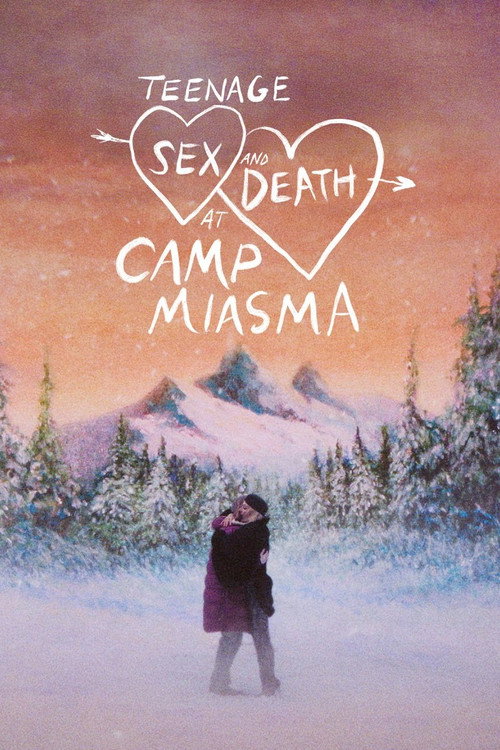
Teenage Sex and Death at Camp Miasma
2026 · Jane Schoenbrun
I Saw the TV Glow became the defining trans allegory of the era, adopted with religious intensity by its fandom; discourse about "the egg crack movie" and A24's handling of its release made Schoenbrun the most important new queer voice in American film.
For when you want your scary movie strange and smart — a midnight watch with friends who quote horror movies, or a solo trip when you're in the mood to be delighted and disturbed at once. Challenge over comfort, but a playful challenge.
What it's about
A young director is handed the job of resurrecting a dying summer-camp slasher franchise and goes looking for the original film's reclusive star — only to be pulled into a blood-soaked spiral of obsession, desire, and delirium. It's a horror movie about the people who make and worship horror movies: fandom, queer desire, and the pull of a fiction that won't stay on the screen.
The experience
Funny, horny, unnerving, and increasingly hallucinatory — it plays the slasher's rules for laughs and then makes you feel how much is actually at stake in loving something this much. Expect a film that keeps shifting under you, equal parts satire and fever dream.
The craft
Jane Schoenbrun works the slasher's most rule-bound conventions — the camp, the killer, the final girl — from the inside, folding a film-within-a-film structure into something dreamlike and sincere. The blend of lurid genre imagery with woozy, immersive atmosphere is their signature, and it rewards a dark room and good sound.
Why it matters
Schoenbrun's step from cult acclaim into full-blooded genre filmmaking, extending a run of films about how screen fictions colonize the people who love them — and a touchstone for the new queer horror.
Snapshot
Jane Schoenbrun's third narrative feature takes the most rule-bound form in American horror — the summer-camp slasher — and turns it into a story about the people who make and worship such films. The premise, as circulated in advance materials, is a doubling device: a young director is hired to revive a moribund slasher franchise, seeks out the original film's reclusive star, and is pulled into obsession and delirium. That is a horror film about horror-film authorship, and it arrives from a filmmaker whose first two features were already about the ways screen fictions colonize the people who love them too much.
A scholarly caution belongs at the top of this dossier rather than buried in it. As of this writing the production record for Camp Miasma is thin: Schoenbrun has discussed the project publicly since the 2024 release of I Saw the TV Glow, and the title, the slasher premise, and the director are established. Cast, crew, financing, shooting format, festival premiere, and critical reception are not matters I can report on with the confidence a dossier requires, and I will not manufacture them. What follows is therefore built from what is genuinely documented — Schoenbrun's prior work and stated method, their established collaborators, and the dense generic and industrial history the film deliberately enters — with extrapolations marked as such.
Industry & production
The film's premise is a report on the industry that produced it. American horror in the 2020s has been organized around the resurrection of dormant intellectual property: Halloween (2018), Scream (2022) — which coined "requel" inside its own dialogue — Candyman (2021), The Exorcist: Believer (2023), Texas Chain Saw, Hellraiser, and The Toxic Avenger all propose that a franchise's death is a temporary condition. The Friday the 13th series, the ur-text of the camp slasher, supplies the sharpest real-world rhyme: a copyright-termination dispute between screenwriter Victor Miller and the producing interests behind Sean S. Cunningham's original kept the property effectively frozen for the better part of a decade, after which a prequel series, Crystal Lake, was set up at Peacock with A24 producing and Bryan Fuller attached before his reported departure in 2024. A film about a young director handed the reins of a dying slasher franchise is not writing satire from imagination.
Schoenbrun's own trajectory is the other half of the industrial story. A Self-Induced Hallucination (2018) was an essay-documentary assembled entirely from YouTube videos about the Slender Man; We're All Going to the World's Fair (2021) was a microbudget feature shot with a skeleton crew and released by Utopia; I Saw the TV Glow (2024) premiered at Sundance and was released by A24, with Emma Stone and Dave McCary's Fruit Tree among its producers. That is an unusually fast ascent from no-budget experimental practice to a studio-adjacent specialty distributor, and Camp Miasma is the first Schoenbrun project conceived from the start inside genre machinery rather than at its margins. Whether that scale-up preserves the tactics that made the earlier films singular is the central production question, and it is also — pointedly — the film's own subject.
Technology
Two technological registers are in play, and both are legible from the premise even without production detail.
The first is format archaeology. The legacy sequel is structurally obsessed with its own archive: it must reproduce, quote, or fake footage from an earlier film, which means emulating the grain, gate weave, and color response of 1980s 16mm and 35mm, or the generational decay of VHS dubs through which most viewers actually encountered these movies. Schoenbrun's prior features are unusually literate in this area. World's Fair is built from webcam capture, screen recording, and the compression artifacts of streaming video; I Saw the TV Glow, shot by Eric K. Yue, reconstructs the look of a mid-1990s cable fantasy series — the interlaced CRT, the soft chroma bleed, the specific ugliness of a show watched late at night on a tube television — as an object of desire rather than nostalgia kitsch. A filmmaker with that particular fluency, handed a franchise premise, is being handed their own toolkit.
The second is the economics of gore. The slasher's signature technology is the practical effect, and the post-2010 revival has largely re-embraced prosthetic and squib work as a mark of authenticity against digital blood. The film arrives, too, into the 2025–26 industry's argument over generative tools and synthetic performance — an argument that bears directly on any film about resurrecting a dead franchise and its aging star, though I cannot report what position, if any, the production takes.
Technique
The paragraphs below extrapolate from the grammar Schoenbrun and their collaborators have established across two features and from what the premise structurally requires. They are not descriptions of scenes.
Cinematography
The Schoenbrun image is defined by artificial light treated as emotional weather: unmotivated magenta and cyan gels, glow sources placed inside the frame, faces lit by screens rather than by lamps. Where World's Fair worked in the low-light murk of a laptop camera, I Saw the TV Glow moved to a saturated, widescreen palette in which suburban parking lots and school hallways are washed in colors no fixture in the room could produce. The camp slasher offers a direct inheritance to work against: the 1980 Friday the 13th codified the roaming subjective camera, the long push through foliage, the tree-line held a beat too long. A film about a director remaking such a film has an obvious formal task — to quote that grammar and then expose it — and Schoenbrun's tendency to hold static, frontal compositions until they curdle is well suited to it.
Editing
Schoenbrun's cutting is patient to the point of provocation, built on held shots, hard cuts to black, and abrupt temporal jumps that skip years without announcement — the device that gives I Saw the TV Glow its devastating final movement. The slasher, by contrast, is a rhythm machine: the set piece's accelerating cross-cut, the false scare, the stinger. A film about making one is naturally an argument between these two clocks, and the film-within-a-film structure supplies the seam along which such an argument can be staged.
Mise-en-scène / staging
The summer camp is one of American horror's most fully coded spaces — bunk cabins, dock, dining hall, woods, lake — and its layout is so standardized that audiences navigate it in advance. Schoenbrun's production design sensibility runs to the uncanny theme-park version of a remembered place, all suburban interiors slightly too symmetrical, merchandise and ephemera arranged like relics. A camp set built for a film shoot inside the film is a natural extension: a real place that is also a facsimile of itself, with the crew's equipment visible at the edge of the frame.
Sound
Alex G (Alex Giannascoli) scored both prior features, and the resulting sound world — detuned guitar, room tone, songs placed as full performance interludes rather than underscore — is central to their effect. I Saw the TV Glow used its soundtrack as a structural element, giving entire scenes over to musical numbers in a way that has more in common with 1990s teen-film and New Queer Cinema needle-drop practice than with horror scoring. Slasher sound, meanwhile, is its own tradition of instruction: Harry Manfredini's ki-ki-ki, ma-ma-ma is the genre's most famous piece of pure signal, a cue that tells the audience what to feel before it shows them anything.
Performance
Schoenbrun directs toward flatness — performances that withhold catharsis, deliver feeling sideways, and let dissociation register as affectlessness rather than distress. Justice Smith and Brigette Lundy-Paine's work in I Saw the TV Glow is the model. The premise of Camp Miasma sets that register against another: the reclusive star, a figure who by definition belongs to a more theatrical performance tradition, and whose scenes with the young director are the film's structural core.
Narrative & dramatic mode
The tri-generic billing — Comedy, Horror, Romance — is not a marketing hedge; it names a real structure. The film's spine is the two-hander between a young fan-turned-author and the star of the thing they love, which is one of cinema's durable forms: Sunset Boulevard (1950), Whatever Happened to Baby Jane? (1962), and, most precisely, Olivier Assayas's Irma Vep (1996), in which a director attempting to remake a silent classic collapses under the weight of the original and of his fixation on its star. Around that spine runs the slasher's ritual machinery, which is not plot so much as liturgy: the transgression, the isolation, the sequence of deaths, the survivor. The comedy comes from the friction between the two — the industrial absurdity of making a body-count film on a schedule — and the romance from the fan's desire, which in this genre has never been cleanly separable from the wish to be consumed.
Genre & cycle
Three cycles converge. The camp slasher proper runs from Friday the 13th (1980) through The Burning (1981), Madman (1981), Sleepaway Camp (1983), and Cheerleader Camp (1988) — a subgenre that industrialized itself with remarkable speed, as Richard Nowell's Blood Money documents, targeting a youth audience with a formula whose economics were as rigid as its iconography.
The meta-slasher begins in earnest with Scream (1996), whose characters recite the rules, and continues through Behind the Mask: The Rise of Leslie Vernon (2006), The Cabin in the Woods (2011), The Final Girls (2015), and Ti West's X/Pearl/MaXXXine trilogy (2022–24), which is the nearest recent kin: horror about film production, aging stardom, and the murderous envy of the person who never got to be on screen. In a Violent Nature (2024) attacked the same material from the opposite direction, giving the film to the killer's tempo.
The third is queer and trans horror, and here the camp slasher carries specific freight. Sleepaway Camp's notorious final revelation has been read for four decades as a transmisogynist punchline, and it sits in the subgenre's foundations like a nail. A trans filmmaker making a camp slasher is, unavoidably, answering it. The surrounding scholarship — Harry Benshoff's Monsters in the Closet, the reclamation of A Nightmare on Elm Street 2: Freddy's Revenge, Carol Clover's account of the final girl as a figure of cross-identification — is the intellectual field the film enters.
Authorship & method
Schoenbrun's practice was formed outside narrative filmmaking: curatorial and programming work, the anthology series The Eyeslicer, and producing Collective:Unconscious (2016), in which five directors adapted one another's dreams. That background shows in an approach that treats found and secondhand material — creepypasta, YouTube confessionals, half-remembered children's television — as primary sources rather than references.
Their established collaborators form a stable unit: cinematographer Eric K. Yue and editor Sofi Marshall on I Saw the TV Glow, cinematographer Daniel Patrick Carbone on World's Fair, and Alex G scoring both. Schoenbrun writes their own scripts. Whether any of these collaborators carried over to Camp Miasma is not something I can confirm, and readers should not take the continuity as given.
Schoenbrun has publicly framed their features as a loose trilogy — the films track, across three registers, a movement from dissociation toward embodiment that they have connected to their own transition, and they have described Camp Miasma as the closing panel. The specific formulation varies across interviews and I paraphrase rather than quote.
Movement / national cinema
American independent cinema, in the branch that runs from New Queer Cinema through the internet-native work of the 2010s. Schoenbrun belongs to a cohort of trans filmmakers — Vera Drew's The People's Joker (2022), Jules Rosskam, Isabel Sandoval among them — who arrived with formally adventurous features in a compressed span, mostly through festivals rather than studio development. The other lineage is post-internet: cinema that takes the screen, the forum, and the parasocial relationship as its native material, where the horror is that a fiction might be more real than the body watching it.
Era / period
The film is a product of the mid-2020s American film economy: streaming contraction, theatrical release consolidated around horror and event pictures, a post-strike labor settlement still being tested, and IP exhaustion advanced enough to be a subject rather than a background condition. It also arrives during a period of intense and hostile political attention to trans life in the United States, which conditions how a trans-authored genre film is received regardless of its content.
Themes
Fandom as possession; the franchise as a haunted house that eats its tenants; the slasher's inherited moral arithmetic, in which sex is the offense and death the sentence — the equation the title states outright and presumably intends to detonate. Robin Wood's reading of horror as the return of the repressed and Vera Dika's formalist account of the stalker film in Games of Terror both bear on a film that treats generic rules as symptoms. Beneath these sits the theme Schoenbrun has pursued from the start: the terror and relief of recognizing yourself in something that was never meant to be about you.
Reception, canon & influence
I cannot summarize the film's critical reception; it has not entered the record in a form I can report, and any account of reviews, festival response, or commercial performance would be invention.
Backward. The lines of influence are unusually legible: Friday the 13th and Sleepaway Camp for the setting and its politics; Scream for self-aware genre; Sunset Boulevard and Irma Vep for the fan-and-star structure; Peeping Tom (1960) and Berberian Sound Studio (2012) for filmmaking as complicity in violence; Cronenberg's Videodrome and Lynch's Mulholland Drive for the media-body and the doubled performer; Gregg Araki and Todd Haynes for the register in which queer desire, pop music, and teenage apocalypse coexist.
Forward. Any claim about legacy would be speculation. What can be said is structural: if the film succeeds, it consolidates a position already visible in the 2020s — the art-horror feature that takes a disreputable subgenre seriously enough to inhabit it rather than ironize it — and it does so for a subgenre whose foundational text contains an injury to the filmmaker's own community. That is a rarer thing than a meta-slasher, and it is the ground on which the film will eventually be judged.
A Deleuzian reading
A body held in freeze-frame at the end of a summer-camp slasher, a man's dubbed voice laid over it.
The full Deleuzian reading of Teenage Sex and Death at Camp Miasma →
Reception
Premiered in Un Certain Regard at Cannes 2026, where it drew a six-minute ovation while, per Variety's own headline, 'confounding' the room; by its August MUBI release the consensus had hardened into 'Schoenbrun's best film yet,' with some calling it their first genuine masterpiece.
How Teenage Sex and Death at Camp Miasma was received, from release to now →
Influences: the films it descends from and the films it influenced
- Friday the 13th (1980) — The unassigned first-person prowl — Barry Abrams' handheld standing in for a killer the film refuses to identify until the Savini prosthetic reveal — plus the camp's cabin/lake/counselor geography, which the seed reoccupies as working architecture rather than parodying.
- Sleepaway Camp (1983) — The held final freeze-frame with a dubbed male voice laid over a trans body: the specific shot-and-sound construction that made the reveal a punchline, and the injury the seed's entire meta-structure is engineered to answer.
- Halloween (1978) — Dean Cundey's opening Panaglide take with the mask-eyehole matte established the roaming subjective camera as the slasher's default grammar — the device the seed inherits and then hands to a character who is making a film.
- Peeping Tom (1960) — The camera rig that kills what it photographs, collapsing the viewfinder image into the film's own frame, with Otto Heller's saturated non-naturalistic darkroom lighting — filmmaking as the instrument of the violence, not its witness.
- Sunset Boulevard (1950) — The two-hander of faded star and younger dependent, fixed by the private screening-room scene in which she watches her own old footage — the fan-and-star power structure the seed rebuilds as a shoot.
- Irma Vep (1996) — The remake-in-progress as narrative armature: handheld coverage of a production that keeps bleeding into the star's off-hours, resolving in a hand-scratched print made by the director inside the film.
- Videodrome (1983) — Rick Baker's breathing-television prosthetics plus the discipline of lighting a face by nothing but the screen it watches — the media object as sole light source, then as flesh.
- Mulholland Drive (2001) — One performer holding two versions of a woman without a cut to explain it, and Club Silencio's lip-sync — a musical interlude staged as an ontological rupture rather than a breather.
- Scream (1996) — Characters who recite the subgenre's rules from inside it, and a pre-title two-hander phone call sustained long enough to function as a self-contained short — the meta-slasher's opening move.
- Perfect Blue (1997) — Match-cuts that splice a performer's shoot into her private life until a given shot's diegetic layer is unlocatable, with the obsessive fan installed as the film's second protagonist.
- The Doom Generation (1995) — Flat unmotivated color-gel lighting on teenage faces against a wall of shoegaze needle-drops — the exact register in which queer desire, pop music and apocalypse share a frame without irony.
- Velvet Goldmine (1998) — The musical number as load-bearing structure: interludes that carry exposition and jump years, hung on a fan's investigation of the star he once worshipped.
- We're All Going to the World's Fair (2021) — Daniel Patrick Carbone's static screen-lit webcam framings and the treatment of secondhand internet material — creepypasta, confessional uploads — as primary source footage rather than quotation.
- I Saw the TV Glow (2024) — The direct template: Eric K. Yue's unmotivated pink and green gels, Sofi Marshall's elliptical year-skipping cuts, and Alex G's score with staged live performances used as chapter breaks.
- Knife+Heart (2018) — A queer film shoot stalked by a killer whose murders are lit in giallo gels and scored by M83 synth, with the film-within eventually screened back to the surviving crew as evidence.
- X (2022) — The crew shooting a movie on the property that kills them, cross-cut so that setups from the film-within rhyme frame-for-frame with the murders happening outside it.
- In a Violent Nature (2024) — The Friday the 13th grammar rebuilt as a scoreless third-person walk locked behind the killer's shoulder — the subjective slasher camera inverted into a formal constraint for the whole runtime.
Similar films
- I Saw the TV Glow (2024) — influence & lineage
- Videodrome (1983) — influence & lineage
- Scream (1996) — influence & lineage
- Strange Darling (2024) — shared sensibility
- The Substance (2024) — shared sensibility
- Leviticus (2026) — shared sensibility
- Smile (2022) — shared sensibility
- The Neon Demon (2016) — shared sensibility
All the films related to Teenage Sex and Death at Camp Miasma →