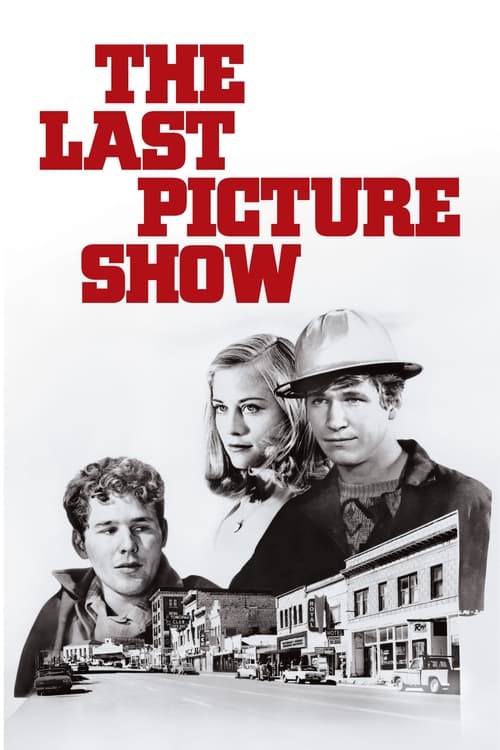
The Last Picture Show
1971 · Peter Bogdanovich
For a reflective, melancholy evening when you want to sit with a film about growing up, lost places, and lost time — comfort viewing for people who find sad things beautiful. Not one for a restless night; it asks for your patience and pays it back.
What it's about
In a wind-scoured Texas oil town in the early 1950s, two high school seniors and best friends — Sonny and Duane — drift through their last year before adulthood. Duane is dating the prettiest girl in town; Sonny stumbles into an affair with the football coach's lonely wife. Around them, everything that once held the place together — the pool hall, the café, the lone movie theater — is quietly dying, and both boys have to decide whether there's any life here worth staying for.
The experience
Slow, tender, and quietly devastating — a film of long silences, dusty streets, and small heartbreaks that accumulate until they land hard. It feels less like watching a story than remembering one, with an ache that stays with you after the lights come up.
Performances
Cloris Leachman is shattering as the coach's neglected wife — a performance of raw, unguarded loneliness — and Ben Johnson brings quiet, weathered gravity to Sam the Lion, the town's fading moral center. Jeff Bridges and Cybill Shepherd, both young here, are startlingly natural.
The craft
Shot in stark black and white at a time when color was the commercial default, and the choice is the whole mood: every frame looks like a memory of a town already gone. Bogdanovich channels the classic Hollywood westerns he loved as a critic while telling a story those films never could — frank about sex, boredom, and dead-end despair. The compositions are austere and beautiful; it rewards a dark room and full attention.
Why it matters
One of the defining films of the New Hollywood, it turned Peter Bogdanovich from film critic into major director overnight and proved that intimate, elegiac American stories could be both critically and commercially serious.
Snapshot
The Last Picture Show is the film that turned Peter Bogdanovich from a worshipful film critic into a major American director, and it remains the most fully realized act of cinematic mourning in the New Hollywood. Adapted from Larry McMurtry's 1966 novel, it chronicles a year in the life of Anarene (the novel's Thalia), a wind-scoured north Texas oil town in 1951–52, where high-school seniors Sonny and Duane drift toward adulthood as the institutions that once held the town together — the movie house, the pool hall, the café, the older generation's code of conduct — visibly die around them. Shot in austere black and white at a moment when color had become the commercial default, the film fuses the formal lessons of John Ford and Howard Hawks with a frankness about sex, boredom, and small-town despair that those classical masters could never have shown. It earned eight Academy Award nominations and won two, for Ben Johnson and Cloris Leachman in supporting roles, and it announced an entire ensemble — Timothy Bottoms, Jeff Bridges, Cybill Shepherd — to American audiences.
Industry & production
The picture emerged from the BBS Productions orbit, the Columbia-affiliated unit run by Bert Schneider, Bob Rafelson, and Steve Blauner that had just produced Easy Rider (1969) and Five Easy Pieces (1970). Stephen J. Friedman produced, and the project carried the low-budget, director-empowering ethos that made BBS the defining boutique of early New Hollywood: modest money, final-cut latitude, and youth-market instincts. Bogdanovich came to it from Roger Corman's stable, having made the ingenious low-budget thriller Targets (1968) and the documentary Directed by John Ford (1971); he was, crucially, a critic and cinephile first, steeped in the studio-era directors he had interviewed and programd.
The decisive creative partnership at the production's core was with Polly Platt, Bogdanovich's wife and production designer, who co-scouted locations, helped shape the casting, and is widely credited with discovering Cybill Shepherd on a magazine cover. McMurtry, a native of Archer City, Texas, co-wrote the screenplay with Bogdanovich, and the film was shot on location in Archer City itself, lending it a documentary fidelity to place. The shoot was famously charged: Bogdanovich began an affair with Shepherd during production, which ended his marriage to Platt — a personal rupture that has shadowed accounts of the film ever since. The film was a critical sensation on release and is generally understood to have been a strong commercial performer relative to its modest cost, though precise budget and gross figures vary across sources and should be treated cautiously.
Technology
Technologically the film is defined by a deliberate refusal of contemporary defaults. By 1971, black-and-white production had become rare enough in mainstream American features that shooting in monochrome was itself a statement, requiring the studio's acquiescence. The film was photographed in the near-square Academy aspect ratio rather than a wide anamorphic frame, reinforcing its evocation of the early-1950s pictures its characters watch. The choice of black-and-white stock, the controlled use of available and naturalistic light across harsh Texas exteriors, and the period-correct framing together constitute a kind of technological nostalgia — the apparatus deliberately set back two decades to match the world depicted. Bogdanovich has long credited Orson Welles, whom he knew well, with urging him to shoot in black and white, advice the director embraced as both an aesthetic and a moral discipline.
Technique
Cinematography
The cinematographer was Robert Surtees, a Hollywood veteran of enormous range whose credits stretched from MGM Technicolor spectacle (Ben-Hur) to The Graduate. His monochrome work here is the film's signature: high-contrast skies, dust and wind made visible, faces modeled in a hard, plain light that flatters no one and ages everyone. Surtees and Bogdanovich favored deep-focus compositions and long, patient takes, frequently framing characters small against the emptiness of the street or the flat horizon so that the town's desolation becomes a constant pressure within the image. The camera often holds at a respectful classical distance, and the visual rhyme between Anarene's streets and the Western landscapes of Ford is deliberate and sustained. The blacks are deep, the whites blown by the sun, the overall palette one of erosion.
Editing
Donn Cambern edited the film. The cutting is unhurried and observational, allowing scenes to play in extended duration rather than fragmenting them, which gives the ensemble room to breathe and lets the rhythms of boredom register as boredom. Set-piece sequences — the skinny-dipping party, the dance, the trip to Mexico (which the film elides, showing only the departure and the depleted return), Sam the Lion's death, and the climactic accident — are handled with restraint, the emphasis falling on reaction and aftermath rather than on action. A restored director's cut released in the early 1990s reinstated several minutes of footage, slightly altering the film's proportions while preserving its measured tempo.
Mise-en-scène / staging
Platt's production design renders Anarene as a place of peeling paint, near-empty interiors, and a few load-bearing public spaces — the picture house, the pool hall, the all-night café — whose decline is the film's true plot. The staging is theatrical in the best sense: Bogdanovich blocks his actors in sustained group compositions, letting glances and physical proximity carry meaning. The recurring motif of the movie marquee, the football field, the dusty main street, and the windblown emptiness organizes the film geographically around institutions that are failing. The final image of the shuttered theater, its last show played out, gives the title its full elegiac weight.
Sound
There is essentially no orchestral score. Instead the soundtrack is built almost entirely from period diegetic music — Hank Williams above all, alongside other early-1950s country and pop heard on car radios, jukeboxes, and from the bandstand. This wall-to-wall source music functions as both historical texture and emotional commentary, the radio acting as a continuous, plaintive voice of the era. Equally important is the film's use of environmental sound: the omnipresent Texas wind, scratchy radio broadcasts, and stretches of silence that make the town's isolation audible. The strategy is one of the most influential aspects of the picture's design.
Performance
The ensemble playing is the film's glory. Timothy Bottoms gives Sonny a watchful passivity; Jeff Bridges makes Duane's swagger thin and vulnerable; Cybill Shepherd, in her screen debut, plays the manipulative beauty Jacy with an unsettling self-possession. Ben Johnson — a former stuntman and Ford/Hawks stock player — anchors the film as Sam the Lion, the dignified custodian of the town's vanishing values, and Cloris Leachman, as the coach's neglected wife Ruth Popper, delivers the film's emotional climax in a final scene of raw, halting tenderness. Both won Academy Awards. Ellen Burstyn (as Jacy's worldly mother), Eileen Brennan, Clu Gulager, Randy Quaid, and Sam Bottoms round out an ensemble of unusual depth and naturalism.
Narrative & dramatic mode
The film operates in a novelistic, ensemble register rather than as a tightly goal-driven plot. Its mode is the chronicle: a community observed across roughly a year, structured by the rhythms of the school calendar, the seasons, and a series of departures and deaths. Causality is loose and lifelike; the dramatic engine is less "what will happen" than "what is being lost." Sex functions as the principal currency of power and disappointment — between Sonny and Ruth, Duane and Jacy, and across the town's tangled adulteries — and the film treats it with a candor that was startling in 1971 yet never prurient. The tonal mode is elegiac realism, balancing wry humor against a deepening sorrow, and the narrative withholds catharsis: the young leave or stay, the old die, and the picture show simply closes.
Genre & cycle
Formally it is a coming-of-age drama and small-town melodrama, but its deeper genre allegiance is to the Western in its twilight. Anarene is the frontier town after the frontier has died, and the film consciously summons the iconography of Ford's West only to show it depopulated and exhausted. It belongs to the early-1970s cycle of revisionist, anti-mythic American films that interrogated the national past, and within the BBS filmography it sits beside Five Easy Pieces as a study of alienation and arrested lives. It also participates in a small but potent cycle of self-consciously nostalgic films — works about moviegoing and the loss of an older America — that the film itself helped to inaugurate.
Authorship & method
Bogdanovich's authorship is that of the critic-turned-director: his method was citation and homage transmuted into personal expression. He framed the town like Ford, paced scenes like Hawks, and took the black-and-white discipline from Welles, yet the synthesis is wholly his own and wholly serious. His collaborators were essential to the result. McMurtry supplied the world and co-authored the script, ensuring fidelity to Texas vernacular and to the novel's unsentimental view of its characters. Surtees translated the directors' shared cinephilia into images of erosion and light. Polly Platt built the physical world and shaped the casting, an authorial contribution that later scholarship has worked to restore to its proper prominence. Cambern's editing gave the chronicle its breathing room. There is no credited composer in the conventional sense; the "score" is curated period music, an authorial choice as consequential as any image.
Movement / national cinema
The film is a cornerstone of the American New Wave — the New Hollywood of roughly 1967–1980 — in which a generation of directors, many of them critics, film-school graduates, or Corman alumni, seized creative control from a faltering studio system. Within that movement Bogdanovich occupies a distinctive position: where contemporaries pushed toward European modernism or countercultural energy, he looked backward, channeling the classical Hollywood grammar he revered into a fully modern sensibility. As a work of American national cinema it is deeply regional, rooted in a specific Texas landscape and idiom, and it stands as one of the New Hollywood's most penetrating portraits of the American interior.
Era / period
Set in 1951–52, the film is a precise period reconstruction made in 1971, and the twenty-year gap is the source of its meaning. The early-1950s setting captures a hinge moment in American life — the Korean War drawing young men away, television beginning to empty the movie houses, the postwar oil economy unable to hold the small town together. The film's monochrome and its Academy framing literalize the period; its candor about sex and its mood of disenchantment belong unmistakably to 1971. The encounter between the two eras — the remembered past and the disillusioned present looking back at it — gives the film its doubled, melancholy vision.
Themes
The governing theme is loss: of youth, of community, of an older moral order embodied by Sam the Lion, and of the movies themselves as a shared public ritual. The closing of the picture show is the master metaphor — the screening of Hawks's Red River (a film starring the very actors of the classical Western tradition) marking the end of an era of communal myth-making. Sexuality runs through the film as both liberation and cruelty, a means by which the bored and the trapped wound one another. Mortality is constant, from Sam's sudden death to the devastating accident that befalls the mute boy Billy at the close. Above all the film mourns the death of a particular America — agrarian, communal, and unironic — and the spiritual emptiness left in its place.
Reception, canon & influence
Critically the film was received as a major event and as the arrival of a significant director; it drew eight Academy Award nominations, including Best Picture and Best Director, and won Best Supporting Actor (Johnson) and Best Supporting Actress (Leachman). It has since entered the canon of essential New Hollywood films and is routinely cited among the finest American films of the 1970s.
Its lines of influence run conspicuously backward. The film is a tissue of homage to John Ford (composition and landscape), Howard Hawks (pacing, and the literal screening of Red River), and Orson Welles (the black-and-white discipline Bogdanovich attributed to Welles's counsel). McMurtry's novel supplied the substance, and the classical Hollywood studio film — the very thing whose passing the story laments — is its deepest source.
Forward, its legacy is broad. It validated black-and-white as a living artistic option in the color era, influencing later filmmakers who chose monochrome for expressive or nostalgic effect. Its strategy of scoring a film entirely with period source music shaped countless subsequent soundtracks. As a regional ensemble chronicle of small-town American decline, it stands behind a long tradition of independent and American-indie filmmaking devoted to the overlooked interior of the country. Bogdanovich and McMurtry reunited the principal cast two decades later for Texasville (1990), adapting McMurtry's sequel, though that film never approached the original's stature. The Last Picture Show endures as the New Hollywood's great elegy — a modern film about the death of the movies, made with total command of the classical language it mourns.
A Deleuzian reading
Start with the wind.
The full Deleuzian reading of The Last Picture Show →
Reception
No reappraisal needed — it landed in 1971 as an instant classic, with critics comparing its arrival to Citizen Kane's and eight Oscar nominations to show for it. What's shifted is the frame: it's now read as the bittersweet peak Bogdanovich never climbed back to.
How The Last Picture Show was received, from release to now →
Influences: the films it descends from and the films it influenced
- Citizen Kane (1941) — Gregg Toland's deep-focus compositions holding foreground and background in equal sharp relief, the technique Bogdanovich and Surtees adopt to let whole rooms and the empty main street register at once.
- The Magnificent Ambersons (1942) — Welles personally counseled Bogdanovich on the black-and-white discipline, and his elegiac monochrome chronicle of a community dying as the modern world arrives is the direct template for Picture Show's mournful tone.
- The Grapes of Wrath (1940) — Ford and Toland's marriage of regional American hardship to deep-focus, source-lit interiors gives Bogdanovich the model for framing the dispossessed against eroding landscape.
- My Darling Clementine (1946) — Ford's frontal, architecturally austere compositions of a frontier main street—people small against weathered false-front buildings—are restaged as Anarene's wind-scoured town center.
- How Green Was My Valley (1941) — Ford's monochrome elegy for a vanishing working community, narrated as remembered loss, supplies the elegiac-realist register Bogdanovich applies to a dying Texas town.
- Red River (1948) — Literally screened inside the film as the last picture show, and Hawks's unhurried, behavior-driven scene pacing is the rhythm Bogdanovich consciously imitates.
- The Best Years of Our Lives (1946) — Wyler and Toland's deep-focus staging of multiple overlapping ensemble lives in long takes, without cutting to isolate, models Picture Show's group-blocked naturalism.
- Hud (1963) — Adapted from McMurtry's own Texas fiction, James Wong Howe's stark black-and-white widescreen images of small-town anomie prefigure the same author's world rendered in monochrome erosion.
- The Man Who Shot Liberty Valance (1962) — Adopted Liberty Valance's deliberate black-and-white, withheld-grandeur monochrome as an elegy for a vanishing frontier and the picture-house that mythologized it.
- The Misfits (1961) — Black-and-white elegy for a dying Western town, using austere anti-picturesque monochrome and empty compositions to grieve obsolescence in the mode The Misfits set.
- American Graffiti (1973) — Extends Picture Show's strategy of scoring an entire film with curated period source music and structuring it as a one-night, multi-character coming-of-age chronicle of a town about to change.
- Paper Moon (1973) — Bogdanovich's own follow-on, again shooting period America in expressive black-and-white and extending his critic's method of transmuting classical-Hollywood citation into personal style.
- Manhattan (1979) — Inherits the validation of black-and-white as a living artistic choice in the color era, using Gordon Willis's monochrome for nostalgic, romantic effect rather than economy.
- Raging Bull (1980) — Directly benefits from Picture Show reopening expressive black-and-white as a serious option for a major color-era production seeking the texture of a vanished period.
- Dazed and Confused (1993) — Carries forward the wall-to-wall period-source-music soundtrack fused to a plotless, large-ensemble coming-of-age chronicle of small-town youth across a single span of time.
- Nebraska (2013) — Revives the black-and-white regional ensemble chronicle of small-town American decline, framing depopulated Plains main streets with the same elegiac, deadpan realism.
- Hell or High Water (2016) — Bogdanovich's use of anamorphic framing on empty West Texas main streets to make institutional decay spatial and legible — storefronts, vacant lots, shuttered businesses as evidence of a dying economy — is the grammar Nuttgens's color location photography directly inherits.
- Brokeback Mountain (2005) — McMurtry's other defining adaptation, it models the elliptical, compressed-chronicle structure of a hard rural community where longing is starved by terrain and time — the same regional terseness McMurtry and Ossana preserved from Proulx.
- Stand by Me (1986) — Small-town period ensemble of adolescents shot in plain, classical, unfussy framing with a diegetic radio/pop soundscape standing in for an orchestral score.
- What's Eating Gilbert Grape (1993) — The dead-end dying-town tableau and the 'young man trapped by place and family' structure, staged in deep-focus frames of a community going nowhere.
- The Holdovers (2023) — Meticulous period recreation and elegiac small-community loneliness, shot with a restrained, near-monochrome austerity that models Holdovers' 'made-in-1970' surface.
- Breaking Away (1979) — Models the naturalistic, on-location portrait of a declining American town where restless working-class kids have nothing to do but wait, using real regional geography rather than sets as the emotional register.
- McCabe & Mrs. Miller (1971) — Released the same year as the other great New Hollywood revisionist-western experiment in immersive period reconstruction, deglamorizing the frontier through texture and weather rather than myth.
- Five Easy Pieces (1970) — A BBS-stable companion built on naturalistic ensemble performance and regional American drift, where character is revealed through aimless behavior in overlooked locales.
- The Graduate (1967) — Bogdanovich and László Kovács deploy New Hollywood telephoto work and discontinuous editing to fracture a coming-of-age arc that refuses resolution, both films ending on faces emptied of the emotions the genre promised — the treadmill-effect of characters arriving nowhere structuring both films' final beats.
Similar films
- American Graffiti (1973) — influence & lineage
- How Green Was My Valley (1941) — influence & lineage
- Nebraska (2013) — influence & lineage
- McCabe & Mrs. Miller (1971) — influence & lineage
- The Grapes of Wrath (1940) — influence & lineage
- Paper Moon (1973) — influence & lineage
- There Will Be Blood (2007) — same viewing thread
- Manhattan (1979) — influence & lineage · often watched together
All the films related to The Last Picture Show →
Watch it with: curated runs of related films
- The Frontier's Long Shadow — A run of American myths going to seed — outlaws, oilmen, and foreclosed ranchers set against big country that outlasts them all; watch them close together and the classic Western slowly dissolves into its elegiac modern kin.