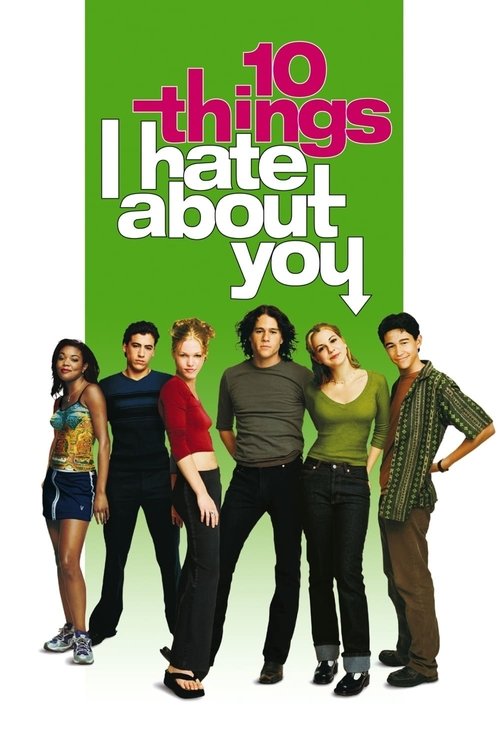
10 Things I Hate About You
1999 · Gil Junger
For when you want pure feel-good — a rewatchable crowd-pleaser for a night in with friends, a breakup recovery, or anytime you need to believe in the grand gesture.
What it's about
New kid Cameron falls hard for Bianca on day one at his Seattle high school, but house rules say she can't date until her older sister does — and Kat Stratford, brilliant and furious at the entire social ladder, has no intention of dating anyone. The scheme: pay the school's resident bad boy to take Kat out. It's The Taming of the Shrew smuggled into a nineties teen comedy, except this time the shrew isn't tamed — she's understood.
The experience
Fast, quotable, and sneakily tender — a comedy that runs on banter and big romantic gestures but keeps landing real feeling underneath. You'll laugh most of the way through and get caught off guard by the moments that aren't joking.
Performances
Julia Stiles gives Kat real teeth and real wounds — ferocious without ever becoming a cartoon — and Heath Ledger, in his American breakthrough, is so effortlessly magnetic that a single serenade with a marching band became one of the teen canon's defining romantic moments.
The craft
Karen McCullah and Kirsten Smith's script does smart surgery on Shakespeare, keeping the plot machinery while flipping its politics, and the dialogue crackles line to line. Shot largely at Tacoma's castle-like Stadium High School, it gives the genre an unusually grand, storybook setting.
Why it matters
A high-water mark of the late-nineties teen-Shakespeare wave, it launched Heath Ledger in America, cemented Julia Stiles as the era's thinking-person's teen lead, and remains one of the most beloved and rewatched comedies of its decade.
The Taming of the Shrew relocated to a Seattle high school named, with a wink, Padua — the sharpest entry in the late-nineties wave of teen Shakespeare that Clueless made possible. Screenwriters Karen McCullah and Kirsten Smith perform the crucial surgery on the source: the shrew is no longer tamed but understood, and Kat Stratford — Julia Stiles, ferocious and wounded — becomes a riot-grrrl heroine whose contempt for the social ladder is the film's moral center. Around her, Gil Junger marshals a murderer's row of about-to-be-famous faces, none more magnetic than Heath Ledger in his American breakthrough, whose bleacher-storming serenade of 'Can't Take My Eyes Off You,' marching band in tow, remains one of the great romantic gestures in the teen canon. Shot largely at Tacoma's castle-like Stadium High School, the film has the architecture of a fairy tale and the mouth of a screwball comedy. Its title poem, read aloud in a classroom, still lands like a dare: sincerity, played absolutely straight, right at the moment irony ruled.
Reception
A solid-but-unspectacular hit in 1999, filed alongside the era's other teen Shakespeare updates — it has since climbed to consensus status as maybe the best teen movie of its generation, a comfort-watch canon fixture rather than a nostalgia curio.
How 10 Things I Hate About You was received, from release to now →
Influences: the films it descends from and the films it influenced
- Clueless (1995) — Established the template the McCullah–Smith screenplay copies: transpose a canonical literary text into fluent contemporary high-school vernacular (Austen's Emma), turning a period comedy of manners into idiomatic teen slang.
- The Taming of the Shrew (1967) — The direct source play in modern-dress form — the younger-sister-gated courtship and the suitor paid to woo the 'shrew,' which the screenplay converts into Padua High's 'nobody dates Bianca until Kat dates.'
- His Girl Friday (1940) — Supplies the screwball register of courtship-as-verbal-combat: rapid, overlapping, antagonistic dialogue as the primary romantic idiom, which Stiles and Ledger play out as sparring.
- Say Anything… (1989) — Model for the grand diegetic musical serenade as romantic gesture (Lloyd's raised boombox), reworked here as Patrick's stadium-bleacher PA-system 'Can't Take My Eyes Off You.'
- West Side Story (1961) — Precedent for relocating Shakespeare into contemporary American youth idiom and staging its emotional beats through musical performance rather than verse.
- Heathers (1988) — Source of the acidic register of teen social-hierarchy contempt and the smart, wounded heroine who regards the clique system with open disdain — theme/social-hierarchy-contempt in caustic form.
- Roxanne (1987) — Modern-dress literary-courtship adaptation (Cyrano) built on the go-between / paid-intermediary deception that structurally mirrors Patrick's bankrolled wooing.
- Pretty in Pink (1986) — The Hughes ensemble grammar of caste-stratified high school (richies vs. outsiders) and the wounded-outsider heroine whose social geography the film inherits wholesale.
- O (2001) — Extends the Shakespeare-in-high-school adaptation model directly, relocating Othello into American prep-school basketball with the tragic jealousy plot intact.
- Get Over It (2001) — Heir to the formula, staging A Midsummer Night's Dream as a high-school play-within-the-film and mining the same literary-source-meets-teen-romance comedy.
- She's the Man (2006) — The most direct heir: Twelfth Night transposed to high-school soccer, replicating the Shrew-in-high-school method of gender-combat courtship from a Shakespeare comedy.
- Easy A (2010) — Carries forward the source-revision plus sincerity-against-irony wit, framing The Scarlet Letter through a literate, self-aware teen heroine-narrator descended from Kat's acerbic intelligence.
- Ghost World (2001) — Extends the ferocious-wounded, riot-grrrl-adjacent outsider heroine — Enid's caustic anti-conformist stance is the Kat Stratford mode pushed toward deadpan alienation.
- Mean Girls (2004) — Builds a teen comedy on covert canonical-text adaptation (Shakespeare's Shrew), the strategy of smuggling a structural argument inside genre pleasure.
- To All the Boys I've Loved Before (2018) — Pairs a transactional-courtship premise (a boy paid to date the reluctant girl) with banter-driven, chemistry-forward two-handers — the casting-chemistry-over-style calculus TATBILB treats as its decisive creative act.
- Anyone but You (2023) — Set the template of modernizing a Shakespeare comedy (here The Taming of the Shrew) into a glossy, pop-scored studio rom-com pitched at a broad young audience.
- Finding Emily (2026) — The school as a closed economy in which a courtship is commissioned and paid for, and a climax that forces the private text — the poem — into compulsory public performance: the private-to-public exposure beat in its campus form.
- She's All That (1999) — Same 1999 teen cycle transposing a literary source (Pygmalion/My Fair Lady) into high school via a bet-driven makeover romance — the parallel 'boy manipulated into courtship' engine.
- Cruel Intentions (1999) — The same-year classic-text-into-teens wave: Laclos's Les Liaisons Dangereuses recast as prep-school seduction, sharing the source-adaptation-revision strategy.
- Never Been Kissed (1999) — Same late-nineties teen-comedy cohort built around a witty, wounded female lead whose sincerity finally defeats the school's performed cool.
- How to Lose a Guy in 10 Days (2003) — Shares the paid/instrumental-courtship con sustained by concealed motive — the wooer has a hidden professional agenda the target doesn't know, generating the same dramatic-irony tension.
Similar films
- The Perks of Being a Wallflower (2012) — same viewing thread
- Fast Times at Ridgemont High (1982) — same viewing thread
- West Side Story (1961) — influence & lineage · often watched together
- Twilight (2008) — shared sensibility
- Girls Like Girls (2026) — shared sensibility
- Heathers (1989) — shared sensibility
- Lady Bird (2017) — shared sensibility
- Flipped (2010) — shared sensibility
All the films related to 10 Things I Hate About You →
Watch it with: curated runs of related films
- Restless Youth, Rigid Walls — Watch these as one long walk through the school years — the teachers who crack you open, the friends who pull you off the sidelines, the first loves and the institutions you push against — where a beloved tearjerker and a surreal boarding-school revolt turn out to be cousins.