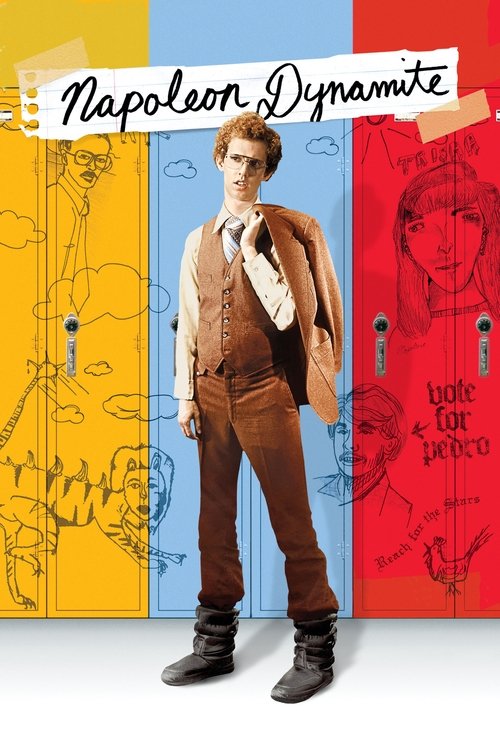
Napoleon Dynamite
2004 · Jared Hess
For when you want to laugh at pure weirdness with zero stakes — ideal with friends, quotable for weeks afterward. Total comfort, of a very specific flavor.
What it's about
Napoleon is a gangly, perpetually exasperated teenager in small-town Idaho, enduring high school alongside a moon-boot-wearing grandma, a delusional ex-jock uncle, and a brother who lives in internet chat rooms. When his quiet new friend Pedro decides to run for class president, Napoleon throws his peculiar talents behind the campaign — such as they are.
The experience
Deadpan to the point of surreal — the jokes arrive with a flat stare and dead air, and either you fall into its rhythm and laugh helplessly or you sit there baffled. There's an odd sweetness underneath all the awkwardness.
Performances
Jon Heder's Napoleon is a fully committed comic creation — the sighs, the slack posture, the wounded 'gosh!' — a character so specific he instantly entered the cultural bloodstream.
The craft
Jared Hess builds the comedy from framing and timing rather than punchlines: symmetrical shots of drab rooms, thrift-store production design that scrambles the decades, and a refusal to ever signal the joke. The climactic dance sequence is a small masterpiece of payoff.
Why it matters
A defining Sundance-to-phenomenon story of the mid-2000s, it became one of the era's great cult comedies, spawned a thousand 'Vote for Pedro' shirts, and stamped its deadpan style on a generation of indie humor.
Snapshot
Napoleon Dynamite is a deadpan small-town comedy that became one of the defining cult objects of the mid-2000s American independent scene. Built around a gangly, mouth-breathing, perpetually exasperated Idaho teenager, the film abandons conventional plot momentum in favor of texture, rhythm, and a meticulously curated atmosphere of rural anachronism. It follows Napoleon (Jon Heder) through the small humiliations of high school as he half-heartedly helps his quiet immigrant friend Pedro run for class president, while contending with a household run by an absent-minded grandmother, a delusional ex-jock uncle, and a chat-room-addled older brother. The film's comedy is almost entirely a matter of register: flat affect, dead air, and a refusal to signal jokes. It emerged from the Sundance Film Festival in January 2004, was acquired by Fox Searchlight in partnership with MTV Films and Paramount, and went on to a theatrical run wildly disproportionate to its micro-budget origins, becoming a merchandising and quotation phenomenon ("Vote for Pedro," "Gosh!") that arguably outgrew the film itself.
Industry & production
The film is a textbook case of the festival-era American indie: a near-amateur production, made cheaply and locally, that was scaled up by a studio specialty division. It grew directly out of Peluca (2003), a black-and-white short Jared Hess made as a student at Brigham Young University, which already featured Jon Heder as a proto-Napoleon figure. Hess and his wife and co-writer Jerusha Hess expanded the short's world into a feature, shooting in and around Hess's hometown of Preston, Idaho, using local locations, regional non-actors in supporting roles, and a tiny crew.
The picture was produced under the Napoleon Pictures Limited banner by Jeremy Coon, Sean Covel, and Chris Wyatt, several of them BYU-connected collaborators. Its budget is widely reported at roughly $400,000 — the kind of figure that places it firmly in the no-budget tier — and it was shot in a compressed schedule. The film premiered at Sundance in 2004 (the same edition that surfaced other quirk-inflected indies), where it generated strong word of mouth and was picked up by Fox Searchlight Pictures, with MTV Films and Paramount involved in the wider release. Searchlight's platform-release strategy — opening narrow, then widening as the cult built — proved ideally suited to a film whose appeal was driven by repeat viewing and quotation. The eventual domestic gross is reported well above $40 million, an enormous multiple on the production cost, though as with many indie successes the precise figures should be treated as approximate. The salary lore around the film — notably that Heder was paid a nominal sum and later renegotiated a profit participation — is part of its mythology; the exact terms are not something I can verify here and I'll flag it rather than assert it.
Technology
Napoleon Dynamite was shot photochemically on 35mm film rather than digitally, a choice consistent with its early-2000s indie milieu and its cinematographer's training. The technological story here is less about novel equipment than about how unremarkable, available means were marshaled to produce a very specific, slightly degraded-looking palette: muted, sun-bleached, faintly institutional colors that read as both contemporary and stuck in an earlier decade. The film does not deploy visual effects, elaborate camera rigs, or coverage-heavy digital workflows; its technological signature is restraint. If there is a "device" at the center of the film, it is anachronism itself — Tupperware, moon boots, tetherball, a chat room, a time machine bought online — props that scramble the viewer's sense of when, exactly, the story is set. I won't overstate the technical specifics of format and stock beyond the established fact that it was a 35mm production, as the granular camera details are not something I can confirm precisely.
Technique
Cinematography
Cinematographer Munn Powell is central to the film's identity. The visual grammar is built on frontal, often symmetrical, locked-off or near-static framing: characters are planted dead-center or balanced against flat backgrounds — a brick wall, a chain-link fence, a beige interior — and held there. The compositions are deliberately a little graceless, refusing the soft, flattering coverage of mainstream comedy. Powell and Hess favor wide and medium shots that isolate figures in unglamorous space, with a palette of dusty pastels, fluorescent interiors, and high-plains daylight. The effect is tableau-like; the frame becomes a kind of deadpan diorama in which awkwardness can sit, undisturbed, for an uncomfortably long beat. This frontality has invited comparison to Wes Anderson's symmetries, but Hess's version is rougher and more vernacular — closer to a yearbook photo or a regional commercial than to Anderson's storybook precision.
Editing
Editor Jeremy Coon (also a producer on the film) cuts against the reflexes of comedy. Where conventional comic editing trims to the joke and punches out, Napoleon Dynamite lingers: shots are held past the point of comfort, reactions are allowed to curdle, and pauses are treated as content rather than dead weight. The rhythm is patient and slightly stilted, which is precisely where the humor lives — in the gap between a line and any response to it. The film is also episodic in construction, strung together from vignettes rather than driven by a tight causal chain, and the editing embraces that looseness, letting set pieces (the dance, the llama, Uncle Rico's videos) stand as discrete bits.
Mise-en-scène / staging
Production and costume design do enormous narrative work. The wardrobe — Napoleon's "moon boots" and graphic tees, Kip's cyber-casual, Uncle Rico's tracksuits and feathered hair, Deb's side-ponytail — collapses several decades into one indeterminate present, locating the characters in a small-town time-warp where the 1980s never fully ended. Interiors are crowded with period-ambiguous bric-a-brac; the staging keeps actors at a slight remove from one another, emphasizing social misfit and physical awkwardness. Hess composes with negative space and dead center, so bodies look marooned. The overall design articulates the film's thesis without dialogue: this is a place out of time, and its inhabitants are out of step with it.
Sound
Sound design is sparse and dry, with naturalistic ambience and a notable willingness to let silence hang. The music, by contrast, is one of the film's great pleasures and is split between John Swihart's original score and a curated bed of pop needle-drops. The most famous of these is Jamiroquai's "Canned Heat," to which Napoleon performs his climactic dance — a sequence that became the film's signature image. Other licensed tracks (including 1980s-flavored pop) reinforce the anachronistic mood. Dialogue delivery is itself a sonic strategy: the cast speaks in flat, regional, often muttered cadences, with Heder's nasal, put-upon exhalations functioning almost as a percussion line.
Performance
The acting style is uniformly deadpan and is the film's true special effect. Jon Heder's Napoleon — sighing, slit-eyed, perpetually annoyed, given to non sequitur boasts — is a fully realized comic creation built from posture, vowel sounds, and exasperation. Around him, Efren Ramirez plays Pedro with an almost affectless stillness that becomes its own kind of charisma; Jon Gries makes Uncle Rico a poignant monument to arrested adolescence; Aaron Ruell's Kip is sweetly oblivious; Tina Majorino's Deb supplies a note of genuine tenderness; and Sandy Martin, Diedrich Bader, Haylie Duff, and Shondrella Avery round out the ensemble. Crucially, none of the performers wink. The commitment to non-reaction — playing absurdity as if it were the most ordinary thing in the world — is what allows the comedy to feel discovered rather than delivered.
Narrative & dramatic mode
The film operates in a plotless or anti-plot mode. There is a nominal A-story — Pedro's campaign for class president, capped by a talent-show finale — but it is deferred for most of the running time in favor of accumulation: scenes that exist to establish character, texture, and gag rather than to advance stakes. The dramatic mode is closer to the comic vignette tradition than to the goal-driven teen movie. Tension, where it exists, is social and low-grade (embarrassment, exclusion, sibling friction) rather than narrative. The film's emotional payoff — Napoleon's dance, which wins Pedro the election and, more importantly, redeems Napoleon's own marginality — works precisely because so little has been overtly "built toward" it; the catharsis feels like a gift rather than a mechanism. This privileging of mood and character over story is a defining trait and a frequent point of both praise and complaint.
Genre & cycle
Napoleon Dynamite sits at the intersection of the high-school comedy and the American "quirk" indie. It belongs to a mid-2000s cycle of festival-launched comedies defined by deadpan tone, curated soundtracks, ironic-yet-affectionate regionalism, and protagonists who are social outsiders. Within the teen-comedy lineage it is anomalous: it has no romance plot to speak of, little raunch, and an essentially chaste, gentle sensibility. Against the gross-out teen films dominant in its moment, it reads as almost wholesome — its rebellion is tonal, not transgressive. It also participates in a broader strain of American comedy interested in losers, dreamers, and the texture of unglamorous places.
Authorship & method
The film is the product of a genuine writing-and-directing partnership: Jared Hess directed and co-wrote with Jerusha Hess, and the two would continue collaborating on subsequent features. Their method here is rooted in autobiography and place — Preston, Idaho is not a backdrop but a subject — and in the conversion of a student short (Peluca) into a feature by deepening rather than complicating its world. The key collaborators reinforce this sensibility: cinematographer Munn Powell, whose frontal compositions are inseparable from the comedy; editor and producer Jeremy Coon, whose patient cutting gives the deadpan room to breathe; and composer John Swihart, whose score sits alongside a memorable pop soundtrack. The casting of Jon Heder — who had already played the character in embryo — makes the actor effectively a co-author of the persona. Hess's signature, visible across his later work, is this combination of symmetrical, slightly amateurish framing; affectless performance; and an affectionate fascination with eccentric, marginal masculinity.
Movement / national cinema
The film is a product of two overlapping American formations. The first is the Sundance-era independent specialty market of the late 1990s and 2000s, in which small films were discovered at festivals and distributed by studio boutique arms. The second, more specific, is the Brigham Young University / Latter-day Saint filmmaking milieu from which Hess emerged: a regional, often family-centered, generally clean comedic sensibility associated with Mormon cultural production of the period. While the film is not overtly religious, its gentleness, its absence of sex and profanity, and its rooted sense of intermountain-West place all bear traces of that context. It is, in a real sense, a film of the American rural West — Idaho specifically — rather than of the coastal indie capitals.
Era / period
Napoleon Dynamite is firmly a film of 2004, even as it works hard to feel placeless in time. Its moment is the post-Garden State, peak-quirk indie comedy years, when deadpan tone and curated soundtracks became a recognizable — and soon heavily parodied — house style. Within the film, however, period is deliberately scrambled: the technology and fashions suggest a small town where time runs slow, the 1980s linger, and modernity arrives only in glitchy fragments (a chat room, an online purchase). This tension — a 2004 film about a place that feels like 1986 — is essential to its meaning, and it is part of why the film aged into a nostalgia object so quickly.
Themes
At its core the film is about alienation and belonging in a place that offers little to its outsiders. Its recurring concerns include: arrested development and the persistence of adolescent fantasy (Uncle Rico's endless replaying of a high-school football glory that never was, Kip's online romance, Napoleon's tall tales); the dignity and absurdity of the misfit; small-town stasis and the dream of escape; and the quiet redemptive power of loyalty and kindness — Napoleon's friendship with Pedro and Deb, and the dance he performs not for himself but to help a friend. Masculinity is a persistent subject, almost always in its thwarted or deluded forms. Underneath the comedy runs a genuine tenderness toward people the wider culture would dismiss, which is the film's most durable quality and the reason its affection reads as earned rather than condescending — though some critics have argued the opposite, that the film invites laughter at its rural subjects.
Reception, canon & influence
Critical reception was divided in a revealing way. Many reviewers embraced the film's originality, its deadpan precision, and Heder's performance; others found it smug, plotless, or condescending toward its small-town characters — a debate about whether the film loves or mocks its world that has never fully resolved. Whatever the critical split, the popular response was overwhelming: the film became a quotation engine and a merchandising phenomenon, with "Vote for Pedro" T-shirts and catchphrases entering wide circulation, and the Jamiroquai dance becoming a piece of pop-cultural shorthand.
Looking backward, the film's influences are legible: the symmetrical, tableau-based deadpan recalls earlier comic stylists (the static frontality and absurdist flatness have antecedents in figures like Wes Anderson and, further back, the deadpan lineage running through Buster Keaton and Jim Jarmusch), while its regional, character-study impulse draws on the American independent tradition. Its most direct ancestor, though, is Hess's own short Peluca.
Looking forward, Napoleon Dynamite helped crystallize — and ultimately exhaust — the "quirky indie" aesthetic that proliferated in the mid-to-late 2000s, influencing a wave of deadpan comedies and a recognizable advertising and music-video style. It launched Jared and Jerusha Hess's feature careers (leading to Nacho Libre and Gentlemen Broncos), made Jon Heder briefly ubiquitous, and later spawned an animated television continuation that reunited cast members. Within the broader canon it endures less as a critical monument than as a cultural one: a film whose tone, characters, and images were absorbed so completely into the vernacular that they outlasted the debates over its merit.
A Deleuzian reading
Hold on the boy against the brick wall.
The full Deleuzian reading of Napoleon Dynamite →
Reception
A $400,000 Sundance oddity that grossed over $44 million, it split critics right down the middle in 2004 (Ebert famously wasn't charmed) while teenagers quoted it into the ground; two decades on it's settled in as a beloved indie-comedy time capsule of the mid-2000s.
How Napoleon Dynamite was received, from release to now →
Influences: the films it descends from and the films it influenced
- Peluca (2003) — Hess's own black-and-white student short that originates Heder's affectless Idaho-misfit persona and the locked-off frontal framing, converted to feature by deepening rather than complicating the same world.
- Stranger Than Paradise (1984) — Establishes the indie grammar of static locked-off frontal tableaux held well past the joke and an episodic vignette structure with anti-plot drift, the deadpan-stillness template Hess inherits.
- Rushmore (1998) — Centered frontal-symmetrical compositions and slow-motion needle-drop set-pieces built around an eccentric, marginal male obsessive — the immediate aesthetic precursor to Hess's deadpan dioramas.
- Songs from the Second Floor (2000) — Rigid frontal tableau staging in muted desaturated pastel palettes, figures pinned in deep negative space and held in extended static takes — the European deadpan-tableau tradition Hess Americanizes.
- Playtime (1967) — Frontal architectural framing that isolates lone figures in geometric negative space, with sparse dry sound gags replacing dialogue — the staging logic behind Napoleon's compositions.
- Sherlock Jr. (1924) — The foundational affectless 'great stone face' — comedy generated by a performer who never reacts, the deadpan-performance root the dossier traces Heder back to.
- Welcome to the Dollhouse (1995) — Deadpan study of adolescent social humiliation in flat suburban frontality, holding awkward beats without rescuing the character — the love-or-mock tension Napoleon inherits.
- Gummo (1997) — Regional small-town Americana observed as a string of plotless vignettes among marginal eccentrics, anti-narrative and fascinated by the overlooked — the documentary-of-place impulse.
- Slacker (1990) — Episodic, plot-refusing structure rooted in a specific regional milieu, validating the Sundance anti-plot character-drift Napoleon runs on.
- The Match Factory Girl (1990) — Affectless minimalist performance against sparse dry ambience and muted production design, comedy and pathos withheld behind a blank face — the Nordic deadpan strain.
- Muriel's Wedding (1994) — Adopts the flat, presentational deadpan framing of the suburban misfit, staging awkwardness head-on for a comedy that never quite mocks its outsider.
- Ghost World (2001) — Takes the planimetric frontality and thrift-store costume semiotics wholesale, but converts Ghost World's sour palette into a cheerful one and its unlivable irony into affectionate quirk — the clearest case of an inheritor keeping the framing and discarding the ending.
- Nacho Libre (2006) — Hess extends his own signature — symmetrical, slightly amateurish frontal framing and affectionate deadpan around marginal eccentric masculinity — into a larger-canvas comedy.
- Gentlemen Broncos (2009) — Continues the Hess method of anachronistic costume, frontal tableau staging and held deadpan beats in a hermetic regional world of arrested-development misfits.
- Eagle vs Shark (2007) — A near-direct riff on Napoleon's deadpan-romance template: affectless performances, static frontal framing, anachronistic costuming and quirk-indie tone applied to a New Zealand misfit.
- Little Miss Sunshine (2006) — Crystallizes the mid-2000s quirk-indie wave Napoleon catalyzed — dysfunctional-family vignettes, deadpan eccentrics and a climactic dance set-piece as redemptive payoff.
- Submarine (2010) — Inherits the Anderson-via-Hess vocabulary of centered symmetrical framing, muted palette and a deadpan adolescent narrator, proving the style's spread into late-quirk auteur cinema.
- A Minecraft Movie (2025) — Source of Hess's authorial signature — deadpan absurdist timing, awkward comic rhythms, and affection for dweeby outsiders — that survives beneath the franchise spectacle.
- Election (1999) — Deadpan high-school campaign satire whose student-election machinery and Middle-American specificity directly prefigure the 'Vote for Pedro' climax and small-town texture.
- Juno (2007) — Proves the deadpan lo-fi indie can build comedy from precise dorky props and homemade texture — the object-driven quirk aesthetic behind Juno's hamburger phone and tchotchke staging.
- Dinner in America (2020) — Codifies the deadpan-symmetry framing of suburban vernacular — dead-center compositions of tract houses and awkward bodies played for absurdist stillness, a direct antecedent of Bernier's disciplined visual scheme.
- Me and You and Everyone We Know (2005) — The other 2004–05 festival film built on rigidly frontal, centered compositions and comedy generated by holding a shot several seconds past the point where a conventional cut would land — the shared formal signature of the American quirk cycle both films came to define.
- The Darjeeling Limited (2007) — The other pole of the planimetric school: perpendicular-to-the-wall frontal framing with characters centered and squared to the lens, held long enough that flat, affectless line readings become the joke — the same compositional-comic system Anderson uses on the brothers.
Similar films
- Rushmore (1998) — influence & lineage
- Election (1999) — influence & lineage
- Slacker (1990) — influence & lineage
- Superbad (2007) — shared sensibility
- House Party (1990) — shared sensibility
- Hundreds of Beavers (2024) — shared sensibility
- Dinner in America (2020) — shared sensibility
- Captain Underpants: The First Epic Movie (2017) — shared sensibility