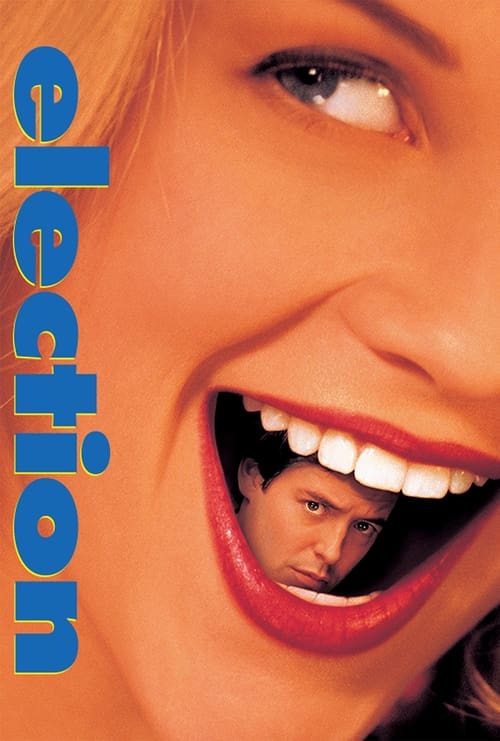
Election
1999 · Alexander Payne
When you're in the mood to laugh at something with real teeth — great with company and a low tolerance for hypocrisy, including your own. Comfort on the surface, sneaky challenge underneath.
What it's about
Tracy Flick, a ferociously prepared overachiever, is running unopposed for student-body president at an Omaha high school — until civics teacher Jim McAllister, nursing a private grudge against her, talks an amiable injured football player into entering the race. What follows is a petty, escalating war between teacher and student that drags in affairs, sabotage, and everyone's carefully maintained self-image.
The experience
Fast, mean, and very funny — the dueling voiceovers let you hear exactly how everyone flatters themselves, and the laughs keep catching in your throat. It's a comedy that leaves a mark.
Performances
Reese Witherspoon makes Tracy Flick an instant icon — chipper, terrifying, and weirdly sympathetic all at once — while Matthew Broderick brilliantly plays against his nice-guy image as a man rotting behind a friendly smile.
The craft
Alexander Payne and Jim Taylor's Oscar-nominated screenplay hands the story to four competing narrators, each exposing the others' lies, and the editing lands punchlines with freeze-frames and needle drops at exactly the wrong (right) moment. It's satire with the timing of a thriller.
Why it matters
A critical landmark of 1999 that launched Payne's career and defined a strain of acidic American comedy; 'Tracy Flick' entered the language as shorthand for a certain kind of ambition, especially in politics.
Snapshot
Election is Alexander Payne's second feature, a corrosive high-school satire adapted with co-writer Jim Taylor from Tom Perrotta's then-unpublished novel. On its surface a story about a rigged student-government race at a fictional Omaha high school, the film operates as a Swiftian comedy of American striving, in which a desperately ambitious overachiever named Tracy Flick (Reese Witherspoon) and an aggrieved, self-deluding civics teacher named Jim McAllister (Matthew Broderick) wage a covert war that exposes the resentments and rationalizations beneath middle-class respectability. Released by MTV Films through Paramount in the spring of 1999, it was a modest commercial performer but a critical landmark, earning Payne and Taylor an Academy Award nomination for Adapted Screenplay and helping to define a strain of acidic American comedy at the turn of the millennium. Its enduring cultural afterlife — the figure of Tracy Flick became shorthand in political journalism for a particular kind of grasping ambition, often unfairly gendered — testifies to a film that has outgrown its modest origins.
Industry & production
Election belongs to a specific late-1990s moment when major studios still maintained specialty and youth-oriented divisions willing to finance mid-budget, writer-driven films. It was produced under the MTV Films banner — a Paramount subsidiary then best known for broad youth comedies — and produced by Albert Berger, Ron Yerxa, David Gale, and Keith Samples through Bona Fide Productions and Jersey Films, the latter being Danny DeVito's company. The budget was modest by studio standards (commonly reported in the $8–25 million range, though precise figures vary across sources and should be treated with some caution). Payne came to the project off his 1996 debut Citizen Ruth, another satire that had established his appetite for tonal risk and unsympathetic protagonists.
The casting reflects the film's strategy of using familiar faces against type. Matthew Broderick — indelibly associated with the charming truant Ferris Bueller — was cast as a teacher whose youthful idealism has curdled, a piece of intertextual irony many critics noted. Reese Witherspoon, not yet a major star, delivered a performance that became the film's lightning rod. The shoot took place in and around Omaha, Nebraska, Payne's hometown, at Papillion-La Vista High School and other local locations, beginning Payne's long practice of grounding his films in specific Midwestern geography.
A well-documented production fact concerns the ending: test screenings reportedly responded poorly to an earlier conclusion, and Payne and Taylor reworked the film's coda — the Washington, D.C. sequence in which McAllister, now relocated and working at a museum, spots Tracy entering a limousine with a politician and impulsively hurls a soda cup at it. The reshoot sharpened the film's bleak comic symmetry.
Technology
Election was shot photochemically on 35mm in the anamorphic widescreen tradition, an aesthetically pointed choice for an intimate comedy about small lives. The film predates the digital-intermediate workflow that would standardize the following decade, so its look derives from in-camera and traditional lab processes. Its most discussed formal device — the use of freeze-frames punctuating the action — is a technique rather than a technology per se, but it depends on the editorial and optical resources of late-analog post-production. There is no significant visual-effects component; the film's technical interest lies entirely in conventional tools deployed with unusual rhetorical precision.
Technique
Cinematography
James Glennon, who had shot Citizen Ruth and would become a recurring Payne collaborator, photographed Election in anamorphic widescreen. The wide frame is used satirically: it surrounds these characters with institutional emptiness — fluorescent-lit corridors, linoleum, drab classrooms — lending an ironic grandeur to petty stakes. Glennon and Payne favor a clean, unfussy, observational camera that withholds the visual flattery a more sentimental high-school film would supply. The film's signature stylistic flourishes are the freeze-frames and the rapid, almost predatory zooms and push-ins that punctuate moments of revelation or hypocrisy — devices that recall the New Hollywood comedies of the early 1970s and that editorialize without a word of narration. Lighting is naturalistic and unglamorous, in keeping with the film's commitment to seeing its characters plainly.
Editing
Kevin Tent, Payne's editor on every feature, cut Election, and the film is among the most structurally ambitious comedies of its era in editorial terms. Its defining device is the braided multiple-voiceover structure: four characters — McAllister, Tracy, Paul Metzler, and his sister Tammy — narrate competing, self-serving accounts of the same events, and the editing constantly juxtaposes a character's flattering self-narration against the unflattering image. The cutting weaponizes the freeze-frame, halting the action to fix a character at a moment of maximum self-delusion or exposure. The rhythm is brisk and ironic, frequently undercutting a line of pious narration with a hard cut to contradictory behavior. This montage-of-perspectives approach gives the film a literary density while remaining propulsive.
Mise-en-scène / staging
Payne is a meticulous observer of class texture, and Election's production design renders the specific material world of middle-American suburbia: the McAllisters' tidy, modest home; the Metzlers' more affluent one; the bland institutional spaces of public education. Staging frequently isolates Tracy in the frame — alone, upright, relentless — while crowding McAllister into compromising domestic and professional arrangements. The film's celebrated cutaway gags (the apple, the bee sting that swells McAllister's eye into a grotesque emblem of his moral rot) are staged with deadpan literalism. Costume and casting work together: Witherspoon's prim, effortful wardrobe and rigid posture, Broderick's slackening everyman ordinariness.
Sound
Rolfe Kent composed the score, beginning a long association with Payne. The music is wry and propulsive, frequently using woodwind and percussive figures that comment on the action with a light, mock-serious irony rather than underlining emotion sincerely. The dense overlapping voiceovers make sound design and mix central to the film's meaning, since the architecture of competing narrations must remain legible. Diegetic sound — the banal ambient noise of school assemblies, hallways, cafeterias — reinforces the film's commitment to an unromanticized everyday America.
Performance
The performances are calibrated to the film's satirical register, broad enough to be funny but rooted enough to wound. Reese Witherspoon's Tracy Flick is the film's enduring achievement: a portrait of weaponized diligence so complete that it transcended the movie to become a cultural type. Crucially, Witherspoon plays Tracy's monstrousness and her genuine vulnerability simultaneously — the loneliness of the unlikable striver is always visible beneath the ambition. Matthew Broderick gives a brave, deglamorizing performance as a man convinced of his own decency while behaving with petty vindictiveness; the casting trades knowingly on his earlier screen persona. Chris Klein's sweet, dim Paul and Jessica Campbell's deadpan, sardonic Tammy round out the quartet, each pitched precisely within Payne's tonal scheme.
Narrative & dramatic mode
Election is structured as ironic satire in the mode of unreliable, multiplied narration. Its central formal idea — four first-person voiceovers that contradict one another and contradict the images — places the film in a tradition of literary-cinematic irony where the gap between self-image and behavior is the primary source of both comedy and meaning. No narrator is to be trusted; each rationalizes. The dramatic engine is a moral and tactical escalation between McAllister and Tracy, but the film refuses the catharsis of clear villainy or vindication. Its tone is comic but its mode is fundamentally satirical and even tragic in its diagnosis: ambition, resentment, and self-justification are presented as endemic to the American character rather than as individual failings. The reworked ending — McAllister's futile, impotent gesture against the now-ascendant Tracy — denies the audience the punishment of the protagonist they may crave, insisting instead on the persistence of the type.
Genre & cycle
The film sits at the intersection of the high-school movie and the adult satire, deliberately weaponizing the conventions of the former. It arrived during the late-1990s teen-film revival (the cycle that included Clueless, Rushmore, 10 Things I Hate About You, Cruel Intentions, and American Pie), but it belongs more truly to a parallel cycle of caustic, ironic American comedies of social diagnosis. The natural companion is Wes Anderson's Rushmore (1998), released months earlier, with which it shares an overachieving, socially maladroit student protagonist and a tone of affectionate cruelty; the two films are frequently paired as the twin pillars of the era's smart high-school comedy. Election is also legible as a political allegory — a microcosmic satire of American electoral democracy, ambition, and the gap between civic ideals and grubby reality — a reading the film actively invites through McAllister's earnest civics lessons.
Authorship & method
Election is a foundational text in Alexander Payne's authorship and in his decades-long partnership with co-writer Jim Taylor. Their method — adapting literary source material (here Perrotta's novel, which Payne read in manuscript before publication) into precisely observed satires of American life, frequently set in Payne's native Nebraska — is fully present here. The Payne-Taylor screenplay is notable for its structural daring and its refusal to supply a sympathetic point of identification, a stance that links Election to Citizen Ruth before it and About Schmidt, Sideways, and Nebraska after.
The film also consolidated Payne's core creative team: cinematographer James Glennon, editor Kevin Tent, and composer Rolfe Kent each became recurring collaborators, and the consistency of Payne's tone across his filmography owes much to this stable ensemble. Payne's authorial signature — the empathetic-yet-merciless gaze, the regional specificity, the tonal tightrope between humiliation and tenderness — is arguably defined here as clearly as anywhere in his work. His direction is restrained and unshowy, trusting the screenplay's architecture and the actors' precision rather than imposing visual flamboyance.
Movement / national cinema
Election belongs to American independent-minded studio filmmaking of the 1990s — work produced within or adjacent to the major studios but bearing the sensibility of the post-sex, lies, and videotape independent movement: writer-driven, tonally adventurous, skeptical of Hollywood uplift. Payne is often grouped with a generation of American satirists and humanists (alongside figures such as the Coen brothers, Wes Anderson, and later Noah Baumbach) who worked the seam between independent sensibility and studio resources. His insistent rootedness in Omaha and the Great Plains makes him one of the few major contemporary American directors associated with a specific regional cinema, a Midwestern counter-tradition to coastal filmmaking.
Era / period
The film is a document of late-1990s, pre-9/11, end-of-Clinton-era America, and it is difficult to separate from that moment. Released in 1999, the same year that produced an unusual cluster of dark American self-examinations (American Beauty, Fight Club, Three Kings, Magnolia), it shares that year's preoccupation with the rot beneath suburban and institutional surfaces. Its civics-class framing and electoral plot acquired retrospective resonance after the contested 2000 presidential election, and the film is frequently cited as eerily prescient about the mechanics and discontents of American democracy. The specific cultural texture it captures — the earnest banality of public high school, the anxieties of middle-class respectability — situates it firmly in its turn-of-the-millennium present.
Themes
The film's central theme is ambition and its discontents — the American gospel of striving examined as both engine and pathology. Tracy Flick embodies meritocratic effort taken to a monstrous extreme, yet the film is careful to show the loneliness and class anxiety that drive her, complicating any simple condemnation. A closely related theme is the gulf between self-image and conduct: every major character narrates a flattering version of themselves that the film's images contradict, making hypocrisy and self-justification the work's true subjects. Resentment — McAllister's envy and wounded entitlement — is dissected with particular precision. Sexual transgression and its rationalizations recur (the earlier affair that destroyed McAllister's colleague, McAllister's own infidelity), and the film draws an unsparing line between private appetite and public piety. Finally, Election is a sustained allegory about democracy itself: the disorder, manipulation, and self-interest that underlie the civic ideal, and the uncomfortable suggestion that the most relentless, not the most worthy, tend to win.
There is also a much-discussed dimension of gender. Some later commentators have argued that the film, and especially the cultural appropriation of "Tracy Flick" as an epithet, participates in a punishing attitude toward female ambition — a critique Perrotta himself engaged with in his later work. The film is rich enough to sustain both its satirical surface and this revisionist reading.
Reception, canon & influence
Election was a critical success on release, widely praised for its intelligence, its tonal control, and Witherspoon's performance, even as its commercial reach was limited. It earned Payne and Taylor an Academy Award nomination for Best Adapted Screenplay and won the National Society of Film Critics award for Best Screenplay, among other critics'-group honors; Witherspoon's performance drew strong notices and is now frequently ranked among the finest comic performances of its era. Over the following two decades the film's reputation grew steadily, and it is now widely regarded as a modern American comedy classic and a key early work of one of the period's major directors.
Its influences run backward to the tradition of literary social satire and to the editorializing techniques of early-1970s New Hollywood comedy (the freeze-frames and zooms echo that period), as well as to the immediate example of Perrotta's novel, whose acid view of suburban life Payne faithfully transmuted. Forward, the film's influence has been broad and durable. It helped legitimize a strain of unsentimental, morally complex American comedy and confirmed a template — the empathetic satire of ordinary American striving — that Payne would extend across his career. Its most visible legacy is cultural rather than strictly cinematic: "Tracy Flick" entered the lexicon of American political commentary as a durable archetype, a rare instance of a film character becoming a unit of public discourse. The film's pairing with Rushmore helped fix the late-1990s template for the smart, melancholy high-school comedy that later filmmakers would inherit. Tom Perrotta returned to the character decades later in his novel Tracy Flick Can't Win, a sequel partly in dialogue with how the film's audiences had received and weaponized its protagonist — a striking testament to the cultural durability of what began as a modestly budgeted Omaha-shot comedy.
A Deleuzian reading
A bee stings Jim McAllister on the eyelid, and by the next morning his face has swelled into a lopsided, weeping ruin.
The full Deleuzian reading of Election →
Reception
A box-office also-ran in 1999 that critics adored (it earned Payne an Oscar nod for the screenplay), Election has only climbed since — now routinely called one of the sharpest American satires of its decade and eerily prescient about politics.
How Election was received, from release to now →
Influences: the films it descends from and the films it influenced
- Tom Jones (1963) — Establishes the bawdy literary adaptation that weaponizes freeze-frames and a knowing, editorializing narrator to gloss a striver's ambition — the exact device Payne revives in Tracy's and Jim's competing freeze-frame-punctuated voiceovers.
- Jules and Jim (1962) — The New Wave template of clipped freeze-frames and braided over-narration as commentary, the editorializing grammar Payne and editor Kevin Tent borrow to interrupt and judge their characters mid-action.
- The Graduate (1967) — New Hollywood satire of suburban ambition built on alienating long-lens compositions and ironic counterpoint scoring — the predatory-zoom-and-wink-of-the-score idiom Payne and Rolfe Kent inherit.
- Citizen Kane (1941) — Assembles a portrait of American ambition through multiple unreliable narrators and frames it as a corrupt election campaign — the narrator-collage plus democracy-allegory structure Election miniaturizes onto a student vote.
- Rashomon (1950) — The foundational architecture of irreconcilable first-person accounts of the same event, which Election adopts as Tracy, Jim, Paul and Tammy each narrate the campaign self-servingly.
- Sunset Boulevard (1950) — The acidic, self-justifying voiceover that lets a deluded narrator indict themselves through their own telling — the ironic gap between speech and conduct Payne builds the whole film on.
- Annie Hall (1977) — Fragmented comedy of competing self-accounts using direct address and braided voiceover so characters argue their case to the audience — the rhetorical confessional mode Election distributes across four narrators.
- GoodFellas (1990) — The immediate precedent for braided first-person voiceover broken by sudden freeze-frames at moral turning points and aggressive zooms — the precise editorial toolkit Election deploys for comic rather than criminal stakes.
- Citizen Ruth (1996) — Payne and Taylor's debut establishing their signature refusal of a sympathetic point of identification — the merciless satire of an American institution that Election sharpens into structural rigor.
- Being There (1979) — Payne inherits Ashby's ironic-fable political satire form — no-revelation structure, deadpan wide framings that refuse to editorialize, characters who are systematically misread while the audience holds ironic distance — in a cinematographic patience that holds wide without cutting to emphasize comedy, a direct descendant of Ashby's editorial vocabulary.
- The Heartbreak Kid (1972) — Extends the unlikable-striver comedy: ironic voiceover and a coolly observational satiric eye trained on American aspiration and self-deception, refusing to let the protagonist off the hook.
- A New Leaf (1971) — The acid character study of an amiable misanthrope whose contempt curdles through voiceover-driven dramatic irony is the clearest modern heir to May's precise, unsentimental comedy of misanthropy.
- About Schmidt (2002) — Extends the Payne-Taylor empathetic-yet-merciless gaze on Midwestern striving, carrying forward the ironic confessional voiceover (Schmidt's letters) as self-revealing narration.
- Sideways (2004) — Continues Payne's adaptation of literary source into precisely observed satire of a self-deluding male ego, sustaining the tonal tightrope and the stable Glennon/Tent/Kent craft ensemble formed on Election.
- Nebraska (2013) — Pushes the regional-specificity and anamorphic-widescreen portraiture of American ambition further, applying Election's unsentimental gaze to heartland delusion in stark black-and-white scope.
- Thank You for Smoking (2005) — Inherits the unsentimental American satire anchored by a charismatic, morally compromised narrator whose ironic voiceover lets the audience enjoy and condemn him at once.
- Mean Girls (2004) — Adopts the high-school-as-political-arena conceit with braided voiceover and against-type casting, treating campus social warfare with the satirical seriousness Election gave the student election.
- Young Adult (2011) — Effectively Tracy Flick at forty — a merciless refusal of the redemption arc for a former high-school striver, extending Election's commitment to a protagonist the film declines to soften.
- Lady Bird (2017) — Carries forward the regionally specific, empathetic-merciless portrait of a female overachiever, balancing satire and tenderness on the tonal tightrope Payne defined.
- The Squid and the Whale (2005) — Extends the strain of unsentimental, morally complex American comedy that Election legitimized — characters mapped by the gap between self-image and conduct, observed without a sympathetic anchor.
- Little Miss Sunshine (2006) — Built tragicomedy out of satirizing America's winner/loser ideology through characters' grim striving — the same nine-steps-to-success self-help logic that Sunshine skewers through Richard's 'refuse to be a loser' program.
- Bottoms (2023) — Treats the high-school microcosm — student politics, hierarchy, and popularity — as heightened total warfare, the satirical framing Bottoms weaponizes.
- Rushmore (1998) — The twin late-90s text of the melancholy high-school comedy centered on a monomaniacal overachiever, sharing deadpan cutaway gags and a precisely controlled tone between humiliation and tenderness.
- The Royal Tenenbaums (2001) — Payne's multiple deadpan voiceovers from characters who systematically misread themselves and each other — narrators unreliable through emotional limitation rather than dishonesty — operate the same dramatic irony machine as Anderson's mock-literary narrator who frames the Tenenbaums' self-deceptions without correction.
- Napoleon Dynamite (2004) — Deadpan high-school campaign satire whose student-election machinery and Middle-American specificity directly prefigure the 'Vote for Pedro' climax and small-town texture.
- The Holdovers (2023) — Payne's school-institution satire built on snap slow-zooms and acid voiceover, seeding the campus-microcosm staging Holdovers softens into pathos.
- Juno (2007) — Model for housing satirically sharp, arch dialogue inside grounded suburban realism so mockery reads as affection — the exact humane-yet-caustic tonal calibration Reitman applies.
Similar films
- Mean Girls (2004) — influence & lineage
- Nebraska (2013) — influence & lineage
- Sideways (2004) — influence & lineage
- Rushmore (1998) — influence & lineage
- Promising Young Woman (2020) — shared sensibility
- Vice (2018) — shared sensibility
- American Beauty (1999) — shared sensibility
- American Psycho (2000) — shared sensibility
All the films related to Election →