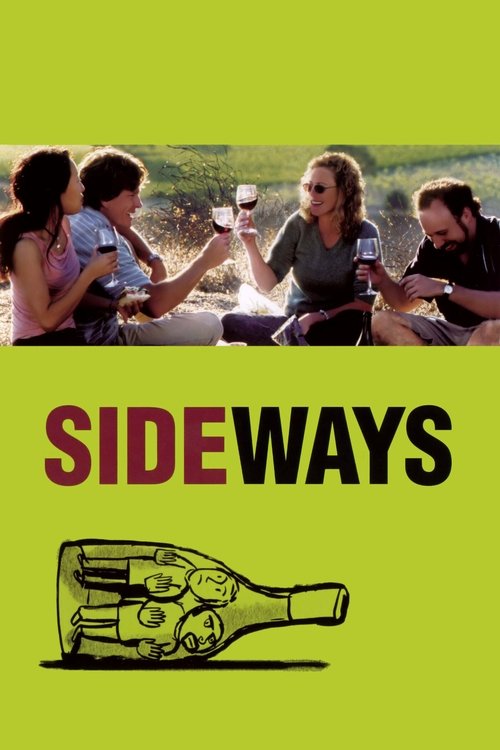
Sideways
2004 · Alexander Payne
For when you want a comedy with a bruised heart — great with a glass of wine, perfect if you're in the mood to laugh at midlife failure and feel unexpectedly tender about it. Comfort viewing with a melancholy finish.
What it's about
A week before his old college friend Jack's wedding, Miles — a depressed, divorced English teacher and unpublished novelist — takes him on a bachelor road trip through California wine country. Miles wants tastings, golf, and communion with Pinot Noir; Jack wants one last fling. Two local women get pulled into the escapade, and the trip slides from comedy into humiliation and something like grace.
The experience
Funny and sad in the same breath — it ambles like a wine tasting, then ambushes you with moments of real ache. You wince, you laugh out loud, and you come away oddly moved by two deeply flawed men.
Performances
Paul Giamatti's Miles is a career-defining portrait of prickly, self-sabotaging melancholy; Thomas Haden Church is hilariously shameless as Jack; and Virginia Madsen brings a warmth that gives the film its soul — her monologue about wine is justly famous.
The craft
Alexander Payne and Jim Taylor's screenplay is a model of character comedy — every laugh doubles as a wound — and the sun-drowsy Santa Ynez Valley photography and jazzy score give the sadness a relaxed, golden glow. It's proof that tone, not plot, can carry a film.
Why it matters
A word-of-mouth phenomenon that swept critics' awards and famously boosted Pinot Noir sales while denting Merlot's reputation, it cemented Payne as the American master of bittersweet midlife comedy.
Snapshot
Sideways is a bittersweet comedy of male midlife disappointment disguised as a wine-country road trip. Miles Raymond (Paul Giamatti), a depressive, divorced middle-school English teacher and perpetually unpublished novelist, takes his soon-to-be-married college friend Jack (Thomas Haden Church), a fading actor, on a week-long bachelor tour of the Santa Ynez Valley. Miles wants tastings, golf, and mournful communion with Pinot Noir; Jack wants a last sexual fling before the wedding. Their divergent appetites entangle two local women — Maya (Virginia Madsen), a waitress and returning student, and Stephanie (Sandra Oh), a winery pourer — and the escapade curdles into farce, humiliation, and a fragile grace note of possible renewal. Directed by Alexander Payne from a screenplay he wrote with his longtime partner Jim Taylor, adapting Rex Pickett's then-unpublished novel, the film became one of the defining American specialty-division releases of the mid-2000s: a small, adult, character-driven picture that achieved outsized critical and cultural reach, including an Academy Award for Best Adapted Screenplay.
Industry & production
Sideways was produced by Michael London and distributed by Fox Searchlight Pictures, the specialty arm whose model — modest budgets, adult subject matter, festival-and-critics momentum leveraged into awards runs — the film came to exemplify. It was Payne's fourth feature and his first shot away from his native Omaha, the setting or spiritual home of Citizen Ruth (1996), Election (1999), and About Schmidt (2002). The source was Rex Pickett's semi-autobiographical novel, which Payne optioned before its publication; the book and film ultimately reached audiences in close proximity. The production shot on location in Santa Barbara County wine country — the Santa Ynez Valley and surrounding towns such as Los Olivos, Solvang, Buellton, and Lompoc — lending the film a specificity of place (real wineries, restaurants, and roads) that functions almost documentarily.
Precise budget and box-office figures should be checked against a reliable source rather than asserted here; what is securely established is that the film was made economically relative to studio norms and performed strongly for a specialty release, sustaining a long theatrical life on word of mouth and awards attention. Its Oscar campaign yielded five nominations — Best Picture, Best Director, Best Adapted Screenplay, Best Supporting Actor (Church), and Best Supporting Actress (Madsen) — converting one, the screenplay award for Payne and Taylor. The film also won the Golden Globe for Best Motion Picture — Musical or Comedy. Widely remarked at the time was the omission of Paul Giamatti from the Best Actor field, a snub that became part of the film's press narrative.
Technology
Sideways is a photochemical film in an era when digital acquisition was beginning to encroach on independent production; it was shot on 35mm and finished as a traditional celluloid release, with cinematographer Phedon Papamichael favoring available and naturalistic light over heavy fixtures. (Specific format details — lens packages, exact stocks, and whether Super 35 was used — are the kind of granular technical claims that should be verified against a camera-department source rather than assumed.) The film's most conspicuous formal-technical flourish is a brief split-screen montage that partitions the frame into multiple panels during a wine-country interlude, a device that gestures playfully at 1960s-style multi-image montage without becoming a governing style. Otherwise the technology serves invisibility: the picture's ambitions are performative and tonal, not apparatus-driven, and its craft is deployed to keep the machinery unobtrusive.
Technique
Cinematography
Phedon Papamichael's photography establishes the sun-warmed, dusty palette of California wine country — golden light on vine rows, the amber of poured glasses, the beige-and-green monotony of two-lane roads — without lapsing into travelogue prettiness. The camera tends to stay at a sober, observational distance, framing the men against landscapes that dwarf their small crises, then closing in for the intimate two-shots that carry the film's emotional weight, most famously the candlelit porch conversation in which Miles and Maya trade metaphors about wine and mortality. This collaboration proved foundational: Papamichael became Payne's principal cinematographer, shooting The Descendants, Nebraska, Downsizing, and The Holdovers in the years after.
Editing
Kevin Tent, Payne's editor across his career, shapes the film's characteristic tonal control — the ability to pivot from broad physical comedy to quiet devastation within a scene without whiplash. The cutting is patient in the dialogue passages, giving performances room to breathe, and comic in its timing during set pieces (the drunken misadventures, the naked-husband chase, the spitting-bucket humiliation of the first tasting). The split-screen montage is the one place editing announces itself rhythmically rather than serving continuity; elsewhere Tent's work is deliberately self-effacing, prioritizing behavioral truth over pace for its own sake.
Mise-en-scène / staging
Payne's staging is built on the texture of unglamorous American middle-class life — motel rooms, chain restaurants, cluttered mother's houses, tasting-room counters. Production and costume design render Miles's shabby-genteel self-image (the Saab, the wine snobbery, the failed-writer's wardrobe) and Jack's aging-jock vanity with precise, faintly cruel accuracy. Props carry theme: the bottle of 1961 Cheval Blanc that Miles has been saving for an occasion that never comes becomes the film's central symbol, and its eventual defiant consumption from a Styrofoam cup at a fast-food counter is a staging choice that condenses the whole picture into one image.
Sound
Rolfe Kent, another recurring Payne collaborator, supplies a jazz-inflected score — light, wry, bossa-nova-tinged — that leans into the film's comic register and undercuts sentimentality, keeping the melancholy from tipping into self-pity. The music's cocktail-lounge ease is in productive tension with Miles's inner desolation. Beyond the score, the soundscape is naturalistic, built on ambient wine-country quiet and the rhythms of overlapping, overlapping-into-awkward conversation that Payne and Taylor's dialogue favors.
Performance
Performance is the film's true medium. Giamatti's Miles is a masterclass in curdled sensitivity — a man whose refinement of palate is inseparable from his capacity for self-loathing — and his restraint anchors the film's shifts between pathos and absurdity. Church, cast against the grain of his sitcom background, gives Jack a guileless, appetite-driven obliviousness that is both monstrous and weirdly innocent. Madsen's Maya brought her a career-redefining role, her porch monologue about why she loves wine — a speech that becomes, without underlining, a statement about fragile, perishable lives — is the film's emotional keystone. Sandra Oh's Stephanie supplies volatility and the sharpest note of real consequence when Jack's lie detonates. The ensemble's calibration, more than any technical device, is what critics singled out.
Narrative & dramatic mode
The film operates in the dramatic mode of tragicomedy, structured as a road movie whose journey is geographic, seasonal (a compressed pre-wedding week), and moral. Its engine is a classic mismatched-pair dynamic — the depressive aesthete and the appetitive hedonist — whose opposed desires generate both comedy and the story's ethical stakes. Payne and Taylor's screenplay is notable for withholding easy redemption: Miles does not sell his novel, does not obviously reform, and the ending offers only the possibility of connection (the knock on Maya's door) rather than its guarantee. The mode is ironic and observational, generous to its characters without excusing them; the film repeatedly invites laughter at behavior it simultaneously frames as sad. Wine appreciation functions throughout as an extended metaphorical register — vintages, varietals, and peak-drinking windows standing in for aging, potential, and the fear of a life left uncorked.
Genre & cycle
Sideways sits at the intersection of the buddy comedy, the road movie, and the American "dramedy" of arrested-development masculinity. Within genre history it belongs to a mid-2000s cycle of literate, adult, specialty-division comedies of disappointment — pictures marketed to grown-up audiences on the strength of writing and performance rather than spectacle, a lane occupied contemporaneously by films like Lost in Translation (2003) and the broader Focus Features / Fox Searchlight ecosystem. It also extends the venerable American tradition of the wine-and-midlife-crisis narrative and the male-friendship-under-strain comedy. Its cultural afterlife arguably helped consolidate a subsequent cycle of indie comedies about failing, self-sabotaging men, though direct lines of descent are diffuse and should be stated as tendency rather than causation.
Authorship & method
The dossier's authorship center is the Payne–Taylor writing partnership, which produced the screenplays for Citizen Ruth, Election, About Schmidt, and Sideways, and whose method fuses satirical precision with an increasingly humanist tenderness — Sideways is often read as the film where the pair's comedy grew warmest without losing its bite. Payne's directorial signature — regional and class specificity, ensemble realism, tonal balance between the comic and the desolate, a refusal of tidy uplift — is fully legible here. The film crystallized his core creative repertory company: cinematographer Phedon Papamichael, editor Kevin Tent, and composer Rolfe Kent, collaborators who recur across his subsequent work and whose sensibilities are inseparable from the Payne "house style." The adaptation method is faithful to Rex Pickett's novel in incident and character while sharpening structure and dialogue; the screenwriting craft, honored with the film's single Oscar, is the authorial achievement most consistently praised.
Movement / national cinema
The film is a product of American independent cinema in its studio-specialty phase — financed and distributed within a Hollywood conglomerate's boutique division but made with the aesthetic values (character over plot, location realism, adult subject matter, auteur control) associated with the independent tradition. It can be placed within a loosely defined strain of American "new sincerity" or humanist realism that reacted against irony-for-its-own-sake, though such labels are critical constructions applied after the fact rather than a self-declared movement. Nationally, it is deeply Californian in setting yet Midwestern in sensibility, reflecting Payne's Omaha roots even as he films the coast.
Era / period
Sideways is emblematic of a specific mid-2000s moment in American film culture: the high-water mark of the specialty-division awards model, when a small adult drama could win a screenplay Oscar, dominate critics' groups, and enter mainstream conversation. It arrived just before the digital transition reshaped both production and distribution, and before the streaming era altered the economics that made theatrically driven, word-of-mouth specialty releases viable. Read historically, it is a late flowering of the theatrical adult-drama business as much as a wine-country comedy.
Themes
Its governing themes are failure and its accommodation; the terror and possible dignity of middle age; the gap between aesthetic refinement and emotional maturity; and male friendship as both sustenance and mutual enablement. Wine organizes all of these — Maya's monologue reframes a bottle's mortality (it is always changing, and one day it will peak and then decline) as a meditation on the value of perishable, unremarkable lives, and Miles's hoarded Cheval Blanc dramatizes the self-defeating habit of deferring pleasure until a worthiness that never arrives. Related motifs include creative disappointment (the unsold novel), self-deception and lying (Jack's serial dishonesty), and the slim, unsentimental hope of a second chance. The film is unusually clear-eyed about class and taste as forms of both aspiration and self-imprisonment.
Reception, canon & influence
Critical reception was strongly favorable, with particular praise for the screenplay, Payne's tonal control, and the four central performances; the film swept many U.S. critics' awards for the 2004 season and converted that momentum into five Academy Award nominations and a win for Adapted Screenplay, plus the Golden Globe for Best Musical or Comedy. Giamatti's absence from the acting nominations became a widely discussed emblem of Oscar oversight. Over time the film has settled into the canon of major 2000s American comedies and is frequently cited as a high point of both Payne's career and the specialty-division era.
Looking backward, the film draws on the American road movie and buddy-comedy traditions, on the mismatched-pair structure with deep theatrical and cinematic roots, and on a tradition of literate midlife-crisis narratives; most directly it adapts Rex Pickett's novel, and it continues the satirical-humanist line of the earlier Payne–Taylor screenplays.
Looking forward, its most measurable legacy lies outside cinema: the so-called "Sideways effect," in which Miles's contempt for Merlot and evangelism for Pinot Noir were widely credited with shifting American consumer wine preferences. This claim has been examined seriously in wine-economics scholarship (studies analyzing Merlot and Pinot Noir sales in the years after release), and while the precise magnitude is debated, the phenomenon is one of the clearest documented cases of a film measurably influencing a consumer market — a genuinely unusual form of cinematic influence. Within film, Sideways helped affirm the commercial viability of adult, character-driven comedy-drama for specialty distributors and cemented the Payne–Papamichael–Tent–Kent collaboration that would define his later films. Its stylistic descendants — indie comedies of male failure and rueful midlife reckoning — are numerous, though specific lines of influence are better described as a shared sensibility than as direct citation.
A Deleuzian reading
A man sits alone at a fast-food counter with a tray of food and a Styrofoam cup.
The full Deleuzian reading of Sideways →
Reception
A critical darling in 2004 — Best Picture nominee, Adapted Screenplay winner, top of countless year-end lists — it's since become the go-to reference point for debates about the mid-2000s 'sad middle-aged man' indie, admired and gently ribbed in equal measure.
How Sideways was received, from release to now →
Influences: the films it descends from and the films it influenced
- Five Easy Pieces (1970) — Supplies the New Hollywood template of a cultured, self-sabotaging male drifter observed in naturalistic long takes and denied any tidy redemption — the character-study grammar Payne inherits for Miles.
- The Last Detail (1973) — Establishes the mismatched-male-pair road journey that balances profane comedy against desolation, the exact tonal register Payne calibrates between Miles and Jack.
- Midnight Cowboy (1969) — Models the abrasive/deluded odd-couple buddy structure in which two failing men develop a codependent tenderness that carries the emotional arc.
- Scarecrow (1973) — A two-hander of temperamentally opposite men — one manic, one melancholic — drifting through episodic naturalistic vignettes, the same comic/depressive counterpoint Sideways runs on.
- Diner (1982) — Pioneers the overlapping, digressive naturalistic dialogue of arrested men circling their own immaturity — the ensemble-realism idiom Payne uses for the four leads.
- Wonder Boys (2000) — A literate, rueful comedy built around a blocked novelist's midlife humiliation, directly prefiguring Miles as the failed-writer protagonist of an adult character comedy.
- Election (1999) — Payne–Taylor authorship prototype whose satirical voiceover and montage precision, plus its refusal of moral tidiness, becomes the house method Sideways warms and extends.
- About Schmidt (2002) — The immediate Payne–Taylor predecessor: a road-structured study of male failure shot in Papamichael's naturalistic light and ending on withheld redemption.
- Il Sorpasso (1962) — Payne, an avowed Sorpasso admirer, builds a two-hander road comedy from the friction between opposed social types and lets character comedy carry social critique without didacticism — his stated debt to Risi's method.
- The Heartbreak Kid (1972) — A self-deceiving, morally shabby protagonist whose comedy of embarrassment is anchored — exactly as Berlin's Lila anchors May's — by one performance of genuine tenderness (Virginia Madsen) placed at the emotional center.
- Lost in America (1985) — Two articulate men run an elective escape into landscape shot through car glass, with humiliations played in unscored wide two-shots and a protagonist whose fluency is his defense mechanism — Brooks's premise that likability is not a precondition for a lead.
- The Descendants (2011) — Direct continuation of the Payne–Papamichael–Tent house style: regional specificity, ensemble realism, and comic/grief tonal control applied to another rueful male reckoning.
- Nebraska (2013) — Reprises the aging-male-failure road structure with Papamichael's naturalistic (monochrome) light and Kevin Tent's patient cutting, ending again on withheld, unsentimental grace.
- Up in the Air (2009) — Carries the Rolfe Kent jazz-inflected scoring and the adult midlife-reckoning specialty comedy-drama shape directly out of the Sideways mold.
- The Trip (2010) — Two mismatched middle-aged men touring restaurants and wine, their melancholy-comic banter masking failure — an almost literal descendant of the wine-and-disappointment road duo.
- Win Win (2011) — Extends Paul Giamatti's Miles register — the compromised, self-deceiving everyman — inside a character-driven specialty comedy-drama of quiet ethical failure.
- The Way Way Back (2013) — Written and directed by Payne's Descendants co-writers, it transplants his rueful tragicomic sensibility and ensemble realism into a coming-of-age key.
- Zindagi Na Milegi Dobara (2011) — Pioneers the pre-wedding two-man road trip through scenic country as an excavation of male anxiety in a bittersweet comic-melancholic register — the precise tonal DNA of ZNMD's bachelor journey.
- A Real Pain (2024) — Establishes the melancholy road-dramedy blueprint of two mismatched men — one restrained, one self-destructively voluble — whose itinerary is a pretext for grief to surface through comic friction rather than plot.
- The Ballad of Wallis Island (2025) — Midlife-decline melancholy carried entirely by a two-hander of mismatched men, prioritizing observed character and comic friction over incident.
- American Fiction (2023) — The failed-novelist protagonist whose publishing humiliations are cross-cut against a domestic/romantic track, scored by a small-combo jazz cue used as wry commentary rather than emotional underline — the register Laura Karpman works in for Monk.
- Gary (2026) — Payne's trip two-hander lets a comic performer play the un-self-aware half entirely straight, and leans on scored needle-drops to carry the tonal turns the dialogue itself refuses to announce.
- Lost in Translation (2003) — A near-contemporary specialty-indie of midlife melancholy in available light whose two lonely adults share a bond that resolves without romantic payoff — the same withheld-redemption restraint.
- The Squid and the Whale (2005) — Extends the literate, acid-but-humane naturalism of male ego and creative failure, handheld and unglamorous, in the same specialty-division comedy-drama register.
- Little Miss Sunshine (2006) — A specialty-division tragicomic road movie about a family of failures that runs the same comic-desolate tonal balance and character-over-plot ensemble structure.
- The Station Agent (2003) — Payne's contemporaneous character study braids comedy and loneliness through lonely men bonding over a shared ritual (wine as the trains are here), the same dramedy-of-restraint the indie canon consolidated in 2003–04.
- The Holdovers (2023) — Payne + Giamatti's first pairing establishing the self-loathing, wine-soaked erudite loser rendered with tender comedy — the exact register recycled for Hunham.
- Another Round (2020) — Male-midlife-stagnation tragicomedy in which drink is the shared medium of both authentic connection and self-deception, balancing comic ensemble rhythm against genuine despair.
Similar films
- Nebraska (2013) — influence & lineage
- Little Miss Sunshine (2006) — influence & lineage
- Paris, Texas (1984) — shared sensibility
- The Holdovers (2023) — shared sensibility
- The Notebook (2004) — shared sensibility
- The Motorcycle Diaries (2004) — shared sensibility
- The Big Lebowski (1998) — shared sensibility
- American Beauty (1999) — shared sensibility