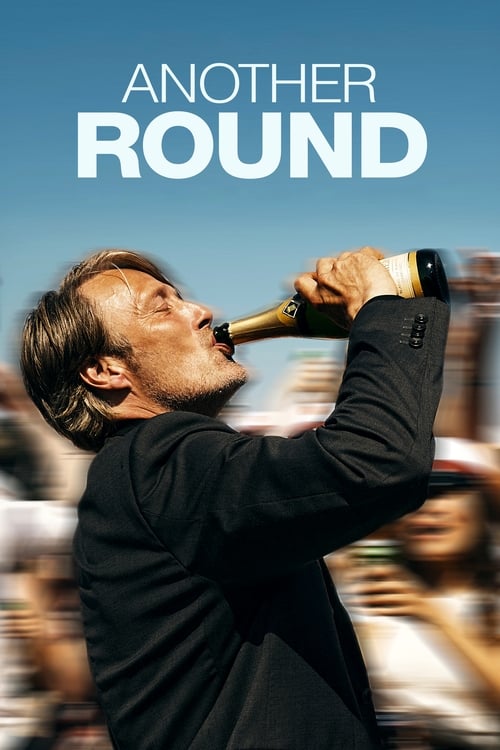
Another Round
2020 · Thomas Vinterberg
For a grown-up night when you want a film that's both a pleasure and a provocation — it goes down easy, then gives you plenty to argue about over a drink (or pointedly without one). Comfort and challenge in the same glass.
What it's about
Four middle-aged high-school teachers in Denmark, each gone gray and flat in his own way, decide to test a pet theory: that humans are born with a blood-alcohol level slightly too low, and that a steady, maintained buzz will restore their spark. They approach it as a controlled experiment — rules, notes, daytime dosing — and at first, astonishingly, life does get better. Then the question becomes where the experiment ends and the drinking begins.
The experience
Warm, funny, and quietly devastating in turns — it lets you feel the genuine lift of the buzz before showing you the bill. It ends on one of the most exhilarating, talked-about final scenes in recent memory, and leaves you somewhere complicated between joy and grief.
Performances
Mads Mikkelsen is extraordinary as Martin, thawing from deadened to alive by degrees — and his physical performance in the finale, drawing on his past as a trained dancer, is worth the whole film on its own.
The craft
Vinterberg keeps the camera close and the tone razor-balanced, playing the drinking as neither cautionary sermon nor celebration but both at once. The screenplay's experiment structure gives a boozy, messy subject a clean dramatic engine, and the music-driven ending lands like a shot of pure feeling.
Why it matters
It won the Academy Award for Best International Feature and earned Vinterberg a surprise Best Director nomination, becoming the defining recent film about drinking culture and midlife renewal.
Snapshot
Another Round — Danish title Druk, literally "binge" or "booze" — is Thomas Vinterberg's tragicomedy about four middle-aged high-school teachers in Aarhus who resolve to test a pseudo-scientific hypothesis: that human beings are born with a blood-alcohol level a fraction too low, and that maintaining a steady mild intoxication will restore their vitality. What begins as a controlled experiment in reawakening slides, with grim comic inevitability, into excess, damage, and one death, before pivoting to an exuberant, ambiguous final release. The film is at once a portrait of male midlife stagnation, a wry anthropological study of Danish drinking culture, and a philosophical meditation stitched through with Kierkegaard. It won the Academy Award for Best International Feature Film and earned Vinterberg a surprise nomination for Best Director; Mads Mikkelsen's central performance, culminating in a now-iconic dockside dance, became the film's signature image. It stands as the most acclaimed work of Vinterberg's late career and a high-water mark for Danish cinema's international reach in the 2010s–20s.
Industry & production
Another Round was produced by the Danish company Zentropa — the outfit Vinterberg and Lars von Trier's circle grew from — with backing consistent with the Nordic public-service and co-production model that has underwritten Danish arthouse cinema for decades: the Danish Film Institute alongside Scandinavian and European co-financing and pre-sales to distributors. It sits squarely within the mid-budget, director-driven European auteur economy rather than the studio system: modest financing, strong festival positioning, and international sales as the route to profit. The film was selected for the 2020 Cannes "Official Selection" label, but the physical festival was canceled amid the COVID-19 pandemic; its effective world premiere came in the autumn 2020 festival circuit (Toronto and San Sebastián). Its commercial and awards life unfolded through the pandemic release landscape, a period when arthouse titles depended heavily on the festival-to-awards pipeline and streaming/limited theatrical hybrids. The Oscar win in April 2021 substantially amplified its global distribution and afterlife. It was widely reported that Leonardo DiCaprio and his Appian Way company optioned an English-language remake; as of writing that project remained in development, and I would treat any further detail as unconfirmed.
Technology
The film was shot digitally in a naturalistic, available-light-leaning register consistent with contemporary Scandinavian realist practice. Its technological signature is not spectacle but proximity: lightweight, mobile camera systems that let the crew stay close to actors in classrooms, kitchens, and bars without imposing elaborate lighting setups. This is the descendant of the low-tech ethos Vinterberg helped codify with Dogme 95 in the late 1990s — that movement's embrace of consumer-grade cameras and rejection of artifice — now filtered through professional digital tools rather than the raw MiniDV of Festen. The result is a look that is polished but restless, keyed to the responsiveness digital acquisition affords a director who prizes performance over precision. Beyond acquisition, there is little conspicuous post-production technology at work: no significant visual-effects layer, the drama grounded in physical performance and location.
Technique
Cinematography
Sturla Brandth Grøvlen shot the film, and his sensibility is central to its effect. Grøvlen is best known internationally for photographing Sebastian Schipper's Victoria (2015) in a single unbroken take, and that background in continuous, actor-following camerawork informs Another Round's intimate handheld coverage. The camera stays mobile and close, favoring the actors' faces and the shifting group dynamics of the four-man ensemble. Crucially, Grøvlen calibrates the image to the characters' intoxication: the early, sober sequences are cooler and more contained, while the drinking passages loosen — warmer, more fluid, more alive — before the imagery curdles as the experiment darkens. Light sources feel motivated and unglamorous. The visual arc mirrors the emotional one, so that cinematography becomes an argument about what alcohol does: how it can make the world briefly more vivid before it makes it worse.
Editing
Anne Østerud and Janus Billeskov Jansen cut the film. Billeskov Jansen is a towering figure in Danish editing, a longtime collaborator of Bille August and a fixture of the national industry; Østerud has worked repeatedly with Vinterberg. Their work here manages a difficult tonal ledger: the film must be genuinely funny, then genuinely devastating, then euphoric, without the seams showing. The editing shapes the rising-and-falling rhythm of the drinking experiment, and it incorporates a documentary-flavored montage device — clips and images of famous historical figures and world leaders associated with alcohol — that punctuates the fiction with an essayistic, deadpan commentary. The film's control of escalation, and its willingness to hold on Mikkelsen in the final sequence, are editorial decisions as much as directorial ones.
Mise-en-scène / staging
The film's world is deliberately ordinary: the institutional corridors and classrooms of a gymnasium (Danish upper-secondary school), suburban homes, harborside Aarhus, the wood-panelled restaurant where the four men convene over increasingly ambitious meals and wine. Vinterberg stages the ensemble as a genuine group — the interplay of four men who have known one another too long — and much of the film's meaning lives in blocking: who leans in, who withdraws, who is drinking and who is watching. The pedagogical setting matters: classroom scenes let the film test its thesis on the men's professional competence, as their teaching visibly improves and then unravels. The staging keeps the philosophical premise embodied rather than abstract, always attached to bodies in rooms.
Sound
Sound is understated and realist through most of the film, which makes its calculated eruptions land harder. Music is deployed sparingly until the finale, when the Danish band Scarlet Pleasure's track "What a Life" scores the closing dance — a needle-drop that has become inseparable from the film's reception. The contrast between the muted, naturalistic soundscape of the drama and the pop release of the ending is itself a formal statement, converting sound into the vehicle of the film's final, unresolved surge of feeling.
Performance
Performance is the film's core medium. Mads Mikkelsen anchors it as Martin, a history teacher hollowed out by routine, and the role trades on Mikkelsen's capacity for interior stillness and sudden physical expression. His background as a trained dancer and gymnast before he became an actor is decisive for the ending, in which Martin's leap into dance reads as both technical showcase and emotional detonation. The ensemble — Thomas Bo Larsen (a Vinterberg regular going back to Festen), Magnus Millang, and Lars Ranthe — gives the group its lived-in texture, each man carrying a distinct relationship to the experiment and to failure. The performances calibrate drunkenness with unusual precision, avoiding caricature; the actors reportedly studied graded stages of intoxication, and the film's credibility rests on that specificity.
Narrative & dramatic mode
The film's dramatic engine is the experiment structure: a hypothesis, a protocol, escalating variables, results. This gives it an almost essayistic spine — it opens with an epigraph from Kierkegaard and periodically returns to a quasi-academic framing — while the human material overflows any thesis. The mode is tragicomedy in the fullest sense: the same behavior is simultaneously liberating and destructive, and the film refuses to resolve the contradiction. It builds through clear phases — reawakening, overreach, collapse, aftermath — and reserves its most radical move for the ending, which withholds a clean moral verdict and instead offers a burst of ambiguous, physical joy. The narrative is ensemble-driven but weighted toward Martin, whose marriage and sense of self provide the emotional through-line.
Genre & cycle
Another Round belongs to several overlapping traditions. It is a midlife-crisis ensemble drama and a "male friendship in decline" film, a durable European genre. It is also a Nordic tragicomedy, working the specifically Scandinavian seam where deadpan humor meets bleakness. And it participates in a cultural-critique cycle about drinking as national ritual — a subject with particular charge in Denmark, where teenage and adult drinking cultures are unusually permissive and socially embedded. Within Vinterberg's own filmography it forms a loose thematic cycle with The Hunt (2012) about male social bonds, communal codes, and how quickly a life can come apart. It resists the redemptive Hollywood addiction-drama template; its interest is less in disease and recovery than in vitality, aging, and the ethics of intensity.
Authorship & method
The film is a Vinterberg–Tobias Lindholm work as much as a solo authorial statement. Vinterberg directed and co-wrote with Lindholm, his frequent screenwriting partner (they had previously written The Hunt and Submarino together, and Lindholm is a significant director in his own right). Their shared method favors morally uncomfortable premises worked out through group dynamics and precise, unshowy dialogue. The philosophical scaffolding draws on the writing of Norwegian psychiatrist Finn Skårderud, whose musings on alcohol the film adapts into its central conceit — though the film is knowing about how it bends the science to its dramatic needs.
Two collaborators shape the sensory result: Grøvlen's intimate handheld cinematography and the Østerud/Billeskov Jansen editing that governs its tonal shifts. The score and music supervision culminate in the Scarlet Pleasure finale rather than a conventional composed underscore.
The single most important fact of the film's authorship is biographical and tragic. Four days into shooting, Vinterberg's nineteen-year-old daughter Ida — who was to have appeared in the film — was killed in a car accident. Vinterberg has spoken openly about how this reoriented the project: what might have been a darker film about self-destruction became, in his account, a film about being alive, and it is dedicated to her. Read against this, the ending's leap toward life carries a weight the premise alone could not supply. This is well documented in Vinterberg's own interviews and should be understood as central to the film's method and meaning.
Movement / national cinema
Another Round is a landmark of contemporary Danish cinema and cannot be separated from Vinterberg's foundational role in Dogme 95, the 1995 manifesto-driven movement he launched with Lars von Trier. Vinterberg's Festen (The Celebration) (1998) was Dogme #1 and remains one of the movement's defining works. Another Round is not a Dogme film — it uses music, artificial light, and conventional craft the manifesto forbade — but it inherits Dogme's DNA: the primacy of performance, the handheld immediacy, the willingness to stage social rituals (a celebration, a communal meal) as pressure chambers where private truths detonate. More broadly, the film is a product of the Zentropa/Danish Film Institute ecosystem that made Denmark, a small country, a disproportionately powerful force in world art cinema across the 2000s–2020s.
Era / period
The film is set and made in the contemporary moment, its concerns rooted in a specific early-2020s European malaise: professional stagnation, the anesthetized routines of comfortable middle age, and a culture ambivalent about its own relationship to alcohol. Its release and reception were inseparable from the COVID-19 pandemic — the canceled Cannes, the disrupted theatrical landscape, an Oscar campaign conducted in a period of shuttered cinemas. That context arguably sharpened the film's resonance: a story about the hunger to feel fully alive, and the risks of chasing that feeling, arrived at a moment of collective confinement and diminished experience.
Themes
The film's central theme is vitality and its price — the human appetite for intensity, and the question of whether a life lived at higher voltage is worth its dangers. Around this cluster: male midlife stagnation and the fear of a diminished self; the specific culture of Danish and Scandinavian drinking, treated with neither moralism nor endorsement; masculinity and friendship, and the ways men medicate loneliness together; teaching, mentorship, and the transmission of aliveness from one generation to the next; and mortality, which the film's production history renders unbearably literal. Kierkegaard's presence supplies the philosophical frame: the "leap," the necessity of anxiety, the courage to commit. The film's genius is to hold the liberating and the ruinous in the same gesture and refuse to adjudicate — the drinking is both the poison and the momentary cure.
Reception, canon & influence
Critically, Another Round was among the most celebrated films of its release year. It won the Academy Award for Best International Feature Film and, in a notable recognition of its craft rather than only its "foreign" status, Vinterberg received an Academy Award nomination for Best Director; it also won the BAFTA for Best Film Not in the English Language and swept the major European Film Awards, including Best Film and Best Director. Reviewers singled out Mikkelsen's performance and the audacity of the ending, and the film's Rotten Tomatoes-era consensus was broadly rapturous; where reception was more divided, it was over whether the film romanticizes drinking — a debate the film seems designed to provoke rather than settle.
Its influences run backward through Vinterberg's own Dogme lineage and through the European tradition of the philosophically framed ensemble drama; the Kierkegaardian scaffolding and the essay-film montage device connect it to a discursive, ideas-driven strain of art cinema. Forward, its legacy is still consolidating but already visible in two directions. First, it cemented a certain image of Mads Mikkelsen for international audiences and gave world cinema one of its most-circulated recent set-pieces in the final dance — a sequence that took on a viral, meme-adjacent afterlife detached from the film's grief. Second, the announced English-language remake attached to Leonardo DiCaprio signals Hollywood's recognition of the premise's portability, the familiar path by which a Scandinavian success is optioned for American adaptation. Within Vinterberg's career it functions as a late-period summation, tying his Dogme origins to his mature interest in communal ritual and moral discomfort, and it is likely to stand as one of the defining Danish films of its decade.
A Deleuzian reading
Four men at a wood-panelled restaurant table, ordering another bottle, and writing things down.
The full Deleuzian reading of Another Round →
Reception
A festival darling that only grew: it swept from Cannes-label 2020 to the Best International Feature Oscar, plus a genuinely shocking Best Director nomination for Vinterberg over bigger names. It's since settled in as the consensus 'best film of 2020' pick for a big chunk of Letterboxd.
How Another Round was received, from release to now →
How to watch Another Round: what to notice on a first viewing
- Watch the light shift as the men start drinking. Grøvlen shoots sober scenes cool and contained, then the image warms and loosens once the men drink, before it curdles. Cinematography argues alcohol's case before any character does: more vivid, then worse.
- Notice who reaches for the bottle first at dinner. Vinterberg blocks the four men around a wood-panelled table, tracking who drinks, who watches, who withdraws as the meal escalates. The blocking makes friendship and peer pressure visible as physical position, not just dialogue.
- Watch Mikkelsen's face for small shifts in his eyes. The actors studied graded stages of intoxication, so drunkenness accumulates in tiny facial changes rather than obvious slurring or stumbling. You can read a character's exact dose off his face, which is the film's whole credibility.
- Listen for the deadpan montage of famous drinkers and leaders. Østerud and Billeskov Jansen cut in documentary clips of historical figures associated with alcohol, interrupting the drama with dry commentary. These inserts turn the film briefly into an essay testing its own hypothesis rather than just living it.
- Notice how quiet and plain the sound design stays. Dialogue and ambient sound stay muted and realistic through most scenes, with music used sparingly. The restraint makes any musical swell stand out when it does arrive.
The whole guide to watching Another Round, with the keys for a rewatch →
Influences: the films it descends from and the films it influenced
- Festen (The Celebration) (1998) — Vinterberg's own Dogme 95 debut establishes the handheld, natural-light intimacy and the communal-ritual-as-crucible structure — a gathering whose codified rules crack open buried male pain — that Another Round refines two decades later.
- The Idiots (Idioterne) (1998) — Its Dogme premise — a group of adults collectively committing to a single transgressive behavioral rule and observing its effects on their lives — is the literal template for Another Round's 'experiment structure.'
- The Hunt (Jagten) (2012) — The prior Vinterberg–Lindholm screenwriting collaboration and Mikkelsen's restrained, close-up-driven performance of a decent man measured by his community's collective judgment.
- A Hijacking (Kapringen) (2012) — Lindholm's clinical, procedural-realist method — unshowy dialogue and a group's behavior tracked under sustained escalating pressure — is the screenwriting DNA carried into the drinking experiment.
- Leaving Las Vegas (1995) — Nicolas Cage's physiologically precise, graded portrayal of a man across stages of intoxication is the direct performance ancestor of Mikkelsen's 'graded-intoxication' calibration.
- Days of Wine and Roses (1962) — Pioneers the drinking-arc dramaturgy in which performance and staging are calibrated to a rising then collapsing blood-alcohol curve rather than to conventional plot beats.
- Scenes from a Marriage (1973) — The European philosophically-framed chamber ensemble where abstract ideas about vitality and dissolution are staged through bodies and faces — the 'embodied philosophy' Another Round inherits.
- Ordet (1955) — The canonical Danish-cinema device of resolving a rationally-framed premise with an irrational, transcendent leap — the miracle/faith gesture that Vinterberg secularizes in the final dance's leap toward life.
- Breaking the Waves (1996) — Danish handheld emotionalism structured so that a music cue, not a composed underscore, delivers the film's decisive emotional payoff — anticipating the Scarlet Pleasure needle-drop finale.
- Withnail and I (1987) — The tragicomic register that treats sustained heavy drinking as simultaneously liberating and elegiac, refusing to resolve into either endorsement or moral.
- Riders of Justice (Retfærdighedens ryttere) (2020) — Contemporary Danish tragicomedy that likewise routes male grief and midlife rupture through Mikkelsen's face, mixing absurdist comedy with genuine mourning in the same tonal-modulation mode.
- A War (Krigen) (2015) — Lindholm's continued authorship of the morally-uncomfortable-premise film — a decent protagonist forced into an ethically ambiguous act, worked out through Danish ensemble procedural realism.
- The Guilty (Den skyldige) (2018) — The Danish single-constraint experiment film built entirely around one governing rule, sharing Another Round's discipline of extracting maximal drama from a tightly controlled formal premise.
- Force Majeure (Turist) (2014) — A Scandinavian tragicomedy that dissects male midlife inadequacy via a controlled social experiment, using excruciating tonal shifts between comedy and marital dread.
- Toni Erdmann (2016) — European tragicomedy of tonal-modulation that builds to a single needle-drop set-piece performance — the Whitney Houston number — detonating suppressed feeling exactly as Mikkelsen's final dance does.
- The Worst Person in the World (Verdens verste menneske) (2021) — A Nordic chapter-structured study of vitality and its price that deploys essayistic voiceover and montage as a discursive, ideas-driven device, adjacent to Another Round's Kierkegaardian essay-film interludes.
- Sideways (2004) — Male-midlife-stagnation tragicomedy in which drink is the shared medium of both authentic connection and self-deception, balancing comic ensemble rhythm against genuine despair.
Similar films
- Ordet (1955) — influence & lineage
- The Worst Person in the World (2021) — often watched together
- The Hunt (2012) — often watched together
- Close (2022) — often watched together
- Resurrection (2025) — often watched together
- The Celebration (1998) — shared sensibility
- The Last Viking (2025) — shared sensibility
- Oslo, August 31st (2011) — shared sensibility