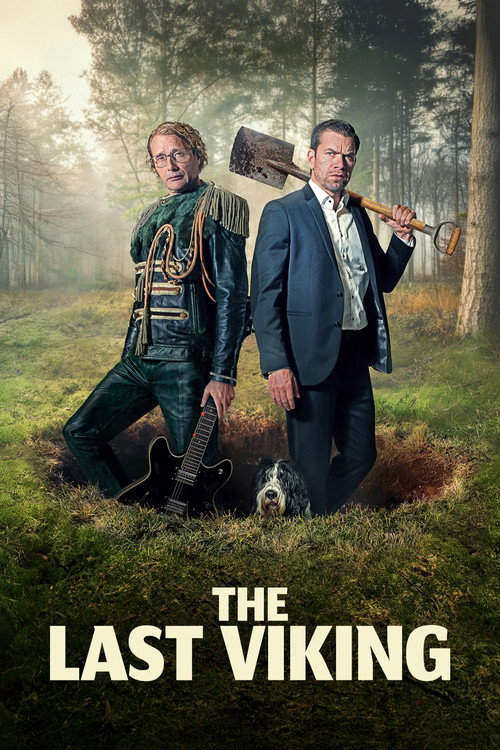
The Last Viking
2025 · Anders Thomas Jensen
When you want to laugh at something you probably shouldn't and end up moved anyway — an offbeat crime comedy with a real heart. Comfort viewing for people whose comfort runs a little dark.
What it's about
After fourteen years inside for a bank robbery, Anker walks out of prison to collect the money — except the only person who knows where it's hidden is his mentally ill brother Manfred, who has lost hold of the location and of himself: he's now convinced he is John Lennon. The two brothers set off to recover the loot, and the search keeps turning into something harder — a reckoning with a shared childhood and with who each of them has become.
The experience
It swings between big, dark laughs and moments of genuine ache, sometimes in the same scene — a heist comedy that keeps ambushing you with feeling. The tone is pure Danish black comedy: absurd on the surface, tender underneath.
The craft
Anders Thomas Jensen's signature move is loading a genre chassis — here, a heist — with a human problem the genre has no procedure for, and the writing keeps the delusion from ever becoming a cheap gag: it's the engine of the story, not a decoration on it. The film balances farce and grief with unusual control.
Why it matters
The sixth feature in Jensen's singular run of dark Danish tragicomedies, and the one that circles back most directly to the territory of his first — a reaffirmation of one of Europe's most distinctive comic voices.
Snapshot
A man comes out of prison after fourteen years to collect the money he went in for, and finds that the only person who knows where it is has lost the ability to know anything reliably — including who he is. That is the engine: a heist film in which the loot is intact and the map is a brain. Anders Thomas Jensen has built his directing career on exactly this kind of premise, a genre chassis loaded with a human problem that the genre has no procedure for, and The Last Viking is the sixth feature in that project and the first to return so directly to the terrain of his first.
The TMDB logline omits the film's defining conceit, which was central to the production's advance presentation: Manfred's illness has settled into the conviction that he is John Lennon. The delusion is not a gag hung on a crime plot; it is the crime plot's obstacle and the film's moral subject at once, because the money can only be recovered by dismantling the thing that is holding a sick man together. Mads Mikkelsen takes Manfred; Nikolaj Lie Kaas plays Anker, the brother with the fourteen years and the claim. The two have been the load-bearing pair of Jensen's stock company since Flickering Lights in 2000.
A caution that governs this dossier. The film is recent, and the granular production record available to me is thin: I cannot verify its premiere venue, its exact camera and post pipeline, its full crew assignments, its box-office performance, the specific terms on which any Lennon or Beatles recordings were licensed, or the texture of its critical reception. None of that is asserted below. What is documented here is the filmography, the working unit, the national and generic lineages the premise runs along, and the reasoning that connects them — with the reasoning marked as such.
Industry & production
Jensen directs roughly once every five years and writes constantly in between, and the second fact is what makes the first possible. He is the most consistently employed screenwriter in Danish cinema: the Susanne Bier features (Open Hearts, Brothers, After the Wedding, Things We Lost in the Fire, In a Better World), two Dogme films (Mifune, with Søren Kragh-Jacobsen; The King Is Alive, with Kristian Levring), Lone Scherfig's Wilbur Wants to Kill Himself, the crime comedies In China They Eat Dogs and Old Men in New Cars, Levring's western The Salvation, and two Thomas Vinterberg pictures that define the last fifteen years of Danish export cinema, The Hunt and Another Round. He came in through the short film and came in decorated: two Academy Award nominations in the live-action short category in the late 1990s and a win for Election Night (Valgaften) in 1999.
That standing is the film's financing. A Jensen feature is a domestic-language, mid-budget Danish production — the Zentropa house has been his home since the beginning, with Danish Film Institute support and the usual Nordic and European co-production layering underneath — that also happens to star one of the few Danish actors with an unambiguous international market. Mikkelsen's post-Hannibal, post-Casino Royale, post-Marvel career has had a recurring feature: he returns to Denmark to do work he could not do elsewhere, and specifically he returns to Jensen. Riders of Justice (2020) demonstrated what that combination is now worth, taking a wider international release than any of Jensen's earlier features — Magnolia handled it in the United States — off the back of a premise that in synopsis sounds like a straight revenge thriller and in execution is a film about statistical reasoning as a defence against grief.
The Last Viking arrives with the same structure of appeal and a sharper marketing hook. "Mads Mikkelsen as a man who believes he is John Lennon" is a sentence that sells internationally in a way that "Danish black comedy about brothers" does not, and the commercial logic of a picture like this is that the hook buys attention for a film whose actual interests are quieter. Whether the production licensed Lennon's or the Beatles' catalogue, imitated it, or worked around it is a live production question — the estate and the publishing are famously expensive and famously guarded — and the answer is not something I can establish. The point worth making is structural: a film built on this conceit has a music-rights problem baked into its budget from the first draft, and that problem shapes the film.
Technology
The specific technical record is not available to me at the level of camera bodies, lenses, or colour pipeline, and I will not invent one. What can be said is that Jensen's cinema has never been technologically ostentatious. His films are made with the standard tools of the contemporary Scandinavian mid-budget feature — digital acquisition, real locations in provincial Denmark and on its coasts, controlled and largely unshowy lighting — and their distinguishing technical labour has historically gone into the body rather than the image.
Men & Chicken (2015) is the reference point: a film whose entire premise is delivered by prosthetic makeup, five men built out of hare lips, wigs, dentures and padding into a family of grotesques, played straight. That is a craft-department picture, and it establishes that when Jensen needs an effect he tends to want it physically present on set, in front of the actors, rather than added later. A film about a man who has reconstructed himself as John Lennon has an obvious analogue: the round glasses, the hair, the posture, the voice. Whether The Last Viking pushes that into full transformation or keeps Mikkelsen legible underneath a few signifiers is a question the film answers formally, and I have not seen it answered.
The one genuinely contemporary technological pressure on a film like this is not on the camera at all. It is rights clearance and the international streaming window: a Danish-language comedy now reaches most of its foreign audience on a platform, subtitled, in a market where the Nordic back catalogue has become a recognisable shelf, and territory-by-territory music licensing for streaming in perpetuity is a materially different negotiation from theatrical clearance. That is the technology that most constrains this particular script.
Technique
Cinematography
Jensen's visual method across six features has been to shoot the absurd with a completely level camera. The comedy in The Green Butchers and Adam's Apples comes from the discrepancy between what is happening and how unexcited the frame is about it: wide masters that hold the whole grotesque tableau, symmetrical compositions, a rural Denmark photographed with the sober, slightly chilly naturalism of a social-realist drama. Sebastian Blenkov shot the early features and established that register; Riders of Justice was photographed by Kasper Tuxen, who brought a warmer, more mobile and more conventionally beautiful image to it without loosening the deadpan. I cannot confirm who photographed The Last Viking. The tradition it inherits is clear enough: the joke is never in the camera, and the camera's refusal to acknowledge the joke is the style.
The road structure implied by the synopsis — two brothers moving through a landscape in search of a buried thing — pulls toward an idiom Jensen has used less: the journey, the changing exterior, the country seen from a car. His films are usually centripetal, built around a compound, a butcher's shop, a church, a farmhouse.
Editing
The signature of a Jensen cut is the hard tonal pivot. A scene of genuine tenderness is terminated by sudden violence, or a piece of slapstick lands on a line of real cruelty, and the film moves on without a beat of adjustment. Adam's Apples does this repeatedly and is the purest example: the film will not tell you how to feel about what it just did. Anders Albjerg Kristiansen and Nicolaj Monberg have cut the recent features. The structural challenge specific to this material is that an amnesia quest is inherently episodic — a sequence of attempts to jog a memory, each of which fails — and episodic comedy dies unless the failures escalate in meaning rather than merely in incident.
Mise-en-scène / staging
Jensen stages men in rooms they are not equipped to be in. The recurring image across the filmography is a group of damaged, mismatched males assembling a household: the criminals renovating a woodland restaurant in Flickering Lights, the congregation of the unwell in Adam's Apples, the improvised family of specialists in Riders of Justice, the brothers on the farm in Men & Chicken. The spaces are provincial, cluttered, and practical — kitchens, garages, institutional corridors — and the comedy is architectural: too many wrong men in too small a space.
A delusional identity is a staging problem with a long precedent. Every object in a scene either supports the fiction or punctures it, and the film's ethics are decided by where the camera stands when the puncture happens.
Sound
Jeppe Kaas has scored every Jensen feature, a collaboration now a quarter of a century old and one of the most stable composer–director partnerships in European cinema. (He is Nikolaj Lie Kaas's brother; the Jensen unit is dense with such connections.) His scores work by understatement and by borrowed sincerity — a plain melodic line, often played straight, which allows a scene of absurd violence to carry real feeling without the film having to say so.
The Last Viking complicates this in an interesting way, because its premise installs a second, competing musical authority inside the fiction. If Manfred believes he is Lennon, then music is not underscore; it is symptom, evidence, and the character's means of self-assertion. A score by Kaas would then have to negotiate with a diegetic songbook that the protagonist believes he wrote. That is a genuinely unusual sound-design proposition, and it is the element of the film I would most want to hear described in detail.
Performance
Mikkelsen has been in all five previous Jensen features, and the relationship has consistently produced his least glamorous and most exposed work: the sweating, murderous butcher of The Green Butchers, the neo-Nazi mechanic of Flickering Lights, the priest in terminal denial in Adam's Apples, the harelipped masturbator of Men & Chicken, the frozen soldier of Riders of Justice. The international career trades on his control and his cheekbones; Jensen uses him to strip both.
Lie Kaas has been the other constant since Flickering Lights, and the pair's chemistry is the company's real asset: Mikkelsen plays containment, Lie Kaas plays leakage. Around them Jensen has kept a repertory — Nicolas Bro, Lars Brygmann, Søren Malling, Bodil Jørgensen, Anders W. Berthelsen, Paprika Steen, and until his death in 2018 Ole Thestrup — whose faces have become a kind of authorship in themselves. I cannot confirm which of them appear here.
Narrative & dramatic mode
The mechanism is a MacGuffin lodged inside a person. Classical heist-aftermath plots externalise the obstacle — the money is in a safe, a country, another man's hands — and generate suspense from an adversary. Here the obstacle is Manfred's mind, and the antagonist is therefore also the beloved, which converts every plot beat into an ethical one. To advance the story, Anker must interrogate, provoke, or destabilise his brother; success in the plot is harm to the person.
This is the same load-bearing structure as Adam's Apples, where the neo-Nazi's project of forcing a priest to admit reality is simultaneously a cruelty and a cure, and the film declines to say which. Jensen's dramatic mode is comedy that keeps promising to become moral instruction and never does. The endings resolve emotionally without resolving philosophically: someone is forgiven, nothing is explained.
The fourteen-year sentence does specific work. It fixes a date, and a man returning from 2011 to 2025 comes back to a country that has changed its phones, its policing, its psychiatric provision and its language about mental illness. Prison as time machine is an old device — it supplies the incomprehension of the returning man for free — and it pairs efficiently with a brother whose own relationship to time has broken in the opposite direction.
Genre & cycle
The film's nearest native ancestor is not art cinema but the Olsen-banden series, the fourteen crime comedies directed by Erik Balling between 1968 and 1998 that are as close to a shared national text as Denmark possesses. Nearly every entry opens with Egon Olsen walking out of Vridsløselille prison with a plan, and the series' comedy lives in the gap between criminal grandiosity and Danish provincial reality. Den sidste viking — a title in the same register as Olsen-bandens sidste stik — is a Jensen picture that steps deliberately into that inheritance and puts a psychiatric case at the centre of it.
The second frame is the Anglo-American crime grotesque: the Ealing tradition of The Ladykillers, where criminals and their loot are undone by decency and incompetence, and the Coen brothers, whose regional deadpan and sudden violence are the closest international analogue to what Jensen does. The third is the fraternal-caregiving road film, of which Rain Man is the inescapable template and the trap — the risk being sentimental instrumentalisation, illness as a device that teaches the healthy brother a lesson.
The fourth and most important cycle is Jensen's own. Flickering Lights is about criminals with a stolen bag of money who go to ground in the Danish countryside; The Last Viking, twenty-five years on, is about criminals and a stolen bag of money that never got spent. The filmography reads as a closing circle, with the intervening films — theodicy in Adam's Apples, biological determinism in Men & Chicken, causality and grief in Riders of Justice — supplying the weight the first film did not carry.
Authorship & method
Jensen writes alone as a director and in partnership as a screenwriter, and the two modes produce visibly different films: the Bier and Vinterberg scripts are structurally severe and emotionally direct, while his own features are shaggier, funnier, and stranger. The constant is a taste for the ethically unresolvable situation, established early and never abandoned.
The method is repertory. Jensen writes for the same faces, works with the same composer, and returns to the same conceptual preoccupation — men who are broken in ways that are funny until they are not, and the improvised families they form. The continuity of the unit is unusual by any standard: Mikkelsen in all six features, Lie Kaas since the first, Jeppe Kaas scoring every one, Zentropa producing throughout, with Sisse Graum Jørgensen among the recurring producers.
A word on the Lennon conceit and Denmark, offered as resonance rather than as a claim about the film's intentions. John Lennon and Yoko Ono genuinely spent the turn of 1969–70 in North Jutland, at the farm of Ono's former husband Anthony Cox near Thisted, and gave a press conference in Aalborg in January 1970 after cutting off their hair. The Lennon myth has a real, documented Danish foothold in exactly the kind of rural nowhere Jensen films. Whether The Last Viking knows or uses this, I cannot say.
Movement / national cinema
Jensen belongs to the generation formed by Dogme 95 without ever having been a doctrinaire member of it. He wrote two of the certified Dogme films, and he absorbed the movement's durable legacies — the primacy of performance, location shooting, an allergy to gloss — while discarding its asceticism. What Dogme actually did for Danish cinema was institutional rather than aesthetic: it made a small national industry internationally legible, and it built Zentropa into a production house with the confidence to back peculiar things.
The peculiar thing Jensen has built inside that shelter is a genre with essentially one practitioner: the Danish black comedy of damaged men, played with total sincerity by the country's best actors. Its nearest relatives abroad are Aki Kaurismäki's deadpan Finnish melancholy and Bent Hamer's Norwegian miniatures, and its nearest relative at home is the broad folkekomedie tradition that Jensen pitches his films toward and then violates. That it has remained commercially viable for twenty-five years says something about the Danish audience's tolerance for the grotesque that has no equivalent in most European markets.
Era / period
A 2025 Danish feature exists in a market where the domestic theatrical release is a prestige event and the real audience arrives later through streaming, and where the international appetite for Nordic material — built by the television crime wave and consolidated by Another Round's 2021 Academy Award — remains high but is no longer novel. Jensen and Mikkelsen are among the very few Danish names that travel on their own.
The film's subject is also of its moment in a way his earlier work was not. Adam's Apples in 2005 could treat institutional psychiatry as an absurdist setting; a film made in 2025 about a man whose delusion is untreated, and about a brother who has to decide whether to break it, lands in twenty years of public argument about mental-health provision, about the ethics of intervention, and about whether a stable delusion that lets someone function is a condition to be cured. Jensen's instinct, on the evidence of the whole filmography, is not to answer.
Reception, canon & influence
I do not have a reliable account of the film's critical reception or commercial performance, and will not manufacture one. What can be established is the baseline: Jensen's features are reliably among the better-performing Danish domestic releases and are recurrent presences at the Robert and Bodil awards; Adam's Apples and Men & Chicken both found substantial cult afterlives abroad, the latter released in the United States by Drafthouse Films; Riders of Justice was the widest international breakout. A sixth Jensen–Mikkelsen collaboration with a high-concept hook would be expected to reach further than any of them, and a film this recent has had no time to be canonised.
The backward influences are legible and several: the Olsen-banden prison-gate opening and its comedy of provincial criminal delusion; the Ealing loot picture; the Coens' regional grotesque; Rain Man's fraternal road structure and the whole post-Cuckoo's Nest argument about who benefits from a cure; the countercultural sainthood of Lennon himself, whose image has been available as shorthand for wounded idealism since 1980; and, most directly, Jensen's own Flickering Lights, whose premise this film reopens, and Adam's Apples, whose central ethical question it reframes.
The forward influence cannot be assessed yet, and the honest thing is to say so. What the film does contribute immediately is to the coherence of the body of work behind it. Six features over twenty-five years, one company of actors, one composer, one production house, and one persistent question — whether it is kinder to let a man keep the story that is holding him up — now constitute a genuine authorship rather than a run of well-liked comedies. If The Last Viking lasts, it will most likely be as the film that made the shape of that project visible in full.
Reception
Premiered out of competition at Venice 2025 to respectful-but-mixed reviews — critics abroad wobbled on its tonal whiplash — then went home and became a phenomenon: the biggest Danish live-action opening since 2018 and Anders Thomas Jensen's best-selling film ever in Denmark, topping 700,000 admissions.
How The Last Viking was received, from release to now →
Influences: the films it descends from and the films it influenced
- Flickering Lights (2000) — Jensen's own debut supplies the exact chassis this film reopens — criminals who abscond with a bag of someone else's money and then have to cohabit in a derelict provincial building while the loot sits inert — along with the repertory unit (Mikkelsen, Nikolaj Lie Kaas, Jeppe Kaas scoring, Zentropa) and the rule that each man's comic damage is eventually traced to a specific childhood injury delivered flat, without underscoring.
- The Green Butchers (2003) — Established Jensen's signature refusal of camera comment: atrocity and farce are framed identically, on a locked or barely-drifting eye-level axis in small tiled provincial interiors, so the joke is never pointed at by a push-in — and it set the Mikkelsen/Lie Kaas casting grammar of pairing a contained, rigid performer against a volatile one.
- Adam's Apples (2005) — The direct ethical template: a man's manifestly false story about himself is the only structural member holding him upright, and the film's dramatic engine is another character deciding whether puncturing it counts as help or homicide — worked out through hard cuts from broad comedy into unannounced physical violence within the same scene.
- Men & Chicken (2015) — Perfected the staging problem of too many damaged brothers in rooms too small for them — blocking that keeps four or five bodies inside one wide, unmoving frame so the comedy comes from spatial congestion rather than cutting — plus the grotesque-as-tenderness register in which prosthetic or behavioral deformity is shot with complete deadpan neutrality.
- Mifune (1999) — Jensen's own co-written Dogme script invented his career-long device of the maintained fiction as an act of care — a brother with a cognitive disability kept on a decaying rural farm whose caretaker performs an elaborate invented character for him — and fixed the Jutland farmhouse, natural light and all, as the setting where family lies get transacted.
- Brothers (2004) — Jensen's screenwriting mode at its most severe: two brothers, one returned from confinement fundamentally altered, and an entire household reorganized around a single withheld fact — proof that the damaged-brothers structure predates his directing and that his own features are the shaggy, comic reworking of scripts he first built as melodrama for Mikkelsen.
- The Olsen Gang (1968) — The Nordic prison-gate opening as structural motor — the released mastermind walks out, is met by his crew, and immediately unveils a plan hatched inside — establishing the convention that prison functions as a time machine in which a man's grandiose scheme is perfectly preserved while the world outside quietly disqualifies it.
- The Lavender Hill Mob (1951) — The Ealing loot picture's governing joke: the theft succeeds but the proceeds are transmuted into a form that cannot simply be spent, so the film's real plot is a patient, bureaucratic recovery operation conducted by mild men — the aftermath, not the job, carries the running time.
- The Ladykillers (1955) — The template for criminals penned into a domestic interior under the authority of someone whose innocence they cannot bring themselves to violate — comedy generated by armed men obliged to observe household manners, and by a gang that destroys itself through proximity rather than through any external investigation.
- The Good, the Bad and the Ugly (1966) — The ur-text for a MacGuffin lodged inside a person: the money's whereabouts exist only in one man's head, which converts the pursuit into forced custodianship — his captor must nurse, feed and protect him precisely so he can be exploited, making care and cruelty a single continuous action.
- One Flew Over the Cuckoo's Nest (1975) — Set the terms of the argument the film inherits — that clinical 'treatment' is administered for the comfort of the administrators — and supplied the staging of institutional rooms as arenas where a man's self-invention is slowly negotiated away by people speaking in reasonable, caring voices.
- Rain Man (1988) — The fraternal road structure in which a neurologically fixed brother's non-negotiable rituals become the literal constraints on the plot's movement, and the sibling who set out to extract money from him is reshaped by the logistics of looking after him — the caregiver-as-exploiter arc that only resolves by abandoning the payday.
- Riders of Justice (2020) — The immediate companion piece in the same authorship: Mikkelsen plays a man who survives by committing to a causal narrative that the film knows is false, surrounded by a squad of specialists who are all in various ways unwell, and the picture pivots from bloody thriller to group-therapy farce on a single cut without changing lens or lighting.
- In Bruges (2008) — The post-job waiting room as a genre in itself — two mismatched criminals stranded in a picturesque provincial town with nothing to do but talk — and the hard tonal cut as its signature edit: a comic exchange severed mid-beat by sudden, unscored violence with no shift in visual register to prepare it.
- Snatch (2000) — The comic variant of the swallowed MacGuffin — a diamond inside a living body converts a chase into a farce of waiting, monitoring and custody, with every armed faction reduced to caretakers of the creature carrying their score.
- Yesterday (2019) — The other recent feature whose entire premise is contingent on clearing the Lennon–McCartney catalogue, demonstrating how music-rights negotiation functions as a production constraint that determines which songs can be performed diegetically, in what length, and therefore how the score and the songbook divide the emotional labor.
Similar films
- Riders of Justice (2020) — influence & lineage
- Brothers (2004) — influence & lineage
- The Mastermind (2025) — shared sensibility
- Another Round (2020) — shared sensibility
- A Pigeon Sat on a Branch Reflecting on Existence (2014) — shared sensibility
- Twinless (2025) — shared sensibility
- The Hunt (2012) — shared sensibility
- Father Mother Sister Brother (2025) — shared sensibility
All the films related to The Last Viking →
Watch it with: curated runs of related films
- Gallows Wit, Unraveling Men — A run of darkly funny character studies where a man decides he's done — with a friendship, a life, a self — and the jokes keep landing right up to the edge; watch them together for how each one lets despair and comedy share the same breath.