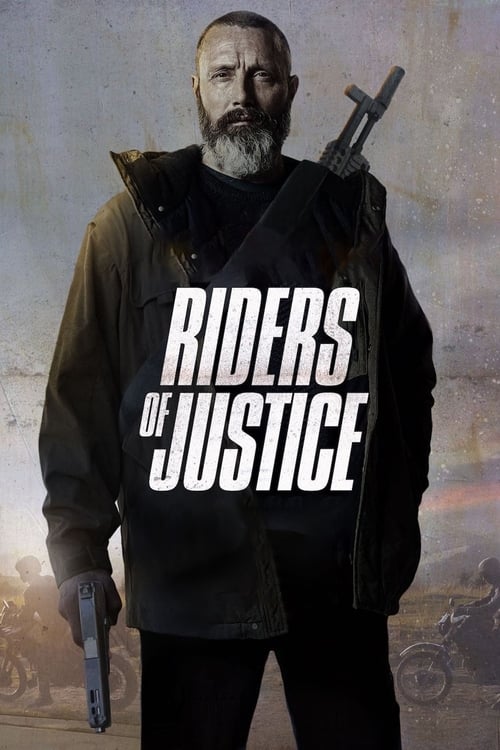
Riders of Justice
2020 · Anders Thomas Jensen
When you want a film that surprises you — you think you're getting a Nordic action movie and end up with something to chew on about coincidence, trauma, and why we need reasons for terrible things. Equal parts entertainment and gut-punch.
What it's about
Markus, a career soldier, comes home from deployment when his wife dies in a train derailment, leaving him to care for a teenage daughter he barely knows how to talk to. Then a statistician who survived the wreck shows up with calculations suggesting the crash was no accident, and he and two fellow data obsessives pull Markus into a revenge campaign against a biker gang. The vengeance is real; whether the math behind it holds up is another question the film keeps quietly turning over.
The experience
A whiplash of tones that shouldn't work and completely does — genuinely brutal violence, laugh-out-loud absurdist comedy, and an undertow of grief that sneaks up on you. It's fast, strange, and far more moving than a revenge thriller has any right to be.
Performances
Mads Mikkelsen is ferocious and heartbreaking as a man who only knows how to process loss through violence, while Nikolaj Lie Kaas, Lars Brygmann, and Nicolas Bro turn a trio of damaged data specialists into the funniest and saddest support group in recent memory.
The craft
Anders Thomas Jensen's script is the star: a mechanism where every joke doubles as a statement about probability and every act of violence has an emotional bill that comes due. The film's control of tone — pivoting from deadpan farce to real sorrow within a scene — is the kind of tightrope act most comedies and most thrillers never attempt.
Why it matters
It became the breakout international hit of Jensen's two-decade collaboration with Mikkelsen and his repertory of Danish actors, and a word-of-mouth favorite proving revenge stories could carry genuine philosophical weight.
Snapshot
Riders of Justice (Danish: Retfærdighedens ryttere) is Anders Thomas Jensen's fifth feature and the fullest expression of a project he has pursued across two decades: the deadpan collision of extreme violence, absurdist comedy, and philosophical grief. Mads Mikkelsen plays Markus, a deployed soldier who returns home when his wife is killed in a train derailment and their teenage daughter, Mathilde (Andrea Heick Gadeberg), needs him. When a survivor of the wreck, the statistician Otto (Nikolaj Lie Kaas), calculates that the crash was too improbable to be accidental, he and two fellow data specialists — Lennart (Lars Brygmann) and Emmenthaler (Nicolas Bro) — draw Markus into a revenge campaign against a biker gang, the film's titular "Riders of Justice." What begins as a genre thriller steadily reveals itself as a study of how traumatized people manufacture causality to make loss bearable. The film is at once a violent action-comedy and a sincere argument about chance, meaning, and improvised family.
Industry & production
The film was produced by Zentropa, the Danish company founded by Lars von Trier and Peter Aalbæk Jensen that has been the engine of much internationally visible Danish cinema since the Dogme 95 era. It is a work of the mature, post-Dogme Danish industry: modestly budgeted by international standards but built on a deep, repeatedly reused pool of craft talent and a star, Mikkelsen, whose global profile (from Casino Royale through Hannibal and Another Round) gives a Danish-language film unusual reach. Precise budget and box-office figures are not something I can reliably state, and I will not invent them; the film's commercial life ran through the pandemic period of 2020–2021, which complicates any clean theatrical accounting. Its international distribution — including a U.S. release handled by Magnolia Pictures — extended Jensen's reach well beyond the Nordic art-house audience that had received his earlier features. The production sits within a durable Danish model in which public film-institute support, television co-financing, and Zentropa's producing infrastructure allow genre-inflected auteur cinema to be made repeatedly with the same collaborators.
Technology
Riders of Justice is a conventionally-originated digital production of its moment: shot on digital cinema cameras and finished through a standard digital-intermediate pipeline, with no ostentatious formal gimmickry. Its technological signature is not in capture format but in restraint and control — clean, stabilized framing, precisely graded interiors, and gunfire and vehicular violence staged with practical squibs, stunt coordination, and controlled effects rather than heavy digital augmentation. Where visual effects appear (the train collision, the choreographed shootouts), they serve plausibility rather than spectacle; the derailment is treated largely through aftermath and implication rather than sustained CGI set-piece. The film's real "technology," thematically, is diegetic: the analysts' facial-recognition scraping, data cross-referencing, and probability modeling are the tools that generate the plot, making computation itself a narrative agent and a target of the film's irony.
Technique
Cinematography
The cinematography is credited to Kasper Tuxen, one of the notable Danish directors of photography of his generation. His work here is composed, cool, and unshowy — a deliberate counterweight to the story's violence and grief. Interiors in Markus's spartan farmhouse are shot in muted, wintry tones; the palette leans toward grays, greens, and desaturated warmth, so that outbreaks of blood and muzzle flash register as genuine violations of an ordered frame. Tuxen favors stable, often symmetrical compositions and gives the ensemble room within the widescreen frame, letting the physical comedy of four mismatched men in a room play in the staging rather than in cutting. The camera's calm is a rhetorical strategy: it refuses to editorialize the carnage, which makes the film's swerves between slapstick and horror land harder.
Editing
The editing is the film's most important formal instrument, because Riders of Justice is fundamentally about causality — the way one event is stitched to another. The picture opens with a chain of small contingencies (a stolen bicycle in Tallinn rippling outward) that the cutting presents as a deterministic sequence, seeding the film's central question of whether the train crash was designed or merely random. Throughout, the editing manages abrupt tonal gearshifts — from a therapy-adjacent scene of male vulnerability to sudden lethal violence — with a control that keeps the comedy and the trauma legible at once. Montage is also used to visualize the analysts' inferential leaps, laying probability and pattern over ordinary footage. I cannot confirm the individual editing credits from memory with certainty and will not guess names; what is clear is that the cut is doing the film's central intellectual work.
Mise-en-scène / staging
Jensen stages the film around a single, resonant location: Markus's isolated farmhouse, which the three analysts colonize until it becomes a makeshift household and command center. The clutter of screens, guns, and mismatched furniture externalizes the men's project of imposing order on chaos. Costuming and physical type do a great deal of characterization — Mikkelsen's rigid, buttoned military bearing against Bro's soft bulk and Brygmann's twitchy anxiety — so that the ensemble reads as a visual comedy of incompatible bodies forced to cohabit. The staging repeatedly places tenderness and brutality in the same room, and the farmhouse's gradual transformation into a home is the film's quiet argument made in production design.
Sound
Jeppe Kaas — a long-standing Jensen collaborator and brother of the film's co-star Nikolaj Lie Kaas — provides the score, which works against the violence with warmth and melancholy rather than propulsion, reinforcing the film's identity as a grief drama wearing a thriller's clothes. The sound design draws a hard line between the muffled, subjective register of trauma and the sharp, startling report of gunfire, so that violence arrives as rupture. Music is deployed sparingly enough that its appearances — often tender or ironic against the action — carry real tonal weight.
Performance
Performance is where the film's tonal tightrope is walked. Mikkelsen plays Markus almost entirely through suppression: a man who has converted grief into rage because rage is actionable and grief is not, his stillness periodically detonating into violence. Against him, Nikolaj Lie Kaas, Lars Brygmann, and Nicolas Bro give broadly comic, deeply wounded turns as three men whose intellect and social damage are inseparable; their bickering ensemble comedy is the film's engine and its heart. Andrea Heick Gadeberg grounds the film emotionally as Mathilde, the daughter whose actual grief the men keep sidestepping. The casting reunites much of Jensen's recurring troupe, and the actors' evident long familiarity gives the improvised-family conceit its lived-in credibility.
Narrative & dramatic mode
The film's dramatic mode is ironic reversal. It adopts the architecture of the revenge thriller — inciting death, an investigation, an escalating campaign against a criminal organization, a climactic shootout — and then systematically undermines the genre's premise that violence delivers justice or meaning. The structural key is the opening causal chain and the analysts' probabilistic reasoning: the film first invites us, like the characters, to see a hidden design behind tragedy, then confronts us with the possibility that we have mistaken coincidence for conspiracy. The narrative is thus built as an epistemological trap. Its resolution is not the defeat of an enemy but the characters' partial acceptance that some catastrophes have no author — an anti-cathartic turn that lands, paradoxically, as emotional catharsis. Comedy and tragedy are not alternated so much as superimposed, with the same events legible as both.
Genre & cycle
Riders of Justice belongs to a lineage of revenge cinema — the aggrieved everyman turned avenger — but processes it through Nordic irony and comedy. It sits most naturally within Jensen's own cycle of Mads Mikkelsen collaborations: Flickering Lights (2000), The Green Butchers (2003), Adam's Apples (2005), and Men & Chicken (2015). Across these, Jensen has developed a recognizable subgenre of his own — the black-comic ensemble film in which damaged men, absurd violence, and unexpected metaphysical or theological questions coexist. Riders of Justice is the most emotionally direct and the most conventionally propulsive entry in that cycle, closest to a "real" thriller while remaining unmistakably part of Jensen's absurdist project. It also converses with the broader wave of internationally successful Nordic crime and revenge narratives without adopting their solemnity.
Authorship & method
The film is a near-total auteur work in the specific Danish sense: Jensen writes and directs, and he builds each project from a fixed repertory company. He is, notably, one of the most prolific and decorated Danish screenwriters of his era — an Academy Award winner for the live-action short Election Night (1998) and a frequent screenwriting collaborator on major Danish dramas, including work associated with director Susanne Bier. That screenwriting pedigree explains the film's structural sophistication and its dialogue-driven ensemble comedy. His method is collaborative in a familial way: the recurring cast (Mikkelsen, Lie Kaas, Bro, Brygmann) functions as a troupe whose interplay the scripts are written toward. The key craft collaborators reinforce this continuity — composer Jeppe Kaas within the extended Jensen circle, and cinematographer Kasper Tuxen supplying the composed, restrained image. The film carries a shared story credit reflecting Jensen's habitual co-development of premises (I associate the initial idea with a collaboration involving Nikolaj Arcel, but state that with appropriate caution rather than as settled fact). The authorial signature is consistent: an interest in men who cannot articulate feeling, violence as displaced mourning, and comedy as the only bearable register for grief.
Movement / national cinema
The film is a product of post-Dogme Danish cinema, made inside the very institution — Zentropa — that produced the Dogme 95 movement. It inherits Dogme's appetite for emotional extremity and its comfort with amateurish, damaged, unheroic characters, but abandons Dogme's formal asceticism for polished genre craft. It belongs to a national cinema that has become globally fluent in exportable genre auteurism — the same ecosystem that produced Bier's dramas, Nicolas Winding Refn's stylized thrillers, and Thomas Vinterberg's work — and that leverages a small, interconnected talent pool with remarkable consistency. Its release also sits alongside a banner moment for Danish cinema and for Mikkelsen specifically, arriving contemporaneously with Vinterberg's Another Round (2020), and it participates in the international visibility that Danish film enjoyed in that period.
Era / period
Riders of Justice is a film of the early 2020s in both circumstance and preoccupation. Its production and distribution straddle the COVID-19 disruption of theatrical exhibition, which shaped how it reached audiences. Thematically it is a work of the data era: its plot is driven by facial recognition, database cross-referencing, and probabilistic inference, and it satirizes the modern faith that enough data can convert randomness into causation and control. Its treatment of returning-soldier trauma and masculine emotional illiteracy is likewise contemporary, engaging with post-deployment PTSD and the cultural conversation about men's inability to grieve. The film reads as a distinctly 2020s parable about the search for pattern in a world of noise.
Themes
The governing theme is causality versus chance — the human compulsion to find agency and meaning behind catastrophe rather than accept randomness. Closely bound to it is grief and its displacement: revenge, statistical analysis, and even the men's found brotherhood are all strategies for not confronting loss directly, and the film's arc is the slow admission that they are. Trauma and masculinity form a third axis, with a cast of men whose intellect and aggression mask abuse, fear, and sorrow they cannot name. Finally, the film advances a warm counter-thesis to its bleak epistemology: improvised family. The unlikely household that forms in Markus's farmhouse becomes the film's answer to a meaningless universe — not a reason for the tragedy, but a way to live after it. Threaded through all of this is a characteristically Jensen-ish, quasi-theological question about whether anything watches over us, left deliberately unresolved.
Reception, canon & influence
Critically, Riders of Justice was received as one of Anders Thomas Jensen's strongest and most accessible films — widely praised for its tonal control, for Mikkelsen's contained lead performance, and for the way it smuggles a serious meditation on grief and randomness inside a crowd-pleasing revenge structure. I will not fabricate specific review scores, quotations, or award outcomes; described in general terms, its reception was strongly favorable across international critical outlets, and it broadened Jensen's audience beyond the art-house niche his earlier work occupied.
Looking backward, the influences on the film are legible. It draws on the revenge-thriller tradition and on Nordic crime cinema for its plot machinery, on Dogme-era Danish cinema for its emotional rawness and unglamorous characters, and on Jensen's own prior Mikkelsen collaborations for its ensemble-of-damaged-men template. Its intellectual scaffolding — the butterfly-effect opening, the meditation on coincidence and determinism — connects it to a broader cinema of chance and interlocking causality.
Looking forward, its influence is best understood as consolidating rather than founding: it cemented the Jensen–Mikkelsen partnership as one of the signature auteur-star pairings of contemporary Danish cinema and stands as the mature template for the tonally hybrid "violent film about grief." Its legacy is still recent and therefore provisional; what is already clear is that it functions as the definitive, most-cited entry point to Jensen's body of work and as a demonstration that action-comedy and genuine philosophical sorrow can be sustained in a single frame.
Reception
Slipped out mid-pandemic (Denmark late 2020, a quiet US release in 2021) and then became a pure word-of-mouth phenomenon — the streaming-era 'why did nobody tell me about this' film that fans now press on each other like a secret.
How Riders of Justice was received, from release to now →
How to watch Riders of Justice: what to notice on a first viewing
- Watch how ordinary the palette looks before violence hits. Tuxen shoots the farmhouse in muted grays, greens, and desaturated warmth, so that blood and muzzle flash register as visible violations of an otherwise calm, ordered frame. The color scheme makes every outbreak of violence look like a rupture, not a routine genre beat.
- Watch four mismatched men try to share one room. Tuxen keeps the ensemble in a single stable, often symmetrical frame, letting the physical comedy of incompatible bodies and clutter play out in the blocking rather than in quick cuts. The comedy comes from watching bodies compete for space, not from editing tricks.
- Listen for warm, melancholy music under violent scenes. The score leans tender and sad rather than propulsive, while gunfire itself arrives sharp and startling against a muffled, subjective register of trauma elsewhere. The music keeps announcing that this is a grief story wearing a thriller's clothes.
- Watch Markus go still right before he turns violent. Mikkelsen plays him through suppression almost entirely, a stillness that periodically detonates, converting grief he cannot process into rage that at least gives him something to do. His violence reads as displaced mourning rather than as simple heroic payback.
- Watch the farmhouse fill up with screens and clutter. The three analysts gradually colonize Markus's isolated house with equipment and mismatched furniture until the command center starts to look like an actual, if strange, home. The production design tracks a group of strangers turning into something like a family.
The whole guide to watching Riders of Justice, with the keys for a rewatch →
Influences: the films it descends from and the films it influenced
- Flickering Lights (2000) — Jensen's debut established the repertory-troupe method (Mikkelsen, Lie Kaas, Bro) and the criminal gang that congeals into an improvised surrogate family holed up in a single hideout — the direct structural ancestor of the farmhouse-command-center ensemble.
- The Green Butchers (2003) — Perfects the Jensen tonal recipe of deadpan black comedy staged around grisly violence and men who cannot speak their grief, played by the same fixed cast written toward as a troupe.
- Adam's Apples (2005) — The template of Mikkelsen as a rigid true-believer whose worldview is a defense against loss, colliding with an ensemble of damaged men — the same displaced-mourning-as-comedy register Riders inherits wholesale.
- Men & Chicken (2015) — A grotesque brother-ensemble whose farce turns on a late epistemological reveal about parentage/origins, prefiguring Riders' structural trick of a comic surface concealing a puzzle about what really caused events.
- Festen (1998) — The Dogme 95 source of the film's unglamorous emotional rawness — handheld intimacy and stripped, confrontational family-trauma performance that Riders formalizes into its 'post-Dogme' restraint.
- Pusher (1996) — Founded the modern Nordic crime idiom — cold, procedural underworld mechanics and Mikkelsen as menace — supplying the genre machinery (biker gang, contract killing) that Riders borrows and then subverts.
- In a Better World (2010) — Written by Jensen: its clockwork of interlocking coincidence driving a revenge-versus-forgiveness moral crisis is the melodramatic screenwriting scaffolding Riders repurposes into a philosophical revenge comedy.
- Magnolia (1999) — Its essayistic prologue arguing that coincidence is not 'just' coincidence is the direct model for Riders' butterfly-effect opening and its formal insistence on visualizing hidden causal chains.
- Amores Perros (2000) — Uses a single traffic collision to fuse the fates of strangers into one causal web — the interlocking-causality architecture, seeded by a random accident, that Riders builds its whole plot and thesis around.
- Run Lola Run (1998) — Dramatizes determinism-versus-chance through branching causal chains and montage of tiny contingencies snowballing into catastrophe — the kinetic 'causal-chain montage' grammar Riders adopts for its inference sequences.
- Nobody (2021) — Extends the ordinary-wounded-man-as-lethal-avenger action-comedy, weaponizing a mild protagonist's buried rage against a criminal gang with the same deadpan-brutal tonal blend Riders popularized.
- In Bruges (2008) — The benchmark for tonal gearshifting between farce and sudden lethal violence among hitmen paralyzed by guilt — the exact black-comic-grief register and whiplash editing rhythm Riders sustains.
- Blue Ruin (2013) — Deglamorizes revenge by making the avenger incompetent and the killing ugly and consequential — the ironic-revenge-subversion Riders shares, exposing vengeance as a grief-management fantasy rather than catharsis.
- Zodiac (2007) — Turns obsessive data-inference — connecting dots, reading pattern into randomness — into its formal engine, the same epistemological trap where the statistician characters mistake coincidence for a designed conspiracy.
- Three Billboards Outside Ebbing, Missouri (2017) — Displaces unbearable grief into escalating, misdirected vengeance played as caustic ensemble comedy — the same 'violent film about mourning' hybrid, aimed at the wrong targets for the wrong reasons.
- Another Round (2020) — A contemporaneous Danish study of middle-aged male sorrow anchored by Mikkelsen's suppressed-grief performance, extending the same post-Dogme troupe's project of finding comedy in emotionally inarticulate men.
- The Last Viking (2025) — The immediate companion piece in the same authorship: Mikkelsen plays a man who survives by committing to a causal narrative that the film knows is false, surrounded by a squad of specialists who are all in various ways unwell, and the picture pivots from bloody thriller to group-therapy farce on a single cut without changing lens or lighting.
Similar films
- Another Round (2020) — influence & lineage
- The Celebration (1998) — influence & lineage
- Nobody (2021) — influence & lineage
- The Last Viking (2025) — shared sensibility
- The Hunt (2012) — shared sensibility
- Citizen Vigilante (2026) — shared sensibility
- Headhunters (2011) — shared sensibility
- Furiosa: A Mad Max Saga (2024) — shared sensibility