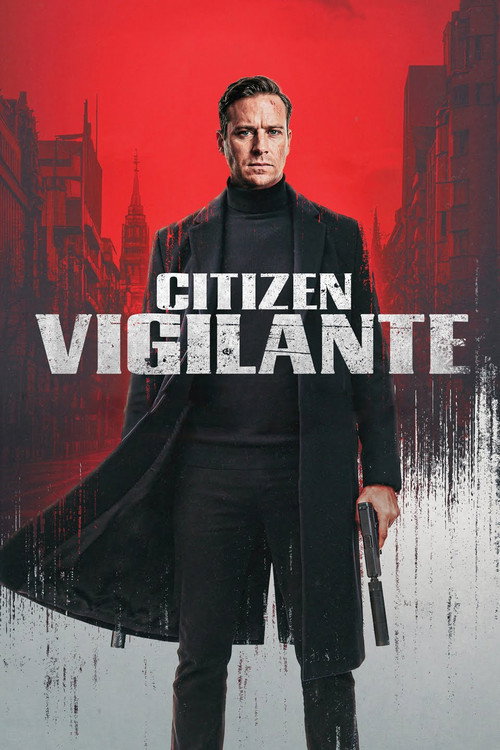
Citizen Vigilante
2026 · Uwe Boll
For when you want something raw and argumentative — a revenge thriller to yell at, debate afterward, and disagree with your friends about. Definitely challenge over comfort; it deals in ugly crimes and uglier questions.
What it's about
An ordinary man starts hunting the criminals the system won't touch — rapists, killers, the protected and the connected — and the internet makes him a folk hero for it. As his following grows, so does the attention of a police chief determined to shut him down, and the question of where justice ends and murder begins gets harder to dodge. It's a vigilante story wired into the age of viral fame.
The experience
Blunt, aggressive, and deliberately provocative — it wants to make you cheer and then make you uncomfortable for cheering. Expect a confrontational ride that keeps poking at your own sense of justice.
The craft
Uwe Boll works fast, cheap, and without a filter, and this is that method applied to hot-button material: grounded violence, news-footage texture, and zero interest in respectability. The rough edges are part of the point — it plays like an angry pamphlet as much as a thriller.
Why it matters
A late-career statement from one of cinema's most notorious provocateur directors, joining the long, contentious tradition of vigilante films that double as social lightning rods.
Snapshot
Citizen Vigilante is a 2026 thriller written, produced, and directed by the German filmmaker Uwe Boll, who also served as his own cinematographer. Armie Hammer stars as Michael Sanders, a former US Army officer and wealthy businessman living in an unnamed European city who begins executing violent criminals — most of them immigrants — along with the judges who let them walk free. Shot in Zagreb, Croatia over roughly three weeks in early 2025 on a $2 million budget, the 89-minute film was released by Quiver Distribution in a limited US theatrical run on June 19, 2026, then uploaded in full to X for a 48-hour window before moving to digital platforms. Its afterlife was shaped less by critics — who dismissed it nearly unanimously, with a 10% Rotten Tomatoes score — than by Elon Musk's promotion of it on X, which pushed it to the top of the Apple TV and Prime Video digital purchase charts by the end of June. The result is a telling artifact of its moment: a scorned, cheaply made vigilante picture that found a mass audience through the very attention-economy channels its premise dramatizes. It is Boll's return to directing after a publicly declared retirement, and the most direct extension yet of the preoccupations of his Rampage trilogy.
Industry & production
Uwe Boll is one of the most legible independent producer-directors of the last quarter-century, and his industrial model remains the most reliable lens on any film bearing his name. Through his companies (Boll KG / Event Film and successors), Boll became notorious in the 2000s for exploiting a since-closed German tax-shelter provision that allowed investors to write off film investments immediately; this let him finance a rapid run of features — the video-game adaptations House of the Dead (2003), Alone in the Dark (2005), BloodRayne (2005) — largely outside the Hollywood studio system, shooting quickly and cheaply, often in Canada and Germany. By the mid-2010s Boll announced he was effectively retiring from filmmaking, citing the collapse of that financing environment, and for a period ran a restaurant in Vancouver.
Citizen Vigilante is the return to directing that retirement implied would never come, and it was made exactly on the old model: a $2 million budget, a nineteen-day shoot in Zagreb (January 27 to February 15, 2025), and Boll in total control as writer, producer, director, and camera operator. The production carried one piece of industrial comedy en route to release: it was originally titled The Dark Knight, and was retitled in April 2025 after a cease-and-desist letter from Warner Bros. Distribution was equally unorthodox. After its limited theatrical opening, the complete film was posted to X for 48 hours before its standard digital rollout — a stunt perfectly matched to its subject. In Germany, the FSK declined to rate the film for cinemas, restricting its theatrical exhibition in Boll's home country. Commercially, the decisive event was Musk's amplification on X, after which the film reached #1 among digital purchases on both Apple TV and Prime Video by June 30, 2026. A sequel has been announced for 2027.
Technology
The film was shot digitally on location in Zagreb, with Boll operating as his own cinematographer — the leanest possible configuration of his run-and-gun method, and the logical endpoint of a career spent minimizing every layer between director and image. The compressed schedule and budget are visible in the finished picture's post-production: reviewers noted conspicuously digital blood spatter, a composited explosion superimposed over a flipped car, and heavy reliance on ADR dubbing throughout. The most technologically significant fact about Citizen Vigilante, however, is not how it was made but how it was delivered: the 48-hour full upload to X made the platform itself a distribution channel, collapsing the film's subject — violence circulating as viral content — into its own release strategy.
Technique
Cinematography
With Boll behind the camera himself, the film extends the raw, unglamorous, quasi-documentary register of his Rampage pictures: mobile framing, functional compositions, and a surface that critics connected directly to the grain and grime of 1970s vigilante cinema — a dirtiness and cheapness that reads, depending on the viewer, as either texture or poverty. The Zagreb locations are deliberately unspecified, photographed as a generic, anonymous European city rather than a particular place, which keeps the film's grievances abstract and continental rather than local.
Editing
Editing, by Ethan Maniquis, is the film's most discussed formal feature. The narrative is non-linear: strands from different points in time are spliced and interleaved rather than told in order. Sonny Bunch at The Bulwark found the interweaving disjointed; the critic at 3 Brothers Film conceded that the intercutting is at times so fragmented it becomes hard to follow, but offered the film's most sympathetic formal reading — that the fragmentation mirrors the way its audience actually consumes social media, violence and context arriving shuffled and decontextualized. Whether by design or by haste, the film's broken chronology is of a piece with its subject.
Mise-en-scène / staging
The film stages its violence in ordinary, contemporary urban environments — streets, courts, the spaces of everyday European city life — rendered for plausibility over spectacle, Boll's default register in his realist work. The staging ambition exceeds the resources in places: the composited car explosion and digital blood flagged by reviewers mark the seams where a $2 million budget meets action-movie demands. The anonymity of the setting is itself a staging choice: this is "Europe" as a condition, not a city with a name.
Sound
The score is by Rodolfo Matulich. The soundtrack's most noted feature in the critical record is its heavy use of ADR, which contributes to the post-dubbed, slightly dislocated quality reviewers described — consistent with the fast Croatian shoot and a mixed-nationality cast, and consistent too with the long tradition of European-shot genre pictures finished in the dubbing studio.
Performance
Armie Hammer carries the film as Michael Sanders, and his performance divided even the film's detractors. Bunch described a thousand-yard stare and reached for Travis Bickle and Rorschach as the operative comparisons; 3 Brothers Film credited Hammer's pale eyes and deep voice with generating real discomfort and authority; Brian Orndorf saw only an actor straining to look stern. Boll, for his part, has said Hammer was ideal casting, prepared and reliable on set — and has acknowledged that he cast him deliberately because he believed the actor had been unfairly canceled, making the casting itself part of the film's provocation. Reports that Hammer was unhappy after seeing the final cut circulated in the trade press; Boll disputes them. Costas Mandylor plays Interpol Chief Henry, the institutional counterweight, with Desiree Giorgetti and Steffen Mennekes in support.
Narrative & dramatic mode
Citizen Vigilante operates in the classic vigilante melodrama's dramatic mode — an ex-military man crosses the line into extrajudicial killing while an officer of the law closes in — but with two significant deviations from the template. First, the structure: the story is delivered out of order, its timelines interleaved, so that cause and consequence arrive scrambled. Second, and more unusual, the motive: Sanders is not propelled by the cycle's standard inciting trauma, the murdered wife or daughter that has licensed screen vigilantes since Bronson. Critics observed that he is driven instead by something closer to an aesthetic irritation at disorder — 3 Brothers Film reads him as neurotic and compulsive about order itself — which strips out the genre's usual emotional alibi and leaves the violence oddly unmotivated in conventional dramatic terms. Boll has said the film was inspired by a real 2016 Hamburg case in which a fourteen-year-old girl was gang-raped and her attackers received suspended sentences; that rage at judicial leniency, rather than personal loss, is the film's engine. The Interpol chief supplies the institutional counter-voice, while the film's virality dimension — the vigilante as public phenomenon — plays out in a form that itself mimics the feeds through which such figures circulate.
Genre & cycle
The vigilante thriller is one of American cinema's most durable and ideologically charged cycles, and this is the tradition the film enters. Its modern template was set by Dirty Harry (1971) and, definitively, Death Wish (1974), in which Charles Bronson's grieving architect becomes an anonymous urban avenger — a film widely read as a barometer of 1970s anxieties about crime and the perceived failure of the state to protect citizens. Taxi Driver (1976) supplied the cycle's dark reverse image, exposing the vigilante impulse as pathology rather than heroism. The cycle recurred across the 1980s and 1990s (the Death Wish sequels, the Punisher adaptations, Falling Down (1993) as a study of the aggrieved everyman), was revived by The Brave One (2007) and the Death Wish remake (2018), and given its most culturally seismic recent expression by Joker (2019), which foregrounded the mechanism Citizen Vigilante names — the lone violent man transformed into a mass folk symbol.
Within that lineage the film's critics placed it precisely: its look evokes the 1970s originals, and its lead performance drew direct comparisons to Bickle and to Watchmen's Rorschach. Boll's own most relevant contribution to the cycle is his Rampage trilogy — Rampage (2009), Rampage: Capital Punishment (2014), Rampage: President Down (2016) — following a young man who commits mass killings while delivering furious anti-establishment monologues and hungering for an audience. Citizen Vigilante is that trilogy's direct descendant, updated from the broadcast-manifesto era to the algorithmic one, and transplanted to a European migrant-crisis setting. Its distinctive — and most contested — move within the cycle is the removal of the personal-trauma origin story, replacing the wronged everyman with a wealthy man affronted by disorder.
Authorship & method
Uwe Boll is a genuine auteur in the strict sense that his films are unmistakably his, whatever one's verdict on their quality. His authorship is defined by independence from studio control, extreme speed and productivity, a provocateur's public persona (the 2006 episode in which he challenged and boxed his critics is emblematic), and a recurring sincere interest in extremity, violence, and blunt political provocation — visible in Postal (2007), Attack on Darfur (2009), Auschwitz (2011), and the Rampage films. On Citizen Vigilante that authorship is total: Boll wrote, produced, directed, and photographed the film himself, working with editor Ethan Maniquis and composer Rodolfo Matulich. The casting of Armie Hammer was itself an authorial statement — Boll has said he hired him because he considered the actor unjustly canceled — and his response to the film's critical drubbing was equally in character: he has pointed to strong audience scores (citing a 94% Rotten Tomatoes audience rating and a 4.5 on Amazon), said he has never cared about reviewers, and rejected concerns that the film could inspire copycat violence by invoking the real crimes against women in Europe that he says motivated it. Thirty years into his career, the method is unchanged: small, fast, self-financed, confrontational, and answerable to the audience alone.
Movement / national cinema
Boll sits at an unusual national-cinema crossroads: a German director who built a transnational career making English-language genre films, financed through German mechanisms and shot wherever production is cheap. Citizen Vigilante extends the pattern with a new twist of displacement — an American star, a Croatian shoot standing in for an anonymous European anywhere, a US distributor, and a social platform as a release channel. He belongs to no art-cinema movement; his lineage is exploitation and direct-to-video genre production, the fast, cheap, provocation-driven tradition that runs parallel to, and often in defiance of, prestige national cinemas. The irony of his homeland's response — the FSK's refusal to rate the film for German cinemas — only sharpens the deterritorialized profile: a German director's film about Europe, effectively unshowable in German theaters and consumed instead through American platforms.
Era / period
Citizen Vigilante is a mid-2020s object through and through. Where 1970s vigilante films indexed urban-crime panic and 1990s ones indexed middle-class grievance, this one indexes the attention economy — and not only thematically but industrially. Its commercial life was made by a platform owner's endorsement: Musk's promotion on X converted a critically derided limited release into the #1 digital purchase on two major storefronts within eleven days, and the film itself had spent 48 hours living natively on X as a free upload. The gulf between its 10% critics' score and the audience numbers Boll touts is the period's signature pattern — reception as a front in a culture war rather than a conversation about craft. Its subject matter — European migration, judicial leniency, the celebrated violent man — places it squarely inside the political arguments of its moment, and its critics treated it accordingly, reviewing it as an intervention as much as a movie.
Themes
The film's thematic cluster is native both to the vigilante cycle and to Boll's own work: the failure of official justice and the private appropriation of the right to kill; the collapse of the line between avenger and celebrity, justice and spectacle; the complicity of the approving crowd. But the critical record locates its real thematic center of gravity elsewhere — in its politics. Sanders's targets are violent criminals who are mostly immigrants, and the judges who free them; Bunch noted that the film aims at officials as much as at migrants, and judged it ideologically ugly, functionally propaganda — while arguing that its incompetence is the more damning charge. Orndorf found the European migrant crisis deployed as provocation in place of story. The film's most unsettling thematic choice is the one noted above: by denying Sanders a personal wound, it presents vigilantism not as grief curdled into violence but as a sensibility — an intolerance of disorder — which removes the genre's traditional moral cushioning and leaves the ideology standing exposed. The 3 Brothers Film reading offers the one formal defense: that the fragmented structure implicates the media environment, showing violence the way feeds deliver it.
Reception, canon & influence
Critically, Citizen Vigilante was buried: a 10% Rotten Tomatoes score with a 2.1/10 average, and reviews that attacked it on both fronts available to a Boll film. Bunch at The Bulwark found it ideologically repellent but argued the deeper failure was craft; Orndorf called it a genuinely unfinished feature and saw no growth in Boll's filmmaking; even 3 Brothers Film, the most generous of the notices on formal grounds, found it lacking a coherent arc. The recurring craft complaints — digital blood, a pasted-in explosion, wall-to-wall ADR, intercutting that tips from fragmented into incoherent — are the familiar Boll indictment. And yet the film's commercial story ran in exactly the opposite direction: the X upload, the Musk endorsement, the #1 digital-sales position, the audience scores Boll brandishes against his reviewers, and a sequel already announced for 2027. Few films have embodied their own thesis so completely — a work about a violent man made into a folk hero by online acclamation, itself made a hit by online acclamation over the unanimous objection of the institutions that review films.
Influences on the film (backward): the vigilante cycle from Dirty Harry and Death Wish through Taxi Driver (whose Travis Bickle critics invoked directly), Falling Down, The Brave One, the Death Wish remake, and Joker; Rorschach of Watchmen as a performance touchstone; and, most directly, Boll's own Rampage trilogy, whose fusion of vigilante violence and the killer's craving for an audience is the film's clearest ancestor.
Legacy / what it shaped (forward): a sequel is already slated for 2027, and the film's platform-driven commercial arc — rejected by critics and a national ratings board, propelled to chart-topping sales by a single billionaire's endorsement — is likely to be its lasting datapoint: an early, unusually pure demonstration of a distribution and reception circuit that bypasses critical institutions entirely. Within Boll's body of work it stands as the fullest realization of his long argument about violence, institutions, and the audience's appetite for both — vindicated, on his own preferred terms, by the audience alone.
A Deleuzian reading
A car lies flipped on its roof in a city the film never names.
The full Deleuzian reading of Citizen Vigilante →
Reception
There's no 'then vs now' yet — it's a month old — but its opening arc was whiplash: critics savaged it on release in June 2026, and it promptly hit No. 1 on the Apple TV and Amazon purchase charts anyway, powered almost entirely by culture-war word of mouth.
How Citizen Vigilante was received, from release to now →
How to watch Citizen Vigilante: what to notice on a first viewing
- Watch for scenes that arrive out of order. Ethan Maniquis splices strands from different points in time and interleaves them, so cause and consequence reach you scrambled. At moments the intercutting is fragmented enough to lose the thread. Violence reaches you the way a feed delivers it, shuffled and stripped of context, which is the film's subject as well as its shape.
- Look for anything that names the city. Boll shot in Zagreb but photographs it as a generic European city: streets, courts, everyday spaces, nothing local. The grievances stay continental rather than tied to one place. This is Europe as a condition, not a city with a name, and the anonymity is what lets the film's anger stay abstract.
- Watch Mandylor's Chief Henry whenever he shares a scene with Hammer. Costas Mandylor plays the Interpol chief as the institutional counterweight. The film runs on a two-hander spine, the vigilante and the officer closing in, each the other's mirror. The chief is the one voice the film gives to the law it otherwise shows failing.
- Listen for the wound that usually licenses a vigilante. Boll gives Sanders no murdered wife or daughter. He is a wealthy ex-officer irritated by disorder, compulsive about order, and that is the whole motive. The film presents it as a sensibility, not a grief. With the genre's usual alibi missing, the violence stands without cushioning, and you are left to judge it yourself.
- Listen for voices that sit slightly apart from the mouths. The track leans heavily on ADR. A fast Croatian shoot and a mixed-nationality cast were finished in the dubbing studio, which gives the dialogue a post-dubbed, slightly dislocated quality. The floating voices belong to a long line of European-shot genre pictures, and they match a story set in a city with no name.
The whole guide to watching Citizen Vigilante, with the keys for a rewatch →
Influences: the films it descends from and the films it influenced
- Dirty Harry (1971) — Establishes the vigilante grammar Boll inherits: telephoto street-level surveillance and a rogue-enforcer POV that frames extra-legal killing as procedural inevitability rather than aberration.
- Death Wish (1974) — Introduces the escalating set-piece architecture — each successive kill staged as a discrete, audience-satisfying payoff — that structures the vigilante spree as a series of provocations.
- Taxi Driver (1976) — Locks the camera to an unreliable loner's diary voice-over and mirror-monologue self-address, the interiorized-narrator device Boll's vigilante uses to court and address an imagined audience.
- Network (1976) — Supplies the 'mad as hell' broadcast apparatus — private grievance amplified into mass spectacle by media — the direct formal antecedent for the film's virality-era framing.
- The King of Comedy (1982) — Models the nobody who commits a transgressive act specifically to seize an audience, fusing violence with a craving for fame that anticipates Boll's spectacle-seeking killer.
- Falling Down (1993) — Provides the episodic city-crossing structure in which a rampage escalates through discrete vignettes of institutional grievance, each encounter a fresh indictment.
- Rampage (2009) — Boll's own template: handheld, run-and-gun long takes of a spree shot with minimal coverage, prioritizing kinetic immediacy over classical découpage.
- Postal (2007) — Boll's method of weaponizing tastelessness — gonzo provocation as blunt political satire of American rage and institutions — carried forward as authorial signature.
- Rampage: Capital Punishment (2014) — The clearest ancestor per the dossier: the killer commandeers a TV station to broadcast a manifesto, explicitly fusing vigilante violence with a craving for an audience.
- Assassination Nation (2018) — Triggers its spree through social-media doxxing and mob contagion, dramatizing the virality-to-violence feedback loop that the seed's vigilante inhabits as premise.
- The Brave One (2007) — Uses a radio-broadcast frame in which the vigilante narrates her own killings to the public, blurring perpetrator and performer in the way the film's virality conceit does.
- God Bless America (2011) — Deploys a self-aware satirical vigilante spree targeting cultural degradation, sharing Boll's stance of sincere provocation aimed squarely at a debased media culture.
- Super (2010) — Renders the DIY amateur vigilante's brutality in deadpan, self-mythologizing register, treating the ordinary man's turn to violence as both pathetic and grandiose.
- Nightcrawler (2014) — Centers a sociopath who curates his own violent footage for an audience, the media-spectacle-of-self logic that Boll updates to the virality era.
- You Were Never Really Here (2017) — Reworks the vigilante-avenger through elliptical, fragmented editing and interiorized sound design — a formal counter-model against which Boll's blunt directness reads.
- Death Wish (2018) — Reframes the classic vigilante for the phone-camera age, staging kills that are filmed by bystanders and go viral, the exact media-spectacle mechanism the seed extends.
- Joker (2019) — Elevates the disaffected urban loner into a media event and mob figurehead via a desaturated, grimy palette, the recent template for violence-as-virality the film updates.
Similar films
- Dirty Harry (1971) — influence & lineage
- The Baader Meinhof Complex (2008) — shared sensibility
- The Order (2024) — shared sensibility
- Elite Squad (2007) — shared sensibility
- Nobody (2021) — shared sensibility
- Law Abiding Citizen (2009) — shared sensibility
- Strange Darling (2024) — shared sensibility
- Rebel Ridge (2024) — shared sensibility