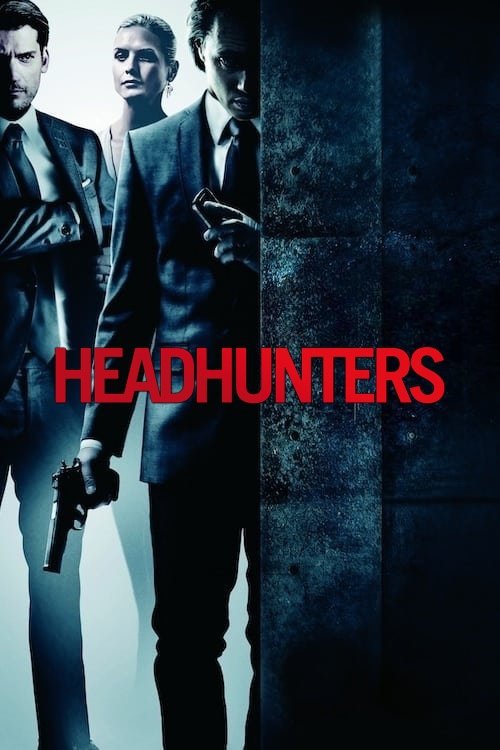
Headhunters
2011 · Morten Tyldum
For when you want a lean, twisty thriller that grabs you in ten minutes and doesn't let go — a one-sitting movie for a night when you want pure propulsion with a wicked grin. Not for the squeamish about indignity: the hero goes through the wringer, literally.
What it's about
Norway's smoothest corporate recruiter has an expensive wife, an expensive house, and a secret second job: stealing art from the executives he interviews. When he targets a rare painting owned by a charming ex-mercenary, the hunter becomes prey, and his gilded life collapses into a headlong chase across the Norwegian countryside.
The experience
A tight, nasty, blackly funny thrill ride that keeps topping itself — each escape is more desperate and more grimly absurd than the last. It moves fast, plays rough, and has a streak of gallows humor that makes you laugh at things you probably shouldn't.
Performances
Aksel Hennie is remarkable as the headhunter — vain, brittle, and increasingly feral — charting a man's total demolition and rebuild across one relentless arc, while Nikolaj Coster-Waldau makes the pursuing mercenary elegantly terrifying.
The craft
Adapted from a Jo Nesbø novel, its real feat is tonal control: pitch-dark comedy, grotesque physical humiliation, and genuine suspense held in balance without a wobble. The escalating set pieces are engineered like clockwork, each one raising the stakes and the absurdity together.
Why it matters
It became one of the most successful Norwegian films ever exported, a benchmark of the Scandinavian crime-thriller wave, and the calling card that took director Morten Tyldum to Hollywood.
Snapshot
A sleek, wickedly entertaining Norwegian thriller in which a corporate headhunter moonlighting as an art thief makes the catastrophic error of targeting a former special-forces mercenary. Adapted from Jo Nesbø's 2008 novel Hodejegerne, the film became one of the most commercially successful Norwegian exports in cinema history and served as the calling card that propelled its director, Morten Tyldum, into Hollywood. Headhunters is notable for its tonal precision — navigating pitch-dark comedy, grotesque physical humiliation, and genuine suspense without losing its footing — and for a central performance by Aksel Hennie that carries almost operatic register shifts across a single sustained arc.
Industry & production
Produced by Asle Vatn and Marianne Gray through Friland Produksjon in association with Yellow Barn Media, the film was a Norwegian–German co-production completed on a budget modest by international action-thriller standards. The production's ability to deliver polished cinematography, credible action sequences, and convincing set design on relatively constrained resources drew considerable comment from industry observers and reinforced a perception of Scandinavian genre filmmaking as punching well above its weight.
The source material came with built-in credibility: Jo Nesbø is Norway's most internationally prominent crime novelist, and the Hodejegerne paperback had already demonstrated commercial reach across European markets before production commenced. Screenwriters Lars Gudmestad and Ulf Ryberg undertook the adaptation, compressing and restructuring Nesbø's plotting while preserving its central logic of escalating catastrophe and its sociological satire. The casting of Nikolaj Coster-Waldau — a Danish actor already known in Scandinavia who would shortly achieve global recognition through Game of Thrones (Season 1 aired the same year) — gave the film a transnational gloss unusual in Norwegian genre production.
The film received support from the Norwegian Film Institute (Norsk filminstitutt), which has historically funded genre productions as part of a broader strategy to develop commercially competitive Norwegian cinema alongside its art-film strand. Headhunters was selected as Norway's submission for the Academy Award for Best Foreign Language Film and won multiple Amanda Awards, the Norwegian national film prize, including Best Film.
Technology
The film was shot digitally, in keeping with the dominant production practice of its moment, on high-definition camera systems that enabled the crisp, color-corrected visual palette its DP favored. John Andreas Andersen, the film's cinematographer, worked with a digital intermediate workflow that allowed precise manipulation of the cool Nordic light that characterizes the film's "civilized" register — the corporate interiors, the glass-and-steel Oslo architecture — in contrast with the degraded, muddy textures that dominate the film's protracted chase sequences. The shift in image quality and color temperature between these two modes is one of the film's subtler tonal instruments.
Post-production color grading leans on a cool, desaturated palette for the upscale scenes and permits warmer, more chaotic earth tones to invade as Roger Brown's carefully maintained facade collapses. This is not a technically novel approach — it echoes David Fincher's controlled digital grading practices, among others — but it is executed with consistency and discipline.
Technique
Cinematography
John Andreas Andersen's camerawork operates in the Scandinavian tradition of clean, functional filmmaking: no visual excess, images that earn their complexity through composition and light rather than movement or flourish. The Oslo sequences in particular — gleaming corporate lobbies, Roger's conspicuously oversized home — are shot with an almost aspirational clarity that mirrors the character's cultivated self-image. Andersen uses shallow depth of field to isolate Roger in social spaces, making him look composed even when the viewer already knows he is overextended.
As the film descends into its rural chase act, the cinematography opens up geographically while tightening psychologically: wider angles expose Roger's physical vulnerability in open landscapes, and the handheld work that enters the film here introduces a controlled shakiness that registers the dismantling of his persona. The outhouse sequence — one of the most discussed scenes in the film — is shot with methodical, almost clinical clarity. The camera does not flinch, which is precisely what makes the scene function as dark comedy rather than simple abjection.
Editing
Editor Vidar Flataukan maintains the film's escalating rhythm through judicious control of pace in its first two acts, allowing the audience to settle into Roger's world before the machinery of disaster begins. Once the chase commences, Flataukan tightens cutting rhythms without resorting to the hyperkinetic grammar of American action editing — sequences are allowed to breathe into discomfort rather than being cut on impact. The film's structural turns — several of which involve significant revelatory reversals — are handled with enough restraint to permit the audience to process the moral recalibration required before pushing forward.
Mise-en-scène / staging
Tyldum and Andersen use production design as socioeconomic legibility. Roger's house is too large, the art on its walls too conspicuous, the breakfast table too symmetrically arranged — it reads as a stage set rather than a home, which is precisely the point. In contrast, the remote farmhouse sequences and the scenes of physical degradation are stripped of all aesthetic self-consciousness: dirt, mess, and functional space replace the performed elegance of the opening act. This environmental shift mirrors the film's central dramatic movement, in which Roger is forcibly divested of every layer of constructed identity.
The staging of confrontations between Roger and Clas Greve plays on physical incongruity: Hennie is notably slight, Coster-Waldau imposingly large, and Tyldum is unsubtle about exploiting this contrast to externalize Roger's fundamental anxiety about status and physical adequacy. Many scenes are staged so that Roger occupies the compositional bottom third while Greve fills the upper portion of the frame.
Sound
Jeppe Kaas's score operates in the register of muscular, propulsive genre composing, drawing on a palette of electronic textures and rhythmic string work that is calibrated to genre expectation without tipping into pastiche. The score amplifies tension without underlining it condescendingly — it tends to arrive late in scenes rather than anticipating them. Sound design in the action sequences is tactile and unglamorous: impacts, vehicles, and environmental sound are given a physicality that reinforces the film's commitment to showing bodily consequence rather than sanitizing it.
Performance
Aksel Hennie's performance as Roger Brown is the film's central technical achievement. Roger is, structurally, a classic unreliable protagonist — confident, articulate, and manifestly deluded — and Hennie navigates the character's self-regard with precision, making him legible as both comic grotesque and credible human being under pressure. The performance demands physical extremity (Hennie spends substantial screen time in states of filth and degradation), comic timing, and moments of genuine pathos, all within a register that must cohere as a single character. That Hennie pulls this off without tipping into caricature is the performance's primary accomplishment.
Coster-Waldau's Clas Greve works as a near-perfect structural foil: composed where Roger is anxious, laconic where Roger is voluble, and physically menacing in a way that makes Roger's compulsive self-inflation read as compensatory. The film is also sharp about using Greve's surface civility — his apparent comfort, his ease in Roger's social world — as the vector of threat rather than raw menace.
Narrative & dramatic mode
The film operates as a trap narrative with a nested con at its structural center. The first act is a confidence exercise, establishing Roger's competence and his criminal sideline with procedural efficiency. The second act springs the trap — Roger moves from hunter to hunted with vertiginous speed — and the third act concerns his improvised attempt to reverse the power dynamic with the limited resources available to a man who, by this point, has lost nearly everything. Nesbø's novel is known for its plotting precision, and Gudmestad and Ryberg's adaptation preserves this quality: every element introduced in the first act functions as a mechanism in the subsequent two.
The dramatic mode blends thriller suspense with dark comedy in proportions that are calibrated rather than accidental. The film is not "a comedy with thriller elements" or "a thriller with comic relief" — the comedy and the menace are formally integrated, each intensifying the other. The spectacle of Roger's degradation is funny precisely because it is genuinely uncomfortable, and it is genuinely uncomfortable precisely because the film has established real stakes.
Genre & cycle
Headhunters belongs to the Nordic Noir wave that achieved international visibility from roughly 2008 onward, catalyzed by the posthumous global success of Stieg Larsson's Millennium trilogy and the subsequent international appetite for Scandinavian crime fiction in both literary and cinematic form. This cycle is characterized by a recognizable visual and atmospheric grammar — cool light, restrained compositions, class consciousness foregrounded — but Headhunters pushes against several of the genre's default registers. Where much Nordic Noir is slow, ruminative, and tonally somber, Headhunters is fast, kinetic, and darkly comic. It shares genre space with the American neo-noir comedy-thriller tradition (Coen Brothers films are the inevitable reference) as much as with the Scandinavian procedural.
Within Norwegian cinema specifically, the film belongs to a generation of genre productions — including Erik Skjoldbjærg's Insomnia (1997), which was also subject to American remake — that demonstrated that Norwegian filmmakers could produce commercially competitive genre work for international markets. Headhunters is arguably the most commercially successful film in this lineage and functioned as proof of concept for subsequent Nordic genre co-productions.
Authorship & method
Morten Tyldum (b. 1967) trained at the Norwegian Film School and at New York University, and Headhunters, though his third feature, was his international breakthrough. His directorial approach is competent and reliable rather than stylistically distinctive: Tyldum is a classicist who prioritizes clarity of narrative communication, performance, and tone over authorial inscription. This is not a criticism — the film's primary pleasures are structural and performative, and Tyldum's transparency as a filmmaker serves those pleasures well. The relative absence of directorial signature may help explain both the film's commercial accessibility and the relative ease with which Tyldum transitioned to Hollywood, where The Imitation Game (2014) confirmed his skill at prestige-oriented genre filmmaking.
John Andreas Andersen (cinematography) and Jeppe Kaas (score) are the key collaborators, along with Hennie and Coster-Waldau whose performances do substantial dramatic work that a less skilled cast would have collapsed. The screenplay by Gudmestad and Ryberg is credited with translating Nesbø's intricate plot mechanics without the seams showing — the adaptation feels motivated rather than dutiful, with the novelistic sociological commentary about Norwegian prosperity, class performance, and masculine anxiety preserved even as the pace is accelerated.
Movement / national cinema
The film is a product of Norwegian cinema in its post-millennium commercially oriented phase, when the Norwegian Film Institute moved to increase genre production alongside auteur filmmaking. Norway's film culture in this period was marked by high per-capita attendance figures, strong state support, and a growing confidence in genre work. Headhunters sits alongside television productions like Lilyhammer and Occupied as evidence of this shift.
The film's success contributed to a broader Scandinavian visibility in global genre markets at a moment when Nordic content — primarily television — was beginning to be recognized as a commercially and aesthetically distinct category. The "Scandi-noir" label, while imprecise, had commercial utility in English-language markets, and Headhunters benefited from and contributed to its circulation.
Era / period
The film was released in 2011, a moment of significant flux in both the international production landscape and in the commercial reception of non-English-language genre cinema. The Weinstein Company's The Artist (2011) and the Larsson adaptations (David Fincher's The Girl with the Dragon Tattoo was released the same year) were among several signals that subtitled genre films could reach audiences well beyond the art-house circuit. Headhunters appeared in this window and benefited from it. The film also arrived at the inflection point in digital cinematography when the aesthetic gap between digital and film formats had narrowed sufficiently that the choice ceased to be a significant critical marker for genre productions.
Themes
The film's primary thematic concern is the performance of identity under economic pressure. Roger Brown is a man whose entire existence is a leveraged position: he steals art to fund a lifestyle he cannot otherwise afford because he believes the lifestyle is what makes him acceptable to his wife and his professional world. The film's central irony is that the performance is, for most of the first act, successful — Roger is genuinely competent, professionally and criminally — but the competence is built on a lie about the self that the plot systematically disassembles.
This connects to a broader meditation on class anxiety in a prosperous society. Contemporary Norway provides a specific context: a culture of conspicuous material comfort in which status markers are highly legible and failure to maintain them is correspondingly conspicuous. Roger's exceptionalism — his height (or lack thereof), his compulsive overcompensation — is given environmental coordinates that make his anxiety socially legible rather than merely psychological.
The doubling of Roger and Greve is explicitly thematic: both are expert operators in domains requiring skill, composure, and a willingness to treat other people as instruments. The film suggests they are versions of the same type, separated by the question of whether their operational competence is in service of something more than ego. Greve's military past gives his amorality a different genealogy than Roger's, but the film does not ultimately flatter either man — it is interested in the structural similarity.
Finally, the film is interested in embodiment and its political dimensions. Roger's body is subjected to extreme humiliation over the film's second and third acts, and the camera's willingness to dwell on this humiliation — filth, injury, physical indignity — is connected to the film's satire of the protagonist's self-image. The body refuses the self-presentation the mind insists upon.
Reception, canon & influence
Critical reception was strongly positive in both Norway and international markets. Critics noted the film's tonal discipline, Hennie's performance, and its ability to deliver sustained entertainment without condescension to genre conventions. The film was frequently compared, by reviewers, to the Coen Brothers — an analogy that is apt in terms of the dark-comedy-thriller mode but perhaps undersells the distinctly European class analysis the film carries.
Influences on the film (backward): The "wrong man" thriller tradition runs through Hitchcock (The 39 Steps, North by Northwest) and is clearly operative here — Roger is an imperfect man placed in an impossible situation and required to improvise survival. The Coen Brothers' Blood Simple (1984) and Fargo (1996) established a template for genre filmmaking in which violent consequence is both horrifying and darkly funny, and Headhunters clearly absorbs this lesson. Fincher's precise, cool control of thriller atmosphere (particularly The Game, 1997, and the aesthetic idiom of Fight Club) is a plausible formal reference for the film's visual and editorial register. Within Scandinavian crime fiction, the film belongs to a lineage extending from Henning Mankell through Larsson that foregrounds social critique as structural rather than ornamental.
Legacy and forward influence: The most concrete legacy of Headhunters is its role in Morten Tyldum's career trajectory: the film functioned as an extended audition for Hollywood that resulted in The Imitation Game (2014, Academy Award nomination for Best Director) and subsequent studio work. It demonstrated, alongside the international Millennium adaptations, that Scandinavian genre cinema could operate at a commercial level competitive with English-language productions.
A Hollywood remake was reported in development in the years following the film's international release — a routine fate for successful foreign-language genre films in the American market — though the record on its status is thin and its progress, as of this writing, uncertain.
More broadly, the film contributed to the international legibility of Nordic genre work and helped establish an audience appetite that the subsequent wave of Scandinavian streaming co-productions (series produced for Netflix, HBO Nordic, and similar platforms) would exploit and expand. Whether Headhunters directly influenced specific subsequent productions is difficult to establish rigorously, but it belongs to the short list of films that made the proposition of commercially ambitious Scandinavian genre cinema empirically credible in international markets.
A Deleuzian reading
Picture the slight man in the latrine.
The full Deleuzian reading of Headhunters →
Reception
A genuine crossover hit in 2011 — one of the rare subtitled thrillers to break out internationally during the Nordic-noir boom — and its stock has only risen since, now regularly held up as the tight, nasty 90-minute thriller Hollywood keeps failing to make.
How Headhunters was received, from release to now →
Influences: the films it descends from and the films it influenced
- The 39 Steps (1935) — Originating template for the wrong-man trap structure: an imperfect civilian protagonist inserted into an impossible situation requiring improvised survival through escalating set-piece traps — the exact narrative architecture Headhunters inherits and tightens around Roger's compounding criminality.
- North by Northwest (1959) — First-act plant/payoff construction where innocuous early details (an auction bid, a monogrammed handkerchief) return as lethal mechanisms; Headhunters' GPS tracker and Rubens painting follow the same precise choreographic logic of planted information becoming structural weapon.
- Blood Simple (1984) — Establishes the tonal template for genre filmmaking where violent consequence is simultaneously horrifying and absurdly funny, with cross-purpose plans compounding catastrophically through misread information — the manure-pit sequence's pitch-black physical comedy is a direct heir of this mode.
- Fargo (1996) — Socioeconomic production design as structural critique: regional affluence rendered as moral vacuum from which criminality logically emerges; Headhunters applies the same principle to Norwegian oil-boom prosperity — the executive's art collection and corporate wardrobe as indictment before a crime occurs.
- The Game (1997) — Trap-structure narrative in which the protagonist cannot distinguish real threat from engineered scenario, combined with rigorous first-act setup/payoff discipline and a cool, desaturated color palette — both the formal strategy and the narrative DNA Headhunters absorbs.
- Fight Club (1999) — The unreliable narrator whose performed identity (competent professional, dominant male) disintegrates under structural pressure, and the digitally-graded teal-shadow visual register that DP John Andreas Andersen adopts as atmospheric baseline for Headhunters' corporate-world sequences.
- Insomnia (1997) — The Norwegian-language genre film that first proved international commercial viability for Nordic crime: a morally compromised protagonist, social texture embedded in location, bleak procedural escalation — the formal template and market precedent that makes Headhunters legible to international distributors.
- Oldboy (2003) — Trap-structure thriller in which an antagonist's elaborate first-act plant (the protagonist's buried past crime) becomes the payoff mechanism; physical extremity as performance mode — the protagonist's body as site of sustained punishment — establishing a genre precedent Headhunters' pig-farm sequence directly inherits.
- Män som hatar kvinnor (2009) — Sibling within the Scandinavian genre export project: shallow-depth-of-field cinematography in cold interiors, class-coded production design where architecture signals moral rot, and the commercial aspiration to carry genre seriousness to international arthouse-multiplex crossover audiences.
- Kraftidioten (2014) — Direct Norwegian heir to Headhunters' tonal precision: simultaneous horror and dark comedy in violence, intertitles deployed as ironic punctuation extending the class critique, and the same industrial precision in escalating-consequence plotting that Headhunters established as the benchmark for Norwegian genre cinema.
- The Imitation Game (2014) — Tyldum's Hollywood transposition of the same directorial toolkit: controlled escalating editing rhythm across a dual-timeline structure, first-act plant/payoff construction (the crossword, the name) treated with the same precision as Headhunters' GPS and painting — identical classicist grammar applied to English-language prestige material.
- No Country for Old Men (2007) — Parallel craft strategy of unglamorous tactile sound design — ambient location sound, physical contact with surfaces, breath — in place of conventional thriller underscore, and compositional power framing that encodes threat through negative space and withheld information rather than kinetic cutting.
- A Prophet (2009) — Controlled escalating editing rhythm that tightens the screw across the running time without gratuitous gear-shifts, and an unreliable protagonist whose survival depends entirely on performed identity — a parallel craft strategy to Headhunters deployed in French crime rather than Nordic noir.
- Drive (2011) — Electronic-string hybrid score as primary emotional architecture (Cliff Martinez's timbral logic running parallel to Jeppe Kaas's), compositional power framing with deliberate stillness to encode protagonist threat, and production-design class contrast between the protagonist's actual world and the aspirational milieu he inhabits.
Similar films
- No Country for Old Men (2007) — influence & lineage
- The Girl with the Dragon Tattoo (2009) — influence & lineage
- Insomnia (1997) — influence & lineage
- Oldboy (2003) — influence & lineage
- The Yellow Sea (2010) — shared sensibility
- No Other Choice (2025) — shared sensibility
- Beasts Clawing at Straws (2020) — shared sensibility
- The Girl with the Dragon Tattoo (2011) — shared sensibility