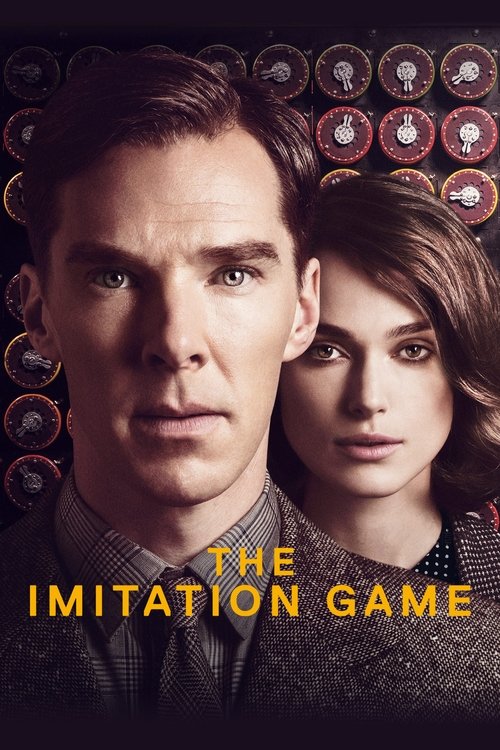
The Imitation Game
2014 · Morten Tyldum
For when you want a smart, satisfying true story that grips like a thriller and earns its lump in the throat — comfort-food prestige with a real sting in it.
What it's about
During the darkest stretch of World War II, brilliant and prickly mathematician Alan Turing joins Britain's top-secret codebreaking operation at Bletchley Park, tasked with cracking the Nazi Enigma cipher that everyone else considers unbreakable. The film cuts between that race against time, Turing's lonely schooldays, and a postwar police investigation that threatens to expose the secret he's kept his whole life: in 1950s England, being gay is a crime.
The experience
A brainy thriller that plays like a ticking-clock puzzle — you lean forward through the codebreaking and then get quietly gutted by the injustice framing it. It's polished, propulsive, and builds to something genuinely moving.
Performances
Benedict Cumberbatch makes Turing bristling, funny, and heartbreaking without softening his difficulty, and Keira Knightley gives warm, sharp support as fellow codebreaker Joan Clarke.
The craft
The script braids three timelines into one clean, suspenseful throughline, so a story about mathematics feels like a race. Handsome period production and a stirring Alexandre Desplat score keep it humming; it's a film built for a cozy screen and full attention rather than spectacle.
Why it matters
A major awards-season hit that did more than any film to put Alan Turing back in the public imagination, landing amid the real-world campaign to redress his persecution.
Snapshot
A prestige biographical thriller charting the wartime career of mathematician and logician Alan Turing (1912–1954), who led the codebreaking effort at Bletchley Park during the Second World War and whose work on electromechanical computation helped shorten the conflict. The film weaves three chronological strands — Turing's formative years at Sherborne School in 1928, the classified Bletchley operation from 1939 to 1945, and his 1951 interrogation by Manchester police following a break-in at his home that exposes his homosexuality — into a single, tightly cross-cut narrative. Equal parts intellectual procedural, wartime ensemble drama, and persecution study, the film arrived as the culmination of a decades-long effort to return Turing to mainstream public consciousness and became one of the most commercially successful independent biographical dramas of its decade.
Industry & production
The screenplay by Graham Moore, adapted from Andrew Hodges's rigorously researched 1983 biography Alan Turing: The Enigma, circulated in Hollywood for several years before appearing on the 2011 Black List — the industry's annual survey of the most admired unproduced scripts — which substantially raised its profile. Black Bear Pictures producers Nora Grossman, Ido Ostrowsky, and Teddy Schwarzman acquired the project and attached Morten Tyldum as director following the international breakout of his Norwegian crime thriller Headhunters (2011). The Imitation Game was Tyldum's first English-language feature. Production was primarily based in England, with filming at locations including Bletchley Park itself, Beaconsfield Studios, and various period-appropriate architectural locations standing in for Sherborne and wartime Manchester.
The film was financed and structured as an independent production, made for an approximate budget of fourteen million dollars — a figure that positioned it below the level of major studio prestige productions but allowed it unusual creative latitude. Distribution in North America was handled by The Weinstein Company, then at the height of its influence as the dominant force in awards-season independent cinema; StudioCanal distributed in the United Kingdom. The film opened at the Toronto International Film Festival in September 2014, where it won the People's Choice Award, a prize with a strong predictive correlation to Oscar contention (previous winners had included The King's Speech and 12 Years a Slave). Its worldwide theatrical gross ultimately reached the neighborhood of two hundred thirty million dollars, an exceptional return on its budget and an unusual commercial achievement for a film of its scale.
The Weinstein Company's award-campaign machinery positioned the film for the 2015 Oscar season, where it received eight nominations including Best Picture, Best Director, Best Actor for Benedict Cumberbatch, and Best Supporting Actress for Keira Knightley. It won in one category: Best Adapted Screenplay for Graham Moore, whose acceptance speech — in which he disclosed a teenage suicide attempt and urged those who feel "weird or different" to stay alive — became a widely circulated cultural moment that resonated directly with the film's subject matter.
Technology
The film was shot digitally, utilizing the ARRI Alexa, the dominant high-end digital cinema camera of the early 2010s, which allows a fine-grained capture well suited to the film's relatively subdued, period-inflected color palette. No particularly novel or experimental technology distinguishes the production; Tyldum and cinematographer Óscar Faura worked within established professional conventions for the prestige drama form.
In thematic terms, the technology of the period depicted — the Bombe, the electromechanical decryption machine developed at Bletchley, itself derived in part from earlier Polish work and from the earlier Bomba designs by Marian Rejewski — is the film's central visual and conceptual object. The production design reproduces the Bombe's rotating drum mechanism and wiring configurations with a reasonable degree of fidelity, though the film dramatizes Turing's role in its conception in ways that compress and simplify the historical record, omitting the crucial mathematical contribution of Gordon Welchman, whose diagonal board modification was essential to the machine's practical effectiveness. The film thus stages the birth of programmable computation as individual heroic invention rather than collaborative scientific iteration — a choice with both narrative utility and significant scholarly controversy.
Technique
Cinematography
Óscar Faura, the Spanish cinematographer who also shot Headhunters with Tyldum, employs a carefully stratified visual scheme across the film's three temporal registers. The Bletchley sequences, which constitute the bulk of the film's running time, are rendered in a cool, institutional palette dominated by grays, muted greens, and the wood-and-metal textures of wartime bureaucracy — a look consistent with the British heritage drama tradition but somewhat more austere than the warm amber tones associated with much of that cycle. The 1928 school sequences are differentiated by slightly softer lighting and a marginally warmer color temperature, lending them a retrospective tenderness. The 1951 Manchester scenes are among the film's most visually bleak: cold interiors, hard practical lighting, and a compression that underscores Turing's isolation.
Camera movement is largely restrained; the film favors deliberate, controlled compositions that reinforce the procedural, puzzle-solving logic of its narrative. Close-ups on Turing's face and hands — manipulating components, writing equations, decoding the machine's behavior — function as a recurring visual motif linking intellectual labor to physical action. The framing of the Bombe machine itself tends toward the reverential: low angles and shallow-focus work that render its rotating drums with a slightly uncanny grandeur.
Editing
William Goldenberg, who won the Academy Award for editing Argo (2012), manages the film's three-strand temporal structure with a clarity that is the production's principal editorial achievement. The intercutting between timelines is largely explanatory rather than formally adventurous — the 1951 police interrogation functions as a framing device that cues flashbacks — but Goldenberg handles the transitions with economy and the climactic convergence of timelines (as the Bombe first decodes a message, and the team grasps the moral complexity of deciding which German attacks to allow to proceed) with genuine propulsive force. The film does not chase the disorienting temporal fragmentation of, say, Memento or The Social Network; its crosscutting is legible and purposeful, serving genre clarity over formal experimentation.
Mise-en-scène / staging
Tyldum's staging throughout favors the social dynamics of the Bletchley ensemble — the jostling egos, the institutional hierarchy, the peculiar camaraderie of the codebreakers — and returns repeatedly to the hut where the Bombe is housed as a kind of theatrical proscenium. Production designer Maria Djurkovic creates a Bletchley that reads as both authentic and symbolically charged: the cluttered desks stacked with intercepts, the diagrams on the walls, the physical proximity of bodies working under pressure. The three time periods are differentiated not just photographically but through the distinct spatial logics of school dormitory, intelligence hut, and detective's interview room — each a container for a different register of exposure and concealment.
The film's most consistently useful staging strategy is its blocking of Cumberbatch in social situations: Turing positioned slightly outside conversational circles, angled away, responding to queries on a slight delay. This spatial embodiment of social difficulty functions efficiently as characterization without requiring explicit diagnostic labeling.
Sound
Alexandre Desplat's score is built on a rhythmic, mechanical pulse that evokes the cycling of the Bombe's rotating drums. The motifs are characterized by ostinato figures — repeated short patterns that accumulate and interweave — creating a sonic analog to the iterative logic of code-breaking. The score is melodically lyrical in its more emotionally direct passages, particularly in material associated with Turing's affection for Christopher Morcom and Joan Clarke, but the mechanical substrate rarely fully recedes. Desplat was nominated for the Academy Award for Best Original Score for this work; he was simultaneously nominated in the same category for The Grand Budapest Hotel, and won for the latter — an unusual circumstance in which he competed against himself.
The production sound design privileges the mechanical textures of the period: the clack of Enigma keys, the industrial rotation of the Bombe, the crackle of wireless intercepts. These sounds are integrated into the score's rhythmic fabric, rendering the boundary between diegetic sound and composed music productively ambiguous.
Performance
Benedict Cumberbatch's performance as Turing occupies the center of the film and largely defines its critical legacy. Working from a script that emphasizes Turing's difficulties with social convention, Cumberbatch constructs a characterization built on precise physical and vocal tics — a slightly accelerated, clipped delivery; a tendency to address questions literally rather than contextually; a brusqueness in professional exchanges that conceals a pronounced emotional sensitivity. The performance draws on a tradition of depicting exceptional intellect as socially alien — a tradition that runs through portrayals of Sherlock Holmes (a role Cumberbatch was simultaneously embodying on the BBC) and through cinematic representations of neurodivergence — but Cumberbatch grounds it in specific behavioral choices rather than generic eccentricity.
Keira Knightley as Joan Clarke (the historical Turing's briefly fiancée and fellow Bletchley cryptanalyst) provides a counterweight: warmer and more socially fluent than Turing, her performance works in the register of supportive intelligence and quietly suppressed frustration with institutional sexism. The film's other principal ensemble members — Matthew Goode as the competitive Hugh Alexander, Charles Dance as the obstructionist Commander Denniston, Mark Strong as the MI6 handler Stewart Menzies — are performed with the precision typical of the British prestige drama tradition, calibrated to narrative function rather than psychological complexity.
Narrative & dramatic mode
The film employs a retrospective investigative frame — Detective Robert Nock's 1951 inquiry into Turing's household burglary — as the mechanism through which the story unfolds. This structure places the audience in the position of someone gradually learning the significance of what seems, to Nock, merely an eccentric mathematician's odd behavior. It is a structural irony: the policeman investigating a minor domestic incident is unwittingly interrogating one of Britain's most consequential wartime minds, whose life he is simultaneously in the process of destroying.
The narrative mode is largely that of the prestige procedural: a puzzle to be solved, an institutional obstacle to be overcome, a ticking clock providing urgency. But the film's dramatic aspirations exceed the thriller frame; its deeper interest is in the relationship between concealment and identity — between the state secret Turing must keep about his wartime work and the personal secret he must keep about his sexuality, both of which the British state simultaneously demands and punishes. The film proposes that Turing's entire existence was structured around a paradox: the man the country needed to be invisible was the man the country needed to survive.
Genre & cycle
The Imitation Game sits squarely within the prestige British biographical drama, a mode that experienced sustained commercial and critical vitality in the early 2010s following the extraordinary success of The King's Speech (2010, dir. Tom Hooper). The cycle to which it belongs — historically grounded narratives featuring institutional settings, calibrated ensemble acting from the British theatrical tradition, BAFTA and Oscar campaigns, and a tendency toward the affirmative rehabilitation of misunderstood figures — also includes Tinker Tailor Soldier Spy (2011), Lincoln (2012), and The Theory of Everything (2014, also released the same awards season). The thriller element — the race to break Enigma, the Japanese attack whose success is permitted in order to preserve the secret — links the film to the wartime procedural tradition, though the film is less interested in suspense mechanics than in using them as narrative scaffolding.
The film can also be located within a specifically LGBTQ+ historical drama cycle that gained momentum in the 2010s, alongside films that sought to reclaim suppressed or criminalized queer lives through mainstream biographical form. Its treatment of Turing's persecution and chemical castration places it in dialogue with films such as Milk (2008) and, later, Judy (2019).
Authorship & method
Morten Tyldum came to the project as an established figure in Norwegian genre cinema whose Headhunters had demonstrated facility with pacing, tonal control, and the management of moral ambiguity in a thriller format. His approach to The Imitation Game is fundamentally interpretive rather than authorial in the strong sense: the film is a skilled realization of a pre-existing literary and screenplay blueprint rather than a vehicle for distinctive directorial vision. Tyldum's formal choices — the controlled camera, the legible cutting, the reliance on performance — subordinate style to narrative clarity, which is characteristic of prestige drama production generally and represents a professional rather than idiosyncratic intelligence.
Graham Moore's screenplay is, in many respects, the film's primary authorial document. Moore's adaptation makes structural choices — the three-timeline format, the detective-frame device, the compression of the Bletchley team into a tight ensemble of six — that determine the film's fundamental shape. Moore acknowledged in interviews that certain dramatic liberties with the historical record were deliberate: the characterization of Denniston as an obstructionist was noted by historians as a significant distortion (Denniston was in fact broadly supportive of the codebreakers' work), and the role assigned to John Cairncross as an identified Soviet mole within the Bletchley group represents a narrative construction that elides considerable historical complexity.
Óscar Faura and Alexandre Desplat are the key craft collaborators whose contributions define the film's sensory texture. Faura's restrained, period-precise cinematography and Desplat's mechanically inflected score together construct a world that is neither nostalgically warm nor coldly austere but poised between the two — a register appropriate to a film about secrets maintained at great human cost.
Movement / national cinema
The film occupies an ambiguous national position that reflects the structural conditions of British prestige cinema in the 2010s. It is a British story, adapted from a British biography, filmed primarily in Britain, with a predominantly British cast and a British-based production infrastructure. Yet its financing, distribution, and awards-campaign orientation were structured according to American independent cinema norms, its director was Norwegian, and its economic engine ran through Harvey Weinstein's company. This configuration — British cultural material processed through international capital and American Oscar machinery — is not unique to The Imitation Game but is characteristic of the co-production model that sustained high-profile British drama in the period: The King's Speech, Atonement, Darkest Hour occupy similar structural positions.
The film draws visually and tonally on the traditions of British heritage cinema — the institutional settings, the period design precision, the emphasis on understatement and repressed emotion — while moderating those conventions with a more kinetic genre energy appropriate to American art-house audiences. This negotiation between heritage restraint and genre propulsion is one of the film's defining tensions.
Era / period
The Imitation Game is a product of the early 2010s consensus around the prestige historical drama as the primary vehicle for serious, adult, non-franchise filmmaking in the theatrical marketplace. The period between The King's Speech (2010) and the mid-decade consolidation of streaming had seen an unusual degree of commercial viability for carefully executed biographical films, and the awards-season apparatus — the Toronto opening, the Weinstein distribution, the BAFTA and Oscar campaigns — was a well-mapped route to cultural visibility and commercial return.
The film also registers the specific cultural moment of its release: by 2014, the campaign to secure a posthumous pardon for Turing (who had died in 1954, almost certainly from deliberate cyanide poisoning) was in its final stages. The British government issued a royal pardon in December 2013, shortly before the film's release; the film's appearance contributed to a broader public engagement with Turing's legacy that would eventually produce the so-called Turing Law of 2017, extending posthumous pardons to all men convicted under the historical law against consensual homosexual acts.
Themes
The film's governing metaphor — drawn directly from Hodges's biography — is the Turing test itself: the philosophical proposition, developed in Turing's 1950 paper "Computing Machinery and Intelligence," that the question of whether machines can think is equivalent to the question of whether a machine can convince an observer that it is human. The film extends this metaphor structurally: Turing spends his life performing humanity in a register that those around him find alien; the film's most painful irony is that the man who conceived the test for human imitation was himself failed by those judging whether he qualified for human treatment.
Closely related is the theme of the secret as structural burden: Turing and his Bletchley colleagues carry the knowledge that they can read German communications but must not reveal this — must even permit certain atrocities to proceed — to preserve the intelligence advantage. This moral weight (dramatized in a scene where the team intercepts coordinates for a convoy attack on a ship Turing's colleague's brother is aboard) figures secrecy not as heroic discretion but as a kind of slow psychic damage. The parallel to Turing's enforced concealment of his sexuality — another secret maintained under threat of catastrophic state punishment — gives the film its central ironic structure.
The film also engages the question of outsiderdom and institutional resistance: Turing's genius is inseparable from his refusal of social convention, and the obstacles he encounters — from Denniston's skepticism to the initial rejection of his approach by his colleagues — are framed as the institutional system's resistance to the anomalous mind it simultaneously requires.
Reception, canon & influence
Critical reception on release was strongly positive in the mainstream press, with particular admiration directed at Cumberbatch's performance and the film's structural elegance. A more skeptical response emerged from historians and from Turing specialists, who noted the distortions of Commander Denniston's character, the elision of Gordon Welchman's contribution to the Bombe design, and what some critics identified as a tendency to aestheticize Turing's suffering for emotional effect. The film's construction of Turing as a proto-Asperger's figure — never stated explicitly but strongly implied — was debated in contexts concerned with the representation of neurodivergence.
The influences on the film run most clearly through the biographical drama of exceptional intellectual achievement: A Beautiful Mind (2001, dir. Ron Howard), with its portrayal of a brilliant, socially eccentric mind under institutional and psychological pressure, established a template for genius-and-breakdown narratives that Moore's screenplay consciously navigates. The Social Network (2010, dir. David Fincher), whose fractured timeline and forensic reconstruction of a historic technological achievement offered a more formally adventurous version of the same terrain, is a clear interlocutor; where Fincher's film pursues the tempo of legal deposition, Tyldum's opts for the procedural thriller's gathering momentum. Andrew Hodges's source biography — itself a landmark work of intellectual biography that had been in print since 1983 and had long been recognized as the authoritative account of Turing's life — is the film's deepest structural foundation, and the liberties the screenplay takes with it were the source of most serious critical contention.
The film's forward influence is less easily traced through formal citation than through cultural impact. As a major theatrical biopic dealing centrally with the persecution of a gay man, it participated in and amplified a cultural rehabilitation of queer historical figures during the mid-2010s. It helped consolidate Cumberbatch's status as the leading prestige-drama actor of his generation and contributed to a broader re-evaluation of Turing's historical position — as the originator of the conceptual framework underlying modern computation — for general audiences previously unfamiliar with that history. Whether it constitutes a lasting canonical object in the history of the biopic form, as opposed to a highly accomplished instance of a well-established mode, remains the open question that its descendants will eventually decide.
A Deleuzian reading
A man stands at the edge of a room while everyone else laughs at a joke that reached them a half-second before it reached him.
The full Deleuzian reading of The Imitation Game →
Reception
A crowd-pleasing awards juggernaut in 2014 — eight Oscar nominations, a huge box-office hit for a biopic — it's since hardened into the go-to example of glossy mid-2010s Oscar bait, with historians and critics increasingly vocal about its liberties with Turing's actual life.
How The Imitation Game was received, from release to now →
Influences: the films it descends from and the films it influenced
- Amadeus (1984) — The retrospective-investigative frame — an authority figure interrogating a witness about a genius's downfall, which organizes the entire past-tense narrative — is the formal template Moore's screenplay adapts directly for Turing's police-interview framing device.
- Maurice (1987) — Ivory stages gay identity as a concealment-identity paradox within British institutional settings (school, law, military) using social-exclusion blocking that places the protagonist in group compositions as a figure of visible separation — the visual grammar Tyldum inherits for Turing at Bletchley.
- The English Patient (1996) — Minghella's three-strand temporal crosscutting uses a stratified color palette — amber wartime past, cooled present, intermediate register — to differentiate narrative layers, the specific chromatic and structural strategy Tyldum adopts for his wartime/Bletchley/1951 tripartite.
- Shine (1996) — Hicks deploys the three-period temporal structure — traumatic childhood, institutional crisis, adult reckoning — specifically to construct a neurodivergent genius, establishing the scaffold Moore's screenplay adapts for Turing's schoolboy, wartime, and postwar prosecution timelines.
- Enigma (2001) — Apted stages Bletchley's Hut 6 as a theatrical proscenium — rows of machines, overhead industrial lighting, bodies arranged around the central codebreaking apparatus — providing the specific production-design template for Tyldum's Bombe-hut staging.
- A Beautiful Mind (2001) — Howard and Crowe established the performance grammar of mathematical neurodivergence — averted eye contact, motor agitation during cognitive effort, physical staging of abstract thought as behavioral disorder — that Cumberbatch inherits and extends rather than originates.
- The Hours (2002) — Daldry's three-strand temporal crosscutting across separate historical periods, unified by Philip Glass's mechanical-ostinato score — a repetitive motif functioning as connective tissue between timelines — is the formal model for both Tyldum's tripartite structure and Desplat's Bombe-derived mechanical score.
- Frost/Nixon (2008) — Howard stages the interview room as the primary theatrical container for historical confrontation — the two-shot interrogation as the space in which historical reckoning is conducted — directly modeling the police-interview framing device that brackets The Imitation Game's narrative.
- The Social Network (2010) — Fincher's deposition framing device — past events reconstructed through adversarial testimony to institutional authority — directly models Tyldum's interrogation frame, while Reznor and Ross's mechanized digital pulse beneath flashbacks anticipates Desplat's Bombe-tick ostinato.
- Tinker Tailor Soldier Spy (2011) — Alfredson's near-static camera within British intelligence interiors, Iglesias's score bleeding between diegetic source music and underscore, and the staging of institutional loyalty as a concealment-identity paradox in Cold War Britain establish the precise aesthetic register Tyldum's film inherits.
- Headhunters (2011) — Tyldum's Hollywood transposition of the same directorial toolkit: controlled escalating editing rhythm across a dual-timeline structure, first-act plant/payoff construction (the crossword, the name) treated with the same precision as Headhunters' GPS and painting — identical classicist grammar applied to English-language prestige material.
- The King's Speech (2010) — Carries forward the interwar/wartime British prestige biopic of a socially halting outsider whose private impediment is overcome in service of the nation, scored and structured for the same sympathetic uplift.
- The Danish Girl (2015) — Hooper inherits Tyldum's staging of gender identity as a concealment-identity paradox within a historical British-adjacent prestige drama, using the same social-exclusion blocking and mid-2010s cultural-rehabilitation framing to transpose the structural template onto a trans-historical subject.
- Hidden Figures (2016) — Melfi's film descends from The Imitation Game's rehabilitative-biographical-drama template, deploying social-exclusion blocking (bodies segregated within institutional space by race) and the heroic-inventor-myth narrative of suppressed exceptional contributions in direct formal succession.
- Darkest Hour (2017) — Wright extends Tyldum's low-angle reverential framing as the cinematographic instrument for constructing British wartime exceptionalism — the camera positioned below a singular, physically transformed performance of historical greatness within a prestige ensemble — amplifying the hagiographic formal vocabulary of its predecessor.
- Bohemian Rhapsody (2018) — The film inherits The Imitation Game's three-strand temporal crosscutting applied to LGBTQ-historical drama, with a retrospective framing device anchoring the narrative that functions analogously to the interrogation frame, and a lead role structured entirely around a public/private concealment-identity paradox.
- The Theory of Everything (2014) — Released the same year with an almost identical formal template — British scientific genius, three-period temporal crosscutting, stratified color palette, Jóhann Jóhannsson's mechanical-ostinato score, and a British prestige ensemble organized around a neurodivergent-adjacent figure — this is The Imitation Game's closest structural twin.
- Number 24 (2024) — Tyldum — a Norwegian director — foregrounded the organizational and intelligence dimensions of wartime resistance as the primary drama, establishing a template for non-physical, administratively-framed WWII heroism that Number 24 extends into occupied Norwegian urban terrain.
- The Resistance Banker (2018) — Parallel prestige biopic of fact-based 'white-collar' war contribution, converting clerical/intellectual work into procedural suspense building to a tragic-heroic close.
- Operation Mincemeat (2022) — WWII British secret-war procedural built on an ensemble of code and concealment, with the same heritage-cinema texture applied to the bureaucratic machinery of deception.
Similar films
- Darkest Hour (2017) — influence & lineage · same viewing thread
- Tinker Tailor Soldier Spy (2011) — influence & lineage
- A Beautiful Mind (2001) — influence & lineage
- Hidden Figures (2016) — influence & lineage
- Frost/Nixon (2008) — influence & lineage · same viewing thread
- Operation Mincemeat (2022) — same viewing thread
- Oppenheimer (2023) — same viewing thread
- Bridge of Spies (2015) — same viewing thread
All the films related to The Imitation Game →
Watch it with: curated runs of related films
- Great Men, Grand Reckonings — A run of prestige true stories about singular, obsessive men chasing an epochal achievement — the bomb, the moon, the checkered flag, a nation — and reckoning with what it cost them and everyone around them.