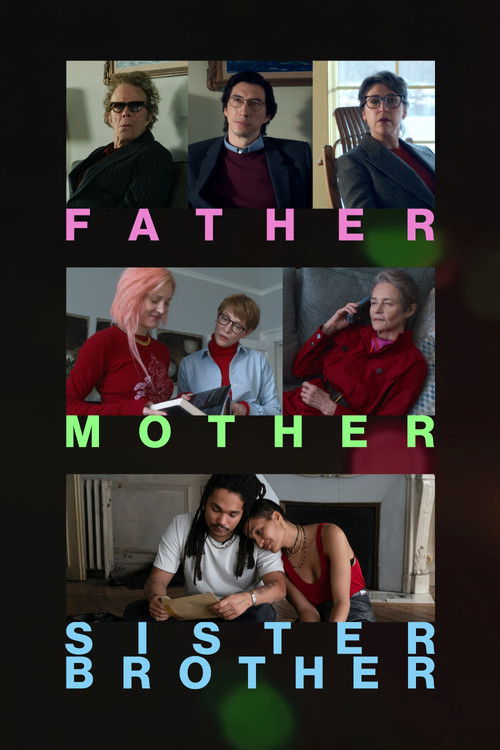
Father Mother Sister Brother
2025 · Jim Jarmusch
For a calm, contemplative evening when you want warmth without sentimentality — something to watch slowly and think about your own family afterward. Comfort viewing for people who like their comfort a little melancholy.
What it's about
Three quiet chapters, three families. In rural New Jersey, adult children pay an obligatory visit to a father who keeps them at arm's length; in Dublin, two sisters take ritual tea with their novelist mother; in Paris, grown twins sort through the apartment their parents left behind. Nothing dramatic happens in any of them — which is precisely where Jarmusch finds everything: the jokes, evasions, and small silences that pass between grown children and the parents they never quite knew.
The experience
Gentle, droll, and deceptively light — the humor is deadpan and the pace unhurried, but the accumulating echoes between chapters sneak up on you. It leaves a lingering tenderness, the feeling of having sat in on conversations where everything important went unsaid.
Performances
The pleasure is in the ensemble's underplaying — an unusually starry cast including Tom Waits, Charlotte Rampling, Cate Blanchett, and Adam Driver, all dialed down to the volume of real family small talk, where a glance carries more than a speech.
The craft
Jarmusch structures the film as a triptych whose segments rhyme — gestures, phrases, and objects recur across New Jersey, Dublin, and Paris, so the three stories quietly comment on each other. The framing is patient and precise, built on doorways, car rides, and shared tables; it's filmmaking that trusts stillness.
Why it matters
It won the Golden Lion at Venice in 2025 — the biggest prize of Jarmusch's four-decade career and a vindication of his lifelong bet that the smallest human moments can hold a whole film.
Snapshot
Father Mother Sister Brother is a triptych of three quiet, near-plotless family encounters, written and directed by Jim Jarmusch and unveiled in competition at the 82nd Venice International Film Festival, where it won the Golden Lion on 6 September 2025. Structured as three discrete chapters — "Father" (rural New Jersey), "Mother" (Dublin), and "Sister Brother" (Paris) — the film observes adult children visiting, or reckoning with the absence of, an emotionally remote parent, and in the process taking the measure of one another. Each segment turns on an ordinary social occasion: an obligatory afternoon at a father's house, a ritual tea with an aging novelist mother, the sorting of a dead couple's apartment by their grown twins. Almost nothing is dramatized in the conventional sense; everything of consequence is withheld, deflected, or left to a glance. Running a compact 111 minutes, the film is Jarmusch at his most distilled — a late-career exercise in restraint, deadpan tenderness, and the comedy and grief of things unsaid. It reached US theaters on 24 December 2025 through Mubi.
Industry & production
The film is an independent, modestly scaled production whose ambition lies in its cast and its geography rather than its budget. Filming proceeded across three countries to match its three settings: the "Father" chapter was shot in and around West Milford, New Jersey, in November 2023, with the European chapters following in Dublin and Paris in early 2024. This staggered, location-anchored shoot — small footprint, real interiors, marquee actors assembling for short, contained segments — is characteristic of Jarmusch's working economy, in which logistical modesty buys creative autonomy.
Distribution fell to Mubi, the streaming-and-theatrical art-house company, which handled the US release and positioned the film within its curatorial brand of auteur cinema; the December 2025 theatrical bow preceded streaming availability on the platform. The Venice premiere and Golden Lion gave the picture an unusually strong festival launch for so deliberately small a work, and the prize reframed it from a minor late entry in a celebrated filmography into a capstone honor for a director who had long been a fixture of the international festival circuit without previously taking its top award. Specific production-company credits and financing arrangements are not well documented in the public record, and I will not guess at them; what is clear is that the film follows Jarmusch's established pattern of European-inflected co-financing and a distribution path through specialist art-house channels rather than a studio.
Technology
Detailed technical specifications — camera systems, capture format, lab and post pipeline — are thinly documented for this title, and I will not invent them. What can be said responsibly is contextual. Jarmusch's recent features have worked in a clean, unobtrusive digital register, and the presence of two cinematographers across three internationally dispersed shoots strongly implies a flexible, location-friendly digital workflow rather than the constraints of photochemical capture. The film's "technology," in any case, is subordinated to an aesthetic of plainness: available and softly motivated light, stable framing, and a refusal of the showy apparatus — drones, elaborate rigs, digital compositing — that marks contemporary commercial filmmaking. The most consequential technical decision is one of restraint: to let the recording instrument disappear so that performance, silence, and the texture of rooms carry the film.
Technique
Cinematography
The film credits two cinematographers, Frederick Elmes and Yorick Le Saux — both Jarmusch veterans. Elmes is among the director's most important long-term collaborators, having shot Night on Earth, Coffee and Cigarettes, Broken Flowers, Paterson, and others; Le Saux photographed Jarmusch's Only Lovers Left Alive and is widely associated with the European art cinema of Olivier Assayas and Luca Guadagnino. The likeliest explanation for the dual credit is a division of labor across the geographically separated chapters, though the public record does not definitively assign each photographer to a specific segment, and I flag that as unconfirmed. Stylistically the imagery is of a piece: composed, frontal, patient framing; muted and naturalistic palettes; a preference for the held wide or medium shot over coverage that chases reaction. The camera tends to sit and watch, letting the awkwardness of a family gathering accumulate within the frame rather than be cut into urgency.
Editing
Affonso Gonçalves, Jarmusch's editor on Only Lovers Left Alive, Paterson, and The Dead Don't Die, cuts the film, and his hand is felt in its unhurried rhythm. The triptych structure depends on editorial discipline — clean chapter breaks (Jarmusch's signature use of fades and intertitle-like demarcations gives each segment its own sealed world) and a willingness to hold shots past the point of comfort. Within scenes, the editing resists the reflex toward escalation; pauses are left intact, and the comedy and pathos are timed to the beat of real conversation, with its lulls and non-sequiturs. The film's much-discussed slowness is, in this sense, an authored tempo rather than a flaw of construction.
Mise-en-scène / staging
The dramatic arena is almost entirely domestic: the father's house, the mother's flat, the dead parents' apartment. Objects do heavy lifting — possessions concealed or revealed, the props of tea and hospitality, the inventory of a home being dismantled. Staging foregrounds the choreography of social obligation: who sits where, who serves whom, who is permitted to move freely through a parent's space and who remains a guest. A central conceit of the "Father" chapter — a parent who masks his actual circumstances from his visiting children — is realized through the discrepancy between the spartan scene the children witness and a comfort they never see, a gap rendered spatially and through what the décor does and does not disclose. Throughout, the unspoken family hierarchy is written into the blocking.
Sound
The score is credited to Jarmusch himself together with the British-German musician Anika (Annika Henderson). Jarmusch is a working musician as well as a filmmaker, and his films have long treated music as a co-author of mood rather than an emotional underliner; here the sonic approach is sparse and atmospheric, leaving wide margins of quiet. Silence is treated as dramatic material — the held pause, the conversational dead air, the ambient hum of a house — so that what little music appears registers strongly. (I note that Jarmusch's recurring musical vehicle in recent years has been the duo SQÜRL with Carter Logan; the confirmed scoring credit here is to Jarmusch and Anika, and I do not assert a SQÜRL credit absent that confirmation.)
Performance
The ensemble works in a uniformly underplayed key. Tom Waits — a Jarmusch fixture since Down by Law and Coffee and Cigarettes — plays the elusive father; Adam Driver, returning to Jarmusch after Paterson and The Dead Don't Die, and Mayim Bialik play his visiting children Jeff and Emily. The Dublin chapter pairs Cate Blanchett and Vicky Krieps as daughters Timothea and Lilith, with Charlotte Rampling as their novelist mother — three performers of great expressive precision deployed in a register of clipped politeness. The Paris chapter centers Indya Moore and Luka Sabbat as the bereaved twins Skye and Billy, with Sarah Greene and the great Françoise Lebrun (of Jean Eustache's The Mother and the Whore) among the company. The acting throughout favors suppression over display: feeling is legible mainly in what the performers decline to say.
Narrative & dramatic mode
The film's mode is anti-dramatic by design. It belongs to the lineage of the episodic, low-event narrative in which structure substitutes for plot: three self-contained vignettes, parallel in theme, that rhyme without ever explicitly cross-referencing one another. Each chapter is built around a single visit or task and resists incident, climax, and resolution; conflict is ambient rather than staged, surfacing in misread cues, evasions, and the careful management of what families do not discuss. The arrangement invites the viewer to read across the panels — to assemble a composite portrait of filial love distorted by distance, money, pride, and time. The progression from "Father" to "Mother" to "Sister Brother" also traces an arc from living, withholding parents to dead, absent ones, so that the final movement reframes the earlier two: the petty frictions of an obligatory afternoon read differently once the parents are gone and only the siblings remain. The dramatic payoff is cumulative and quiet, lodged in recognition rather than revelation.
Genre & cycle
Nominally a comedy-drama, the film sits in Jarmusch's characteristic deadpan tragicomic register, where humor arises from awkwardness, timing, and the absurdity of social ritual rather than from jokes. Formally it belongs to the anthology, or portmanteau, film — and specifically to Jarmusch's own recurring practice of the multi-story structure, which runs through Mystery Train, Night on Earth, and Coffee and Cigarettes. It also participates in the broader contemporary cycle of the chamber family drama, the small-scale, performance-driven study of kinship and estrangement, here stripped of melodrama and rendered as observational comedy of manners.
Authorship & method
Father Mother Sister Brother is a thoroughly auteurist object, and its method is the method Jarmusch has refined over four decades: minimalism, episodic architecture, deadpan affect, and a reliance on a recurring stock company of actors and musicians. The collaborators here are nearly all long-standing — cinematographers Frederick Elmes and Yorick Le Saux, editor Affonso Gonçalves, and actors Tom Waits and Adam Driver all carry significant prior Jarmusch history — which makes the film read as a gathering of a creative family that is also, fittingly, a film about families. Jarmusch's authorship is legible in the priorities: tone over incident, music as mood, location and object as character, and a faith that withholding is more expressive than stating. His dual identity as filmmaker and musician again shapes the work, with the co-composed score functioning as an authorial signature rather than a hired service.
Movement / national cinema
Jarmusch is one of the foundational figures of the American independent cinema that emerged in the early-to-mid 1980s — the downtown New York milieu out of which Stranger Than Paradise (1984) became a defining text — and this film is recognizably the late work of that movement's sensibility: small, personal, formally rigorous, and indifferent to mainstream narrative convention. At the same time the project is emphatically transnational. Shot across the United States, Ireland, and France, financed and distributed through European-facing art-house channels, and premiered at a major European festival, it embodies the border-crossing character that has marked Jarmusch's career since Night on Earth dispersed its stories across five cities. It is American independent cinema in pedigree and European art cinema in circulation.
Era / period
The film is a product of the 2020s art-cinema landscape, in which the theatrical lives of director-driven films are increasingly mediated by specialist streaming-distributors such as Mubi, and in which festival prizes function as crucial market signals. As late-career Jarmusch, it can be read alongside the autumnal works of his generation of independents — pared-down, reflective films made by directors with nothing left to prove and a deepening interest in mortality and time. Its preoccupation with aging parents and adult children carries a generational resonance, and the Golden Lion conferred on it the kind of institutional consecration that often attends an established artist's distilled later style.
Themes
At its core the film is about estrangement within intimacy — the way blood relation does not guarantee understanding, and the way love between parents and children, and among siblings, is routinely routed through ritual, evasion, and the unsaid. Money and class run as a quiet thread: the father who conceals his real circumstances, the financial pretenses and professional comparisons that needle the Dublin tea, the material remainder of a life that the Paris twins must sort and value. Mortality and time govern the whole, the triptych moving from withholding parents who are still present to parents who are gone, so that the film becomes a meditation on what is left unsaid until it can no longer be said. Communication failure — the missed cue, the deflected question, the politeness that substitutes for candor — is both the film's recurring subject and its formal principle. Underneath the comedy of awkwardness lies a steady current of grief.
Reception, canon & influence
Critical reception was strong if not unanimous. The Golden Lion marked the high-water mark of the film's festival run, and aggregated reviews skewed favorable — roughly 83% positive on Rotten Tomatoes and a Metacritic score in the mid-70s at the time of writing — with admirers praising its delicacy, its tenderness, and the precision of its ensemble, and detractors finding its slowness, low stakes, and minimal narrative progression inert. That divide is itself characteristic of Jarmusch's reception across his career, where the same restraint reads to some as profundity and to others as withholding.
The film's backward-facing influences are firmly within an art-cinema tradition of the everyday and the elliptical. The patient observation of family ritual, the privileging of the small gesture, and the structuring of feeling around what goes unspoken descend from Ozu and from a Chekhovian dramaturgy of muted, anticlimactic encounter; the anthology architecture extends Jarmusch's own Night on Earth and Coffee and Cigarettes; and the deadpan tragicomedy is continuous with his entire body of work. Its forward legacy cannot yet be responsibly assessed — the film is too recent, and any claim about what it will shape would be speculation. What can be said is that the Golden Lion is likely to secure its place as a significant late entry in Jarmusch's filmography and to renew scholarly attention to his anthology method and his late style. Where the historical record on this title remains thin — in production financing, technical specification, and the precise division of cinematographic labor across its three chapters — that thinness should be acknowledged rather than filled in, and revisited as fuller documentation becomes available.
A Deleuzian reading
A father sits in a house that looks poorer than it is.
The full Deleuzian reading of Father Mother Sister Brother →
Reception
Premiered at Venice 2025 to warm but 'minor Jarmusch' reviews — then stunned everyone by taking the Golden Lion, instantly reframing the gentle little triptych as the film that beat the festival's biggest heavyweights.
How Father Mother Sister Brother was received, from release to now →
How to watch Father Mother Sister Brother: what to notice on a first viewing
- Notice how long the camera holds a wide, frontal shot. Jarmusch favors composed, patient framing over cutting to reactions, letting the awkwardness of a family gathering accumulate inside a single held shot. The stillness of the frame is doing the work a script would normally do with dialogue.
- Notice who sits, who stands, and who serves the tea. The unspoken family hierarchy is written directly into the blocking, who is permitted to move freely through a room and who stays a guest. You can read a whole family's power structure off where people are standing, not what they say.
- Notice the fades that seal each chapter off from the next. Each of the three visits gets its own sealed world, marked off by a fade rather than by any shared plot or explanation connecting them. You are meant to read across the three visits and notice what rhymes, not to follow one continuous story.
- Listen to how long a pause is allowed to sit. Conversational dead air, the ambient hum of a house, and unfilled silences are left intact rather than trimmed, so the sparse score registers strongly when it finally enters. Silence here is not a gap waiting to be filled. It is the material the scene is made of.
The whole guide to watching Father Mother Sister Brother, with the keys for a rewatch →
Influences: the films it descends from and the films it influenced
- Tokyo Story (1953) — The static, low, frontal compositions and the structuring of a family's mortality around anticlimactic, half-spoken encounters is the template Jarmusch's static-wide-frontal framing and unspoken-feeling dramaturgy descend from.
- Late Spring (1949) — Ozu's 'pillow shots' of empty rooms and objects holding the frame as pure duration models the way Jarmusch lets location and domestic object function as character while emotion stays suppressed.
- Jeanne Dielman, 23 quai du Commerce, 1080 Bruxelles (1975) — Fixed frontal long takes that observe domestic ritual in something near real time, with silence and dead air treated as expressive material rather than gaps to be cut.
- Stranger Than Paradise (1984) — Establishes Jarmusch's signature fade-to-black blackouts between single-take, single-setup scenes — the chapter-fade editing grammar carried directly into this film.
- Mystery Train (1989) — His first interlocking triptych: three self-contained stories anchored to one location and clicked together by a shared off-screen event, prototyping the anthology architecture.
- Night on Earth (1991) — The explicit anthology-of-vignettes design — discrete, equally weighted episodes that rhyme tonally rather than connect by plot — is the structural ancestor of this triptych.
- Coffee and Cigarettes (2003) — Static, near-frontal two-handers built almost entirely from deadpan conversation in a single setting, privileging tone and rhythm over incident.
- The Match Factory Girl (1990) — Frontal, planimetric tableaux paired with radically underplayed, affect-suppressing performance to render class and money — the deadpan-of-restraint Jarmusch shares.
- Broken Flowers (2005) — Frederick Elmes' composed, static, frontal framing wedded to an episodic structure and deadpan melancholy — the same DP method recurring in this film's cinematographic labor.
- Only Lovers Left Alive (2013) — Yorick Le Saux's languid cinematography plus Jarmusch's own SQÜRL score as authorial signature, the precise collaborator pairing (Le Saux + director-composed music) reused here.
- Songs from the Second Floor (2000) — Deep-focus static-wide-frontal tableaux staged as deadpan tragicomedy, where the locked camera and held duration are themselves the comic and elegiac instrument.
- Paterson (2016) — Builds drama from daily ritual and the smallest gestures with anti-dramatic, low-stakes patterning and an underplayed central performance, extending the same withholding within his oeuvre.
- Still Walking (2008) — An Ozu-descended single-day family gathering where mortality, estrangement and class friction surface only through mundane domestic ritual and what goes unsaid.
- Wheel of Fortune and Fantasy (2021) — A contemporary triptych of self-contained chamber stories told in static, talky long takes whose anti-dramatic anthology form parallels this film's architecture.
- Showing Up (2022) — American-independent anti-dramatic observation of low-stakes everyday life, with muted, suppressed performance refusing climax — the same faith that minimal narrative progression can carry feeling.
- Right Now, Wrong Then (2015) — Chamber-scale, dialogue-driven scenes held in long static takes (punctuated by abrupt zooms) where deadpan repetition and anti-dramatic structure do the work plot normally would.
Similar films
- Night on Earth (1991) — influence & lineage
- Only Lovers Left Alive (2013) — influence & lineage
- Twinless (2025) — same viewing thread
- Hard Truths (2024) — same viewing thread
- Jay Kelly (2025) — same viewing thread
- Young Mothers (2025) — shared sensibility
- Sentimental Value (2025) — shared sensibility
- Our Little Sister (2015) — shared sensibility
All the films related to Father Mother Sister Brother →
Watch it with: curated runs of related films
- Funny Because It Aches — A run of tender, deadpan dramedies where love, grief, and the panic of becoming yourself all get metabolized through jokes — watch these when you want to laugh and cry in the same scene.